
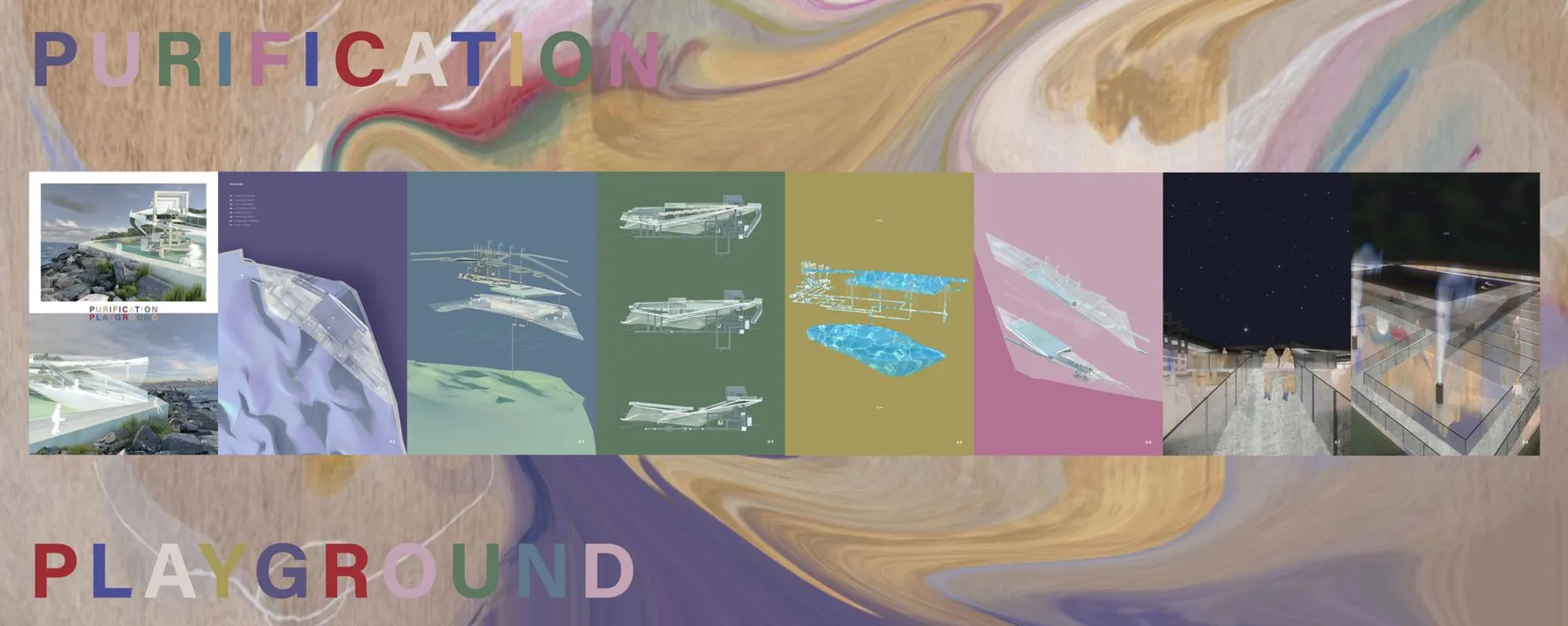
Purification Playground: Turning Water Treatment into a Public Spectacle
A waterfront prototype that choreographs filtration, play, and transparency into a new civic typology along a rocky shoreline.


Water treatment plants are the infrastructure we agree to forget. Buried behind fences, tucked into industrial districts, they do their work silently, and we prefer it that way. Purification Playground refuses that arrangement entirely. It drags the mechanics of water filtration onto a rocky waterfront, wraps them in glass, layers them with cascading pools and walkways, and dares the public to step inside. The result is a building that functions as both a civic utility and a destination: part playground, part living diagram of how water moves from contamination to clarity.
Designed by Pitak Asavesna, the project is a People's Choice Award entry for Ripple, a competition focused on architecture's relationship with water. Sited on a rocky shoreline, the scheme proposes a new architectural typology: transparent, performative, and participatory infrastructure that positions purification at the center of public engagement rather than behind it.
Layered Terrain: Concrete Platforms Meet the Rocky Shore

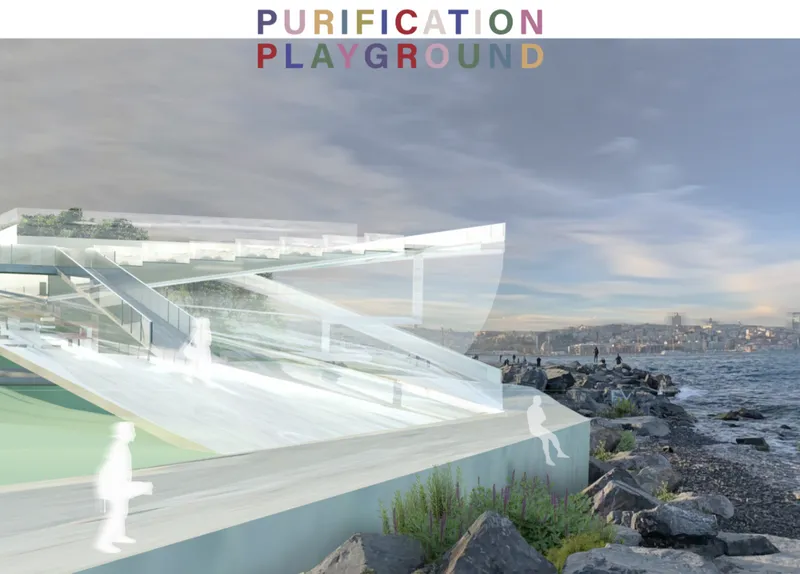
The project's most striking formal move is its terracing. White concrete walkways and pools cascade down toward the waterfront, negotiating the irregular topography of the rocky shoreline rather than flattening it. The layered platforms read simultaneously as landscape and architecture, blurring the line between a constructed deck and a geological formation. Translucent surfaces catch the shifting light at dusk, turning the entire composition into something luminous, almost aquatic in character.
These tiered levels are not decorative. Each corresponds to a stage in the water treatment sequence, from surface collection to filtration to recreation. Visitors move through them physically, descending through what Asavesna calls three "water modes": dynamic, passive, and active. Cascading water walls occupy the dynamic zones, quiet reflection pools define the passive areas, and kinetic installations activate the spaces in between. The architecture becomes a spatial curriculum, teaching through experience rather than signage.
Glass Railings and Starlight: Transparency as a Design Ethic
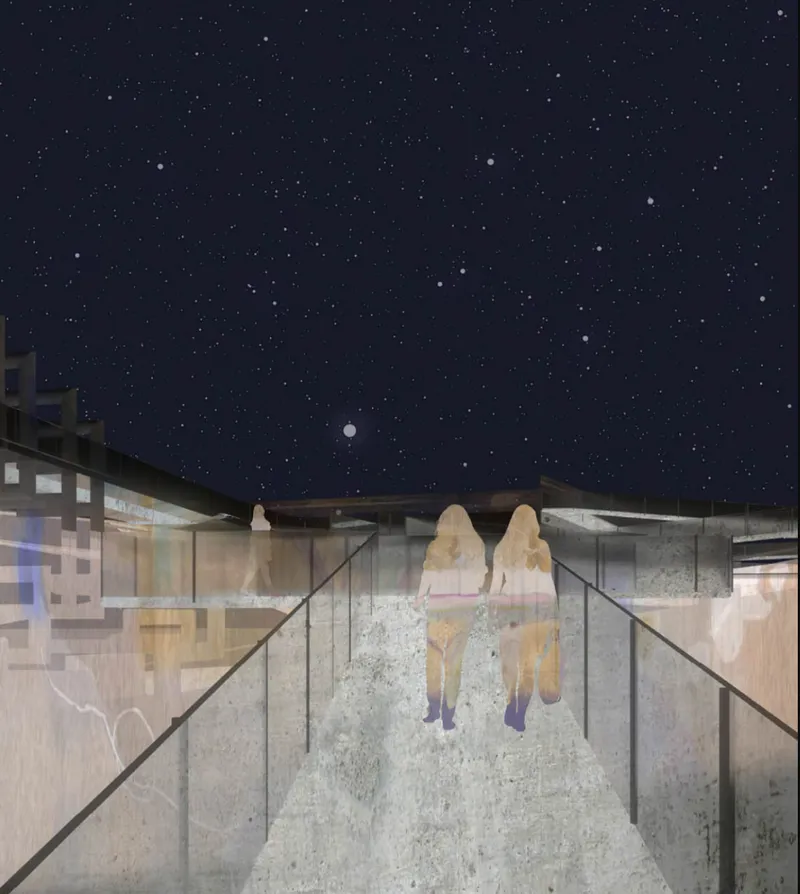
Viewed from above at night, the scheme reveals a second layer of intention. Two figures stand on a concrete plaza bordered by glass railings, the starry sky reflected in the wet surfaces around them. The transparency here is both literal and conceptual. Glass structures expose the inner workings of the water systems below, making pipes, filters, and flow patterns visible to anyone walking overhead. Circulation routes are designed to guide visitors through each layer of filtration, so the act of moving through the building is also the act of reading it.
The nighttime rendering is telling. Most water infrastructure disappears after dark. Here, the architecture glows. Fountain projections, illuminated pools, and the openness of the glazed enclosures ensure the building remains legible and inviting at all hours. It treats visibility as a civic responsibility, not a security risk.
Fountain Projections and the Pool Portal
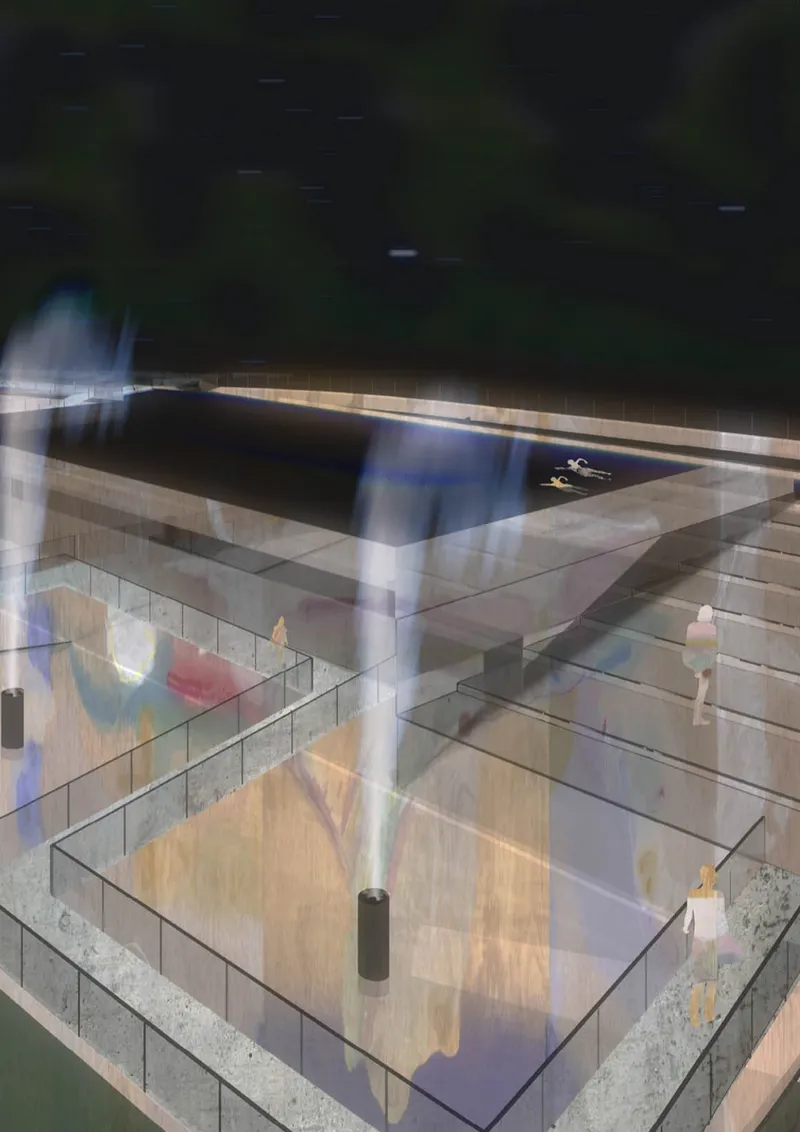
The aerial night view of the rectangular pool on the concrete deck shows the project at its most theatrical. Fountain projections arc from the pool's edges, turning a functional filtration basin into a spectacle. Asavesna's programme list reads like a glossary of invented water landscapes: Surface Stream, Floating Flood, Fast Fountains, Drizzle Ducts, Slithering Street, Turbulent Terrain, Purifying Pond, Pool Portal. Each name suggests a specific spatial and sensory condition, from immersive engagement to visual communication of water flow to pure recreational play.
What holds these diverse programmes together is the insistence that filtration and recreation are not separate functions. The Purifying Pond is also a place to swim. The Pool Portal is both a threshold in the treatment process and a passage between public zones. Every element does double duty, and that efficiency of purpose is what makes the project feel like a genuine prototype rather than an exercise in metaphor.
Section Logic: Three Stacked Levels of Flow and Inhabitation
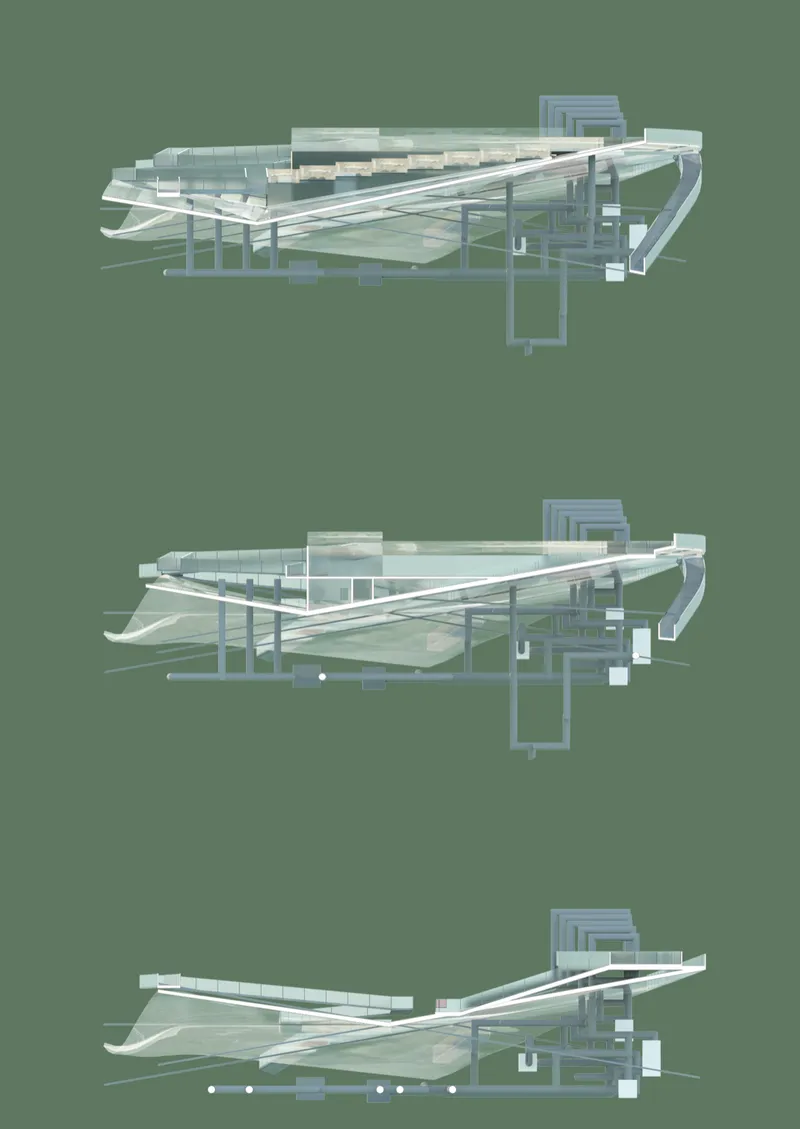
The section drawing clarifies the structural ambition. Three stacked levels of sloping platforms define the building's profile, each tilted to direct water through gravity-fed channels. Interior spaces nest beneath the platforms, creating sheltered zones for education, observation, and mechanical equipment. The slopes are not merely formal gestures; they are functional surfaces that move water from one purification stage to the next while simultaneously creating varied spatial conditions above and below.
Reading the section alongside the rendered views, you begin to understand the project's organizational clarity. The upper levels are open, wet, and public. The middle levels are semi-enclosed, where glass walls allow observation of treatment processes. The lowest levels house the technical core. The architecture works as a gradient from spectacle to system, and the section makes that gradient legible in a single drawing.
Why This Project Matters
Purification Playground matters because it takes one of the most unglamorous pieces of urban infrastructure and asks a genuinely productive question: what if we stopped hiding it? The answer is not a decorative skin over a treatment plant, but a full spatial rethinking of how water purification can coexist with public life. The terracing, the transparency, the programmatic doubling of filtration and play: these are specific architectural strategies, not vague sustainability slogans.
Asavesna's proposal is ultimately a prototype for waterfront design that treats ecological performance and urban delight as the same objective. In a moment when cities worldwide are confronting rising water levels, aging infrastructure, and public distrust of invisible systems, the idea of making the process visible, tactile, and even joyful feels less like idealism and more like common sense. The project suggests that the future of civic infrastructure might not be larger plants behind taller fences, but open buildings where the public can watch, walk through, and play alongside the systems that keep their water clean.
View the Full Project
About the Designers
Designer: Pitak Asavesna
Enter a Design Competition on uni.xyz
uni.xyz runs architecture and design competitions year-round that reward proposals with spatial conviction and real site intelligence.
Project credits: Purification Playground by Pitak Asavesna Ripple (uni.xyz).




Popular Articles
Popular articles from the community


Co-Life: Senior Housing Design That Reconnects Older Adults With the City
Co-Life reimagines senior housing design through healing gardens, shared streets, workshops, and a sustainable community across generations.

The Ocean Hive: Sustainable Architecture for a Self-Sufficient Civilization at Sea
The Ocean Hive imagines sustainable architecture at sea, where modular habitats, algae, wave power and ocean waste sustain a growing colony.

Conexión: Biophilic Design Reimagines High-Rise Living in Hong Kong
Conexión reimagines high-rise living in Hong Kong through biophilic design, green facades, shared spaces, daylight, water and nature within.

The Earth Pod: 3D Printed Homes for Resilient Refugee Communities
The Earth Pod reimagines refugee housing through 3D printed homes made from clay, combining resilience, self-sufficiency, and rapid shelter.

Similar Reads
You might also enjoy these articles

The Musturak Paradise: Senior Living Architecture for a Connected Future in Temara, Morocco
The Musturak Paradise reimagines senior living architecture in Temara via private homes, social spaces, culture, community, and shared care.

The Leaf Center: Cultural Center Architecture for Social Integration in Amsterdam
Cultural center architecture becomes a bridge at The Leaf Center, connecting international students with Amsterdam through art and exchange.
Conexión: Biophilic Design Reimagines High-Rise Living in Hong Kong
Conexión reimagines high-rise living in Hong Kong through biophilic design, green facades, shared spaces, daylight, water and nature within.

Wander to Wonder: Modular Playground Design for Children in Kutupalong Refugee Camp
Wander to Wonder uses modular playground design to create flexible, imaginative play spaces for children in Kutupalong refugee camp.





Comments (0)
Please login or sign up to add comments
No comments yet. Be the first to comment!