

The Evolution of Architecture Competitions: From Historical Beginnings to Modern Day
This article explores the transformative journey of architecture competitions, from their ancient origins to their role in modern design and global challenges.



Architecture competitions have long been a vital part of the architectural profession, serving as a platform for innovation, showcasing emerging talents, and driving the evolution of design concepts and methodologies. This article traces the journey of architecture competitions from their historical origins to their current status in the modern world.

Historical Beginnings
The genesis of architecture competitions can be traced back to ancient civilizations. One of the earliest recorded competitions was for the design of the Parthenon in Athens, around 448 BC. This tradition continued through the Middle Ages and the Renaissance, with competitions often being held for significant religious and civic structures.

The Renaissance and Beyond
During the Renaissance, architecture competitions became more formalized. The 1418 competition for the design of the Florence Cathedral dome, won by Filippo Brunelleschi, is a notable example. These competitions were not just about selecting a design; they were also about fostering a collective dialogue among architects and patrons.

The 19th and 20th Centuries
The 19th and early 20th centuries saw an explosion in the number of architecture competitions, coinciding with the Industrial Revolution and the rise of modern nation-states. Competitions during this period were often tied to national pride and identity. Iconic examples include the 1889 Eiffel Tower in Paris and the 1922 Chicago Tribune Tower competition.

Post-World War II Era
The post-WWII era marked a shift towards more pragmatic and utilitarian architecture, reflecting the global need for reconstruction and efficient urban planning. Competitions were increasingly used to address social and housing issues, leading to more inclusive and community-focused designs.
The Digital Revolution
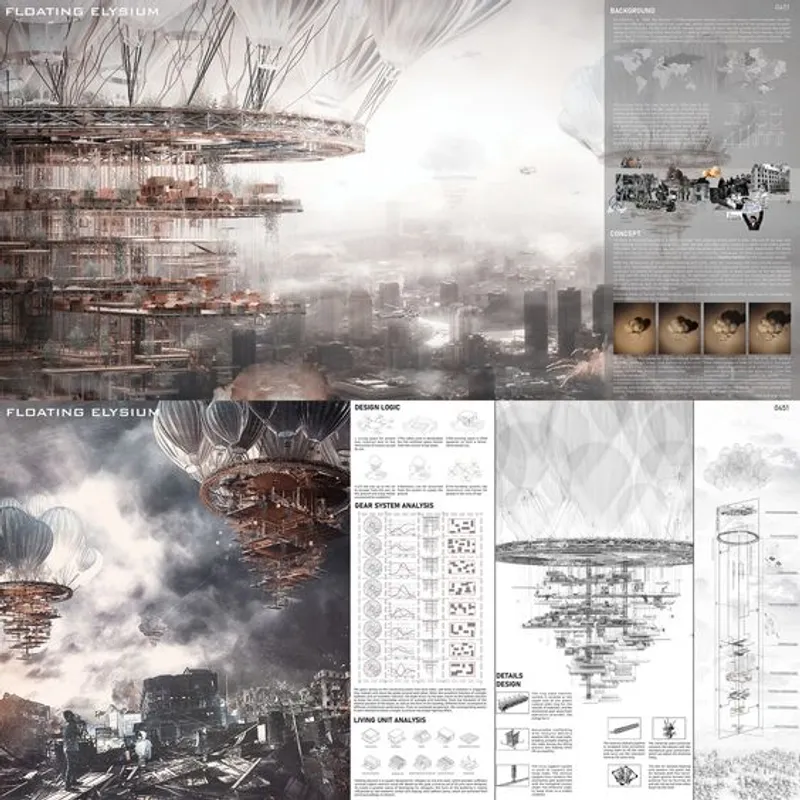
The advent of digital technology has significantly impacted architecture competitions. Digital submissions have become the norm, allowing for more intricate and visually stunning presentations. Moreover, digital tools have democratized the competition process, enabling broader participation from around the globe.

Current Trends and Future Outlook
Today, architecture competitions are more diverse and inclusive than ever. They are not only about monumental structures but also about addressing global challenges such as sustainability, climate change, and social equity. Competitions like the Solar Decathlon and the Pritzker Architecture Prize have shifted the focus towards innovation in sustainable design and social impact.
Competitions are now platforms for experimentation and testing new ideas. They encourage cross-disciplinary collaboration, integrating technology, biotech, and environmental science into architectural practice.

The evolution of architecture competitions reflects the broader changes in society, technology, and the environment. From the grand designs of the past to the sustainable and socially conscious projects of today, these competitions continue to shape the architectural landscape, pushing the boundaries of design and construction. As we look to the future, architecture competitions will undoubtedly play a crucial role in addressing the complex challenges of our time.


Popular Articles
Popular articles from the community


longwave studio Reorganizes a 112 m² Tainan Apartment Around the Daily Routines of a Family and Two Cats
In Tainan, Taiwan, birch plywood, rust-red furniture and a freestanding plaster wall link arrival, storage, work and family life in one apartment.

Juan García Correa, John González and Claudia Rueda Sink a Circular Amphitheater into a Manizales Engineering Building
On the La Nubia campus in Manizales, Colombia, the S1 Building folds labs and offices into a hillside of ramped lawns that double as a campus route.

David Ortega Stacks a Two-Story Mexico City Penthouse Around a Steel Stair and a Pergola-Shaded Roof Terrace
In Colonia Roma, a 300 m² penthouse uses oak joinery, a planted steel stair and a slatted roof pergola to make a new-build apartment feel like a house.

Architekt Andreas Gruber Scatters 23 Dark Timber Chalets Across a South Tyrolean Forest Edge
In Molini di Tures, Amonti Chalets breaks a resort into a hamlet of gabled timber houses, with parking, storage and services pushed into the slope.

Similar Reads
You might also enjoy these articles

Gil Mello Arquitetura Tilts a Single Roof Toward the Waterfalls on a Plateau Above Aiuruoca, Brazil
In Aiuruoca, Minas Gerais, a 200 m² house of local labor and reclaimed poles pairs a low valley veranda with a tall mountain one.

U.GA Architects Wraps an Oval Rooftop Pool in Curved Board-Formed Concrete on Busan's Jeollidan-gil
In Busan's Jeonpo-dong, a 454 m² mixed-use block stacks a neighborhood facility, guest rooms and an oval rooftop pool inside spiraling concrete walls.

Felipe Hess Arquitetos Turns a Blind Stone Wall to the Street and Opens a Brazilian House onto a Courtyard and Canal
A canal-front house in Brazil hides behind painted stone and planting, then opens to an olive-tree courtyard, a reed-ceilinged porch and a curving pool.

David Macias Steps a Doorless Stone and Plaster House Down a Tropical Colombian Hillside
In the humid hills of Colombia, Threshold House replaces the front door with an open void and terraces its 850 m² down the slope instead of fighting it.

Explore Architectural History Competitions
Discover active competitions in this discipline

Challenge to illustrate the ruins of Petra

Challenge to reimagine the Iron Throne

Photograph architecture without architects

Illustrate the lost glory of Angkor Wat - Render Challenge
Comments (0)
Please login or sign up to add comments
No comments yet. Be the first to comment!