
Gabrielle Vinson Architecte Strips a Toulouse Row House Back to Its Essential Volume
A five-meter-wide family home in Toulouse gains light, garden, and a legible history through careful subtraction and material reuse.


Most renovation briefs ask an architect to add: more rooms, more insulation, more storage. The MNB House in Toulouse, designed by Gabrielle Vinson Architecte, does the opposite. By removing a garage, a veranda, and a utility room, and by shrinking the building's footprint to enlarge the garden, the project gains something rarer than square meters: clarity. What remains is a compact, beam-and-slab structure on a five-meter-wide parcel, opened up into a single legible volume where every surface carries evidence of what came before.
The most compelling idea here is the refusal to erase. Old partition walls are filled with concrete and polished flush, leaving their imprints visible in the finished surfaces. Original speckled tiles salvaged from the demolished veranda reappear in the bathroom. The house does not pretend to be new; it reads as a palimpsest, each layer of inhabitation still traceable. That strategy turns a modest renovation into something closer to an argument about how buildings carry memory.
Glass Block as Urban Filter
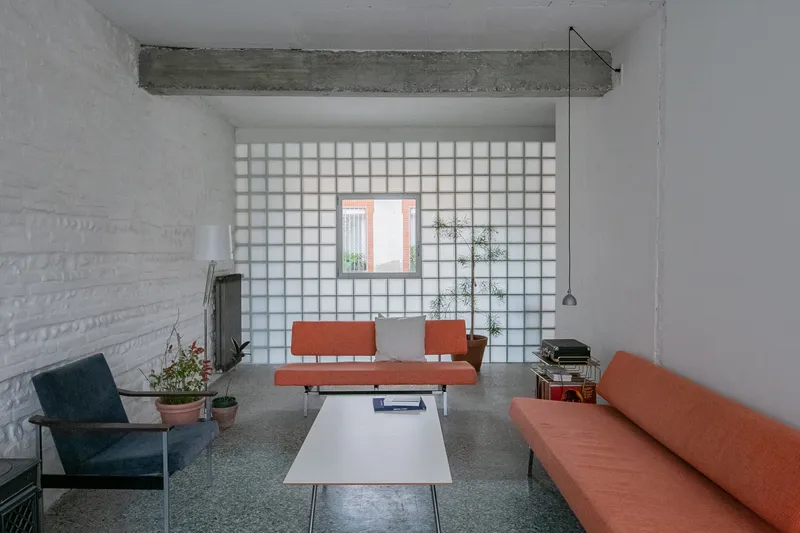
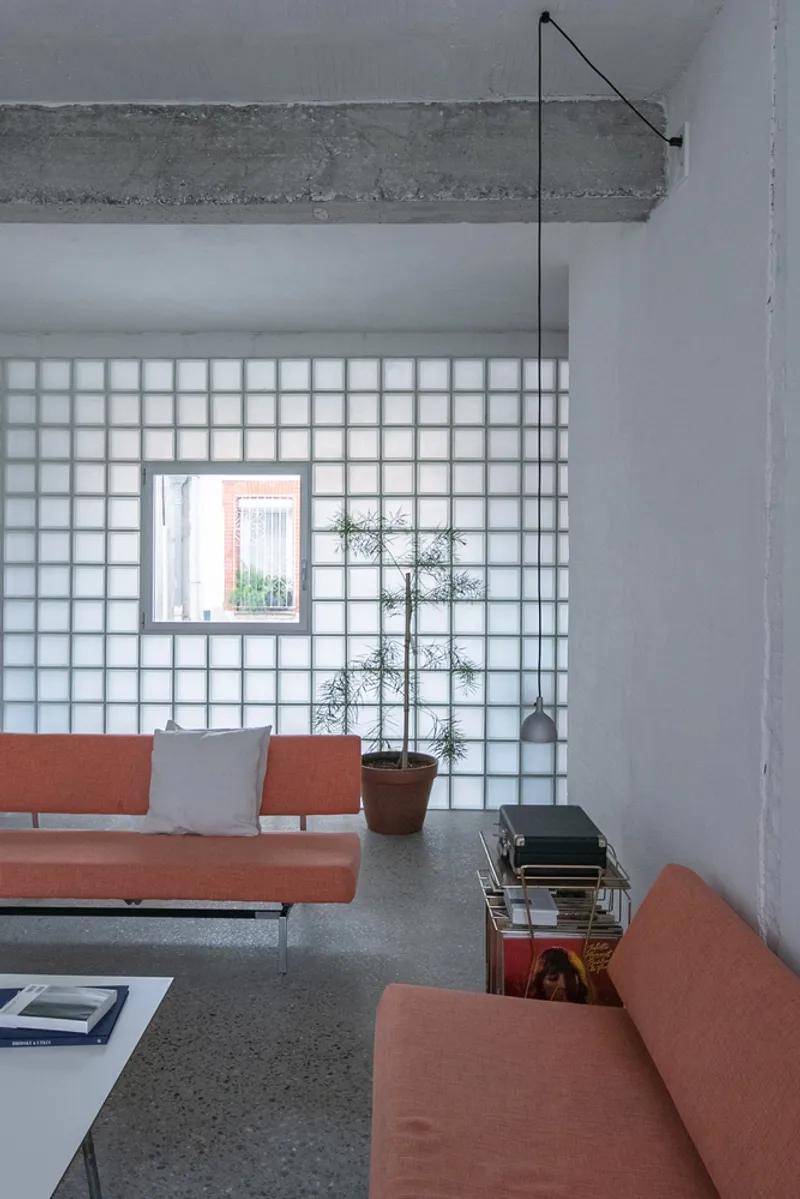
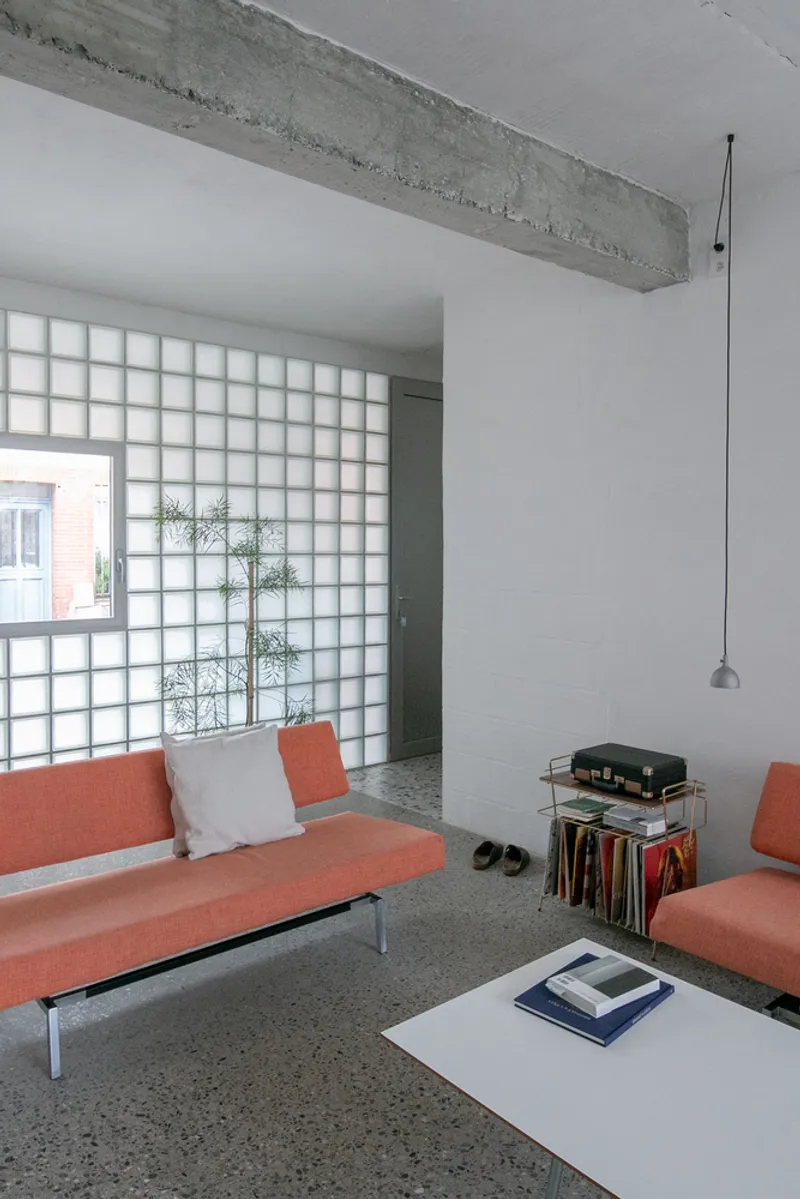
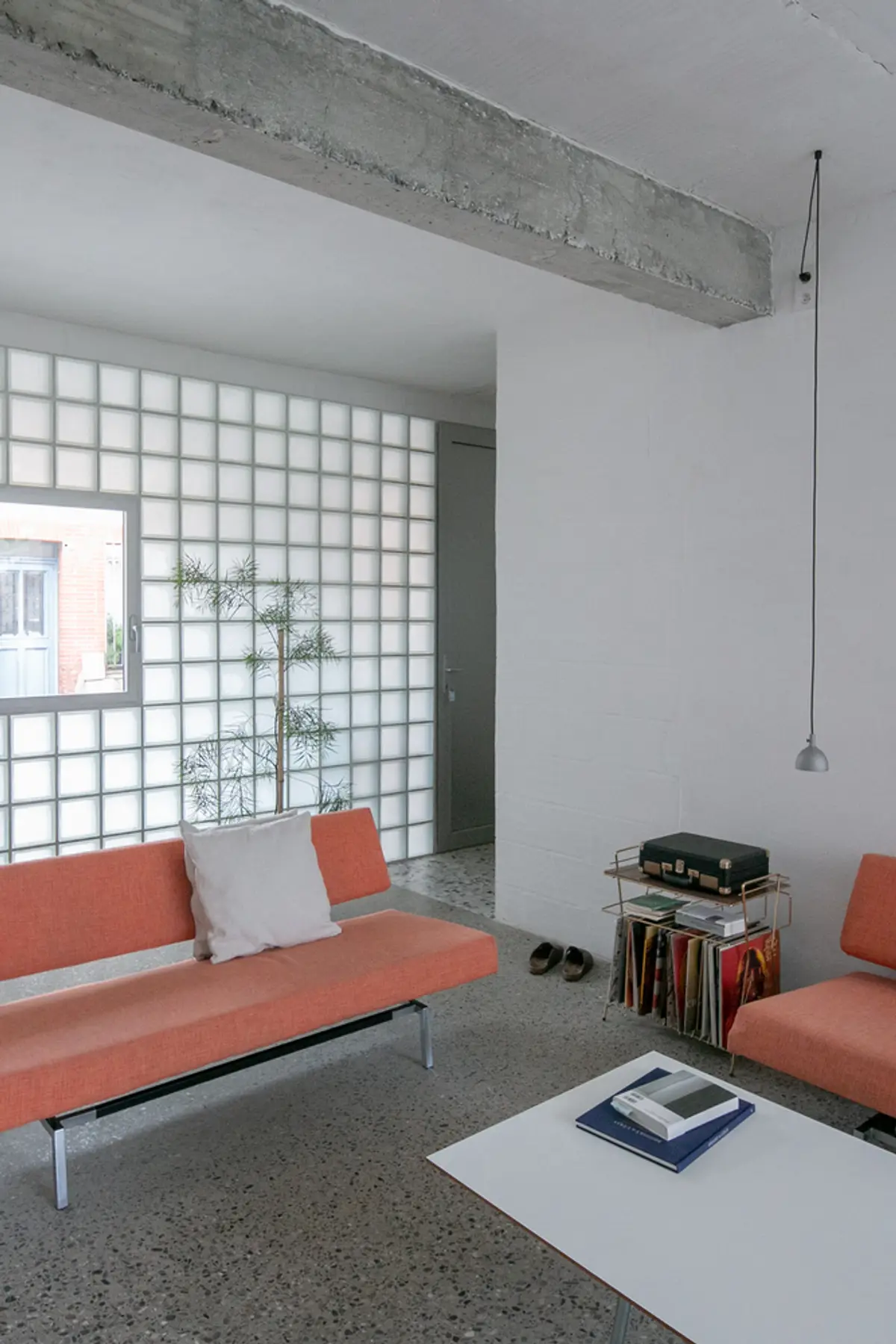
The street-facing elevation introduces a glass block wall set back from the original facade plane. The gap between the two skins creates a practical buffer zone for bicycles and waste containers, keeping domestic clutter out of sight without resorting to a solid wall or a gate. Light pours through the translucent blocks and scatters across the terrazzo floor inside, producing a diffused glow that changes character throughout the day.
Structurally, an exposed concrete beam spans the full width of the living area above the glass block partition. It reads as both functional spine and spatial datum, dividing the room into zones without closing anything off. The pendant light hung from the beam anchors a seating area on one side while the other opens toward the garden. It is a straightforward move, but the proportions are right: the five-meter width, which could feel cramped, instead feels disciplined.
Kitchen and the Garden Connection
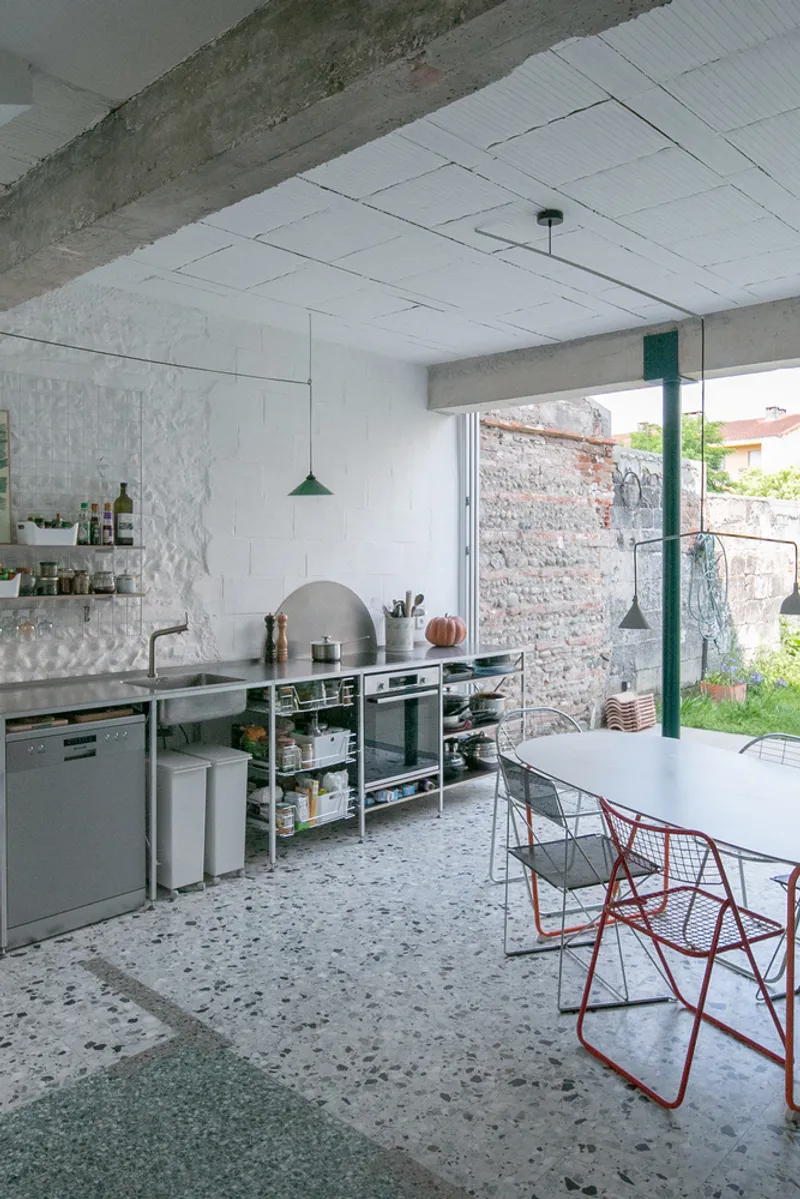

At the rear of the ground floor, a large sliding glass door on the eastern wall dissolves the boundary between the kitchen and the garden. The exposed brick wall running alongside it is left untreated, its rough texture a counterpoint to the polished concrete elsewhere. Overhead, suspended ceiling panels conceal services while allowing the structural depth to remain visible at the edges, a detail that keeps the space honest about its construction.
The courtyard itself benefits directly from the strategy of subtraction. By demolishing the veranda and utility room, the garden gained enough area to function as an outdoor room rather than a leftover strip. A timber slatted canopy provides shade along one edge, and a planted bed at the base of the concrete block boundary wall softens the transition to neighboring properties. The result is a sequence that flows from the glass block street wall through the living area and kitchen, and out into planted open air.
Working Corners and Flexible Furniture
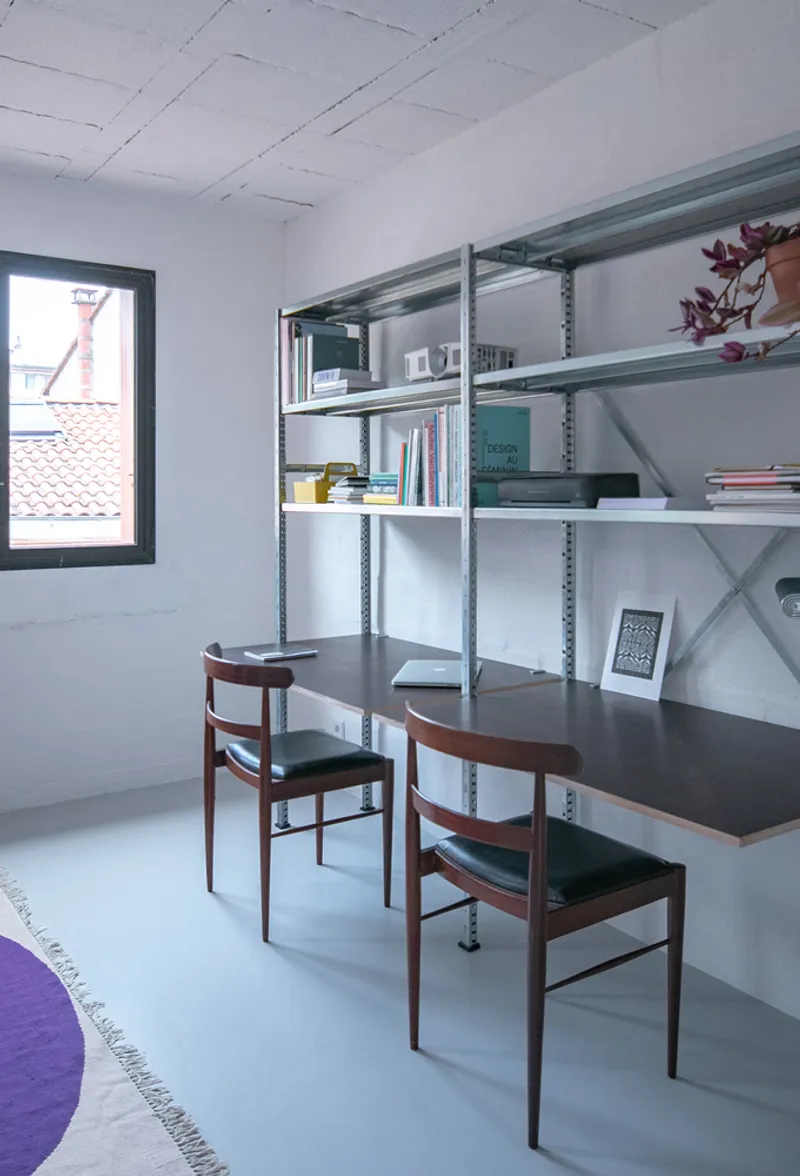
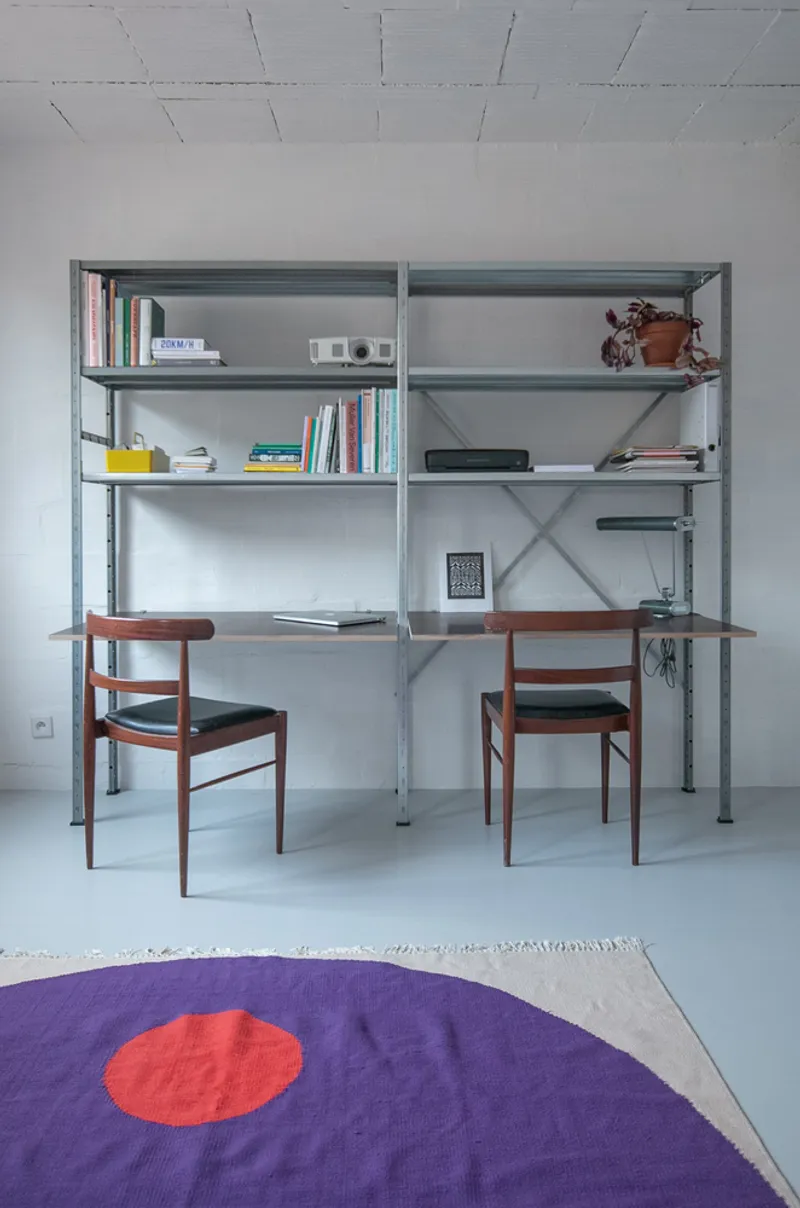
The open plan demands that everyday functions, working, eating, storing, find their places without dedicated rooms. Vinson solves this with a slender steel shelving system that doubles as a desk. Its grey metal frame recedes visually while holding books, objects, and a workspace within a single modular unit. Two wooden chairs drawn up to the integrated desk and a purple geometric rug on the polished concrete floor define the workstation zone without any walls at all.
These interiors are deliberately sparse. The suspended ceiling panels above the desk area, matching those in the kitchen, unify the ground floor acoustically and visually while concealing new service runs that were threaded through the existing structure. It is the kind of practical coordination that rarely photographs well but makes an open plan actually livable.
Views from the Top Floor
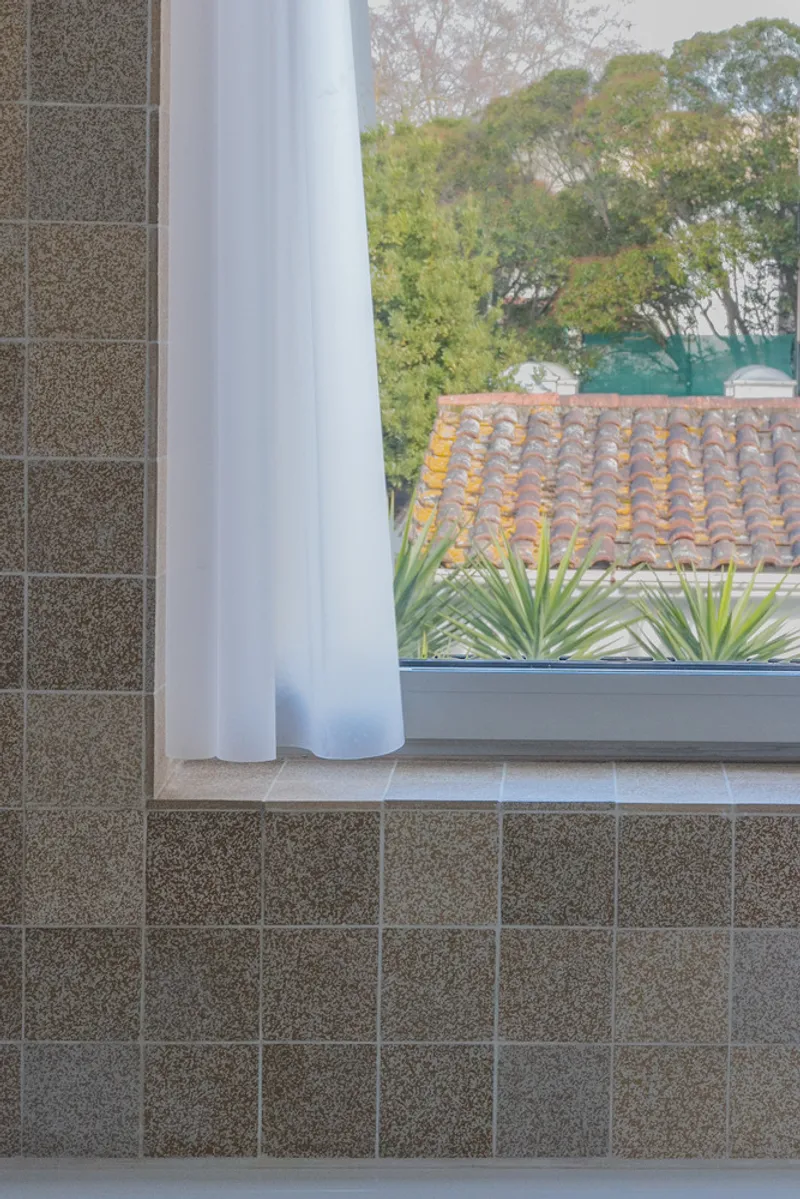
The upper level, externally insulated at the roof and punctuated by new openings, is left deliberately open to accommodate future change. A window seat with a grey terrazzo surround frames a view across Toulouse's clay-tiled rooftops and mature trees, turning a small dormer into a contemplative perch. The terrazzo finish ties the upper floor back to the ground level palette, maintaining material consistency without repeating the same spatial moves.
Keeping the top floor unfinished is a bet on time. Rather than locking the house into a fixed program, Vinson gives the family room to grow into the structure at their own pace. The new roof insulation and openings ensure that whatever configuration eventually arrives will start with good thermal performance and generous daylight. It is a form of restraint that trusts the inhabitants more than the architect, and that trust is itself a design position.
Why This Project Matters
The MNB House is not a showcase renovation. There are no dramatic volumes or heroic gestures. Its intelligence lies in the calibration of what to keep, what to remove, and what to leave visible. The decision to polish old partition imprints into the concrete walls rather than plaster over them gives the house an archaeological honesty that most residential projects avoid. It tells residents, and visitors, that a building is not a finished product but a process.
In a market where renovations routinely gut interiors and start over, this project proposes a slower, more attentive alternative. Material reuse, garden expansion through subtraction, and a deliberately incomplete upper floor all point toward an architecture that values longevity over spectacle. For a five-meter-wide row house in Toulouse, that is exactly the right ambition.
MNB House, by Gabrielle Vinson Architecte. Toulouse, France. Completed 2023. Photography by Gabrielle Vinson.
About the Studio
Share Your Own Work on uni.xyz
If projects like this are the kind of work you want to make, uni.xyz is a place to publish your own, find collaborators, and enter design competitions.


Popular Articles
Popular articles from the community


Faces of the Soviet Avant-Garde: Turning Moscow's Street Names into an Open-Air Museum
A network of sculptural installations across a Moscow residential district transforms forgotten architect names into spatial encounters with cultural memor

Temporary Home for Dogs: A Reversed Zoo Rethinks Animal Shelter Architecture
In Bucharest, a sinuous corridor and freed landscape flip the logic of containment, designing a shelter that works to make itself unnecessary.

Extended Shell: Retrofitting Kolkata's Balconies as Living Urban Thresholds
A modular retrofit system recovers the social and environmental intelligence of Kolkata's historic verandas for contemporary Park Street residents.
Opera by the Sea Estonia: Three Shells Dissolving Architecture into Tallinn's Coastline
A winning opera house proposal replaces monumental form with interconnected shells that blur the boundary between building, park and Baltic Sea.

Similar Reads
You might also enjoy these articles


Hodi-Mandai Geram
Project Function: Preservation and revitalization of the Intangible heritage and socio-spatial identity of the Hodi by Housing, Cultural Memory Center, Sacred Grove, landscape, local tourism economy


Olio Towers: A Mid-Rise for Performers That Fuses Housing, Rehearsal, and Stage
Located blocks from Houston's Theater District, this modular tower stacks living units around a central performance atrium.

Oasis: Modular Green Housing Carved into Dhaka's Urban Fabric
A shortlisted Plugin Housing entry reclaims unauthorized settlements in Dhaka with stepped concrete volumes, green roofs, and ventilation-driven design.

Black Hole: A Floating Megastructure for the Post-Physical Era
Emiliano Mazzarotto envisions a spherical, self-scaling arena where e-sports, digital hotels, and holographic stadiums replace traditional public space.

Explore Housing Competitions
Discover active competitions in this discipline

Challenge to reimagine the Iron Throne

Photograph architecture without architects

Illustrate the lost glory of Angkor Wat - Render Challenge

Design challenge to reuse E-waste
Comments (0)
Please login or sign up to add comments
No comments yet. Be the first to comment!