

Ahmedabad University Centre by Stephane Paumier Architects: A Vibrant Hub for Learning, Culture, and Sustainability
Dynamic university hub blending learning, culture, and sustainability with food street, performance spaces, rooftop sports, and LEED Platinum certification.


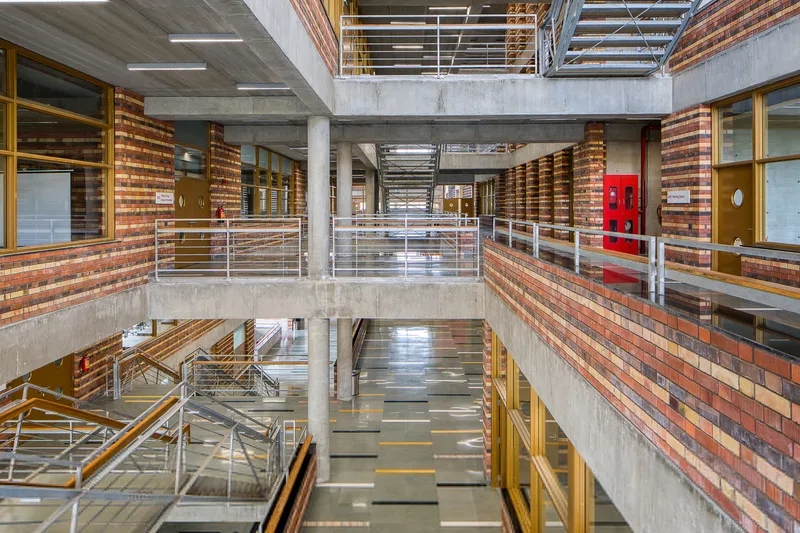
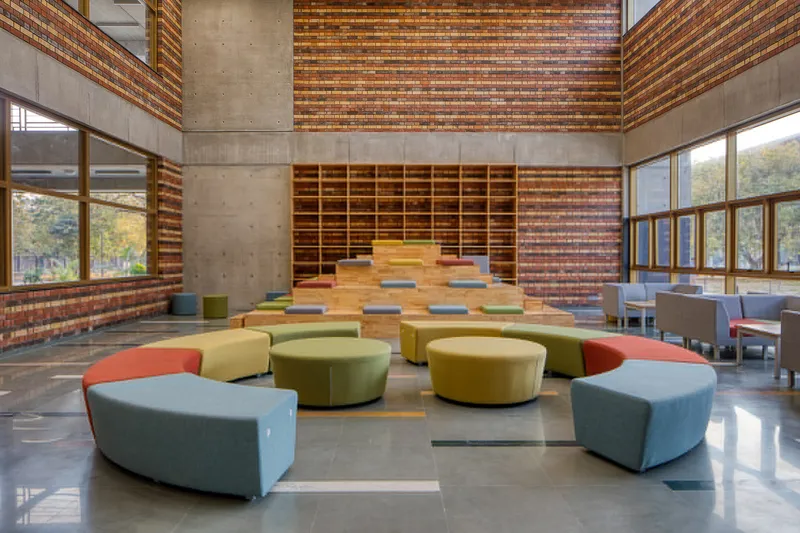
Located in the heart of Ahmedabad, India, the Ahmedabad University Centre, designed by Stephane Paumier Architects, serves as a dynamic campus hub that seamlessly blends academic life, cultural exchange, and sustainable architecture. Completed in 2022 and spanning over 20,880 square meters, the centre redefines the boundaries between formal learning environments and interactive public spaces.
A Central Node for Campus Life
Commissioned by the University Board, the project was conceived as a vibrant interstitial space—a social incubator where students and faculty gather, collaborate, and relax between academic sessions. Strategically placed near the vehicular entrance with an underground parking facility, the centre forms a transitional gateway between the city and the university's pedestrian-focused campus.
One of the most culturally resonant aspects of the design is the ground-level food street, inspired by the everyday vibrancy of Ahmedabad’s street food culture. Drawing parallels to the Galata Bridge in Istanbul—home to a string of restaurants beneath its span—the building features three verandahs overlooking the central park, designed to host live performances and student gatherings under the canopy of existing trees.


Programmatic Complexity and Vertical Integration
The building is structured vertically with distinct functions assigned to each level:
- Ground & First Floor: Designed as an extension of the public street, this zone houses multipurpose rooms, student clubs, and activity areas.
- Second Floor: Features a versatile performance hall equipped with telescopic bleacher seating that can be retracted for sports activities such as basketball, volleyball, and indoor games.
- Third Floor: Dedicated to the faculty club and café, offering panoramic views of the central park and morning sunlight through covered verandahs.
- Fourth Floor: Hosts quiet reading zones and the Career Development Cell, supporting academic growth and professional preparation.
- Rooftop: Includes a 6x6 futsal court and a running track, shaded by a solar panel roof generating 140 KW of renewable energy.


Light, Air, and Sustainability at the Core
With a massive footprint of 96m x 36m, the architectural challenge was to infuse natural light and ventilation deep into the building’s core. Using 3D simulation tools, the architects designed staggered floorplates and South-facing verandahs to allow daylight to travel diagonally across the structure. Notably, on May 1st and August 15th, a symbolic ray of light aligns perfectly through the East façade, marking International Workers’ Day and India’s Independence Day.


Pioneering Construction and Green Infrastructure
This is Ahmedabad’s first large-scale building to use precast concrete technology, incorporating hollow core slabs and thin steel strands for structural efficiency. While beams and walls are cast in situ, prefabricated slabs ensure faster construction with reduced material waste.
The LEED Platinum-certified building emphasizes water and energy sustainability:
- A sewage treatment plant in the basement reuses grey and black water for irrigation, toilet flushing, and cooling systems.
- Over 450 rooftop solar panels power internal systems during daylight hours.
- Recessed windows and deep verandahs minimize glare, reducing the need for blinds and artificial lighting.


A Campus Catalyst for Innovation and Community
The Ahmedabad University Centre is more than just a functional building—it is a cultural catalyst, sustainability benchmark, and interactive urban element. By integrating academic spaces, social zones, and environmental consciousness, the design embodies the future of university architecture in India.

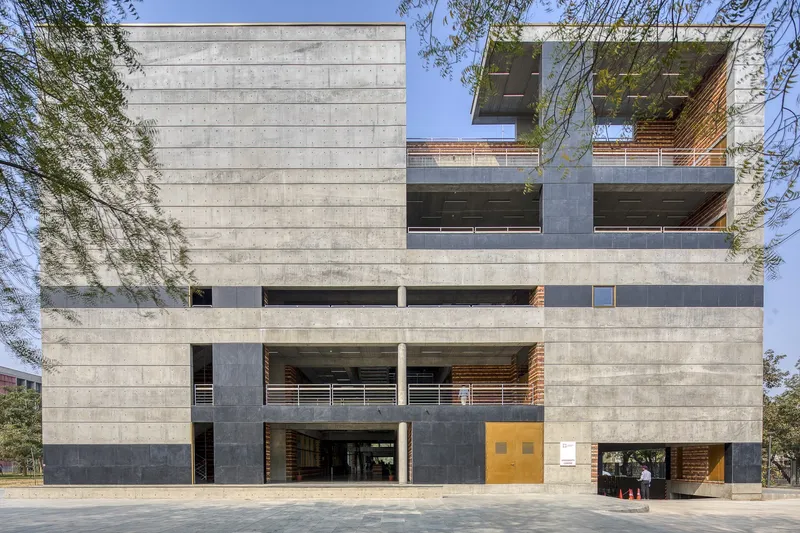
All Photographs are works of Amit Pasricha, Umang Shah


Popular Articles
Popular articles from the community


Peris and Toral.arquitectes Wrap 54 Social Rental Homes in Besòs Around a Brick-Screened Atrium
In Barcelona's Besòs district, a perforated brick block turns its shared walkways into a light-filtering atrium for 54 social rental homes.

S-AR Builds a Five-Square-Meter Concrete Chapel in a Mexican Garden from Thin Walls and Old Bricks
In Santiago, Nuevo León, a tunnel of 8 cm concrete walls tilts down to a steel cross, floored with crushed brick from the chapel it replaced.

Gonçalo Grácio Refurbishes a 104 m² House Inside the Medieval Walls of Castelo de Vide
In Castelo de Vide, Portugal, a compact whitewashed house is reworked with rough lime and clay plaster, deep window niches and a small rooftop terrace.

Madras Spaces Turns a Tight Rural Plot near Tiruchirappalli into an Inward-Looking Courtyard House
A 92 m² farmhouse in V. Thuraiyur, Tamil Nadu, built from load-bearing brick and reclaimed tile, that hides its openness behind a perforated wall.

Similar Reads
You might also enjoy these articles


Hodi-Mandai Geram
Project Function: Preservation and revitalization of the Intangible heritage and socio-spatial identity of the Hodi by Housing, Cultural Memory Center, Sacred Grove, landscape, local tourism economy

Olio Towers: A Mid-Rise for Performers That Fuses Housing, Rehearsal, and Stage
Located blocks from Houston's Theater District, this modular tower stacks living units around a central performance atrium.

Oasis: Modular Green Housing Carved into Dhaka's Urban Fabric
A shortlisted Plugin Housing entry reclaims unauthorized settlements in Dhaka with stepped concrete volumes, green roofs, and ventilation-driven design.

Black Hole: A Floating Megastructure for the Post-Physical Era
Emiliano Mazzarotto envisions a spherical, self-scaling arena where e-sports, digital hotels, and holographic stadiums replace traditional public space.

Explore Ahmedabad Competitions
Discover active competitions in this discipline

Submit a world, not a render

Studio work deserves a jury

The International Standard for Design Portfolios

The Global Benchmark for Architecture Dissertation Awards
Comments (0)
Please login or sign up to add comments
No comments yet. Be the first to comment!