

Alba & Oriol House by MH.AP Studio
A sustainable Mediterranean home in Salou blending tradition and modernity, featuring sloping roofs, natural materials, and seamless indoor-outdoor living.


A Coastal Home Balancing Tradition, Warmth, and Sustainability
Set in the sunny coastal town of Salou, Spain, Alba & Oriol House by MH.AP Studio represents a seamless dialogue between Mediterranean architectural heritage and contemporary living. Designed in close collaboration with the homeowners, the project translates personal aspirations into architectural form — combining comfort, natural light, and energy efficiency in a modern yet grounded home.

Alba, one of the clients, dreamed of a sloping roof with exposed wooden beams, evoking warmth and rustic elegance. Oriol, meanwhile, envisioned a home deeply connected to nature but with a strong sense of privacy. These dual desires became the foundation for a design that explores balance, proportion, and texture, drawing inspiration from local poultry ranches, regional vernacular forms, and the open verandas of Colombian haciendas.

Spatial Composition and Living Experience
The house unfolds as a play of volumes and rooflines, defined by its distinctive split-roof silhouette. This gesture not only references traditional agrarian architecture but also enhances spatial quality, bringing abundant daylight and cross ventilation into the interior.

On the ground floor, the architects organized all primary living spaces for accessibility and family interaction. The plan includes three bedrooms, a spacious open-plan living room, and a kitchen that opens directly to the garden. Above, a flexible studio space functions as an artist’s retreat or an optional third bedroom and bathroom, ensuring adaptability for future needs.

Each room maintains a direct or filtered visual connection to the outdoors, emphasizing the relationship between interior comfort and exterior landscape — a recurring theme in MH.AP Studio’s work.

Material Authenticity and Construction Logic
Rooted in Mediterranean construction principles, the design prioritizes thermal mass, natural ventilation, and material honesty. The walls are built using 40-centimeter-thick cellular concrete, offering excellent thermal inertia and insulation. Complementing this, the double-layered roof integrates 20 centimeters of cork insulation beneath ventilated clay tiles, ensuring the home remains cool in summer and retains warmth in winter.

A strategically oriented veranda extends from the living area, forming a shaded threshold between the house, pool, and garden. This element, inspired by South American colonial architecture, reinforces the dialogue between shelter and openness, blurring the boundary between inside and out.
The material palette — natural wood, textured concrete, terracotta tiles, and warm-toned finishes — contributes to a calm, tactile atmosphere, emphasizing the beauty of craftsmanship and sustainability.


Sustainability Through Design
Rather than relying on high-tech systems, the house embodies passive design strategies to achieve comfort and reduce energy use. Its compact footprint, thick masonry walls, and ventilated roof work together to regulate interior temperatures year-round.

Large windows by Technal maximize daylight, while cross-ventilation channels coastal breezes through the home. Locally sourced materials from Porcelanosa Grupo, Levantina, and ROSAGRES ensure longevity and minimize the project’s carbon footprint.

A Contemporary Mediterranean Haven
The Alba & Oriol House is more than a family residence — it’s a manifestation of shared values between architect and client. It bridges tradition and innovation, privacy and openness, and aesthetic delight with environmental consciousness.


All photographs are works of Simone Marcolin


Popular Articles
Popular articles from the community


Juan García Correa, John González and Claudia Rueda Sink a Circular Amphitheater into a Manizales Engineering Building
On the La Nubia campus in Manizales, Colombia, the S1 Building folds labs and offices into a hillside of ramped lawns that double as a campus route.

longwave studio Reorganizes a 112 m² Tainan Apartment Around the Daily Routines of a Family and Two Cats
In Tainan, Taiwan, birch plywood, rust-red furniture and a freestanding plaster wall link arrival, storage, work and family life in one apartment.

GROUP A Strips a 1969 Rotterdam Harbor Headquarters to Its Frame and Wraps It in Timber Louvers
In Rotterdam's M4H harbor district, Ferro Offices reuses a 1969 frame, adds one timber storey and reaches BREEAM-NL Outstanding.

U.GA Architects Wraps an Oval Rooftop Pool in Curved Board-Formed Concrete on Busan's Jeollidan-gil
In Busan's Jeonpo-dong, a 454 m² mixed-use block stacks a neighborhood facility, guest rooms and an oval rooftop pool inside spiraling concrete walls.

Similar Reads
You might also enjoy these articles


Hodi-Mandai Geram
Project Function: Preservation and revitalization of the Intangible heritage and socio-spatial identity of the Hodi by Housing, Cultural Memory Center, Sacred Grove, landscape, local tourism economy

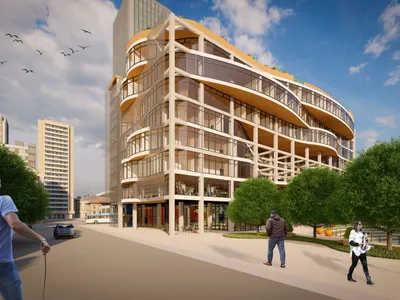
Olio Towers: A Mid-Rise for Performers That Fuses Housing, Rehearsal, and Stage
Located blocks from Houston's Theater District, this modular tower stacks living units around a central performance atrium.

Oasis: Modular Green Housing Carved into Dhaka's Urban Fabric
A shortlisted Plugin Housing entry reclaims unauthorized settlements in Dhaka with stepped concrete volumes, green roofs, and ventilation-driven design.

Black Hole: A Floating Megastructure for the Post-Physical Era
Emiliano Mazzarotto envisions a spherical, self-scaling arena where e-sports, digital hotels, and holographic stadiums replace traditional public space.

Explore Architecture Competitions
Discover active competitions in this discipline

Challenge to reimagine the Iron Throne

Photograph architecture without architects

Illustrate the lost glory of Angkor Wat - Render Challenge

Design challenge to reuse E-waste
Comments (0)
Please login or sign up to add comments
No comments yet. Be the first to comment!