

Armstrong Cottage: An Off-Grid, Net-Zero Family Retreat by Peter Braithwaite Studio
Armstrong Cottage is an off-grid, net-zero lakefront retreat in Canada, combining sustainable timber and steel construction with immersive, nature-integrated family living.


Armstrong Cottage, designed by Peter Braithwaite Studio, is a visionary off-grid, net-zero family retreat located on a secluded lake in Peterborough, Canada. Commissioned by a Toronto-based family, the cottage offers a unique opportunity to reconnect with childhood summer memories in an isolated natural setting while prioritizing sustainability, environmental sensitivity, and immersive family experiences.

Designing for Nature and Isolation
Given the remote lakefront location, the project presented substantial logistical challenges. Construction required barges, floating docks capable of adjusting to seasonal water levels, and the transportation of heavy machinery over frozen lake ice during winter months. Despite these complexities, the project team embraced innovative solutions to ensure minimal impact on the native ecosystem.


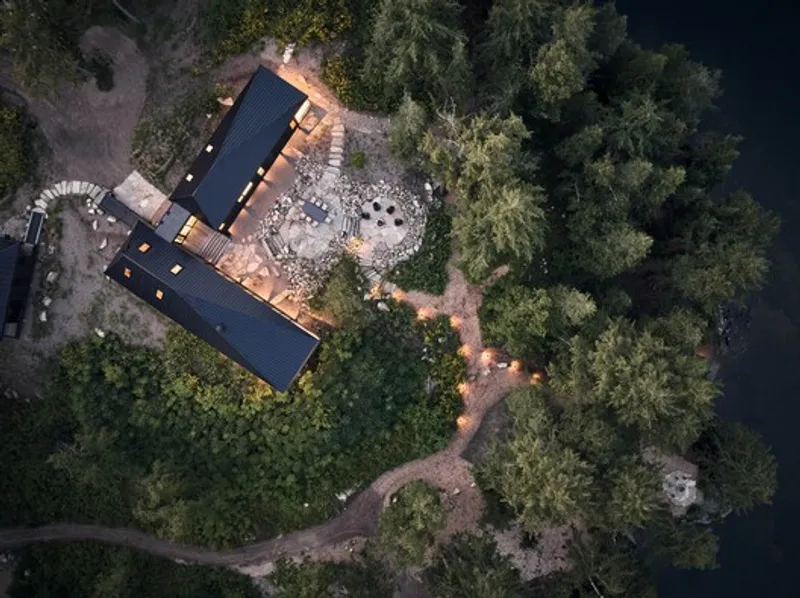
The cottage is composed of two elevated pavilions—sleeping and living areas—strategically positioned on stilts within natural clearings on the island. This elevated design allows the structures to hover within the tree canopy, preserving the forest floor beneath and integrating the dwelling seamlessly into the surrounding landscape.


Sustainable and Sensitive Construction
To achieve the lightweight, elevated form, steel wide flange columns were fastened directly to the native bedrock. This minimized the need for concrete, reducing environmental impact while protecting the fertile island soil from potential contamination.


The superstructure was designed as a modular “kit of parts”, utilizing wood and steel beams, laminated rigid frames, hip members, and rafters. These elements were selected for their structural efficiency and ease of transportation to the remote site via barge, allowing quick on-site assembly using steel plates and bolts.
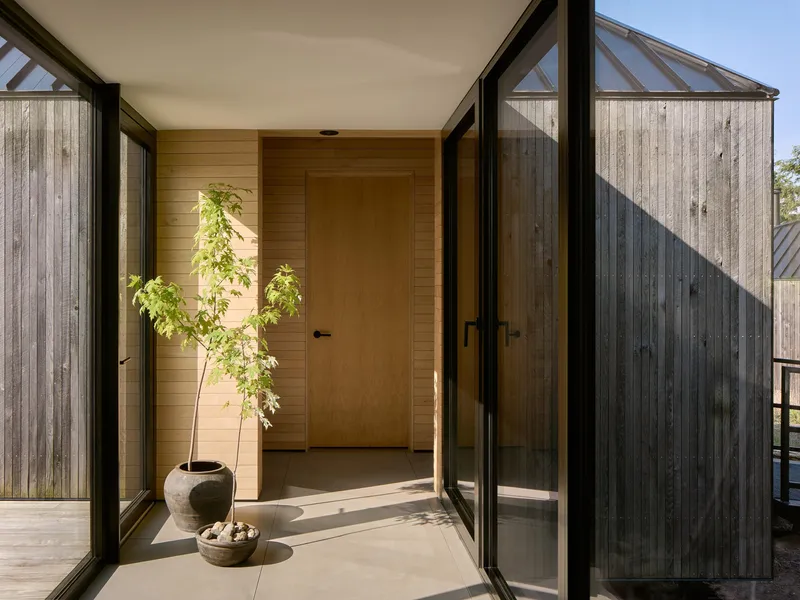

Throughout the project, emphasis was placed on low embedded energy systems, sustainable materials, and highly efficient building technologies, ensuring the cottage remains a net-zero, environmentally responsible retreat.


Immersive Living in a Natural Setting
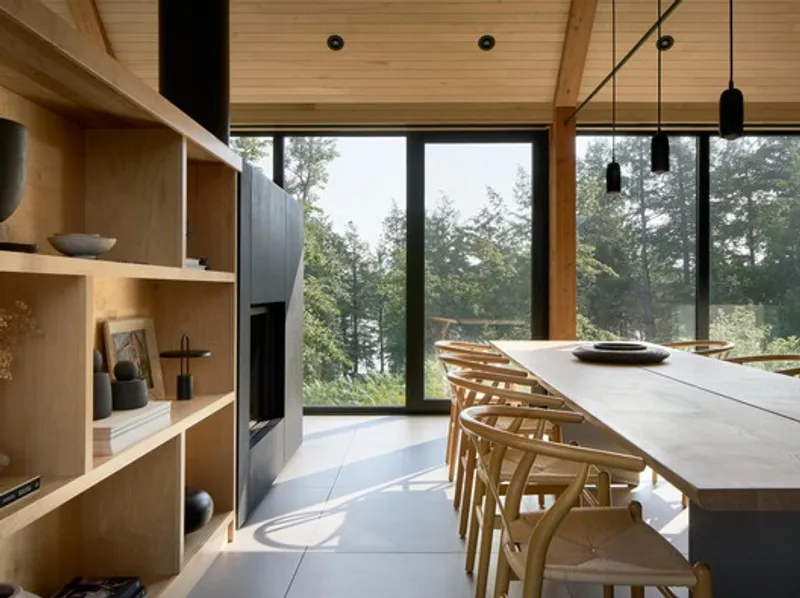
Armstrong Cottage’s design prioritizes a deep connection with the natural environment. Floor-to-ceiling windows, open terraces, and strategic placement within tree clearings create an immersive experience where the family can enjoy the surrounding forest, water, and wildlife. The interiors feature exposed wood, steel beams, and natural finishes that harmonize with the landscape while providing warmth, comfort, and functionality.


The project exemplifies modern sustainable residential architecture, balancing human comfort with ecological responsibility, logistical ingenuity, and a sensitive approach to site-specific design.


A Net-Zero Lakefront Retreat
Armstrong Cottage stands as a model of off-grid, environmentally conscious living. It demonstrates how thoughtful design, sustainable material choices, and innovative construction strategies can deliver a low-impact family home that integrates seamlessly into its natural surroundings. This lakefront retreat is not only a home but a celebration of childhood memories, family life, and nature.

All the Photographs are works of James Morley / doublespace photography


Popular Articles
Popular articles from the community


Jaramillo Van Sluys Arquitectura and Urbanismo Turn a Demolished Registry Lot in Quito into an Orchard Plaza
In Quito's Centro Histórico, a 2,800 m² plaza exposes the San Agustín convent wall and redraws its lost Augustinian orchard in volcanic stone.

longwave studio Reorganizes a 112 m² Tainan Apartment Around the Daily Routines of a Family and Two Cats
In Tainan, Taiwan, birch plywood, rust-red furniture and a freestanding plaster wall link arrival, storage, work and family life in one apartment.

U.GA Architects Wraps an Oval Rooftop Pool in Curved Board-Formed Concrete on Busan's Jeollidan-gil
In Busan's Jeonpo-dong, a 454 m² mixed-use block stacks a neighborhood facility, guest rooms and an oval rooftop pool inside spiraling concrete walls.

David Macias Steps a Doorless Stone and Plaster House Down a Tropical Colombian Hillside
In the humid hills of Colombia, Threshold House replaces the front door with an open void and terraces its 850 m² down the slope instead of fighting it.

Similar Reads
You might also enjoy these articles


Hodi-Mandai Geram
Project Function: Preservation and revitalization of the Intangible heritage and socio-spatial identity of the Hodi by Housing, Cultural Memory Center, Sacred Grove, landscape, local tourism economy


Olio Towers: A Mid-Rise for Performers That Fuses Housing, Rehearsal, and Stage
Located blocks from Houston's Theater District, this modular tower stacks living units around a central performance atrium.

Oasis: Modular Green Housing Carved into Dhaka's Urban Fabric
A shortlisted Plugin Housing entry reclaims unauthorized settlements in Dhaka with stepped concrete volumes, green roofs, and ventilation-driven design.

Black Hole: A Floating Megastructure for the Post-Physical Era
Emiliano Mazzarotto envisions a spherical, self-scaling arena where e-sports, digital hotels, and holographic stadiums replace traditional public space.

Explore Architecture Competitions
Discover active competitions in this discipline

Challenge to reimagine the Iron Throne

Photograph architecture without architects

Illustrate the lost glory of Angkor Wat - Render Challenge

Design challenge to reuse E-waste
Comments (0)
Please login or sign up to add comments
No comments yet. Be the first to comment!