

VARSA: Converting 2,000 Years of Maharashtra's History into Physical Space
A shortlisted Bharat Bhavan proposal embeds chronological time into hillside volumes, each era defined by distinct scale, light, and material.


What if two millennia of history could be felt in the compression of a corridor, the flood of light through a clerestory, the weight of stone closing in before releasing you into an open amphitheater? VARSA answers that question by converting Maharashtra's layered past into a sequence of architectural volumes. Each era, from the Golden Era through Mughal and Maratha rule to the contemporary moment, becomes a distinct space with its own scale, light condition, and material character. The name, drawn from the Marathi word for heritage and generational inheritance, declares intent: this is not a museum of artifacts but a spatial continuum of collective memory.
Designed by Jayesh Kulkarni, VARSA was a shortlisted entry in the Bharat Bhavan 2020 competition on uni.xyz. Sited near Nandgaon, Lonavala, within reach of both Pune and Mumbai, the project leverages the terrain's contour differences and surrounding natural landscape to embed its volumes into the hillside rather than impose upon it. Maharashtra's forts, wadas, pilgrimages, folk arts, and urban traditions are not isolated as exhibits but woven into a unified architectural language that reads as both landmark and landform.
A Courtyard That Works Around What Already Exists
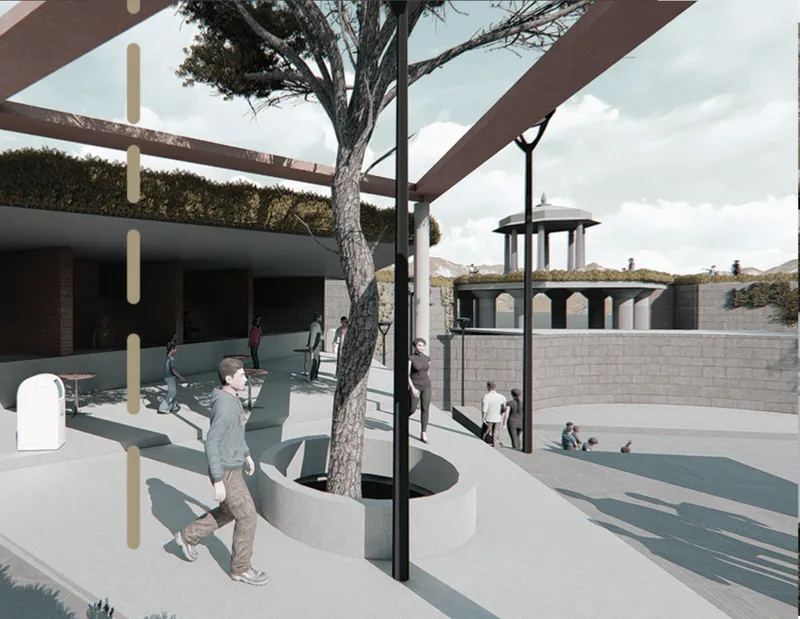
The courtyard at VARSA operates as a threshold between the public world and the narrative journey within. A timber pergola structure filters light overhead while an existing tree remains rooted in place, its canopy punctuating the geometric precision of block masonry walls beyond. Retaining mature vegetation is not a decorative choice; it anchors the institution in the site's ecological reality and signals that the architecture yields to what was already there. The pergola, with its rhythmic timber members, recalls the covered walkways of traditional wadas without resorting to stylistic imitation. Metal support columns and the movement of figures beneath the canopy give the space a civic openness that sets the tone for everything that follows.
Performance Carved into the Hillside


VARSA positions performance and public gathering as essential civic functions, not afterthoughts. The semicircular amphitheater plaza is carved into the terrain with stepped concrete seating that opens directly toward the mountain range beyond, turning landscape into backdrop. The scale is deliberate: large enough for public events and festivals, yet intimate enough that a single visitor seated on a stone step feels the weight of the surrounding hills. Below, concrete paving extends the public ground plane, linking the performance area to everyday circulation routes.
Adjacent to the amphitheater, ribbed concrete planter edges beneath deciduous trees create shaded micro-environments at the building's periphery. Scattered autumn leaves across these planted beds reinforce the sense of a landscape that breathes with seasonal change rather than sitting frozen for display. The block masonry walls visible throughout maintain material continuity across the complex, grounding every outdoor moment in the same tectonic logic. These spaces serve the project's core ambition: intersecting art, performance, history, and daily life on a single public platform accessible across generations.
A Timber Pavilion Suspended Over Water and Time
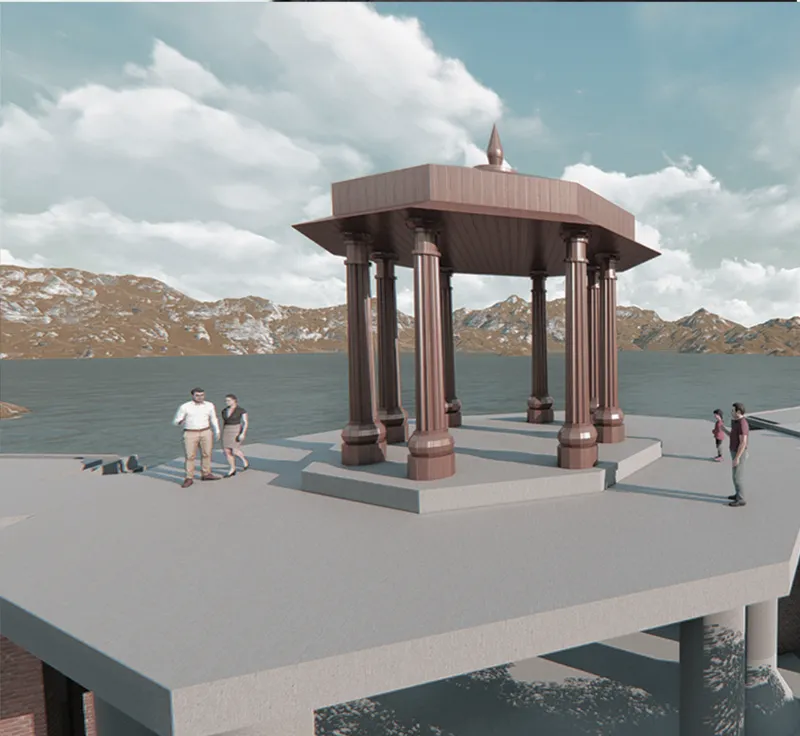
Perhaps the most striking spatial gesture in VARSA is the elevated timber pavilion that projects outward on cylindrical columns over a lake, framing snow-dusted mountains in its aperture. Within the narrative sequence, this pavilion functions as a moment of release: after moving through compressed, dark volumes that evoke conflict and suppression, the visitor arrives at an open, light-filled structure symbolizing freedom, progress, and hope. The material shift from heavy masonry to lightweight timber registers physically. You feel the floor change underfoot, the breeze off the water, the sudden absence of enclosing walls. It is architecture communicating historical emotion without a single word of text, and the lake below reflects both the structure and the mountains, doubling the sense of openness.
Interior Volumes Where Light Tells the Story
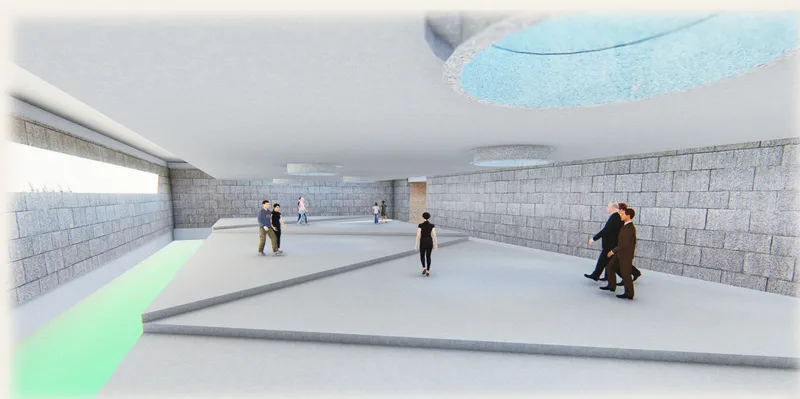

Inside, the gallery spaces reveal how VARSA uses light as a narrative instrument. One gallery features concrete block walls pierced by ceiling oculi, circular openings that drop controlled shafts of light into otherwise muted interiors. Visitors move through these pools of illumination as if passing through distinct chapters of a timeline, each pool defining a zone of attention. The material is raw and restrained: exposed block masonry, concrete, and a deliberately limited palette that refuses to compete with whatever artifacts or installations occupy the space.
Deeper in the sequence, angled stone block walls create volumes that feel deliberately compressed. Figures standing on a white floor surface appear dwarfed by the angular geometry closing in from both sides, a spatial condition that evokes the weight of historical periods defined by conflict or subjugation. The contrast between these tight, heavy rooms and the open timber pavilion over the lake is not accidental. It is the entire thesis of the project made physical: that history is not a flat line but a rhythm of constriction and release, darkness and light, weight and buoyancy.
Why This Project Matters
VARSA challenges the convention that cultural institutions should be neutral containers for curated content. By assigning each historical era its own architectural character, the project makes the building itself the primary exhibit. The decision to embed volumes into the Lonavala hillside rather than erect a monumental object on top of it reflects a considered position on how regional architecture should engage with landscape: not as a figure on a ground, but as geology with intention.
What makes Kulkarni's proposal compelling is its refusal to separate the experiential from the educational. The compression of a corridor is not a stylistic flourish; it is the architecture of a historical period made tangible. The open timber pavilion over the lake is not a scenic viewpoint; it is the spatial equivalent of liberation. For a competition tasked with imagining Maharashtra's cultural identity in built form, VARSA offers a provocation worth taking seriously: that the most powerful way to convey history is not to tell it, but to let visitors walk through it.
About the Designers
Designers: Jayesh Kulkarni, Bharat Bhavan 2020
Enter a Design Competition on uni.xyz
uni.xyz runs architecture and design competitions year-round that reward proposals with spatial conviction and real site intelligence.
Project credits: VARSA: Converting 2,000 Years of Maharashtra's History into Physical Space by Jayesh Kulkarni, Bharat Bhavan 2020 Bharat Bhavan 2020 (uni.xyz).


Popular Articles
Popular articles from the community


Temporary Home for Dogs: A Reversed Zoo Rethinks Animal Shelter Architecture
In Bucharest, a sinuous corridor and freed landscape flip the logic of containment, designing a shelter that works to make itself unnecessary.

Opera on the Sea: Driftwood Logic Shapes a Timber Opera House on Estonia's Coast
Trevor Orgill's opera house translates the entangled drift of floating timber into a civic building where wood, water, and music converge.

Manzana Morphosis: Stretching Barcelona's Grid into a Living Landscape for 2050
A radical reworking of the Eixample manzana turns density into a tool for generous public space, vertical ecology, and environmental performance.

Singing Woman: Contemporary Architecture Inspired by Estonia’s Voice and the Sea
Singing Woman turns Estonia’s song culture into flowing opera house architecture, blending public life, landscape, sea, and national memory.

Similar Reads
You might also enjoy these articles
Sustainable Architecture Design: Embracing Nature and Modernity at Villa Solsidan
The article explores Villa Solsidan by AndrénFogelström, showcasing its sustainable architecture design and integration with the natural surroundings in Saltsjöbaden, Sweden.
Scientific and Educational Monitoring Center of the Yenisei, Krasnoyarsk
Architecture as an instrument for ecological research, education, and environmental awareness along Russia’s largest river.
Development of Andretta Artist’s Village, Palampur, Himachal Pradesh, India
Reimagining Andretta as a living cultural landscape where art, architecture, and community converge to shape a global creative village.
Street Children Rehabilitation Center: A Model of Social Architecture for Community Rehabilitation
An inclusive social architecture project that transforms streets into nurturing environments, restoring dignity, identity, and opportunity for vulnerable children.

Explore Bharat Bhavan Competitions
Discover active competitions in this discipline

Challenge to reimagine the Iron Throne

Photograph architecture without architects

Illustrate the lost glory of Angkor Wat - Render Challenge

Design challenge to reuse E-waste
Comments (0)
Please login or sign up to add comments
No comments yet. Be the first to comment!