

Doepel Strijkers Wraps a Dutch Crematorium in Timber and Thematic Gardens
A biophilic transformation in Zaandam redefines how architecture can support grief, ritual, and the passage of seasons.


Crematoriums are among the most emotionally charged building types an architect can take on, yet they rarely receive the design attention they deserve. Most default to a predictable formula: stone, silence, and a vague neutrality meant to offend no one. The renovation and expansion of the PC Uitvaart crematorium in Zaandam by Doepel Strijkers Architects rejects that formula entirely. Working with a 2,400 square meter site at the municipal cemetery opposite Vijfhoekpark, the Rotterdam firm has wrapped the original building, designed by Hans Valk, in a new timber armature that fundamentally changes how people move through, experience, and remember a place of farewell.
What makes the project genuinely interesting is its refusal to treat nature as decoration. The biophilic strategy here is structural: a wooden lattice envelope encloses thematic gardens, filters sunlight, and dissolves the boundary between ceremony and landscape. Developed in collaboration with landscape office MADMA from Rotterdam, the design allows entire funeral proceedings, from ceremony to reception, to unfold in a single multifunctional space that opens directly onto planted courtyards. The result is a crematorium that acknowledges grief without suppressing it, using seasonal change, natural light, and greenery as active participants in the ritual of saying goodbye.
A Timber Envelope That Does Real Work

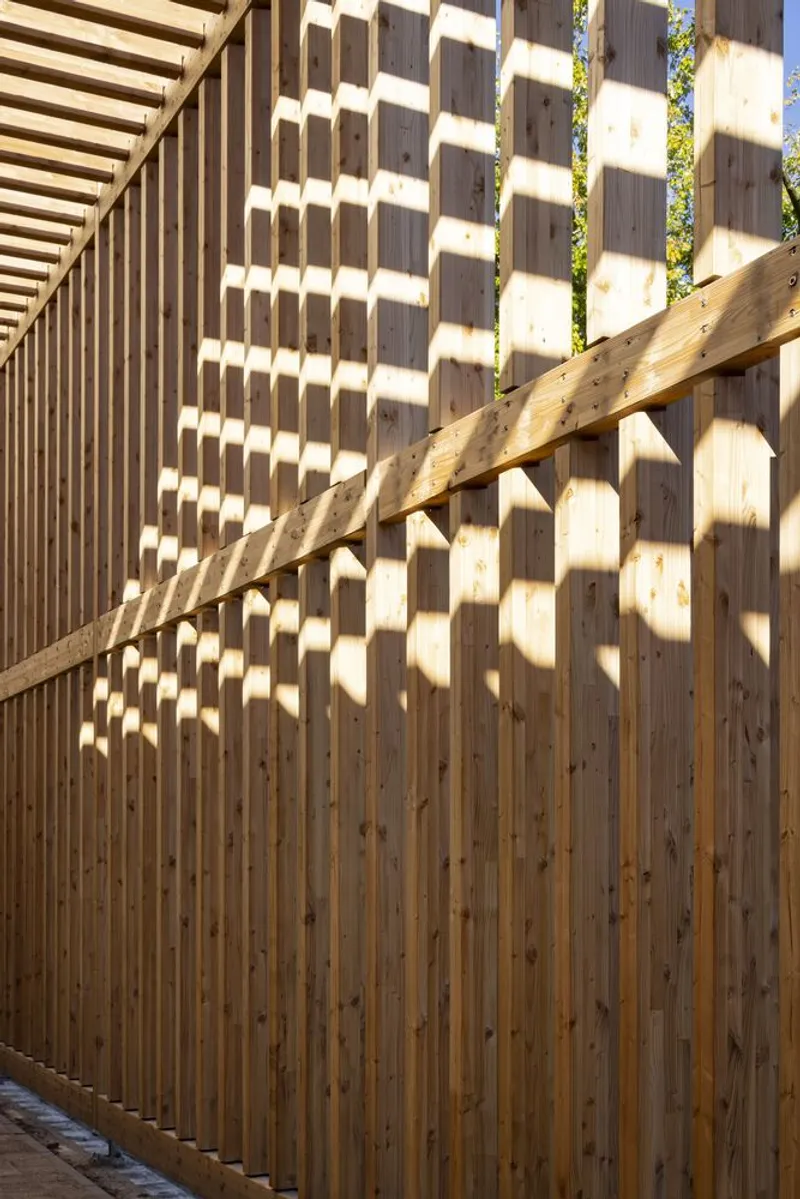
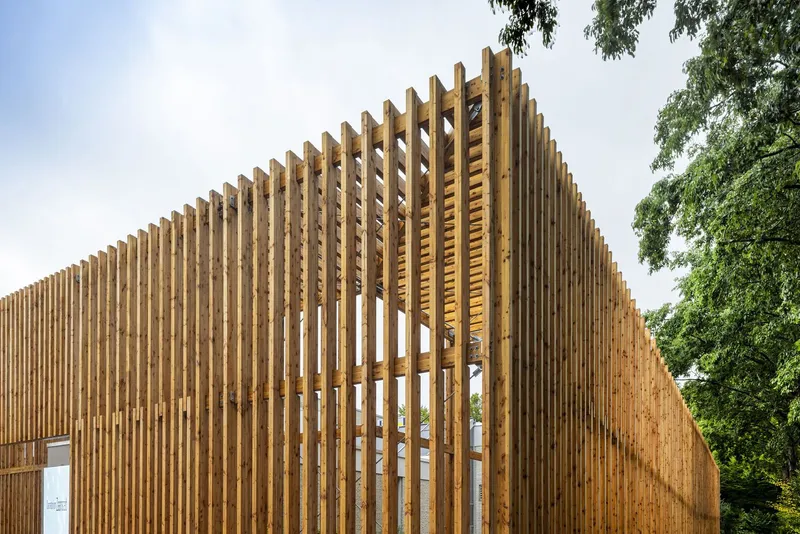
The most visible move is the wooden structure that wraps around the existing crematorium, and it earns its presence. The vertical timber slats serve simultaneously as sun protection, spatial enclosure, and visual identity. Against the white rendered walls of the original Hans Valk building, the warm lattice reads as both addition and invitation: a new layer that softens the institutional edges without pretending they aren't there.
Diagonal cross-bracing within the screens casts dappled shadow patterns that shift throughout the day, giving the building a temporal quality. The timber is not merely cladding. It establishes the framework for outdoor garden rooms, creates covered walkways between program areas, and resolves what was previously a logistical problem of multiple entrances on different sides of the building. Now, the wooden envelope orchestrates movement, guiding visitors along a deliberate, contemplative route.
Gardens as Ceremony Rooms

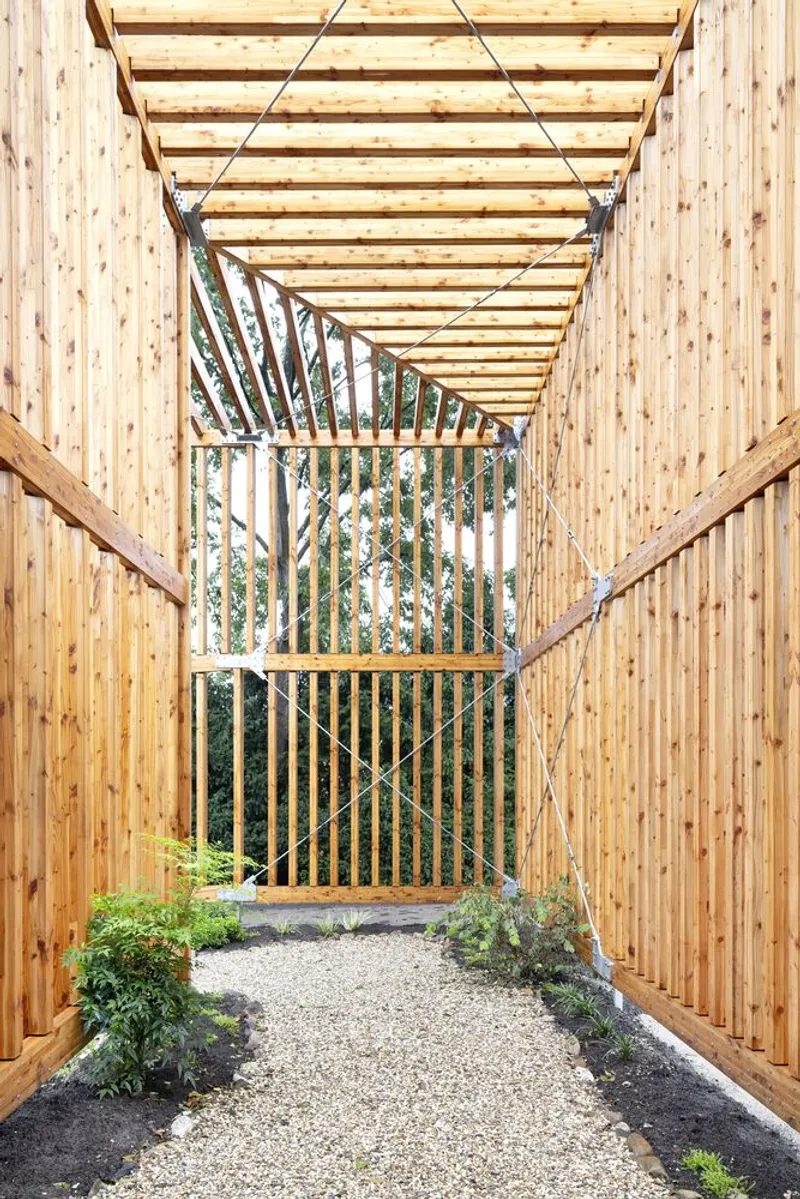
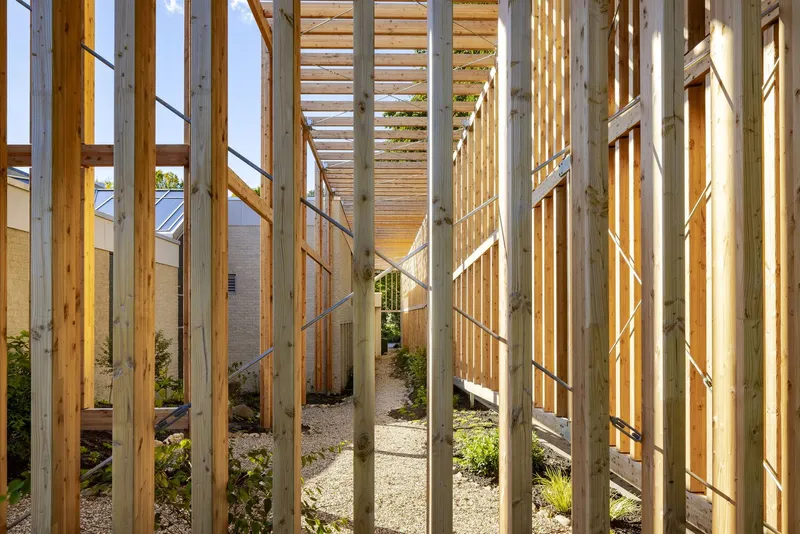
The collaboration with MADMA yields thematic gardens that are far more than pleasant backdrops. Enclosed by the timber pergola structure, these gravel courtyards and planted beds function as outdoor ceremonial extensions. The design deliberately opens facades where they meet the gardens, giving mourners direct access to landscape and uninterrupted views of seasonal change. A Japanese maple in autumn foliage, visible through the timber screen, becomes as much a part of the farewell as any spoken eulogy.
Covered walkways with vertical slat walls thread between garden spaces, creating transitional moments between arrival, ceremony, and departure. The planting is neither manicured nor wild but carefully calibrated: enough structure to feel intentional, enough softness to feel alive. Light filters through exposed beams and slats, creating an atmosphere that shifts with weather and time of day. The gardens don't compete with the architecture; they complete it.
Approaching the Building


Arrival matters enormously in a crematorium, and the design handles it with care. From the street, the timber slatted facade rises behind a landscaped traffic island, signaling something warmer than the institutional norm. An entrance stairway ascends through planted slopes toward the screened building, its dusk-lit profile suggesting shelter rather than solemnity. The vertical slat screen at the entrance frames views through to the gravel courtyard beyond, offering a visual preview that eases the transition from public street to private grief.
Multiple entrances on different sides of the building allow for the practical reality that funerals often involve overlapping schedules and different groups arriving simultaneously. The timber envelope resolves these flows without corridors or signage, using spatial sequencing and garden views to orient visitors intuitively.
Inside: Ritual Made Flexible

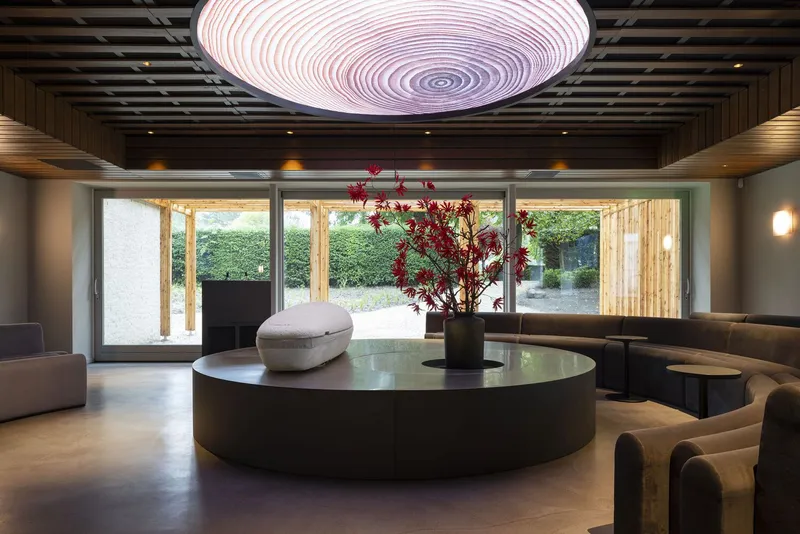

The interiors reflect the same principle that drives the exterior: architecture should support people, not prescribe behavior. The ceremonial hall features curved bench seating rows beneath suspended tubular light fixtures, a geometry that gathers attention inward without feeling rigid. The space is designed as multifunctional: a single room can accommodate the entire arc of a funeral, from the formal ceremony through to the informal gathering afterward, eliminating the disorienting transitions between rooms that characterize most crematoriums.
Lounge spaces feel domestic rather than institutional. A circular ceiling pendant hovers above a round table holding a red-leafed branch, a detail that reads as both design choice and quiet metaphor. Elsewhere, curved seating wraps beneath suspended planters and a wood slat ceiling, collapsing the distinction between furniture, greenery, and structure. The spaces are designed to host ceremonies for all cultures, with flexible arrangements that allow families to shape rituals according to personal and cultural preferences.
Green from Outside to Inside


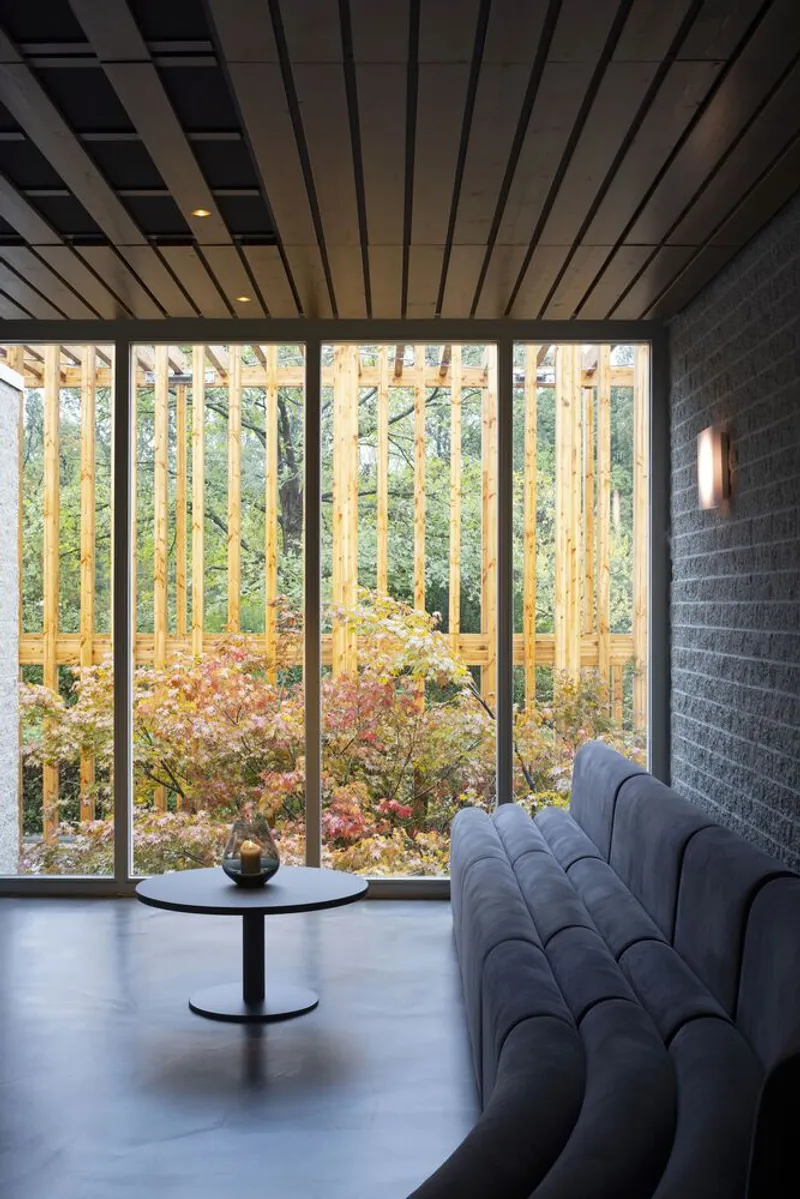
The biophilic ambition reaches its most literal expression in the interior planting strategy. A backlit vertical green wall with trailing vines occupies a dark interior space, functioning as living partition and atmospheric device. Planted beds appear within lounge areas beneath timber baffle ceilings, so that the boundary between garden and room effectively dissolves. A window wall overlooking the timber slats and autumn foliage frames the seasons as something to sit with, not merely glance at.
Plants are integrated not as ornaments but as spatial elements: seating dividers, visual screens, sources of scent and texture. The approach is consistent with MADMA's landscape strategy outside, creating a continuous gradient from the thematic gardens through the facades and into the rooms. It is biophilic design in the fullest sense, not a potted fern on a reception desk but a fundamental reorientation of the building's relationship to living systems.
Material Transitions and Circulation
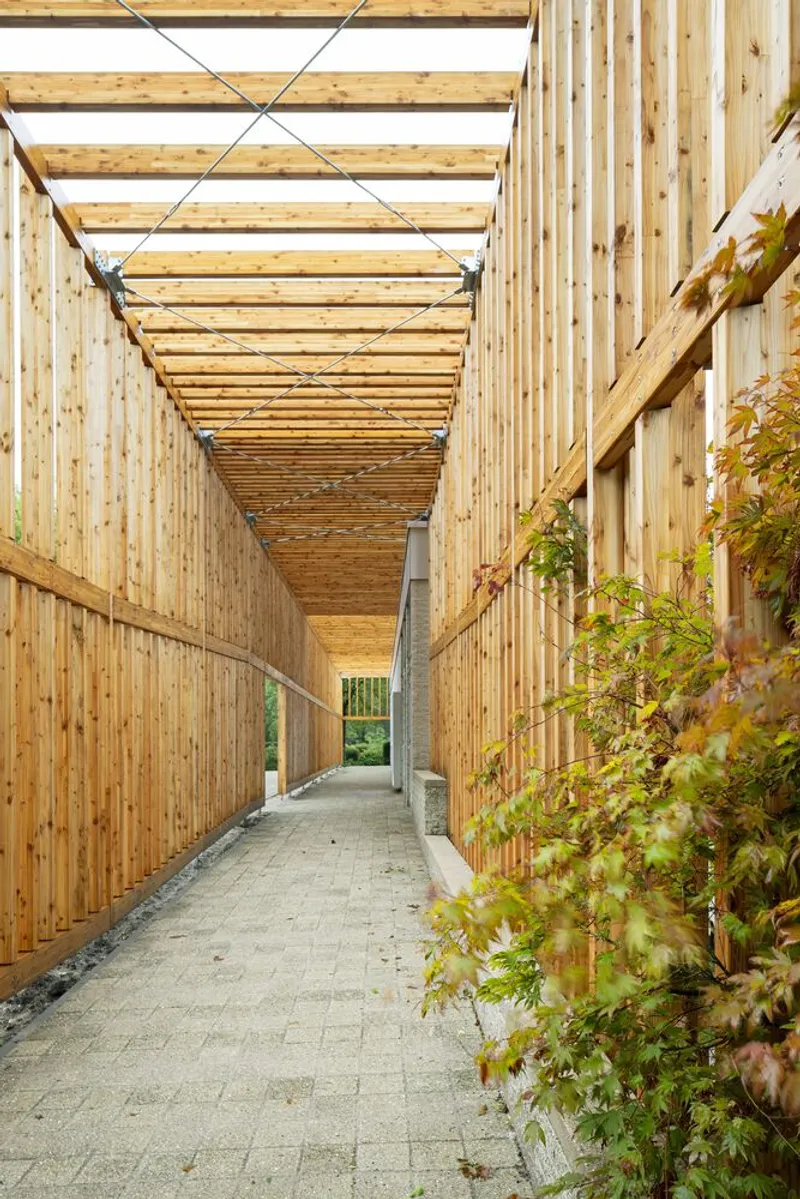


Circulation spaces reveal the care embedded in the details. A covered timber walkway with vertical wood slatted walls and planted foliage along a gravel path connects garden rooms without ever feeling like a corridor. By contrast, an interior corridor with textured white stone walls and grey concrete columns provides a more neutral register, appropriate for the operational zones and back-of-house functions. The material shift between timber and stone signals a change in mood and purpose without requiring signage.
A Japanese maple in autumn color, framed behind vertical timber slats and a gravel bed, acts as a composed vignette along these routes. These moments feel deliberate: the architects understand that people moving through a crematorium are in a heightened emotional state, and that every view, every material surface, every quality of light contributes to or detracts from the experience of farewell.
Outdoor Gathering and the Pergola
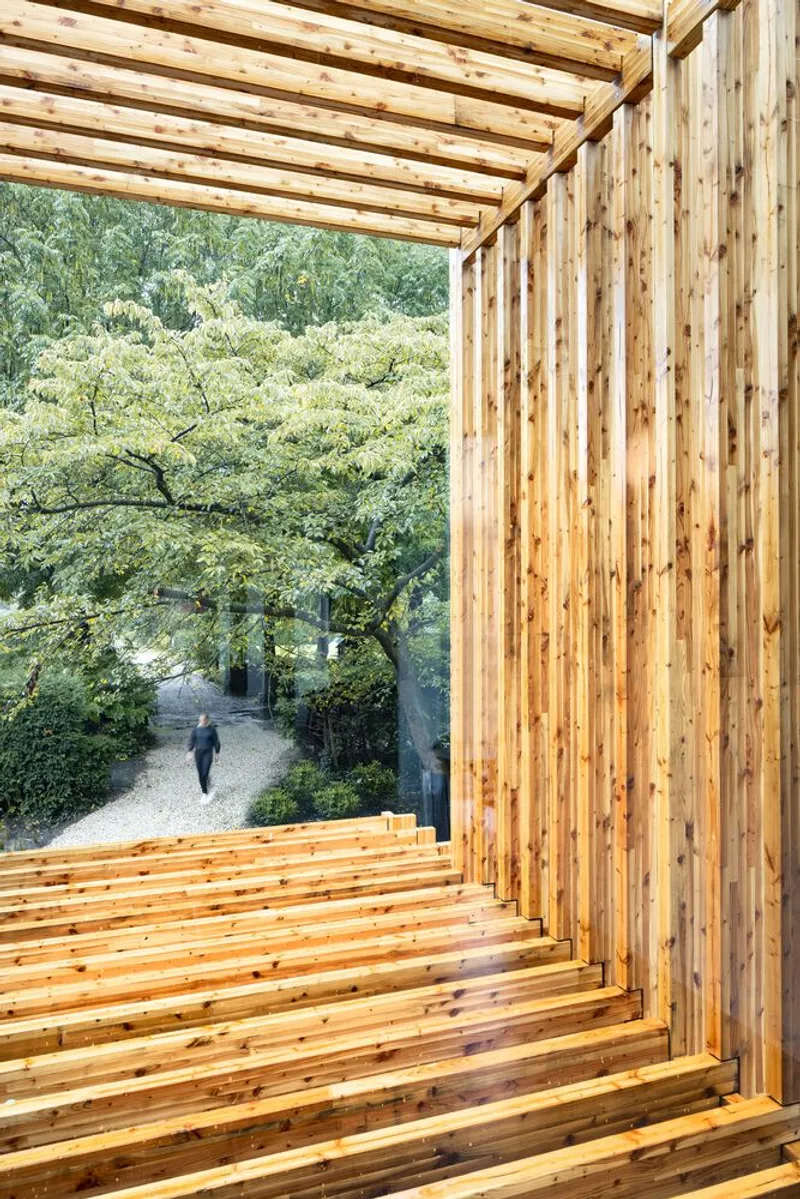
One of the coffee rooms includes outdoor space that can be used for ceremonies, and the timber bench seating under an exposed rafter pergola overlooking a garden path offers exactly the kind of informal gathering spot that funerals need but rarely get. After the formal ceremony, people want to stand outside, talk quietly, watch leaves move. The pergola structure provides shelter without enclosure, a threshold condition that acknowledges both the need for protection and the need for air.
Plans and Drawings


The axonometric diagrams reveal the design logic clearly. One drawing shows four variations of the facade enclosure system transitioning from solid walls to vegetation-covered screens, illustrating how the timber lattice operates as a gradient rather than a binary boundary. The isometric of the courtyard complex maps planted zones against annotated design concepts, showing how garden rooms and built spaces interlock. The exploded axonometric pulls apart the multiple floor levels and courtyards, making visible the layered strategy of wrapping, connecting, and opening that defines the project.
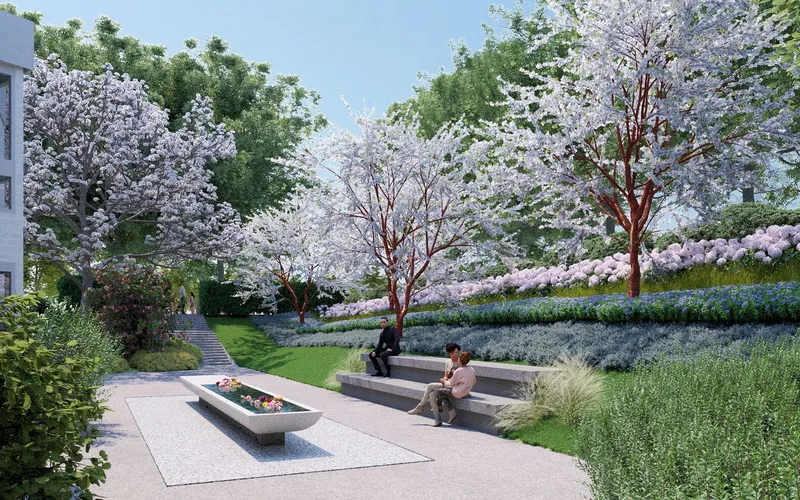
A rendered courtyard view with stepped seating, flowering cherry trees, and people gathering in spring offers a vision of the building in its most optimistic season. Compared to the interior ceremonial hall, the contrast is instructive: one space gathers attention inward, the other disperses it outward. Together, they represent the full emotional range the building is designed to hold.
Why This Project Matters
The PC Uitvaart crematorium renovation matters because it treats death architecture as a design problem worthy of real ambition. Too many crematoriums settle for a kind of bland solemnity, as though the only appropriate architectural response to grief is absence of character. Doepel Strijkers and MADMA have argued otherwise, building a case that nature, material warmth, and spatial flexibility can support mourning more effectively than marble and silence. The decision to wrap an existing building in a new timber skin rather than demolish it also carries its own quiet message about transformation and continuity.
The project also functions as a proof of concept for inclusive ceremonial space. By designing multifunctional rooms adaptable to different cultural traditions and integrating technology for personalized rituals, the architects have created infrastructure that can evolve with its community. Completed in 2024, it serves as a generic brand book implemented at its first specific location, suggesting that the ideas tested here in Zaandam are intended to travel. If they do, the funeral industry will be better for it.
PC Uitvaart Crematorium, Zaandam, The Netherlands. Architect: Doepel Strijkers Architects. Landscape architecture: MADMA, Rotterdam. Area: 2,400 m². Completed: 2024. Photography: Peter Tijhuis.
About the Studio
Share Your Own Work on uni.xyz
If projects like this are the kind of work you want to make, uni.xyz is a place to publish your own, find collaborators, and enter design competitions.


Popular Articles
Popular articles from the community

Extended Shell: Retrofitting Kolkata's Balconies as Living Urban Thresholds
A modular retrofit system recovers the social and environmental intelligence of Kolkata's historic verandas for contemporary Park Street residents.

Temporary Home for Dogs: A Reversed Zoo Rethinks Animal Shelter Architecture
In Bucharest, a sinuous corridor and freed landscape flip the logic of containment, designing a shelter that works to make itself unnecessary.
Opera by the Sea Estonia: Three Shells Dissolving Architecture into Tallinn's Coastline
A winning opera house proposal replaces monumental form with interconnected shells that blur the boundary between building, park and Baltic Sea.

Singing Woman: An Opera House That Performs Before the Curtain Rises
Ovidiu Cristian Pavel's conceptual opera house translates Estonia's choral identity into a sculpted waterfront landmark facing the Baltic Sea.

Similar Reads
You might also enjoy these articles


Hodi-Mandai Geram
Project Function: Preservation and revitalization of the Intangible heritage and socio-spatial identity of the Hodi by Housing, Cultural Memory Center, Sacred Grove, landscape, local tourism economy


Olio Towers: A Mid-Rise for Performers That Fuses Housing, Rehearsal, and Stage
Located blocks from Houston's Theater District, this modular tower stacks living units around a central performance atrium.

Oasis: Modular Green Housing Carved into Dhaka's Urban Fabric
A shortlisted Plugin Housing entry reclaims unauthorized settlements in Dhaka with stepped concrete volumes, green roofs, and ventilation-driven design.

Black Hole: A Floating Megastructure for the Post-Physical Era
Emiliano Mazzarotto envisions a spherical, self-scaling arena where e-sports, digital hotels, and holographic stadiums replace traditional public space.

Explore Crematorium Competitions
Discover active competitions in this discipline

Challenge to reimagine the Iron Throne

Photograph architecture without architects

Illustrate the lost glory of Angkor Wat - Render Challenge

Design challenge to reuse E-waste
Comments (0)
Please login or sign up to add comments
No comments yet. Be the first to comment!