

ARX Portugal Turns a 1978 Lisbon Office Tower into 19 Luxury Apartments Wrapped in Fluted Stone
Castilho 203 replaces a failing concrete office block near Parque Eduardo VII with a luminous residential tower clad in Vila Viçosa marble.


Lisbon's Rua Castilho runs along the western edge of Parque Eduardo VII, flanked by some of the city's most self-consciously prestigious addresses. Number 203, a corner lot at the intersection with Rua Padre António Vieira, once held a Tomás Taveira office building completed in 1978. When new ownership arrived with residential ambitions, ARX Portugal Arquitectos was brought in to perform what initially looked like an adaptive reuse. It became something far more radical: surveys exposed such severe structural deficiencies that a high percentage of the original reinforced concrete frame had to be demolished, reconfigured, and rebuilt from scratch.
What stands now is an 18-storey tower (14 above ground, 4 below) containing 19 apartments, a spa, a swimming pool on the eighth floor, and a panoramic terrace at the top. The most interesting move here is not the program, which is straightforward luxury housing, but the way ARX leveraged the rebuilding to undo a critical flaw: the old building's south gable was entirely blind. The new design punches it open with generous windows and balconies aimed directly at the Tagus River and the Castelo de São Jorge, turning a dead wall into the building's primary amenity.
A Facade That Earns Its Verticality
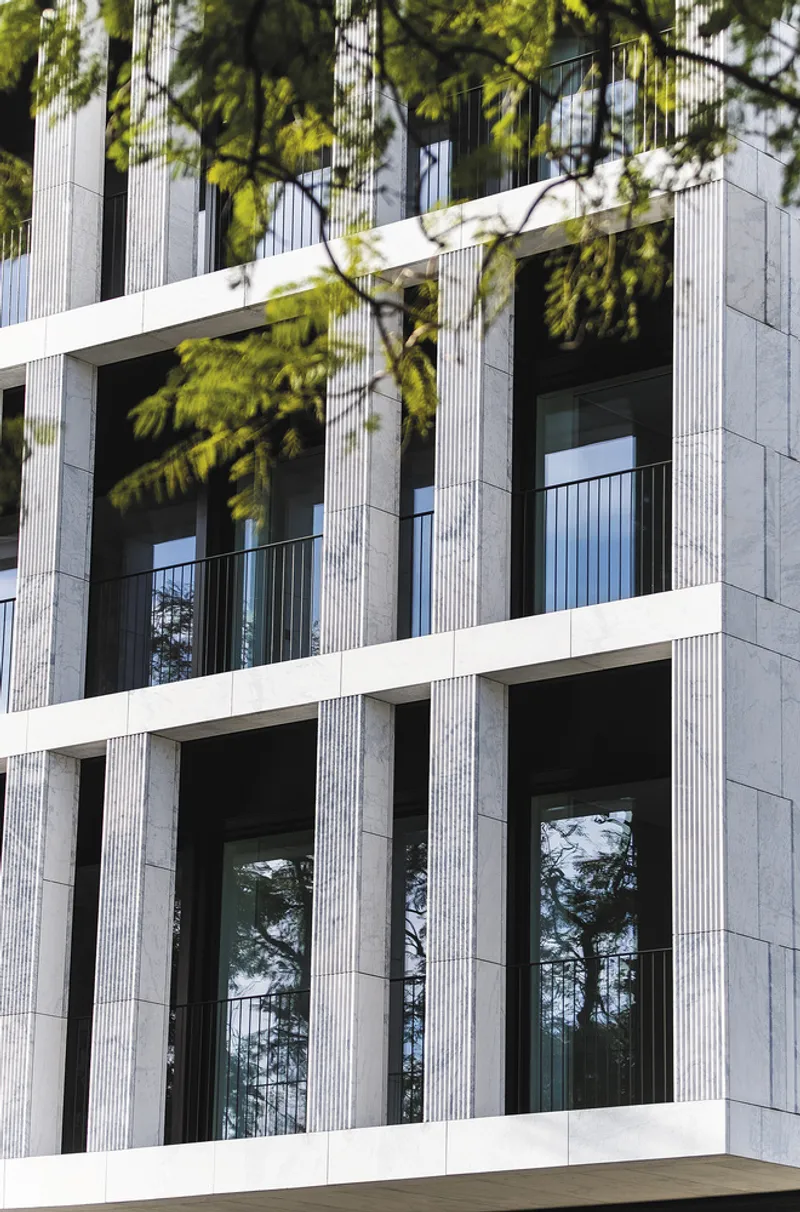
The defining external gesture is a grid of vertical fluted stone panels in white Vila Viçosa marble. The fluting is not decorative appliqué; it articulates the mineral grain of the stone and exaggerates the tower's slenderness against a skyline of bulkier neighbors. Between these ribs, deep recessed balconies create shadow pockets that shift throughout the day, giving the facade a kinetic quality that photographs only partially capture.
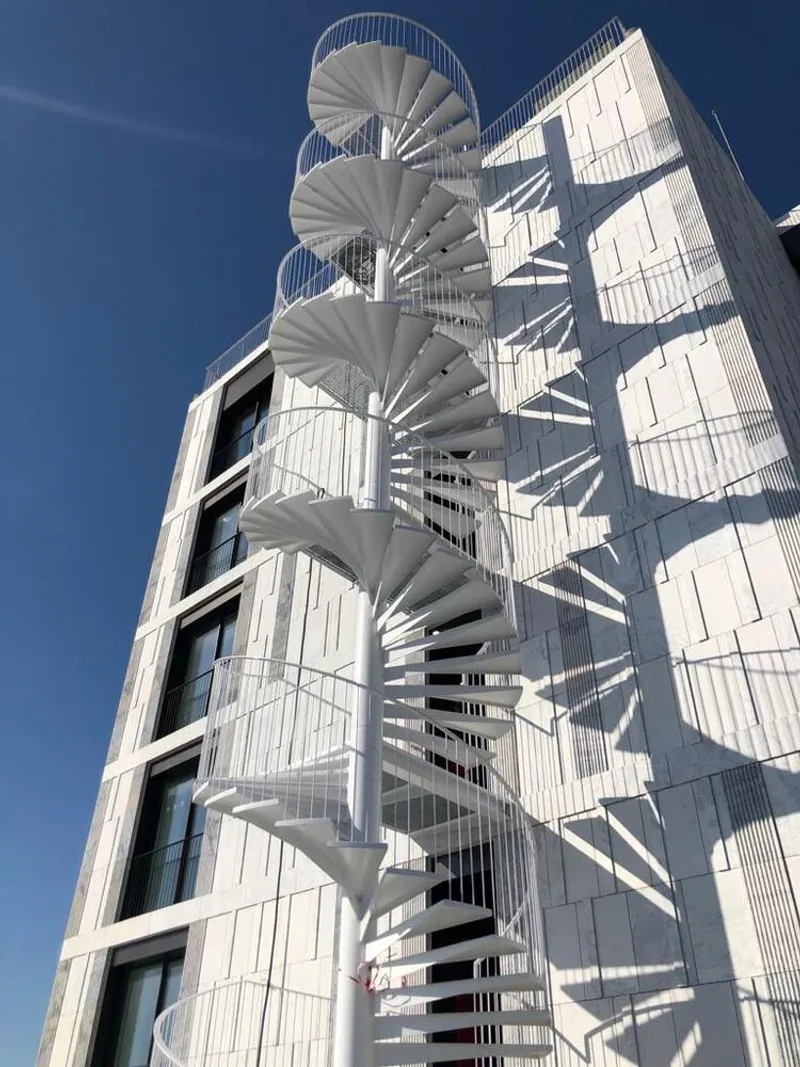
A white metal spiral staircase bolted to one of these ribbed panels (visible on an upper level) signals the penthouse and terrace access, adding an almost nautical accent to the otherwise geological palette. The contrast between the heavy, scored stone and this lightweight steel helix is deliberate: it reinforces the idea that the building's character comes from tension between materials, not from any single finish.
Reorienting the Threshold

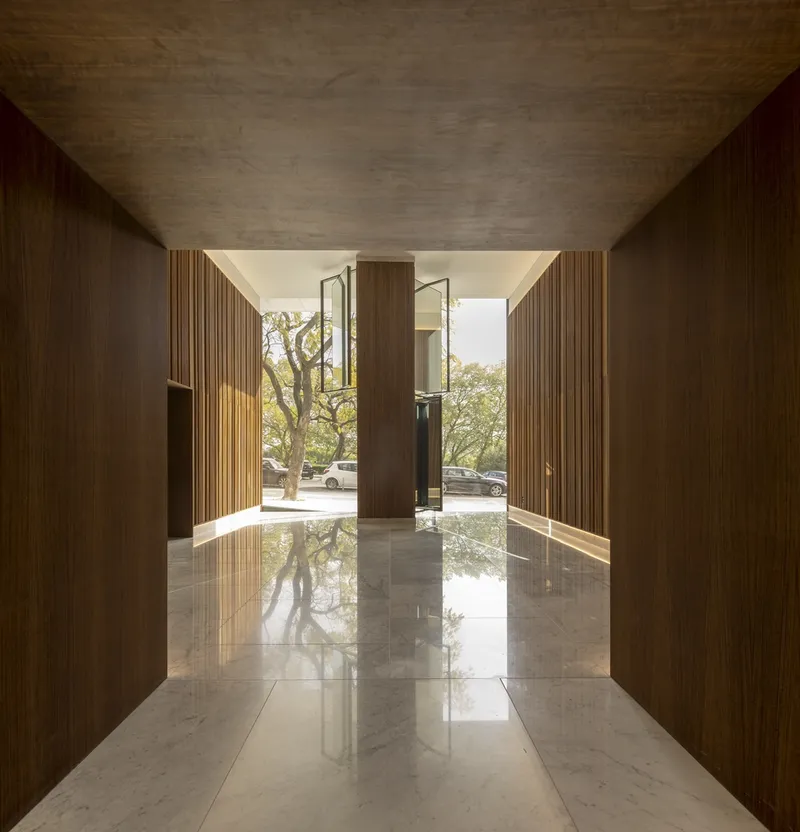
One of the project's most consequential decisions was relocating the entrance from the quieter Rua Padre Vieira to Rua Castilho, facing the park. The new threshold is framed in oxidized brass, set beneath a deep timber soffit that filters dappled light across the entry sequence. It is a generous, almost ceremonial gesture that calibrates the building to the monumental axis of Parque Eduardo VII rather than to a secondary side street.
The entry corridor beyond extends this logic: vertical timber cladding lines the walls while a polished stone floor reflects trees and daylight from the far end. The effect is a compressed perspective tunnel that releases you into the lobby with a deliberate sense of arrival. ARX clearly understood that in a neighborhood where buildings compete on address alone, the procession from sidewalk to elevator matters as much as any view from the thirteenth floor.
The Lobby as Curated Experience

The reception hall pairs horizontal wood plank walls and ceiling with two mirrored viewing windows that compress and expand the perceived depth of the room. This is the space designed in collaboration with artist José Pedro Croft, and it reads as an installation rather than a waiting area. The mirrors introduce a perceptual doubling, layering the exterior landscape into the interior in a way that is disorienting just long enough to be interesting.
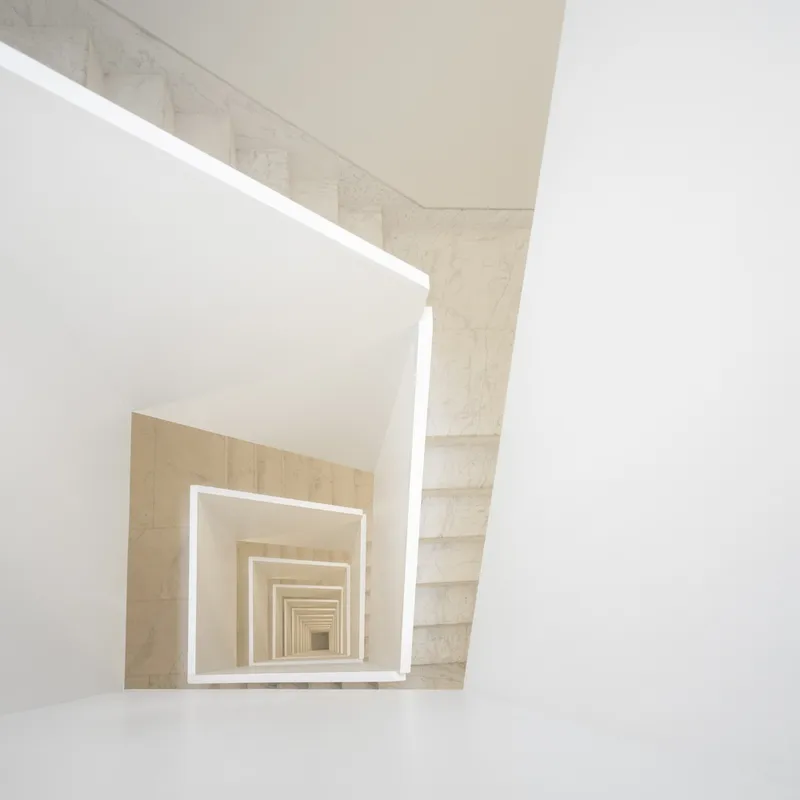
Elsewhere in the common circulation, a square stone stairwell creates a receding frame perspective when viewed from below. It is a classic architectural set piece, but it works here because the material consistency (stone on stone, warm lighting, no exposed services) maintains the tonal discipline that ARX established at the front door. Every communal space operates as a transition rather than a leftover.
Living Rooms That Frame the City
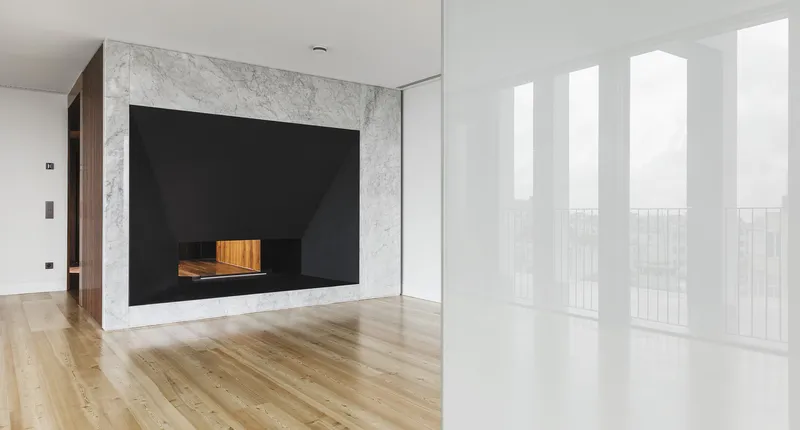
Inside the apartments, the palette shifts to dark bronze anodized wood and aluminum against tall white curtained windows. A marble fireplace surround anchors the living room shown here, its proportions echoing the vertical rhythm of the exterior stone grid. The curtains are floor-to-ceiling and sheer enough to filter the famously strong Lisbon light without blocking it, a detail that sounds minor until you remember that the previous building had a blank wall in exactly this orientation.
From the eighth floor upward, each level holds a single three-bedroom apartment. The penthouse on the thirteenth floor spans 287 square meters, opening onto the roughly 260-square-meter panoramic terrace above. These are not cramped luxury units carved from a converted office plate; the structural reworking allowed ARX to proportion each floor for domestic scale, with cross-ventilation and 360-degree views on the upper levels.
Infrastructure Without Apology
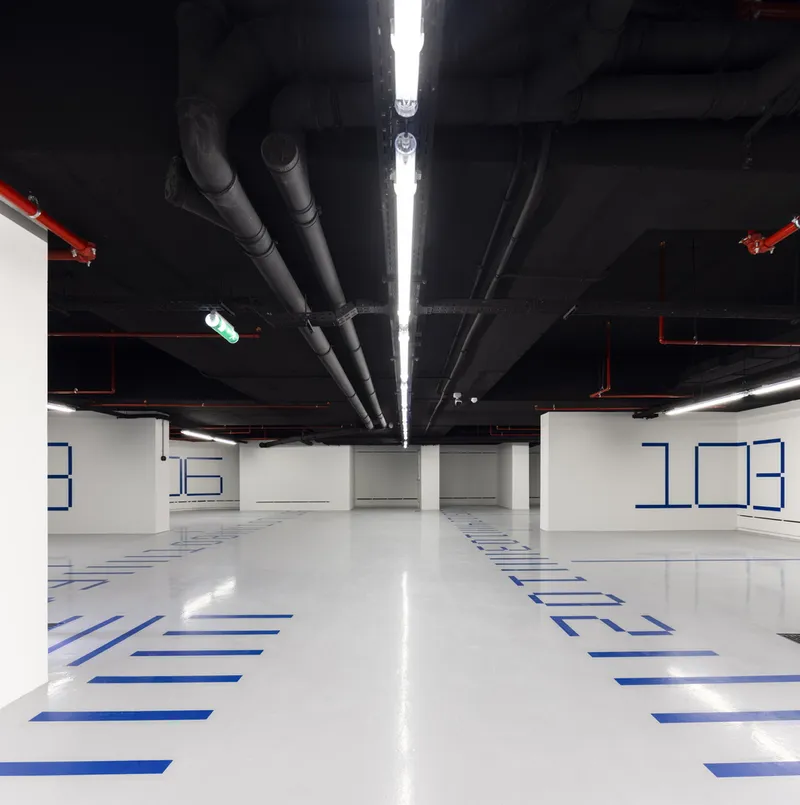
Four underground levels accommodate 21 parking spaces, and the garage is handled with more care than most residential basements receive. Exposed black ceiling ducts are left visible (a refreshing refusal to hide services behind drop ceilings), while bold blue wayfinding graphics on a white epoxy floor turn what is usually the least considered part of a building into a legible, almost graphic environment. It is a small thing, but it signals that ARX's attention to detail extends below grade.
Why This Project Matters
Castilho 203 is instructive because it reveals what happens when an adaptive reuse project discovers, mid-process, that the thing it wanted to adapt is fundamentally broken. Rather than abandoning the site or erecting a generic replacement, ARX used the crisis as license to rethink everything: the entrance, the orientation, the relationship to landscape, and the material identity. The result is a building that looks nothing like the Taveira original and owes nothing to it structurally, yet occupies the same footprint with a far sharper understanding of what the site actually offers.
The broader lesson is about restraint in a luxury market that rarely practices it. ARX's own framing, that the design emphasizes "nobility and quality over ostentation," could sound like marketing copy, but the evidence supports it. The fluted stone is genuinely well detailed. The custom hardware is specific without being theatrical. The communal spaces are designed with the same intensity as the apartments. In a Lisbon real estate landscape increasingly dominated by branded residences and imported aesthetics, Castilho 203 makes a quiet case for local material intelligence and architectural specificity.
Castilho 203 Building by ARX Portugal Arquitectos. Lisbon, Portugal. 8,550 m². Completed 2020.
About the Studio
Share Your Own Work on uni.xyz
If projects like this are the kind of work you want to make, uni.xyz is a place to publish your own, find collaborators, and enter design competitions.


Popular Articles
Popular articles from the community

Manzana Morphosis: Stretching Barcelona's Grid into a Living Landscape for 2050
A radical reworking of the Eixample manzana turns density into a tool for generous public space, vertical ecology, and environmental performance.

Singing Woman: An Opera House That Performs Before the Curtain Rises
Ovidiu Cristian Pavel's conceptual opera house translates Estonia's choral identity into a sculpted waterfront landmark facing the Baltic Sea.


FCC Arquitectura Expands a Portuguese Granite House with a Board-Marked Concrete Wing
In Portugal, JV House pairs a cleaned-up whitewashed and granite dwelling with a timber-shuttered concrete extension, courtyards and a garden pool.

David Ortega Stacks a Two-Story Mexico City Penthouse Around a Steel Stair and a Pergola-Shaded Roof Terrace
In Colonia Roma, a 300 m² penthouse uses oak joinery, a planted steel stair and a slatted roof pergola to make a new-build apartment feel like a house.

Similar Reads
You might also enjoy these articles


Hodi-Mandai Geram
Project Function: Preservation and revitalization of the Intangible heritage and socio-spatial identity of the Hodi by Housing, Cultural Memory Center, Sacred Grove, landscape, local tourism economy


Olio Towers: A Mid-Rise for Performers That Fuses Housing, Rehearsal, and Stage
Located blocks from Houston's Theater District, this modular tower stacks living units around a central performance atrium.

Oasis: Modular Green Housing Carved into Dhaka's Urban Fabric
A shortlisted Plugin Housing entry reclaims unauthorized settlements in Dhaka with stepped concrete volumes, green roofs, and ventilation-driven design.

Black Hole: A Floating Megastructure for the Post-Physical Era
Emiliano Mazzarotto envisions a spherical, self-scaling arena where e-sports, digital hotels, and holographic stadiums replace traditional public space.

Explore Residential Building Competitions
Discover active competitions in this discipline

Challenge to design mud housing for contemporary communities

Challenge to reimagine the Iron Throne

Photograph architecture without architects

Illustrate the lost glory of Angkor Wat - Render Challenge
Comments (0)
Please login or sign up to add comments
No comments yet. Be the first to comment!