
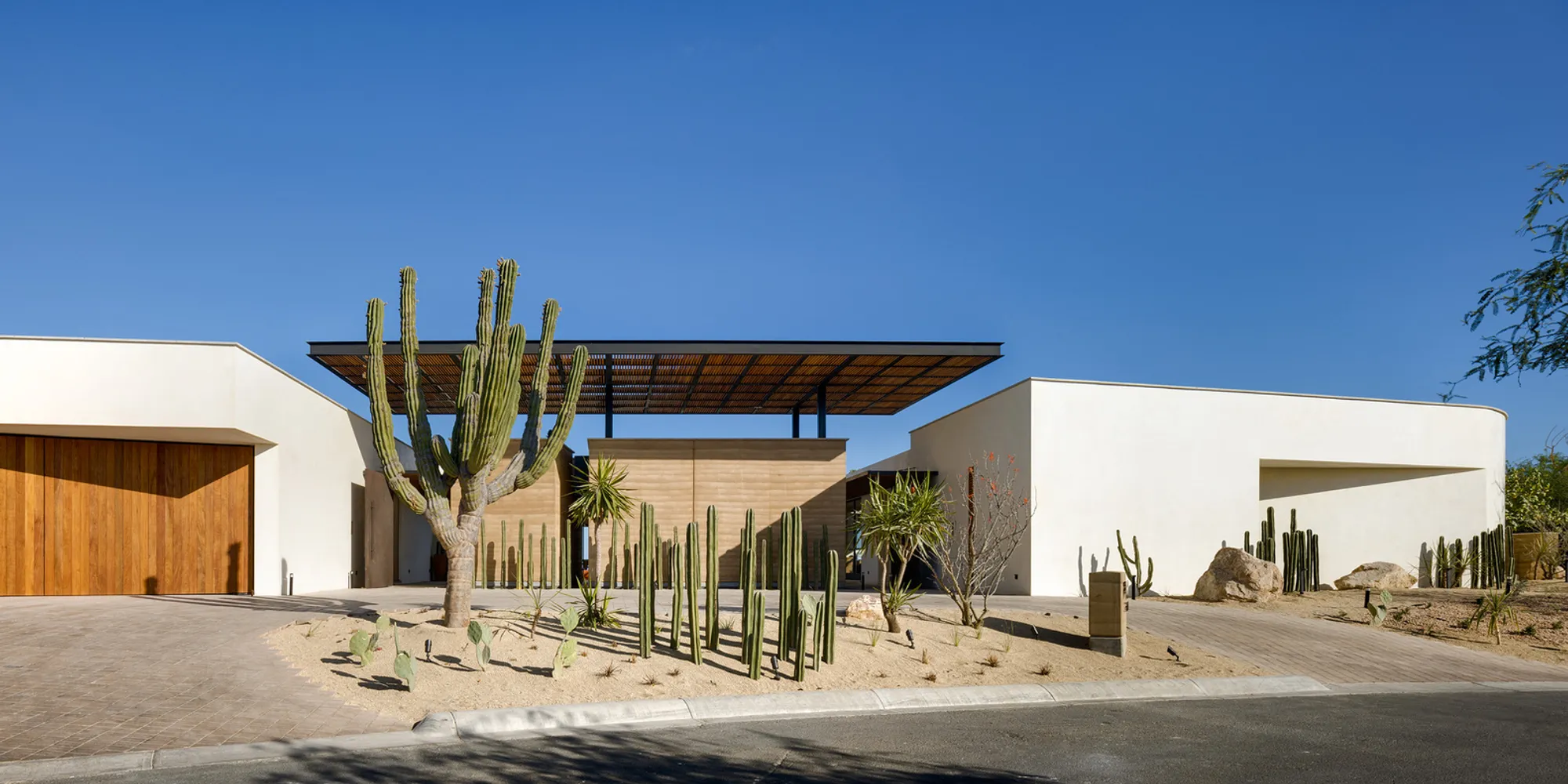
Cima House: A Rammed Earth Retreat in Baja California
R/MA Rivero Mas Asociados built a luxury desert residence in Cabo San Lucas with rammed earth walls, two courtyards, timber pergolas, and solar power.


Cabo San Lucas sits at the southern tip of the Baja California peninsula in Mexico, where the desert meets the Sea of Cortez. The landscape is arid, rocky, and vast: cardon cacti, rammed earth tones, and mountains rolling down to the coast. Cima House, designed by R/MA Rivero Mas Asociados, is a luxury residence built on this landscape using the materials of the desert: rammed earth walls, white lime render, timber pergolas, and stone. The strategy is subtractive: the house is designed as a solid volume with courtyards and openings carved out of it, not as a collection of rooms added together.
The plan arranges the rooms around two interior courtyards, each with a timber pergola filtering the intense Baja sun. The courtyards hold native planting, gnarled desert trees, and water features that cool the air by evaporation. The main living spaces open on both sides to the courtyards through full-height black-framed pivot doors. The bedrooms face the Sea of Cortez through curtained glass walls. The house runs on solar power.
The Exterior: Rammed Earth and Desert Forms
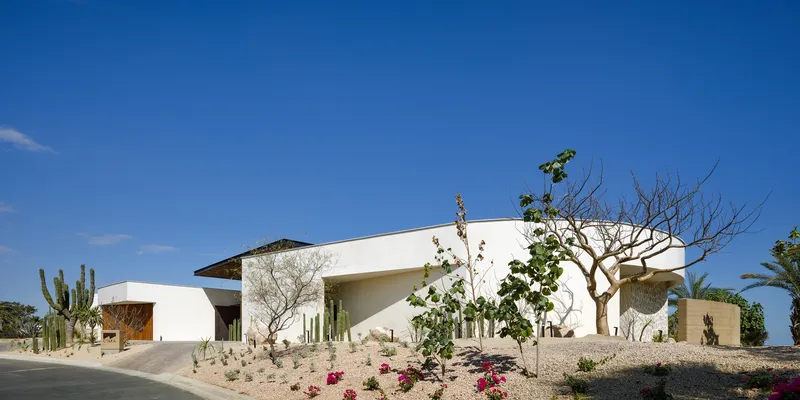
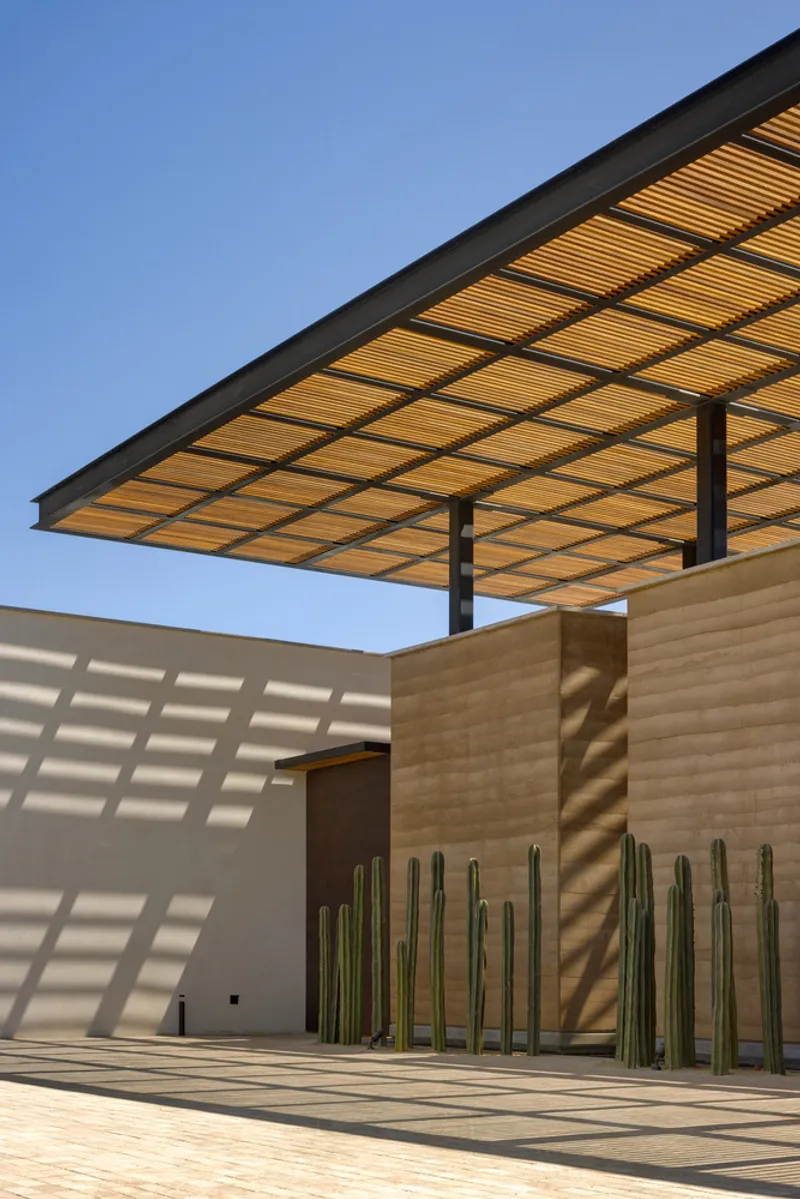

From the road, Cima House reads as a long, low volume with white-rendered and rammed earth walls curving along the site. Cardon cacti and native desert shrubs line the entry. Timber pergolas project from the facade, casting diagonal shadows on the rammed earth walls. The palette is deliberately matched to the Baja landscape: the rammed earth is the same colour as the soil, and the white render catches the sun the way the salt flats do. The house does not try to dominate the desert; it repeats its tones and forms.
The Courtyards and Pergolas
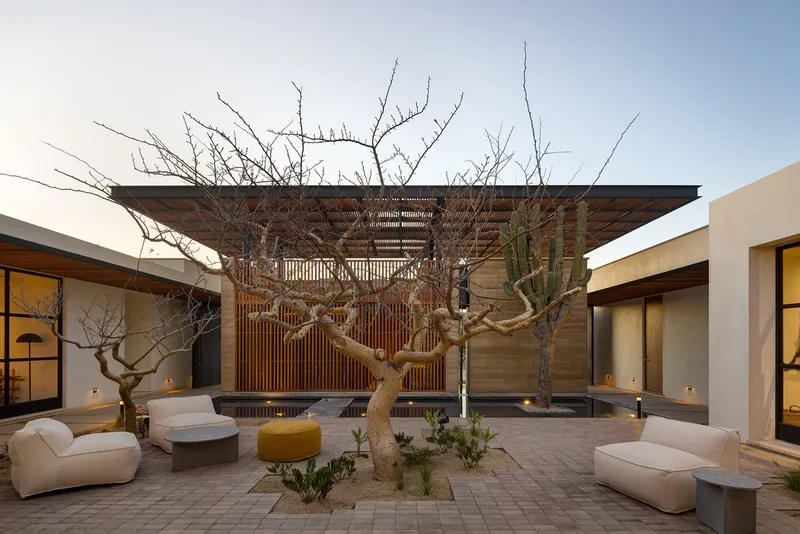


The two central courtyards are the heart of the house. Each is covered by a timber pergola that filters the sun into striped light. Native trees grow from the paving. Water features reflect the sky. The courtyards are outdoor rooms in the fullest sense: shaded, enclosed, cool, and connected to the interior on all sides. The sculpture courtyard has a ceramic anthropomorphic figure beside a dark reflecting pool, a quiet moment that turns the space into a small gallery.
The Kitchen and Living Spaces
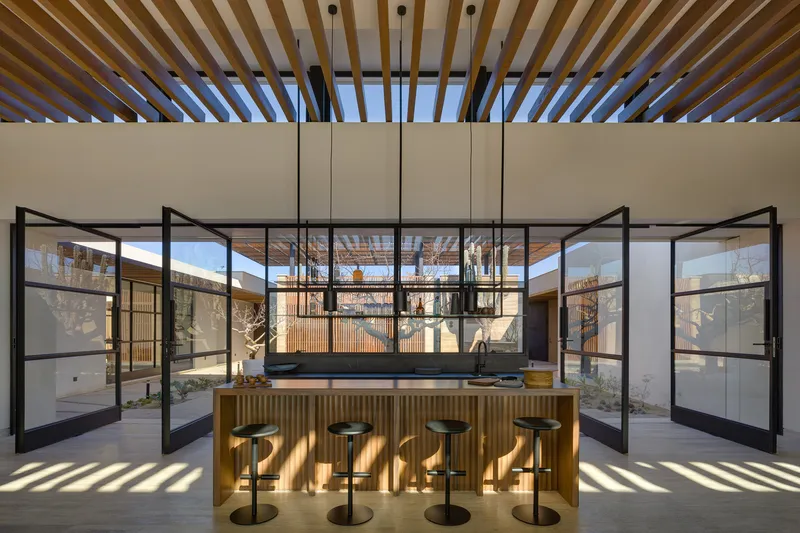
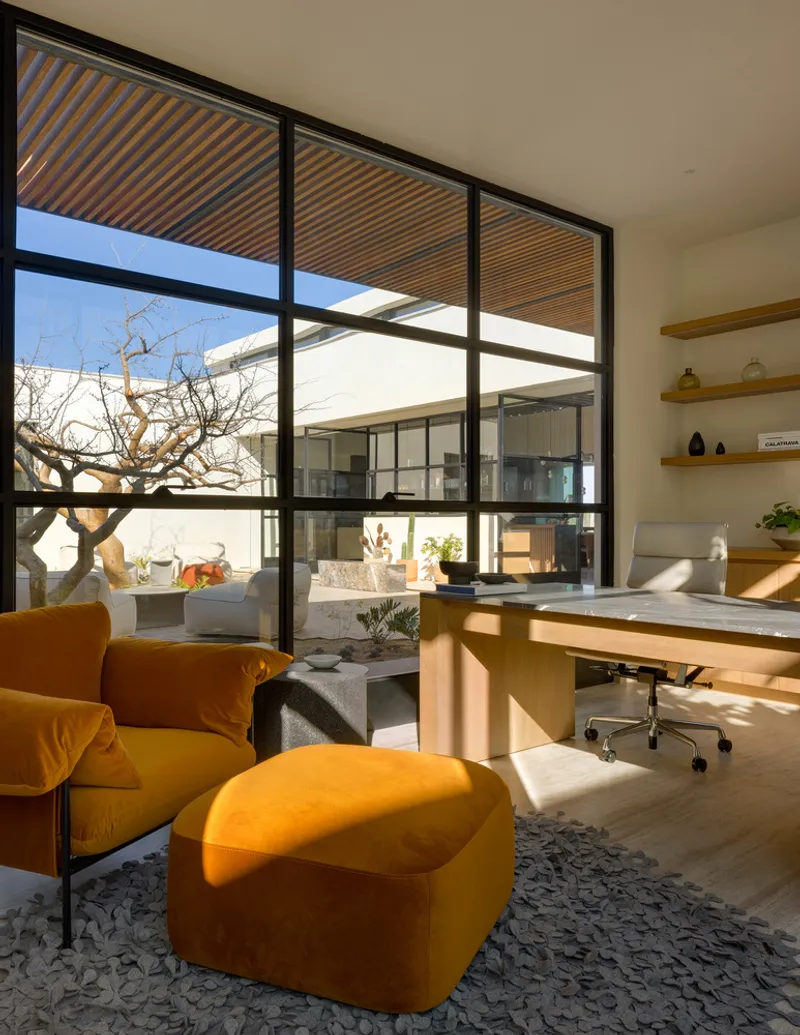
The kitchen sits between the two courtyards, with full-height black-framed pivot glass doors opening to both sides. When all the doors are open, the kitchen becomes a passage through which the air and the courtyards flow. The ceiling is exposed timber slats. Black pendant lights hang over the timber island. The study next door has an orange velvet armchair, a black-framed window wall to the desert, and a pivot door to the courtyard. The pattern repeats throughout: indoor rooms that open on multiple sides to outdoor rooms.
Bedrooms, Wellness, and Stair
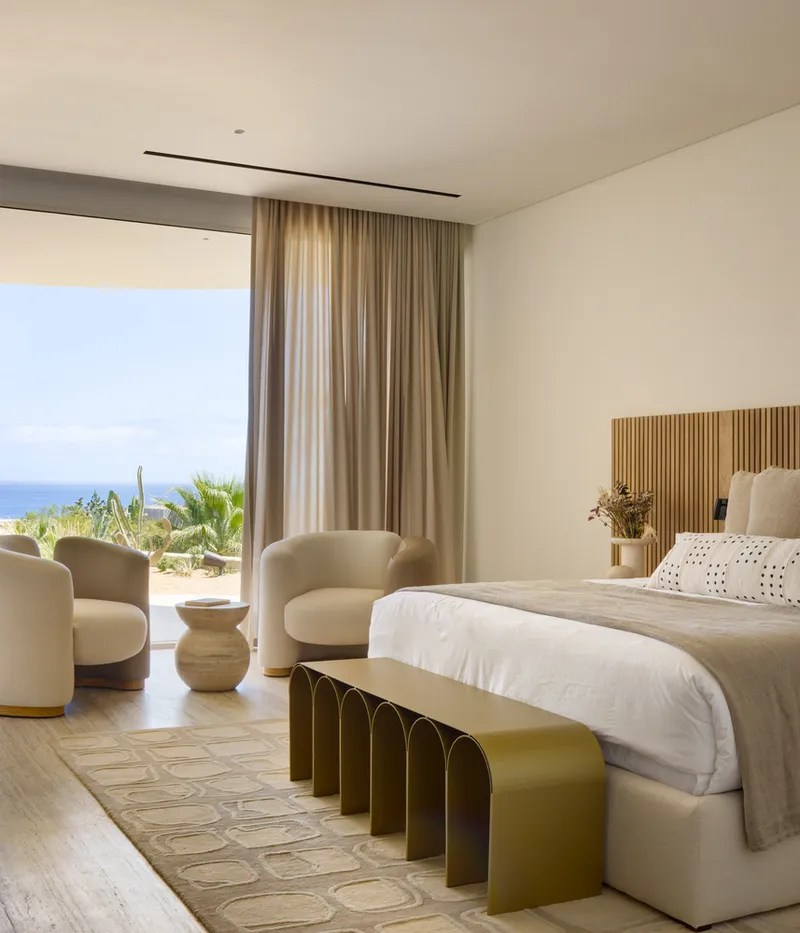

The master bedroom has an upholstered headboard, pale linen bedding, and a curtained glass wall that opens onto a terrace with a direct view of the Sea of Cortez and the distant headlands. Arched niches in the walls display ceramics. Vertical timber slats line the alcoves. The palette is pale: linen, timber, stone, white walls. The wellness room is a narrow timber-lined space with a massage table, built-in cabinets, and a polished concrete floor.

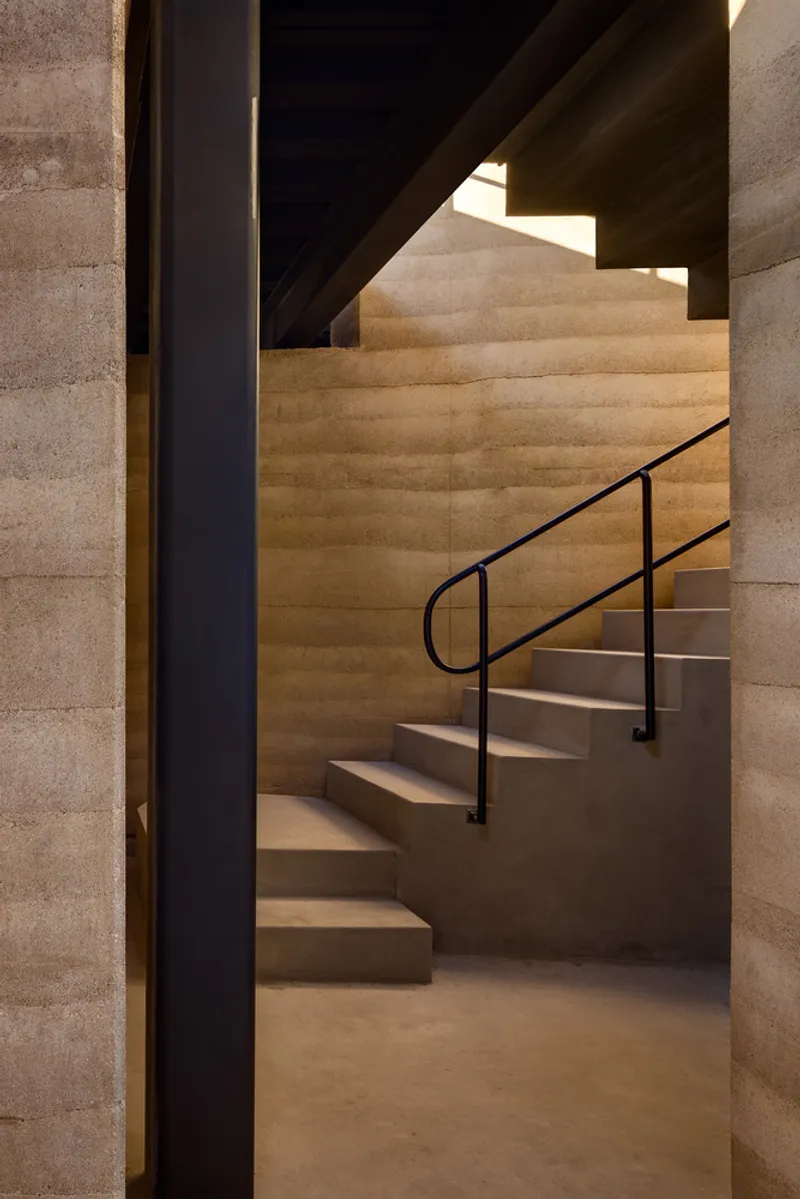

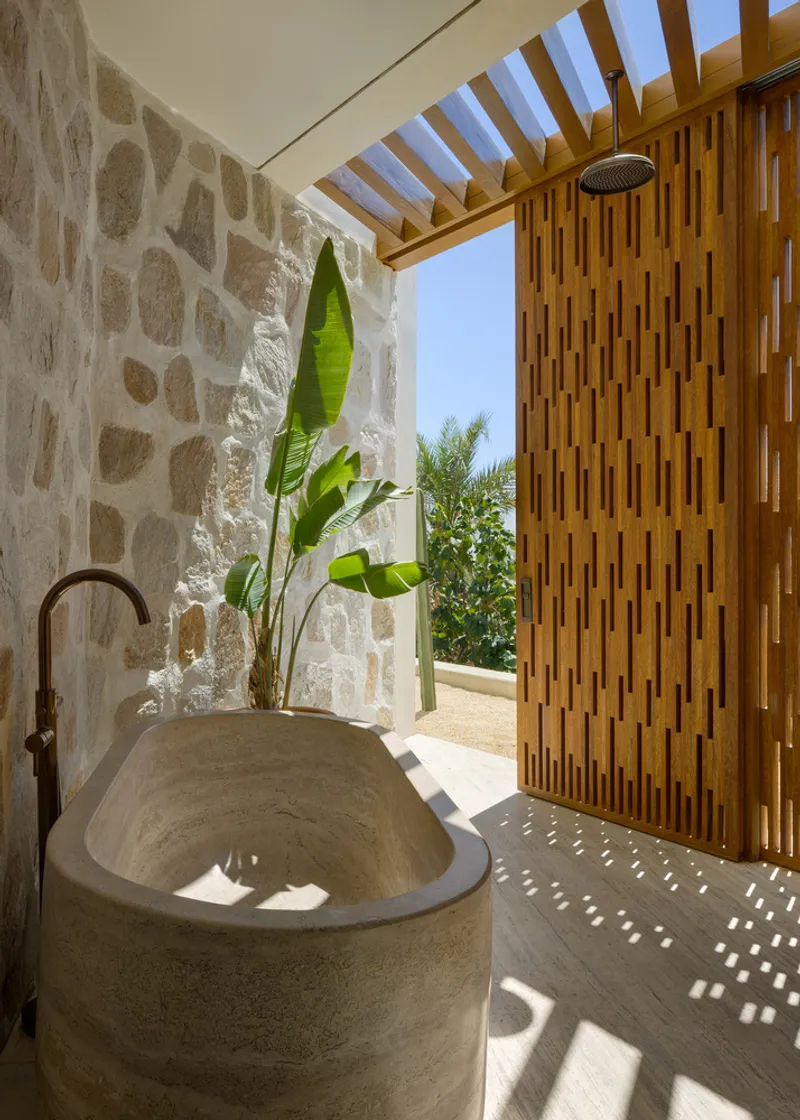
The stair is a small but decisive detail: rammed earth walls showing the visible layered strata, concrete steps, and a slender black steel handrail. The children's bunk room is playful and bright, with timber bunks, a ladder, and a striped rug. The wellness shower is an outdoor room with a carved stone soaking tub, a rough stone wall, a banana plant, and a timber slat door.
The Pool and the Sea


The infinity pool runs along the facade, reflecting the house and the sky. Loungers line the edge. At dusk, the warm interior light spills through the pivot doors and the courtyard openings, turning the house into a lantern against the dark desert. The aerial view reveals the full strategy: the roof is covered with solar panels, the two courtyards are visible as green openings in the volume, and the curved pool traces the edge of the site. The house runs almost entirely on its own power.
Why This Project Matters
Luxury residences in Baja California tend to default to either Spanish colonial revival or glass-box modernism. Cima House does neither. It uses the traditional materials of the region (rammed earth, stone, timber, white lime render) but assembles them with a contemporary spatial logic based on courtyards, pergolas, and pivot doors. The result is a house that feels fundamentally of its place, not a visitor to it. The solar power, the water features, and the native planting make the sustainability claims more than rhetorical.
If you are designing a desert residence, a courtyard house, or any project that needs to balance luxury with climate sensitivity, this project is worth studying for how a subtractive volumetric strategy can produce interior comfort and outdoor connection in a harsh landscape.
About the Studio
Share Your Own Work on uni.xyz
If you are working on desert architecture, luxury residential design, or rammed earth construction, uni.xyz is a place to publish your work and connect with a global design community.
Project credits: Cima House by R/MA Rivero Mas Asociados. Cabo San Lucas, Baja California Sur, Mexico. Photographs: Rafael Gamo.



Popular Articles
Popular articles from the community


The Earth Pod: 3D Printed Homes for Resilient Refugee Communities
The Earth Pod reimagines refugee housing through 3D printed homes made from clay, combining resilience, self-sufficiency, and rapid shelter.

The Musturak Paradise: Senior Living Architecture for a Connected Future in Temara, Morocco
The Musturak Paradise reimagines senior living architecture in Temara via private homes, social spaces, culture, community, and shared care.

Riyadh For All: Intergenerational Urban Design for Active Aging in Rabat
Riyadh For All reimagines urban design in Rabat with intergenerational co-living, adaptive courtyards, and Moroccan cultural exchange today.

Co-life: Sustainable Architecture for Age-Friendly Community Living
Co-life reimagines sustainable architecture for seniors through courtyards, rammed earth, shared gardens, and spaces designed for belonging.

Similar Reads
You might also enjoy these articles


Hodi-Mandai Geram
Project Function: Preservation and revitalization of the Intangible heritage and socio-spatial identity of the Hodi by Housing, Cultural Memory Center, Sacred Grove, landscape, local tourism economy


Olio Towers: A Mid-Rise for Performers That Fuses Housing, Rehearsal, and Stage
Located blocks from Houston's Theater District, this modular tower stacks living units around a central performance atrium.

Oasis: Modular Green Housing Carved into Dhaka's Urban Fabric
A shortlisted Plugin Housing entry reclaims unauthorized settlements in Dhaka with stepped concrete volumes, green roofs, and ventilation-driven design.

Black Hole: A Floating Megastructure for the Post-Physical Era
Emiliano Mazzarotto envisions a spherical, self-scaling arena where e-sports, digital hotels, and holographic stadiums replace traditional public space.


Explore Housing Competitions
Discover active competitions in this discipline



Challenge to reimagine the Iron Throne


Photograph architecture without architects


Illustrate the lost glory of Angkor Wat - Render Challenge


Design challenge to reuse E-waste
Comments (0)
Please login or sign up to add comments
No comments yet. Be the first to comment!