
Bloco Arquitetos Hangs a Concrete Roof Over Brasília's Cerrado in the Dante House
An L-shaped pavilion in Lago Sul works with a 130cm slope and five suspended beams to frame light, air, and native landscape.


Brasília's architectural DNA is concrete. From Oscar Niemeyer's civic monuments to the superblocks that define daily life, the city has always understood the material as both structure and statement. So when Bloco Arquitetos set out to build the first house in a new Lago Sul condominium near the main bridge to the city center, they had both a tradition to honor and a blank slate to work with. Dante House, completed in 2022 on a 400 m² footprint, does both: it is unmistakably of Brasília, yet it refuses to be merely reverential.
What makes the project genuinely interesting is the roof. Five parallel concrete beams run the length of the house, but the three central ones are hung beneath three inverted transverse beams, creating a structural assembly that supports slabs at different levels. The result is a sawtooth profile that cracks open gaps between planes, letting zenithal light and thermal ventilation pour through without relying on conventional windows. The house was designed for a young family transitioning from an apartment to a ground-level home after the arrival of a baby, and that domestic ambition, connection, openness, daily rhythm, is legible in every decision.
A Street Face That Gives Nothing Away
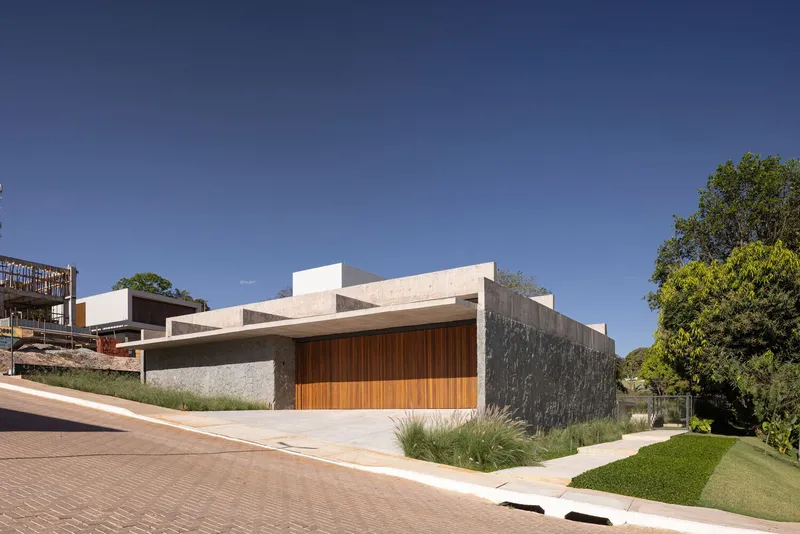
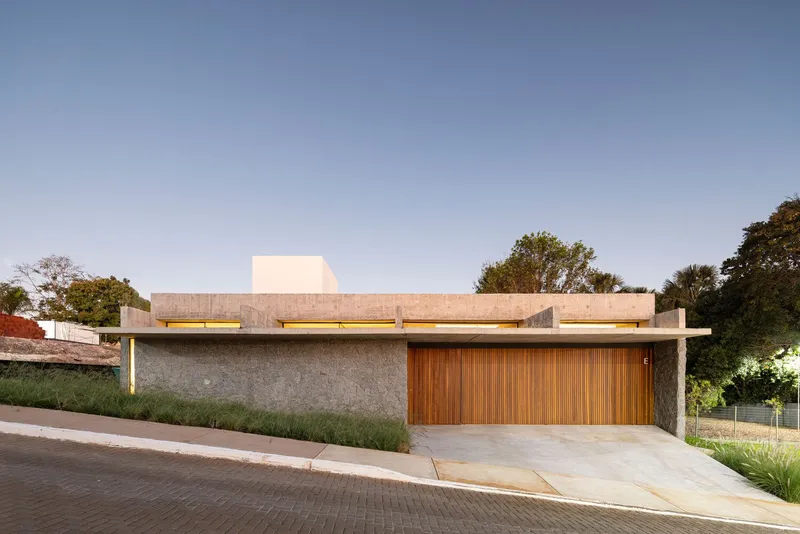
From the street, Dante House is almost reticent. Board-formed concrete, dark stone, and vertical timber cladding compose a facade with few openings. The wide concrete roof slab floats over a timber garage door, establishing a horizontal datum that reads as quietly monumental. The site slopes 130cm between its side boundaries, and rather than leveling the lot, Bloco Arquitetos set the ground floor at the midpoint. One side of the house is partially buried into the grade; the other lifts slightly above it, exposing a white upper volume. The topographic move is subtle from the curb but decisive for everything that happens behind the walls.
The Suspended Roof as Protagonist
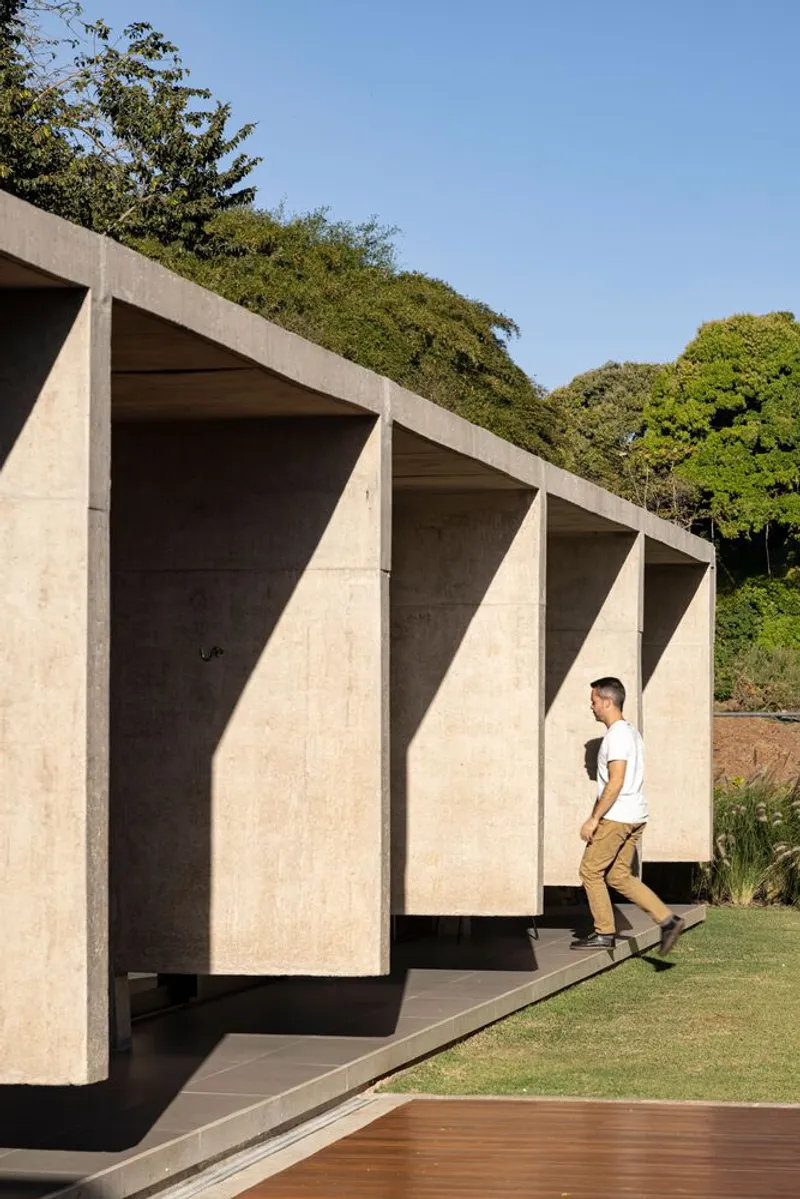
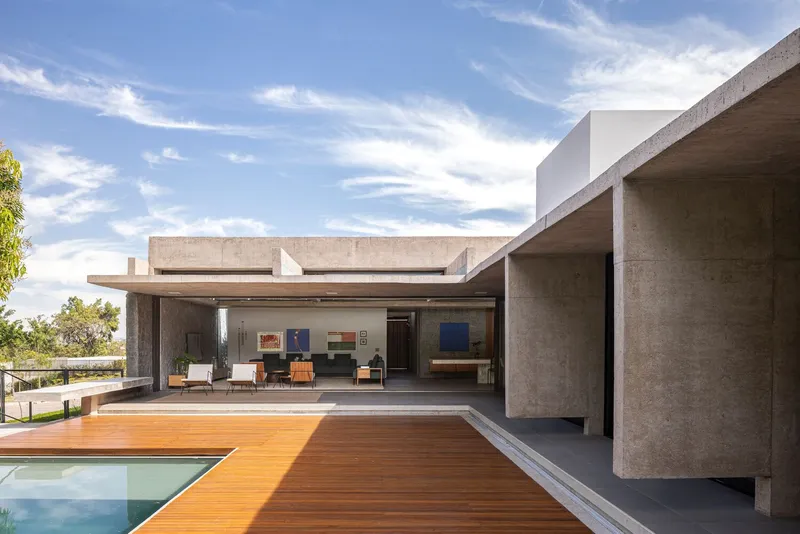
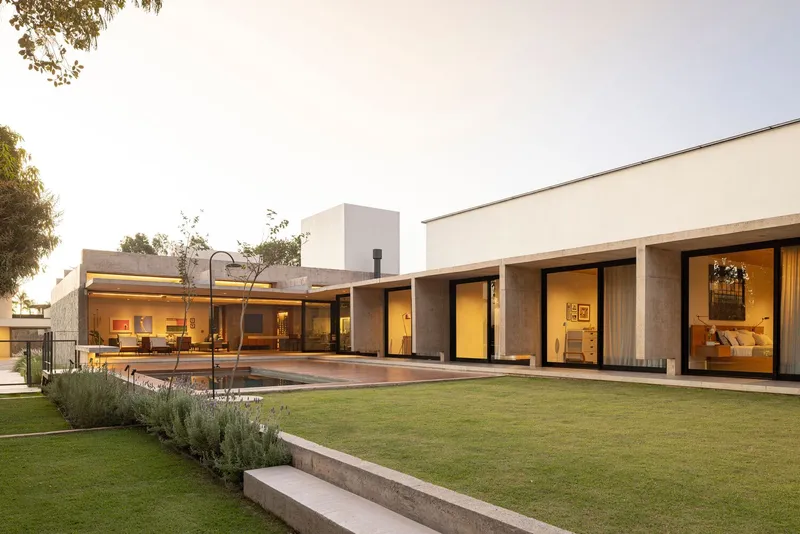
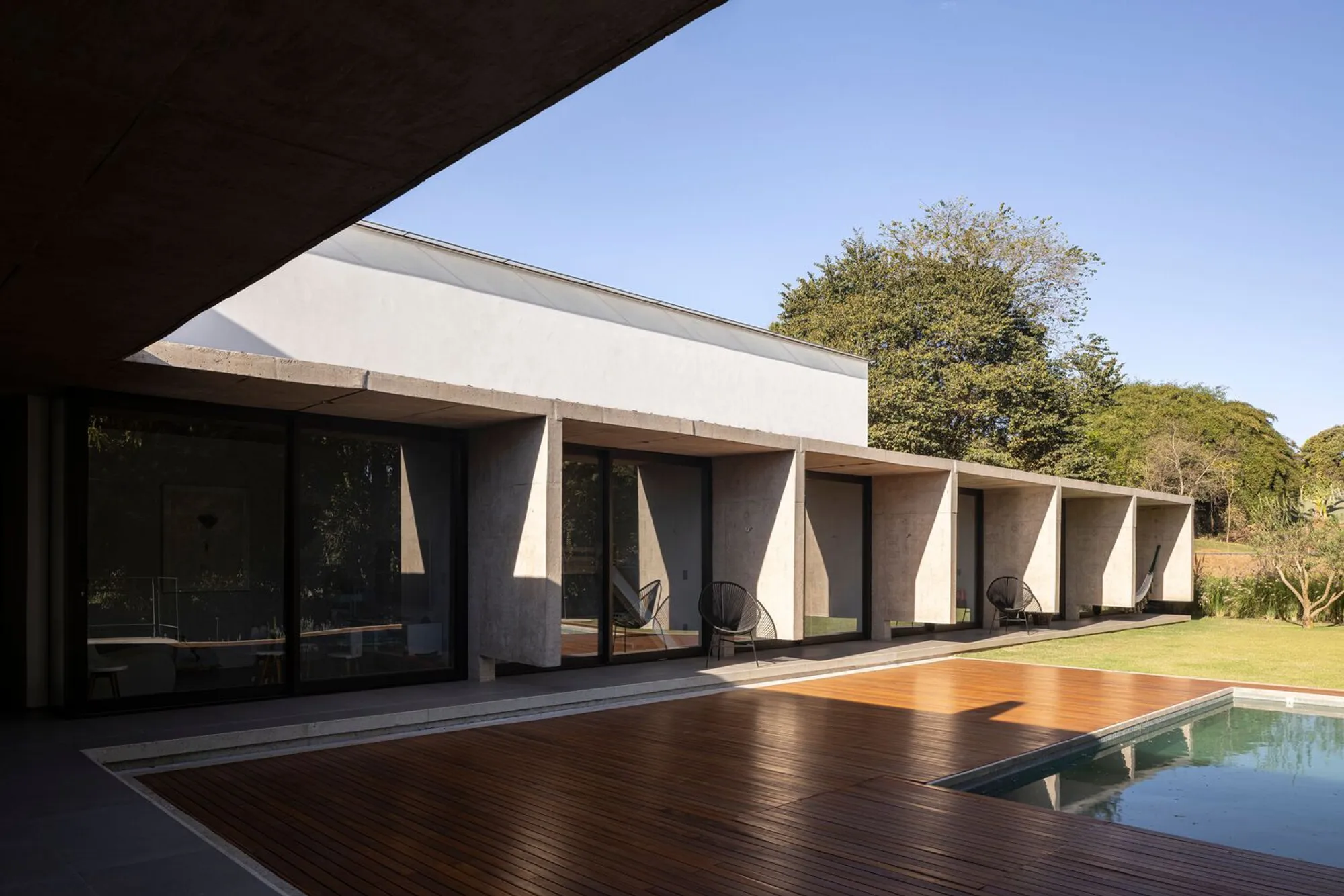
Step to the rear and the concrete ceiling becomes the main event. The sawtooth profile is immediately legible: deep beams run in parallel, their undersides board-formed with visible grain, while the gaps between slabs admit strips of sky. The structural engineer, André Torres, deserves credit here. Hanging central beams from inverted transverse members is not a parlor trick; it eliminates the need for deep perimeter walls and allows the interior-facing facades to be almost entirely glass. The covered terrace, pool edge, and timber deck all sit beneath this canopy, turning the backyard into an outdoor room with the same spatial intensity as the interior.
At dusk, the glass walls dissolve entirely, and the house reads as a single illuminated volume beneath a floating concrete plane. The trapezoidal columns along the colonnade add a rhythmic cadence that keeps the long elevation from becoming monotonous.
Living and Dining Under the Coffers
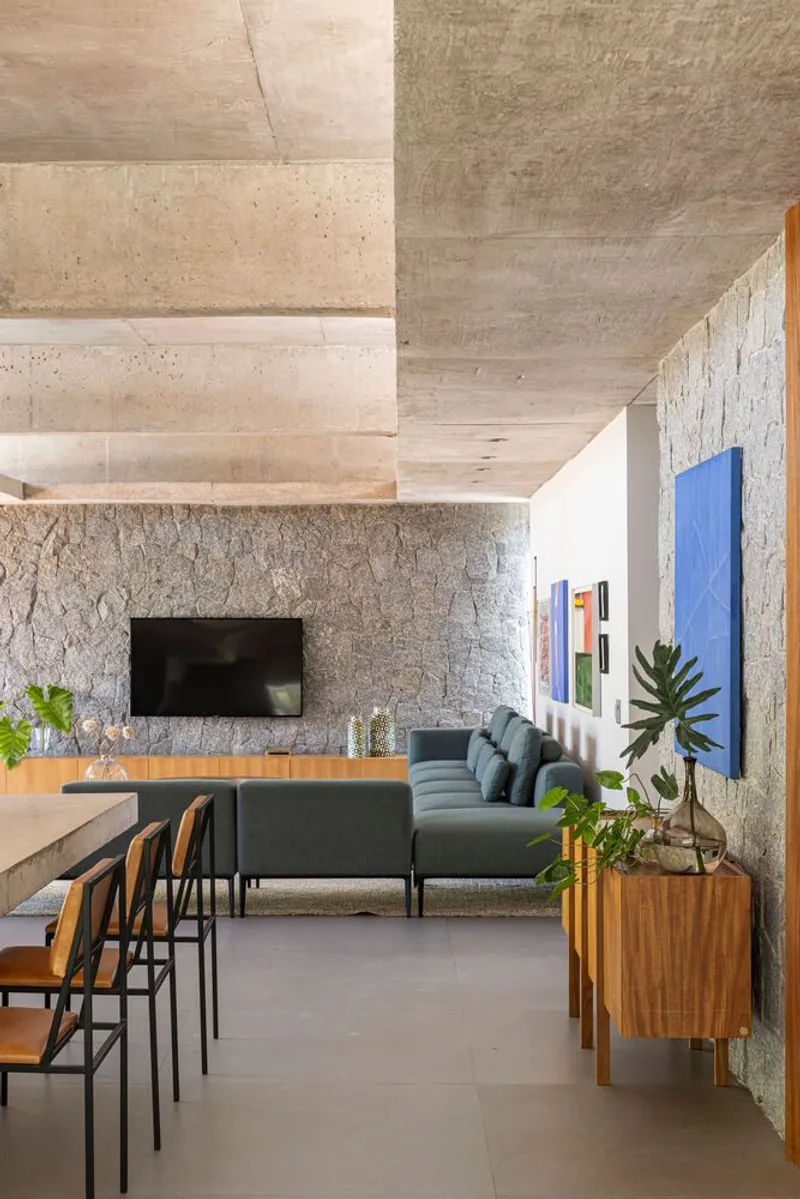
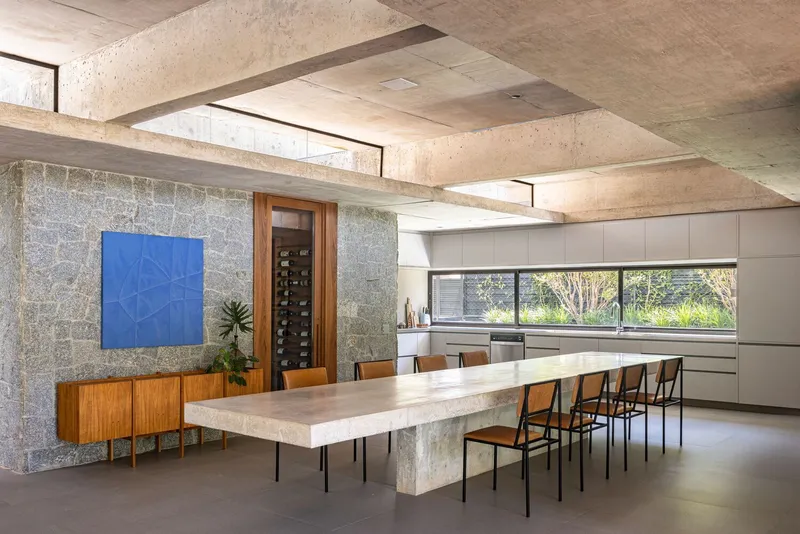
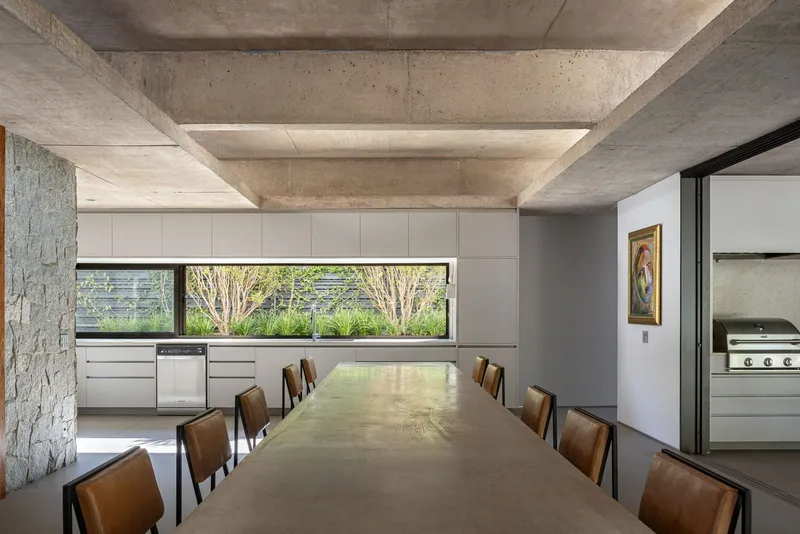
Inside, the coffered concrete ceiling dominates every social space. The living and dining areas flow into each other beneath geometric coffers that modulate scale, making a 400 m² single-story house feel neither cavernous nor cramped. A long travertine table starts in the kitchen and extends into the living zone, serving simultaneously as dining surface and study desk. It is a simple gesture with real domestic intelligence: the family can cook, eat, work, and supervise a child across one continuous surface without walls intervening.
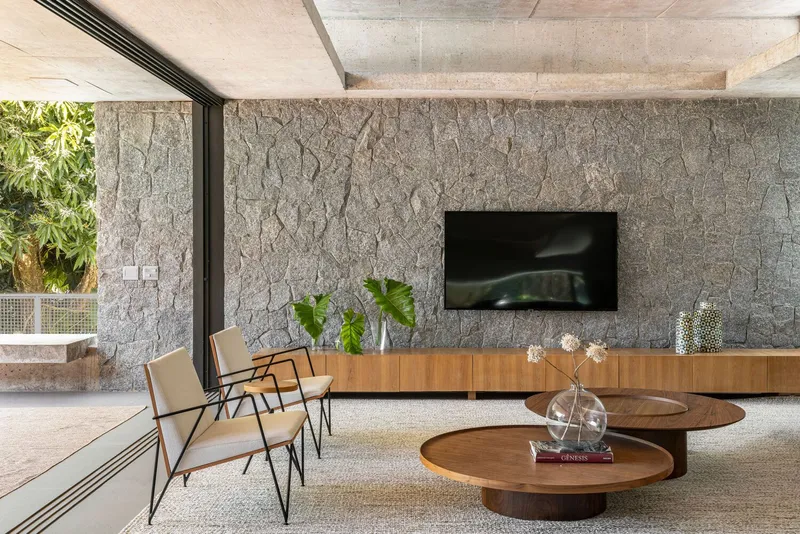
The stone accent wall that anchors the living room is a rough-textured counterpoint to the smooth coffers above. A horizontal window behind the dining chairs frames the planted garden at eye level, grounding the view in greenery rather than sky. Light enters from multiple directions: clerestory slots at the stone wall, linear skylights between beams, and full-height sliding glass toward the courtyard. The effect is layered and constantly shifting through the day.
Stone, Light, and the Kitchen as Threshold
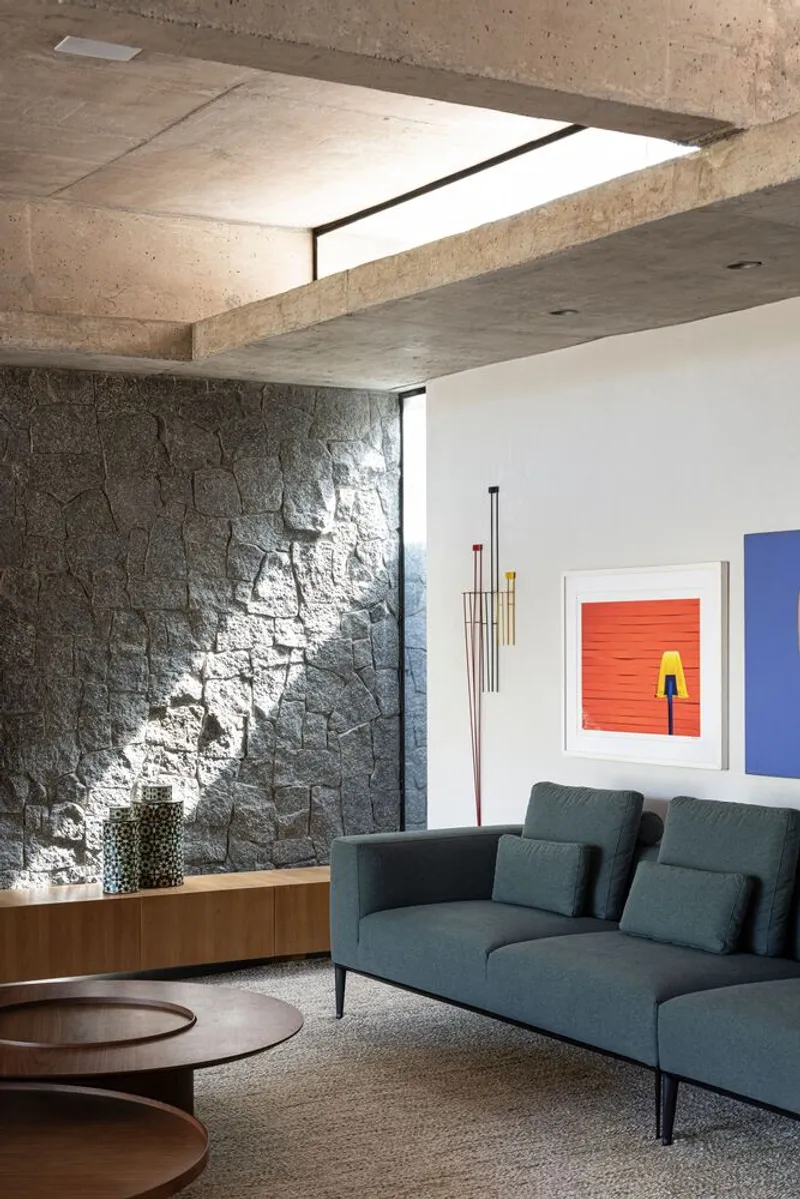
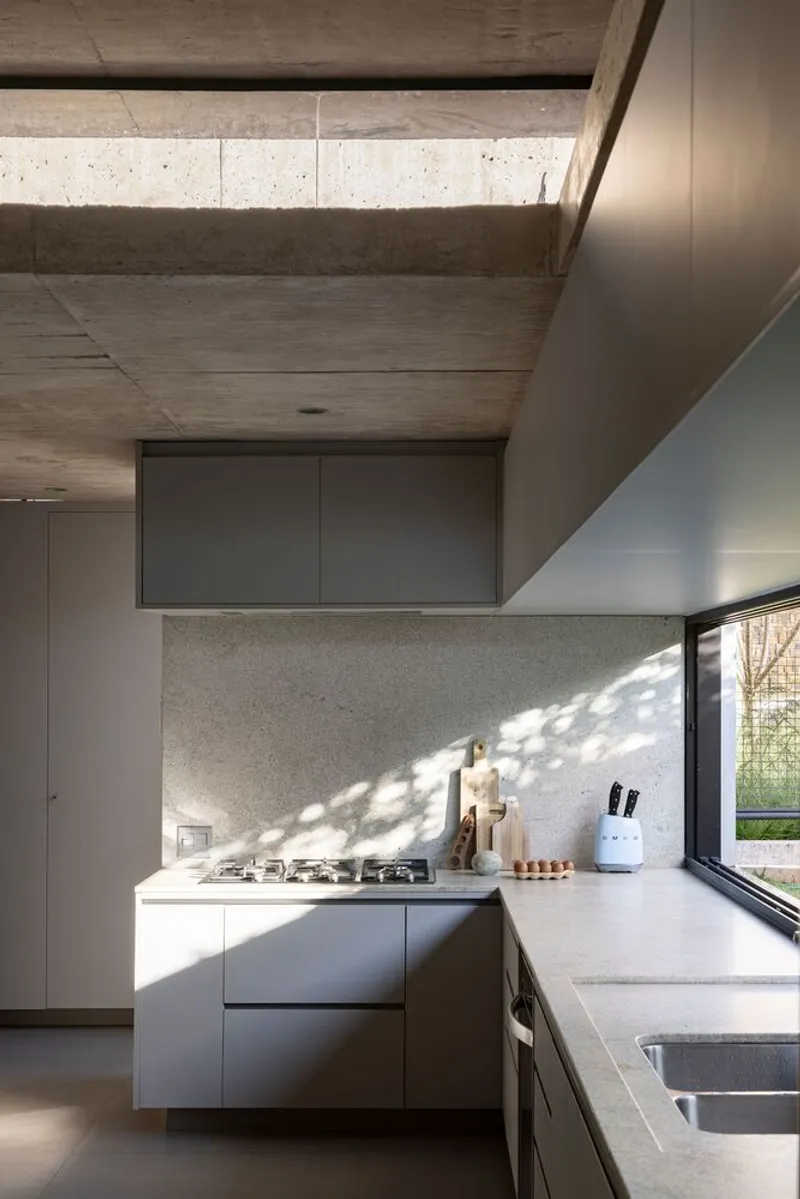
Two moments reveal how carefully Bloco Arquitetos choreographed natural light. In the living room corner, a clerestory slot between the stone wall and the concrete ceiling casts dappled afternoon light across the rough masonry, turning a structural joint into an ornamental event. In the kitchen, sunlight filters through overhead glass onto a textured stone backsplash and a concrete countertop, creating patterns that shift with the hour. These are not accidental effects. The gaps between roof slabs are dimensioned to admit light at specific angles, and the material palette of stone, concrete, and timber was chosen precisely because it rewards that kind of raking illumination.
The Courtyard Corridor and Private Quarters

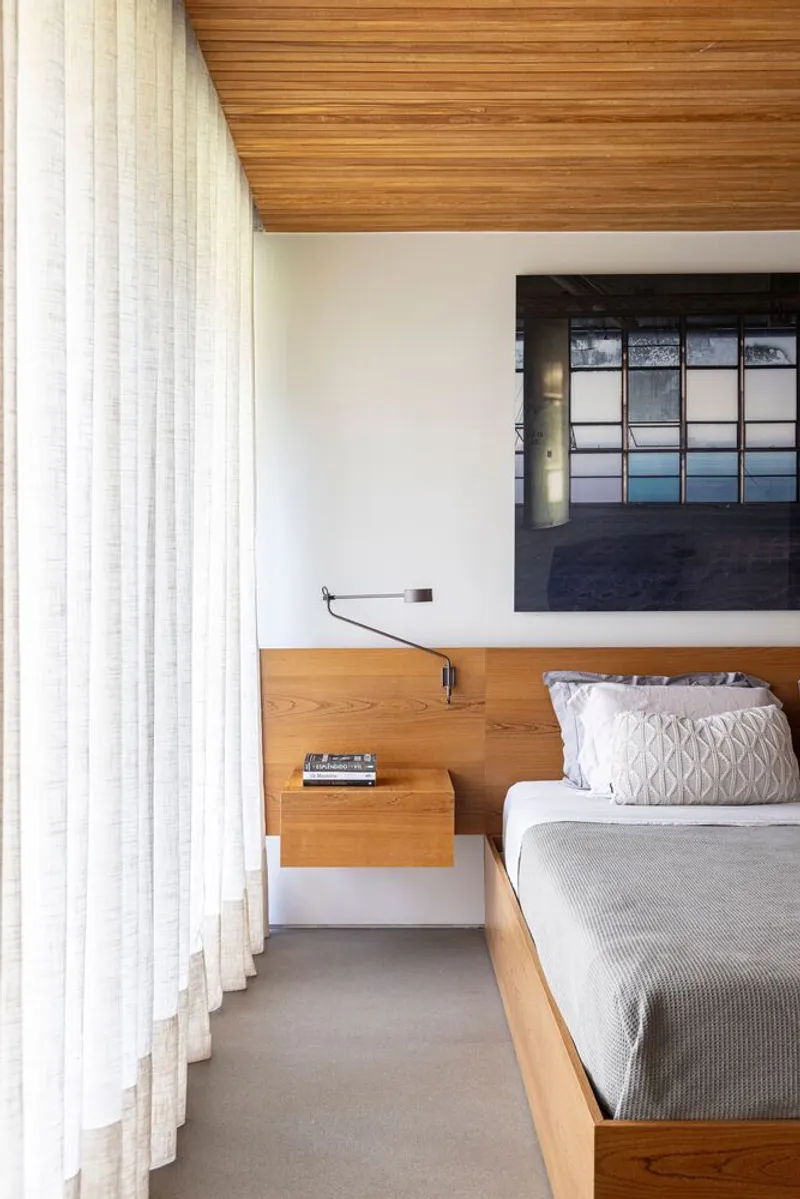
The L-shaped plan creates a protected courtyard garden where native cerrado species and low-water-demand plants establish a pocket of local ecology. The bedrooms face this green void, accessed through a corridor lined with vertical timber cladding and covered by a large skylight. Walking from the social wing to the private wing, the spatial experience shifts: the coffered ceiling gives way to a luminous overhead slot, the stone walls yield to timber, and the scale contracts. It is a deliberate decompression sequence.
Inside the bedrooms, the language softens further. Timber slat ceilings, platform beds, and sheer curtains filtering diffused daylight create rooms that feel calm without being austere. Each bedroom opens onto a balcony fitted with hammocks facing the large courtyard, a nod to the informal domestic life of Brasília's climate. A sauna and wine cellar round out the program, tucked into the partially buried side of the house where the thermal mass of the earth provides natural insulation.
Pool Terrace and Landscape Integration
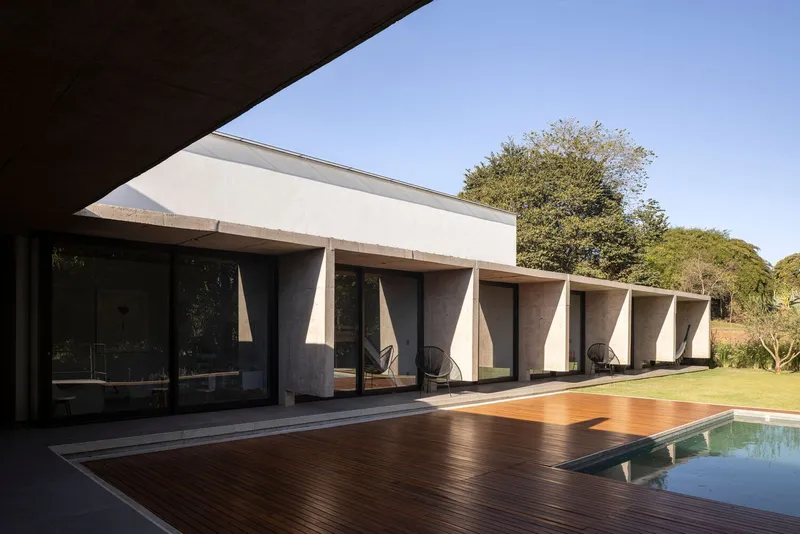
The pool terrace is where the structural ambition pays its biggest dividends. The colonnade of trapezoidal concrete columns marches along the timber deck, framing views of the surrounding landscape under a relentlessly clear cerrado sky. The pool edge aligns with the concrete frame, and the deck extends generously enough to function as an outdoor living room. Because the internal facades are almost entirely transparent while the perimeter facades are largely closed, the house turns its back on neighbors and opens completely to this private outdoor zone. Privacy and openness coexist without compromise.
Why This Project Matters
Dante House matters because it demonstrates that the exposed concrete tradition of Brasília is not a museum piece. Bloco Arquitetos took a structural system, inverted transverse beams suspending central spans, that could easily read as engineering bravado and used it to solve real domestic problems: ventilation in a hot climate, privacy on a new development site, and spatial continuity for a young family. The gaps between slabs are not decorative; they are the climate strategy. The L-shaped plan is not a formal gesture; it creates the courtyard that makes the bedrooms livable. Every design decision has a practical alibi and an aesthetic payoff.
It also sets a standard for how new neighborhoods in Brasília might develop. As the first completed house in its condominium, Dante House had no context to respond to, only context to create. By grounding the material palette in local tradition, planting native cerrado species, and working with the site's natural slope rather than erasing it, Bloco Arquitetos offered a template that is specific to its place without being nostalgic. That combination of structural invention, climatic intelligence, and regional rootedness is rare in residential work anywhere. In Brasília, it feels exactly right.
Dante House by Bloco Arquitetos, Lago Sul, Brasília, Brazil. 400 m². Designed 2020, completed 2022. Photography by Joana França.
About the Studio
Share Your Own Work on uni.xyz
If projects like this are the kind of work you want to make, uni.xyz is a place to publish your own, find collaborators, and enter design competitions.




Popular Articles
Popular articles from the community


Conexión: Biophilic Design Reimagines High-Rise Living in Hong Kong
Conexión reimagines high-rise living in Hong Kong through biophilic design, green facades, shared spaces, daylight, water and nature within.

The Earth Pod: 3D Printed Homes for Resilient Refugee Communities
The Earth Pod reimagines refugee housing through 3D printed homes made from clay, combining resilience, self-sufficiency, and rapid shelter.

The Ocean Hive: Sustainable Architecture for a Self-Sufficient Civilization at Sea
The Ocean Hive imagines sustainable architecture at sea, where modular habitats, algae, wave power and ocean waste sustain a growing colony.

Co-life: Sustainable Architecture for Age-Friendly Community Living
Co-life reimagines sustainable architecture for seniors through courtyards, rammed earth, shared gardens, and spaces designed for belonging.


Similar Reads
You might also enjoy these articles


Hodi-Mandai Geram
Project Function: Preservation and revitalization of the Intangible heritage and socio-spatial identity of the Hodi by Housing, Cultural Memory Center, Sacred Grove, landscape, local tourism economy


Olio Towers: A Mid-Rise for Performers That Fuses Housing, Rehearsal, and Stage
Located blocks from Houston's Theater District, this modular tower stacks living units around a central performance atrium.

Oasis: Modular Green Housing Carved into Dhaka's Urban Fabric
A shortlisted Plugin Housing entry reclaims unauthorized settlements in Dhaka with stepped concrete volumes, green roofs, and ventilation-driven design.

Black Hole: A Floating Megastructure for the Post-Physical Era
Emiliano Mazzarotto envisions a spherical, self-scaling arena where e-sports, digital hotels, and holographic stadiums replace traditional public space.


Explore Architecture Competitions
Discover active competitions in this discipline



Challenge to reimagine the Iron Throne


Photograph architecture without architects


Illustrate the lost glory of Angkor Wat - Render Challenge


Design challenge to reuse E-waste
Comments (0)
Please login or sign up to add comments
No comments yet. Be the first to comment!