
Design the System, Not the Object: Computational Design 101 by BeeGraphy
A browser-based course that takes students from a first node graph to a fabrication-ready project, free for universities through a partnership with BeeGraphy.


In most design studios you draw the object. In computational design you write the rules that produce it, then change a rule and watch every version update. That shift is where Computational Design 101 begins: BeeGraphy's course on UNI, taught by Ar. Syed Mohammad Asim.
In traditional design, you draw one object. In computational design, you design the system that produces the object.Ar. Syed Mohammad Asim, in the course's first lesson
A way of thinking, not a style
Asim opens the course with a definition that fits on one slide:
Computational design is an approach where design is defined through rules, parameters and algorithms rather than manually drawing geometry.Ar. Syed Mohammad Asim
BeeGraphy makes the same point in its brief for the 2027 awards: "There is a common misconception that computational design is a style. It is not. Computational design is a way of thinking." And Asim is clear about who stays in charge:
The computer is just facilitating your design that is in your head onto the screen. The computer is not designing for you.Ar. Syed Mohammad Asim
What the course covers
Computational Design 101 runs in BeeGraphy, a node-based parametric editor that works entirely in the browser: no software installs and no licence fees. Its eight chapters move from coordinates and lists to attractors and data-driven form, and end in a project prepared for fabrication:
- The Computational Design Mindset
- Geometry Foundations
- Data and Lists
- Geometry Transformations
- Curves, Surfaces and Solids
- Attractors and Design Logic
- Data Driven Form Generation
- Final Computational Design Project
Each chapter pairs video tutorials with a guided exercise and a homework project, from "Thinking in Coordinates" and a "Fan and Twisting Tower" to a "Custom Responsive System" driven by attractors. The final project carries 35% of the course mark: a fabrication-ready system, with an independent form taken all the way to profiles, nesting, notches and numbered DXF files at real-world units, plus a render.
Work is graded against four criteria: computational logic, technical execution, design intent and exploration, and communication and documentation. Every deliverable is submitted as a link to the BeeGraphy script, so the tutor opens the working model rather than a screenshot. There are 29 recorded lessons, nearly 14 hours of video in all, alongside a course book written by Asim, and students who submit their final project receive a course certificate.

Meet the instructor
Ar. Syed Mohammad Asim is an architect, a computational designer and the founder of ArchiCodes. He teaches every lesson and wrote the course book. He began teaching computational design when a platform invited him to run Grasshopper sessions as he was finishing his master's degree:
So I wasn't confident in myself, they were confident in me.Ar. Syed Mohammad Asim
He took up the offer once his master's was done, while he was setting up his own practice. The first lesson of the course, an introduction of about 25 minutes, is free to watch on the course page.
Why the browser matters
Educators who have looked at the course raise the same practical questions: how it fits a semester's weekly hours, how instructors are trained, and what happens for students without powerful computers. Running in the browser helps with the last: there is nothing to install, and a BeeGraphy model travels as a link and stays adjustable. Laurent Lescop of ENSA Nantes, a juror at the 2024 awards, put it this way:
What stood out to me was how the platform helped translate ideas into fabrication-ready forms. For students, it invites exploration. For professionals, it's a workflow enabler.Laurent Lescop, juror, BeeGraphy Design Awards 2024
What designers made with BeeGraphy
The clearest evidence is the work. In the BeeGraphy Design Awards 2024 on UNI, shortlisted designers submitted 60 projects, each with a working BeeGraphy model, and a jury of 25 chose 15 awards. For Julia Koerner of JK3D and UCLA, it was "the first time I judged a competition where I could manipulate the geometry." Here are five of the awarded projects.
Petals Lampshade, Eda Özaltay

Petals lets you design light through material choice. A metal shade casts sharp, dramatic shadows, while plexiglass diffuses light, creating colorful, playful forms.Eda Özaltay, Petals Lampshade
Polyhedra sculpture, Lars Renklint
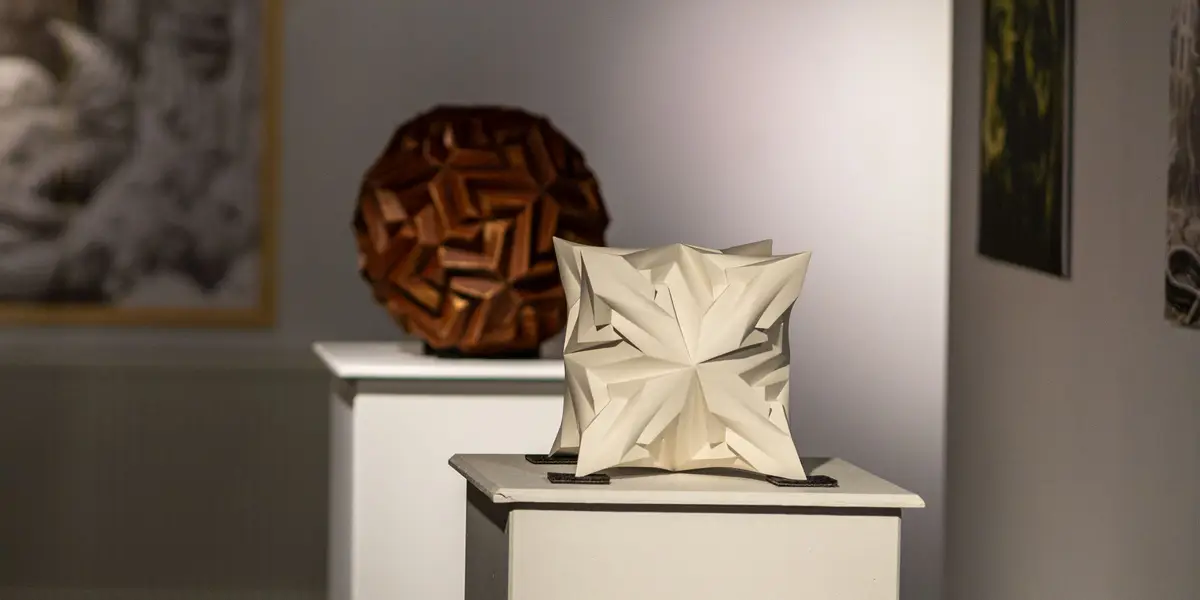
Lars Renklint's Polyhedra sculpture, shown on the cover of this article, won Best in Category in Art and Collectibles. Juror James Solly of Format Engineers and AA Design + Make described what it was like to use the model:
The combination of allowable variables gives well-constrained freedom, letting me generate forms of my own that are clearly within the intent of the original designer.James Solly, juror, BeeGraphy Design Awards 2024
Lumos Kinetica, Bartu Lokumcu

No better way to show that this is production ready than to actually build it yourself!Gediminas Kirdeikis, juror, on Lumos Kinetica
Fallen Leaves, Amir Ahmed

Amir Ahmed's Fallen Leaves won Best in Category in Art and Collectibles. UNI looked at the project in detail in an earlier article.
Bamboo Tree Pavilion, Pranav Raghavan

This is very well thought out project from idea to feasibility and impact.Erwin Redl, juror, on Bamboo Tree Pavilion
Next: the BeeGraphy Computational Design Awards '27

The awards return with a new brief, "From Logic to Configurators". Entry is free for students, young professionals and educators, on their own or in teams of any size, with one configurator per category. Each of the six categories is set in a client scenario:
- Facade Systems & Architectural Skins, for a Milan boutique residence
- Light, Shadow & Lumina Objects, for a Mayfair study room
- Digital Jewelry & Micro-Sculptures, for a bespoke Paris pendant
- Home Decor & Artifact Design, for a Manhattan penthouse
- Future Furniture & Structural Objects, for Tokyo seating
- Surface Panels & Pattern Systems, for a Dubai Marina feature wall
Pre-registration is open until 4 January 2027, and registration runs from 5 January to 30 April. A free workshop series runs from January to March. Models are due on BeeGraphy by 31 March and published as configurators by 15 April, with documentation on UNI by 30 April. Results are announced on 28 May 2027.
There is $7,000 in prizes. Students and young professionals compete for $3,400: a Winner ($1,000), a Runner Up ($600) and six Best in Category awards ($300 each). Educators compete for $3,600 and three physical trophies: a Grand Prize ($1,500), a Runner Up ($1,200) and a Special Mention ($900). The eleven-member jury includes Alessandro Margnelli of AKT II, Mark Aspinall of the Royal College of Art, Robert Brackett of Pratt Institute and Michele Blasilli of Swarovski.
For professors: bring the course to your university
Universities enrol their students as a cohort. The course is free through a university partnership: eight chapters in the browser, with no installs and no licence fees. A university applies on UNI's page for universities, and once the agreement is in place it receives a class code for its students and can follow their progress and grading.
Partner faculty are also eligible for the Educator Awards. An educator's score is the number of their students' entries multiplied by those entries' average jury score, so quality counts as much as quantity, and students simply add their tutor as a mentor on their entry.
For students
The course is not sold to individuals. Watch the free first lesson on the course page, ask your professor or head of department to apply, and enter the BeeGraphy Computational Design Awards '27 in the meantime: it is free.
Observing what our community creates has been truly valuable. The participants’ work reminded me of the original purpose behind BeeGraphy. Development is a living process, driven by time, attention, and participation. We remain committed to our goal: building a platform where creativity is limited only by imaginationGrigor Grigoryan, founder and CEO of BeeGraphy, after the 2024 awards
Published in partnership with BeeGraphy. Cover: Polyhedra sculpture by Lars Renklint, Best in Category, BeeGraphy Design Awards 2024.


Popular Articles
Popular articles from the community


Wave 'Coral': Four Perforated Canopies Bring Human Scale to a Monumental Plaza
A wavy lattice shell repeated four times around an obelisk, turning a vast paved square into pockets of shade, planting and places to sit.


VOA Arquitetura Opens a Twenty-Year-Old Family Beach House on São Paulo's Coast to the Sea
A renovation at Praia da Baleia, São Sebastião, wraps an aging holiday home in timber slats and glass, turning it outward toward the beach and garden.

Peris and Toral.arquitectes Wrap 54 Social Rental Homes in Besòs Around a Brick-Screened Atrium
In Barcelona's Besòs district, a perforated brick block turns its shared walkways into a light-filtering atrium for 54 social rental homes.

S-AR Builds a Five-Square-Meter Concrete Chapel in a Mexican Garden from Thin Walls and Old Bricks
In Santiago, Nuevo León, a tunnel of 8 cm concrete walls tilts down to a steel cross, floored with crushed brick from the chapel it replaced.

Similar Reads
You might also enjoy these articles
VOA Arquitetura Opens a Twenty-Year-Old Family Beach House on São Paulo's Coast to the Sea
A renovation at Praia da Baleia, São Sebastião, wraps an aging holiday home in timber slats and glass, turning it outward toward the beach and garden.

Tato Architects Rotates a Metal-Clad Gable on a Kyoto Flag Lot to Carve Out Four Corner Gardens
On a flag-shaped lot in Kyoto, a 108 m² house for a couple and their cat turns from its neighbors and hangs a desk over a light-filled void.

ESPECIE arquitectura Lifts a Heated Pool Bedroom and Garden Capsules over a Sloping Murcia Plot in Casa PB16
A house extension in Las Torres de Cotillas, Spain, breaks into raised glass, concrete and planted capsules that reconnect a sloped garden to daily life.

BLT Arquitectos Wraps a Shared Innovation Hub at Córdoba's Catholic University in a Glowing Polycarbonate Shed
On the Universidad Católica de Córdoba campus in Argentina, a 650 m² workshop hall in polycarbonate and concrete serves every faculty as one shared room.

Explore Computational Design Competitions
Discover active competitions in this discipline


Submit a world, not a render

Studio work deserves a jury

The International Standard for Design Portfolios

The Global Benchmark for Architecture Dissertation Awards
Comments (0)
Please login or sign up to add comments
No comments yet. Be the first to comment!