

For Kids: Modular Play Boxes Reclaim Forgotten Urban Voids for Children
A cube-shaped modular system transforms overlooked interstitial spaces into playful learning hubs within dense inner-city neighborhoods.


Children will play anywhere. Stairwells, parking lots, alleyways: give a kid ten minutes and any leftover scrap of city becomes a jungle gym. The problem is that "anywhere" is rarely safe, rarely designed with small bodies in mind, and rarely tolerated by the adults who control public space. For Kids starts from a blunt observation: rapidly urbanizing cities are full of interstitial voids that no one uses, while children in those same cities have almost nowhere to go. The answer is a foldable, cube-based modular structure that slots into these leftover pockets, turning dead space into what the designers call "social play boxes" for recreation, learning, and community gathering.
The project is the work of Mehrasa Nikokar, Fateme Ghanbari, and Farideh Yoosefimoghadam. Their proposal targets inner-city neighborhoods dominated by residential blocks, educational facilities, and cultural institutions, places where children are present in large numbers but dedicated play infrastructure is conspicuously absent. The team also acknowledges the social reality of child labor in surrounding areas, framing the intervention not just as a playground but as an inclusive refuge.
Reading the Gaps: Site Analysis and Urban Integration
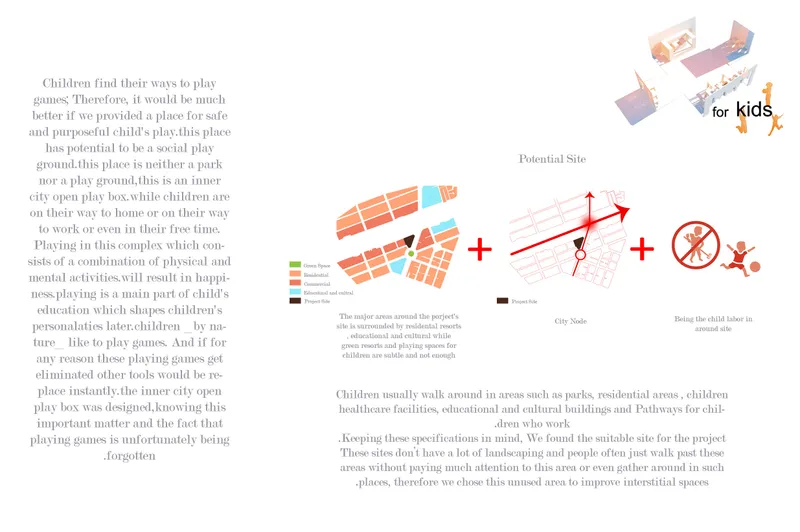
The site analysis diagram maps surrounding residential blocks, open green spaces, and pedestrian pathways, with orange highlighting to identify underused zones ripe for intervention. What stands out is the density of residential fabric and the relative scarcity of programmed open space. The designers chose sites connected to key city nodes to ensure both accessibility and visibility, a critical factor when designing for children who depend on adult supervision and proximity to home. These are not peripheral lots; they sit within the daily circulation patterns of families, students, and commuters.
The strategy is surgical rather than sweeping. Instead of proposing a single large park, the team identifies multiple small voids, spaces people walk past every day without registering. By activating these gaps, the project distributes play opportunities across a neighborhood rather than concentrating them in one location. For a child, that means a play box might be a two-minute walk from the front door rather than a fifteen-minute trip requiring a parent's full attention.
The Open Play Box: From Cube to Interactive Module
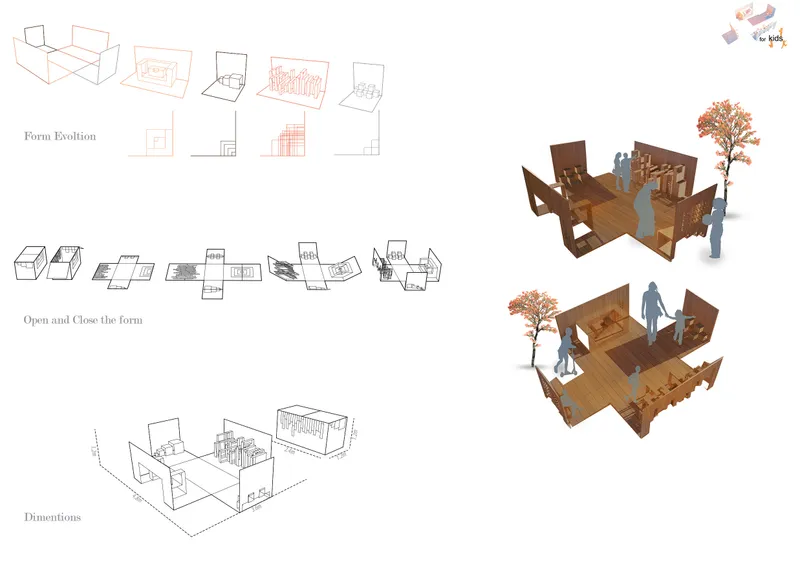
The axonometric drawings reveal how a simple cubic geometry evolves into something far more dynamic. The base unit is a cube-shaped modular structure with a foldable and expandable form. In its closed state it reads as a compact volume; opened up, it extends platforms, ramps, and enclosures that invite climbing, sitting, hiding, and group play. Timber construction gives the modules a warm, tactile quality that stands apart from the concrete and asphalt around them, and the renders show figures of children and adults interacting with the structures beneath autumn trees.
Modularity is the real engine of the design. Individual units can be joined to create larger play environments or separated to fit tighter spots. A single box might serve as a quiet reading nook; three linked together become a climbing landscape. The progression from simple form to interactive assembly means the system scales to match whatever void it occupies. It also means the program can shift: playground one day, outdoor classroom the next, community seating for an evening gathering. The designers frame this flexibility as essential to keeping the intervention relevant across ages, activities, and seasons.
Mapping Spatial Use Patterns Across Multiple Sites
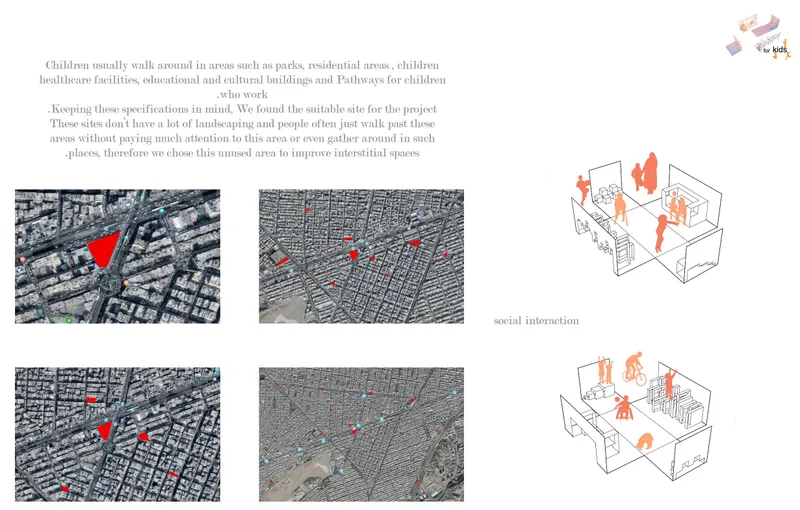
Aerial photographs marked with red location pins sit alongside axonometric diagrams that decode how each site is currently used and how the play boxes would alter those patterns. The juxtaposition of real-world photography and diagrammatic analysis is effective: you see the emptiness of the existing condition and the potential density of activity the modules could introduce. Pedestrian flows, adjacent building uses, and sight lines are all accounted for, suggesting that the designers thought carefully about where adults would naturally be present and where children would feel safe enough to play independently.
The multi-site approach also strengthens the social argument. Distributing play infrastructure across a neighborhood means more children encounter it, more parents pass through it, and more community members adopt it as a gathering point. The designers position the installation as a social anchor: not just equipment for kids but a catalyst for the kind of spontaneous adult interaction that strengthens neighborhoods. In areas where child labor remains a concern, creating visible, welcoming, and programmatically rich spaces for young people carries weight well beyond urban design.
Why This Project Matters
For Kids operates at a scale that large urban masterplans routinely ignore. It does not ask for a new park or a rezoned block; it asks what happens when you take the scraps of city that nobody wants and hand them to the people with the fewest options. The cube module is deliberately simple, almost generic in its starting geometry, yet the design intelligence lies in how that simplicity becomes versatile: foldable, linkable, reprogrammable. That combination of low formal ambition and high functional ambition is rare in competition entries, and it makes the proposal feel buildable rather than theoretical.
More importantly, the project treats play as infrastructure, not decoration. Nikokar, Ghanbari, and Yoosefimoghadam ground their design in the developmental reality that play shapes cognition, social skills, and emotional resilience. By embedding that understanding in a repeatable, adaptable physical system, they offer a blueprint that any dense city could adopt. The interstitial void is a universal urban condition; giving it back to children is a straightforward act of justice that also happens to produce better neighborhoods for everyone else.
View the Full Project
About the Designers
Designers: Mehrasa Nikokar, Fateme Ghanbari, Farideh Yoosefimoghadam
Enter a Design Competition on uni.xyz
uni.xyz runs architecture and design competitions year-round that reward proposals with spatial conviction and real site intelligence.
Project credits: For Kids by Mehrasa Nikokar, Fateme Ghanbari, Farideh Yoosefimoghadam.




Popular Articles
Popular articles from the community

EW PARK: Sustainable Architecture Reimagines the Future of Urban Parking
EW PARK reimagines city parking as a modular wooden tower combining automation, solar energy, electric mobility, and adaptable urban design.

The Earth Pod: 3D Printed Homes for Resilient Refugee Communities
The Earth Pod reimagines refugee housing through 3D printed homes made from clay, combining resilience, self-sufficiency, and rapid shelter.

The Ocean Hive: Sustainable Architecture for a Self-Sufficient Civilization at Sea
The Ocean Hive imagines sustainable architecture at sea, where modular habitats, algae, wave power and ocean waste sustain a growing colony.

Conexión: Biophilic Design Reimagines High-Rise Living in Hong Kong
Conexión reimagines high-rise living in Hong Kong through biophilic design, green facades, shared spaces, daylight, water and nature within.


Similar Reads
You might also enjoy these articles

Bao Huynh Watercolor Atelier: A Serene Art Retreat in Hội An
Bao Huynh Watercolor Atelier in Hội An blends multifunctional art spaces, sustainable design, local materials, and family-friendly living in a serene environment.

Atelier Macri Concept Store Interior Design by CASE-REAL
Atelier Macri store features a "ko" counter, walnut wood details, cork displays, blending retail, gallery, and seamless customer experiences.

Manuel Vargas Izquierdo Stadium and High-Performance Sports Center: Architectural Excellence in Jalpa de Méndez
The Manuel Vargas Izquierdo Stadium blends sustainable design, inclusive sports facilities, and cultural-inspired architecture, revitalizing Jalpa de Méndez’s public spaces.

KAKR Buluh Awar Hall: Revitalizing Community and Ecology Through Bamboo Architecture
Community built bamboo hall revitalizes Buluh Awar village, empowering youth, restoring ecology, celebrating vernacular craftsmanship through sustainable architecture and culture.


Explore Playground Competitions
Discover active competitions in this discipline


Challenge to merge furniture with learning

Design challenge to equip cities with modern furniture

Competition to design a workstation for architects

Packaging challenge - Design meets sustainability
Comments (0)
Please login or sign up to add comments
No comments yet. Be the first to comment!