

From CP with Love: Reimagining Connaught Place as a Circular Innovation District by 2070
A speculative proposal transforms New Delhi's iconic commercial hub into a closed-loop urban ecosystem built on modular infrastructure and circularity.


Connaught Place is already shaped like a circle. So why does it still operate like a straight line? The iconic radial plan of CP, one of New Delhi's most recognizable urban forms, channels commerce, culture, and governance through a fundamentally linear model: extract, consume, discard. "From CP with Love" asks what happens when you take that geometry seriously, turning CP's concentric rings into the organizing logic for a closed-loop urban ecosystem that reuses, repairs, remanufactures, and recycles every resource flowing through the district.
Designed by Sumanth S Rao, Kushal Shah, Rahul Dewan, Sahil Kanekar, and Alankrita Sarkar, this Honorable Mention entry in the Neo Delhi competition projects Connaught Place forward to the year 2070. The proposal reframes CP not as a Central Business District but as a Central Innovation District (CID), structured around six urban pillars: Governance, Energy, Built Environment, Resource Management, Mobility, and Goods & Products. It is speculative, yes, but grounded in systems thinking that treats the district as a living prototype for Indian urbanism.
Six Pillars Radiating from a Single Center
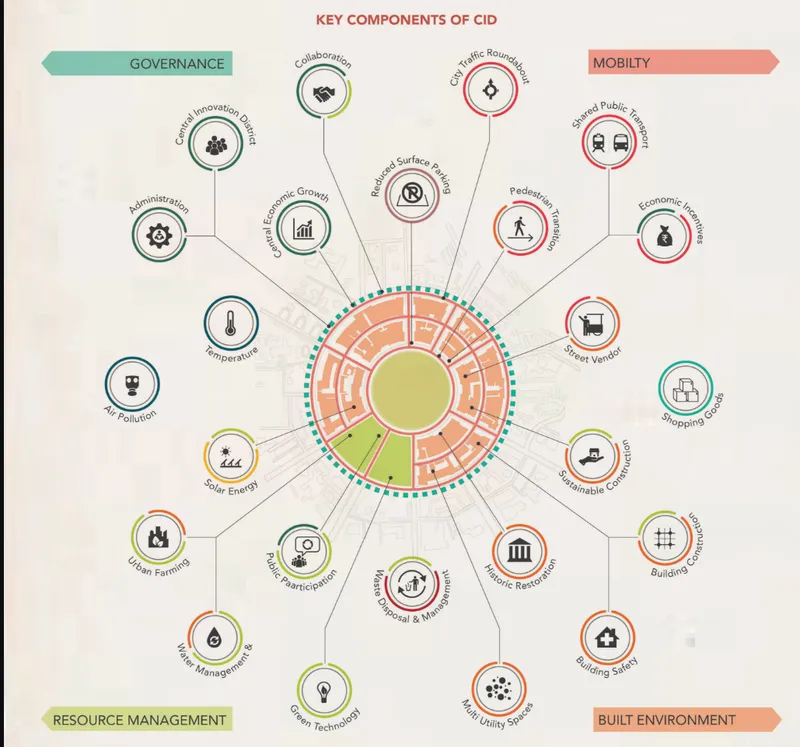
The project's organizational diagram lays out the CID framework as a set of interconnected systems radiating from CP's central hub. Governance, energy, mobility, resource management, built environment, and goods & products each receive dedicated attention, but the diagram makes clear that none of these pillars functions in isolation. Renewable energy grids feed modular buildings; collaborative governance structures enable decentralized production and distribution; waste segregation protocols connect directly to urban farming initiatives. The radial format is not decorative. It maps onto the actual geometry of Connaught Place, turning an inherited colonial plan into an armature for circular design.
Circularity in Motion: Shared Mobility and Reclaimed Parking
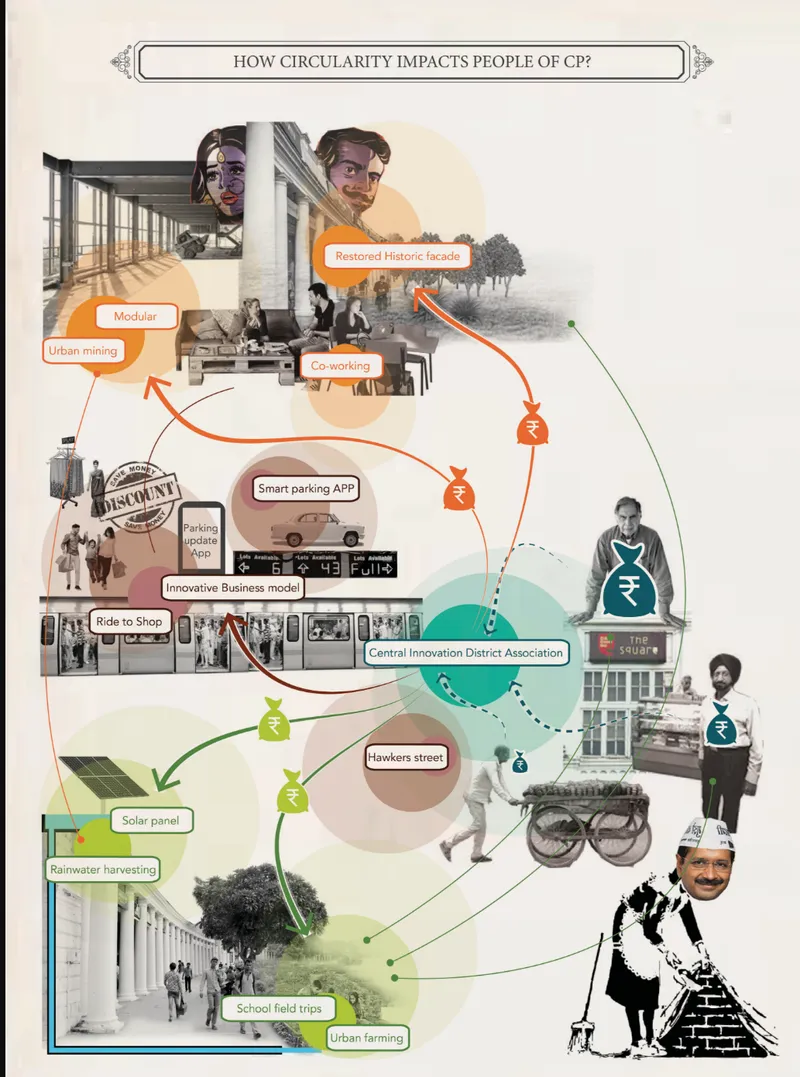
One of the proposal's most tangible interventions targets mobility. The illustrated diagram maps circularity impacts through interconnected community spaces and sustainable mobility systems, showing how a radical reduction in personal vehicle dependency reshapes CP's ground plane. Surface parking zones, currently consuming vast areas of usable public space, are repurposed into vibrant pedestrian zones, hawker streets, and community gathering areas. Intermediate public transport loops and multi-level parking facilities absorb displaced vehicles, while pedestrian-friendly pathways stitch the inner and outer circles together.
The ambition here is not just environmental. By removing cars from the surface, the proposal unlocks social infrastructure: spaces for civic learning, digital education hubs, and environmental awareness zones that the designers describe as integral to the CID's identity. The diagram illustrates how mobility, when reimagined as a circular system of shared use rather than private ownership, becomes a catalyst for spatial and social transformation.
Modular Blocks That Shift from Coworking by Day to Community Kitchens by Evening

The axonometric drawing reveals the project's approach to spatial adaptation at the block level. Existing structures within CP's inner rings are retrofitted using urban mining techniques and modular construction systems, enabling both vertical and horizontal expansion without additional land consumption. The key insight is temporal flexibility: shared office spaces operate during business hours, then transform into community kitchens, event venues, or educational spaces in the evening. This multi-utility approach maximizes spatial efficiency by treating time as a design variable, not just area.
At street level, green zones and interactive landscapes integrate geo-textile technologies for water retention and groundwater recharge. Urban forests, community farms, and hawker streets coalesce into a responsive ground plane that supports biodiversity while maintaining the commercial energy that has defined CP for decades. The modular logic extends to products and materials as well: circular business models incentivize designs with end-of-life reuse built in, creating a supply chain that mirrors the district's spatial loops.
Three Development Initiatives Organized Around a Central Green Core
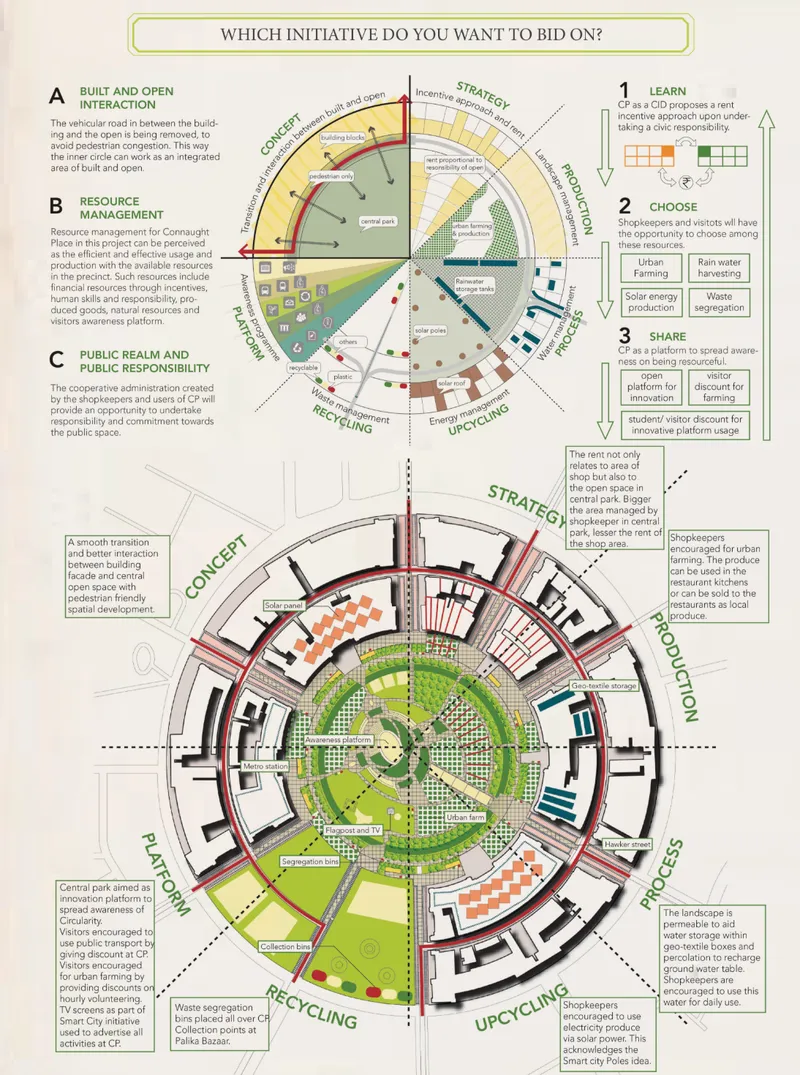
The circular site plan distills the proposal into three development initiatives arranged radially around a central green space. Buildings are organized along CP's existing concentric arcs, but the programme is fundamentally different: localized economies replace centralized retail, co-op governance models replace top-down management, and rent structures are restructured to incentivize participation in community-driven initiatives like waste segregation, solar energy production, and urban farming. The diagram makes visible a governance architecture as much as a spatial one, with stakeholders from hawkers to institutions sharing responsibility for public resources.
What the site plan also reveals is restraint. The designers do not propose demolishing CP and starting over. They work within the existing radial framework, treating it as infrastructure that can be reprogrammed rather than replaced. The central green space acts as both ecological lung and symbolic center, a commons around which the circular economy literally revolves. It is a plan that respects the historic morphology of Connaught Place while fundamentally altering what flows through it.
Why This Project Matters
Circular economy thinking has gained traction in product design and industrial policy, but it remains underexplored as an urban design framework. "From CP with Love" takes the abstraction of circularity and maps it onto a specific, beloved, deeply contested piece of Indian urbanism. By choosing Connaught Place, the designers confront the tension between heritage preservation and radical transformation head-on, proposing a model where both can coexist through modular systems, adaptive reuse, and temporal programming.
The 2070 timeline is ambitious, perhaps strategically so. It gives permission to think beyond incremental code changes and imagine CP as a living lab for urban sustainability. The proposal's real contribution is not a single building or park but a systems diagram: a way of seeing the district as an interconnected metabolism of governance, energy, materials, and movement. If Indian cities are going to grow sustainably, they will need frameworks like this one, and they could do worse than start with the circle that already exists.
View the Full Project
About the Designers
Designers: Sumanth S Rao, Kushal Shah, Rahul Dewan, Sahil Kanekar, Alankrita Sarkar
Enter a Design Competition on uni.xyz
uni.xyz runs architecture and design competitions year-round that reward proposals with spatial conviction and real site intelligence.
Project credits: From CP with Love by Sumanth S Rao, Kushal Shah, Rahul Dewan, Sahil Kanekar, Alankrita Sarkar Neo Delhi (uni.xyz).


Popular Articles
Popular articles from the community


U.GA Architects Wraps an Oval Rooftop Pool in Curved Board-Formed Concrete on Busan's Jeollidan-gil
In Busan's Jeonpo-dong, a 454 m² mixed-use block stacks a neighborhood facility, guest rooms and an oval rooftop pool inside spiraling concrete walls.

longwave studio Reorganizes a 112 m² Tainan Apartment Around the Daily Routines of a Family and Two Cats
In Tainan, Taiwan, birch plywood, rust-red furniture and a freestanding plaster wall link arrival, storage, work and family life in one apartment.

Architekt Andreas Gruber Scatters 23 Dark Timber Chalets Across a South Tyrolean Forest Edge
In Molini di Tures, Amonti Chalets breaks a resort into a hamlet of gabled timber houses, with parking, storage and services pushed into the slope.

GROUP A Strips a 1969 Rotterdam Harbor Headquarters to Its Frame and Wraps It in Timber Louvers
In Rotterdam's M4H harbor district, Ferro Offices reuses a 1969 frame, adds one timber storey and reaches BREEAM-NL Outstanding.

Similar Reads
You might also enjoy these articles

Gil Mello Arquitetura Tilts a Single Roof Toward the Waterfalls on a Plateau Above Aiuruoca, Brazil
In Aiuruoca, Minas Gerais, a 200 m² house of local labor and reclaimed poles pairs a low valley veranda with a tall mountain one.
U.GA Architects Wraps an Oval Rooftop Pool in Curved Board-Formed Concrete on Busan's Jeollidan-gil
In Busan's Jeonpo-dong, a 454 m² mixed-use block stacks a neighborhood facility, guest rooms and an oval rooftop pool inside spiraling concrete walls.

Felipe Hess Arquitetos Turns a Blind Stone Wall to the Street and Opens a Brazilian House onto a Courtyard and Canal
A canal-front house in Brazil hides behind painted stone and planting, then opens to an olive-tree courtyard, a reed-ceilinged porch and a curving pool.

David Macias Steps a Doorless Stone and Plaster House Down a Tropical Colombian Hillside
In the humid hills of Colombia, Threshold House replaces the front door with an open void and terraces its 850 m² down the slope instead of fighting it.


Comments (0)
Please login or sign up to add comments
No comments yet. Be the first to comment!