

Time Architects Designs a Playful Multi-Level Home for a Family of Six on a Narrow Vietnam Plot
On a 5.7 by 10.4 meter site, Grow Up House stacks living, learning, and play into a vertical loop that keeps four kids and their parents connected.


Raising four children in a house barely wider than a shipping container sounds like a constraint that would force compromise at every turn. Time Architects treated it as a provocation instead. Grow Up House, completed in 2022 on a 5.7 by 10.4 meter lot in Vietnam, stacks domestic life into a continuous vertical circuit where cooking, studying, exercising, and sliding down a staircase all happen within earshot of one another. The result is 231 square meters of floor area that behaves less like a conventional house and more like a three-dimensional playground threaded with sightlines.
The project was commissioned after COVID-19 lockdowns made the family acutely aware of how their previous home failed them. Confinement revealed that the standard Vietnamese tube house, with its stacked, compartmentalized rooms, isolates children from parents the moment someone climbs a flight of stairs. Time Architects' response was to punch voids, skylights, and double-height gaps through the section so that a parent in the kitchen can call up to a child on the mezzanine, and a child in a bedroom can glance down to the courtyard. It is a house designed around the conviction that visual and verbal contact between family members should never require a phone.
A Facade That Breathes
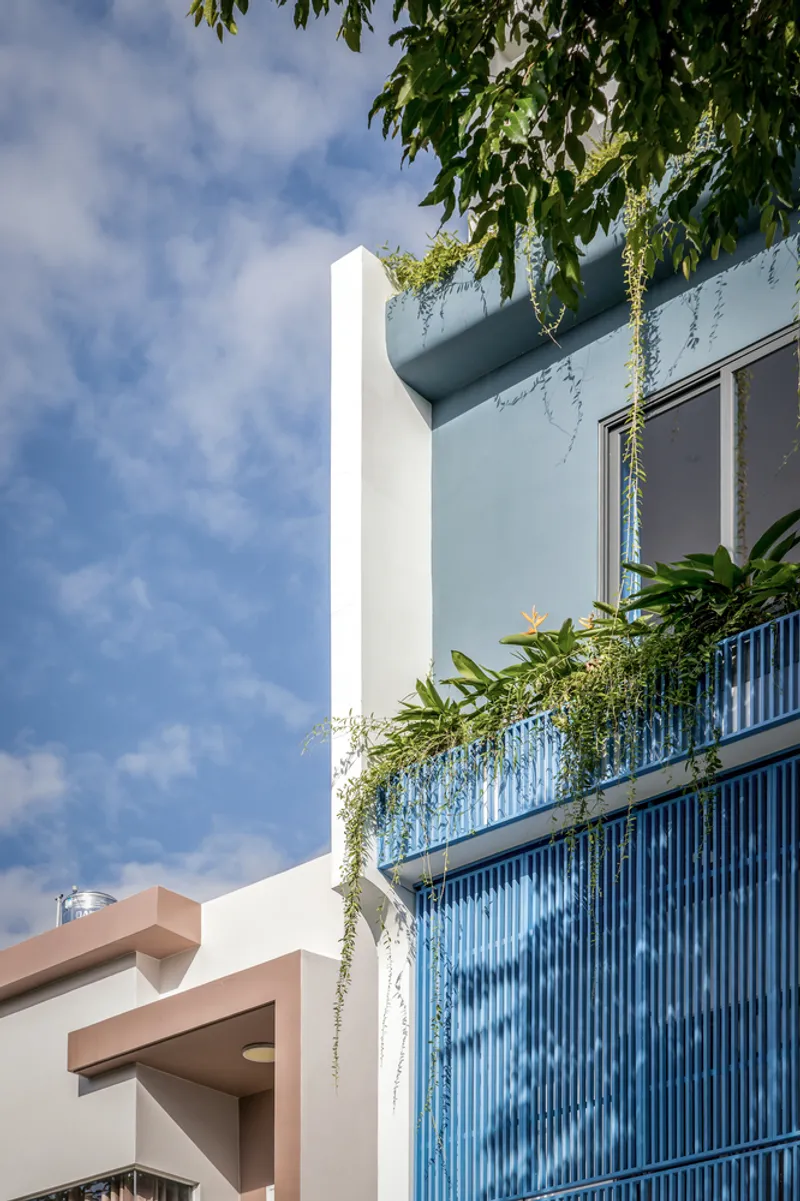

From the street, Grow Up House announces itself with a corrugated blue screen that wraps the upper levels, punctuated by a planted balcony and trailing vines. The color is assertive without being aggressive, a calm signal that something deliberate is happening behind the surface. Timber slat screens at the ground-floor entry filter light and air while providing a degree of privacy from the lane. The layering of materials, corrugated metal over white subway tile over slatted timber, creates depth on a facade that is barely six meters wide.
Greenery cascades from every gap the architects left open. The planting is not decorative afterthought; it performs. Vines cool the facade, the overhead blue mosaic pool visible at the courtyard entry adds thermal mass and a splash of delight, and the slatted overhangs modulate harsh tropical sun before it reaches interior glass. Every surface is doing at least two jobs.
The Courtyard as Vertical Lung
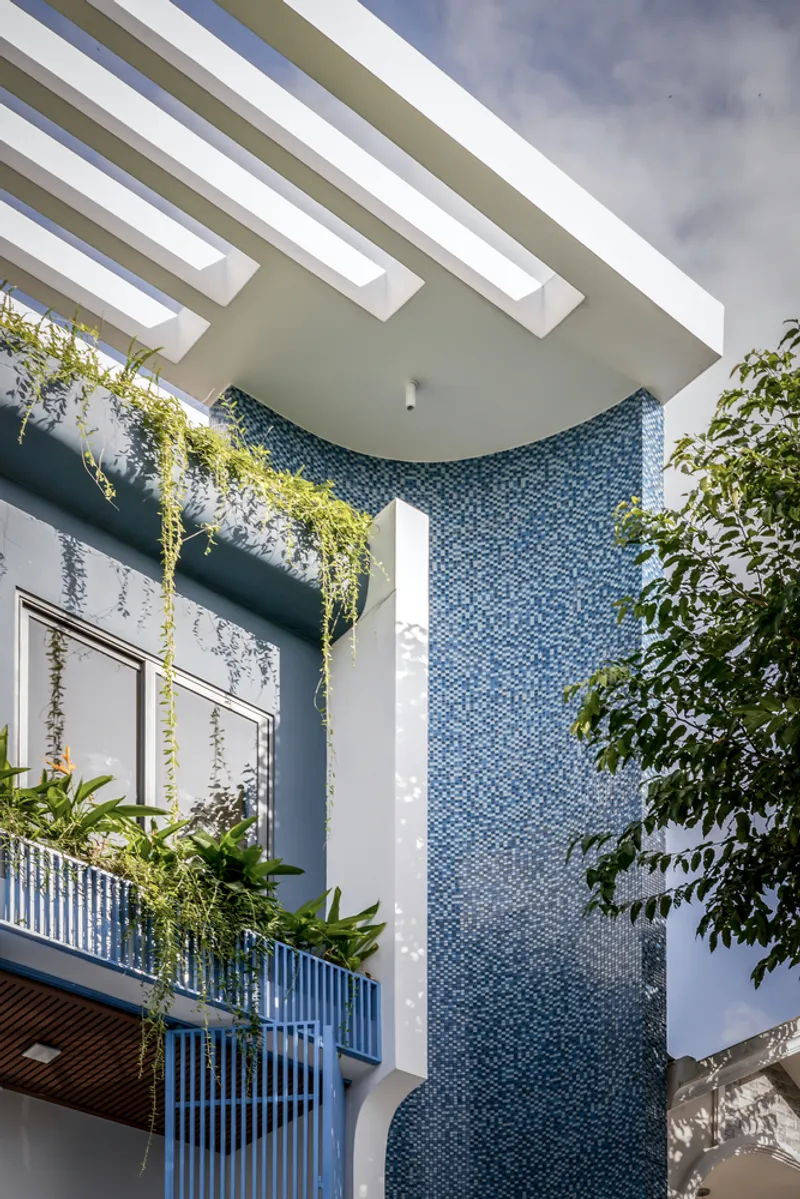
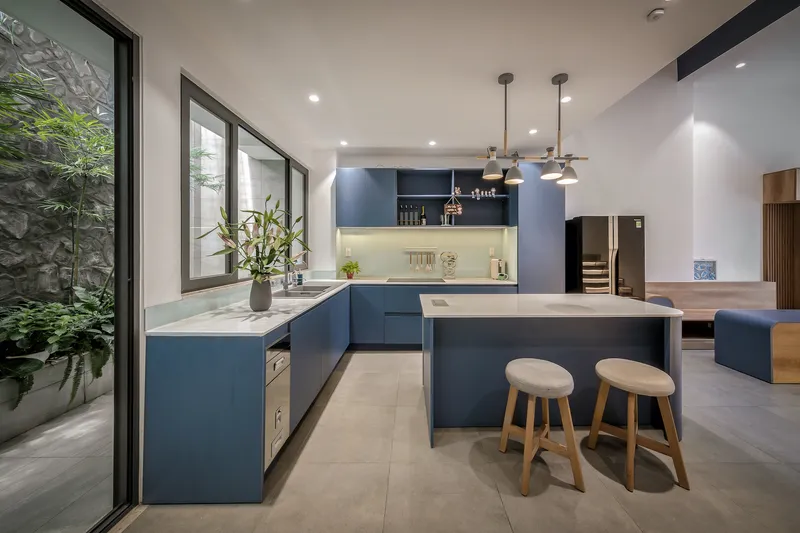
On a site this tight, a courtyard is a luxury that the architects clearly deemed non-negotiable. The interior void, marked by a blue mosaic tile column and open to the sky, pulls daylight down through the section and drives stack-effect ventilation up through the building. It is the house's lung, and every major room faces it. The ground-floor kitchen looks directly into the planted courtyard through floor-to-ceiling glazing, so the cook is never sealed off from sky and green.
The mosaic column is a deliberate provocation: a saturated, tactile object placed at the core of the plan where you would normally expect a structural element to disappear into drywall. Here it becomes a landmark. Children can orient themselves by it. It is the fixed point around which the house's vertical circulation spirals.
Stacking Life: Kitchen to Mezzanine to Sky
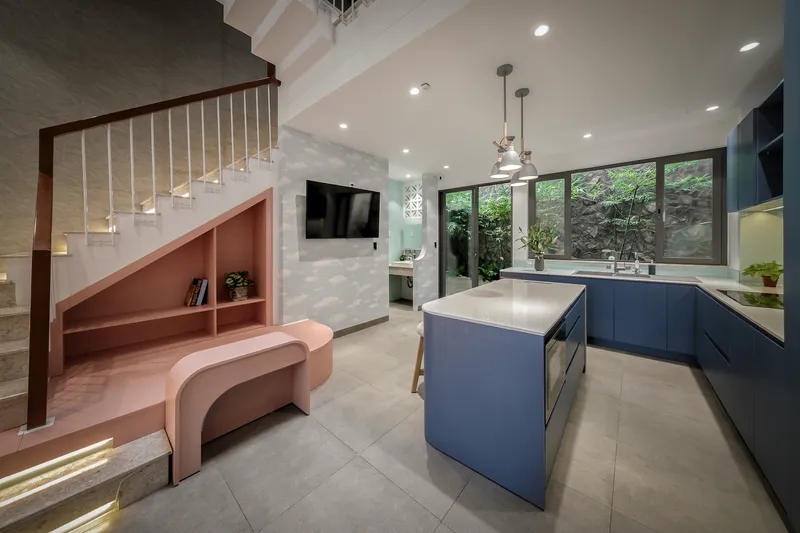
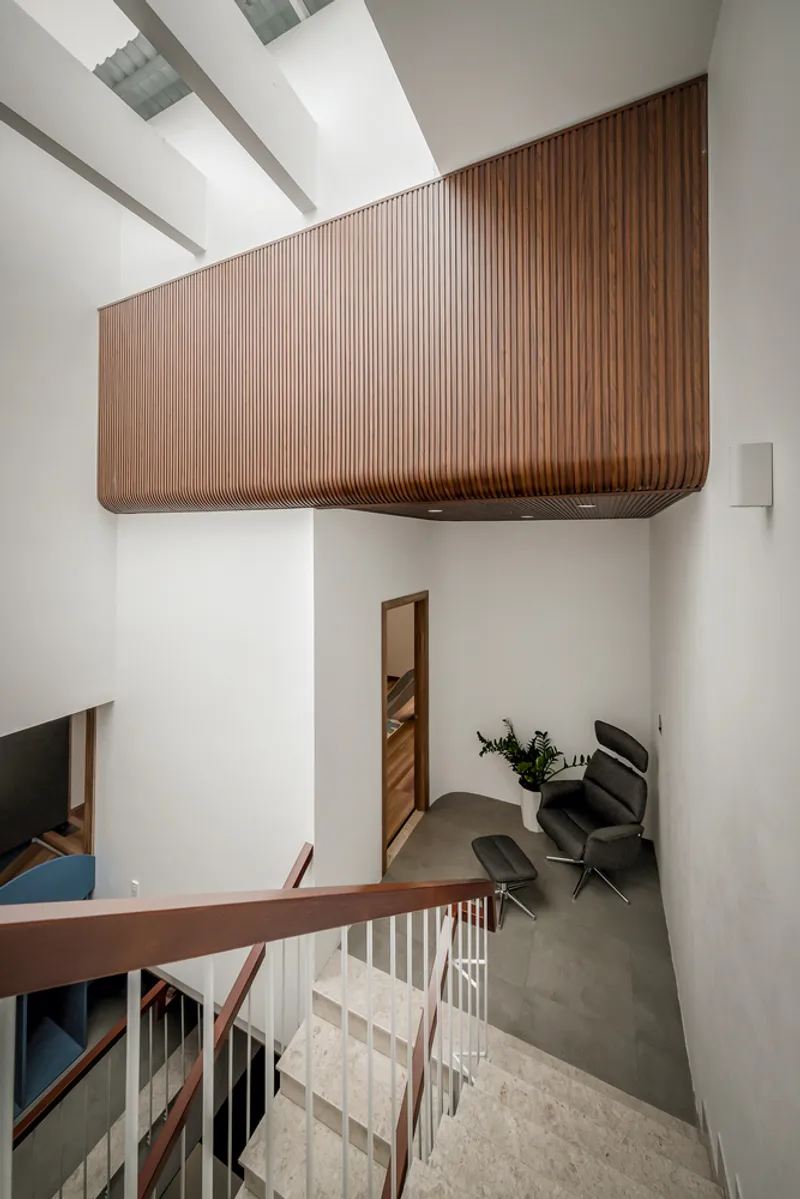
The open-plan ground floor pairs a navy blue kitchen island with pink niche shelving, a color combination that reads as confident and slightly irreverent. The palette signals that this is a house for living in, not a show home. Sight lines run from the kitchen through the courtyard garden and up through a double-height void to a suspended timber-clad volume overhead. That volume, cantilevered above the seating area, hovers beneath a skylight that washes the entire section in diffused light.
The mezzanine level, visible from below, serves as the family's communal zone: part playroom, part exercise corner, part TV den. Its openness to the ground floor means a parent chopping vegetables can maintain a conversation with children two meters above. Time Architects understood that in a house for young kids, supervision is not about surveillance cameras or baby gates; it is about keeping floors legible to one another.
The Slide and the Stair
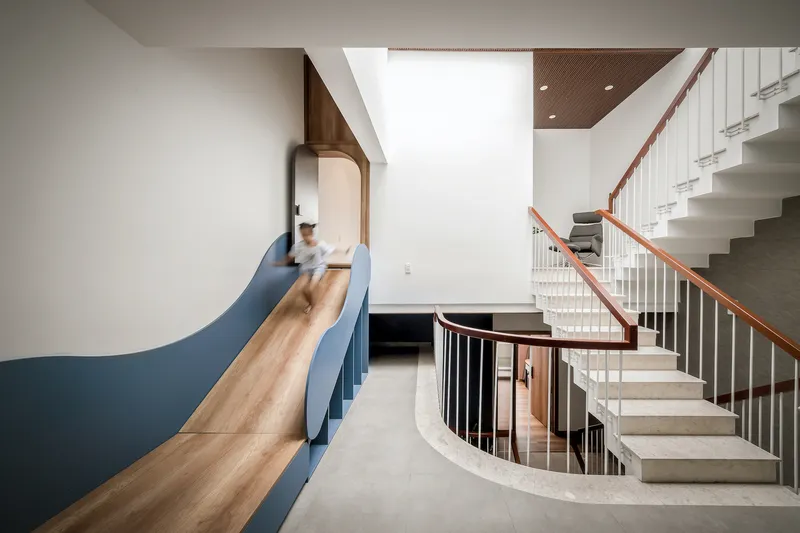
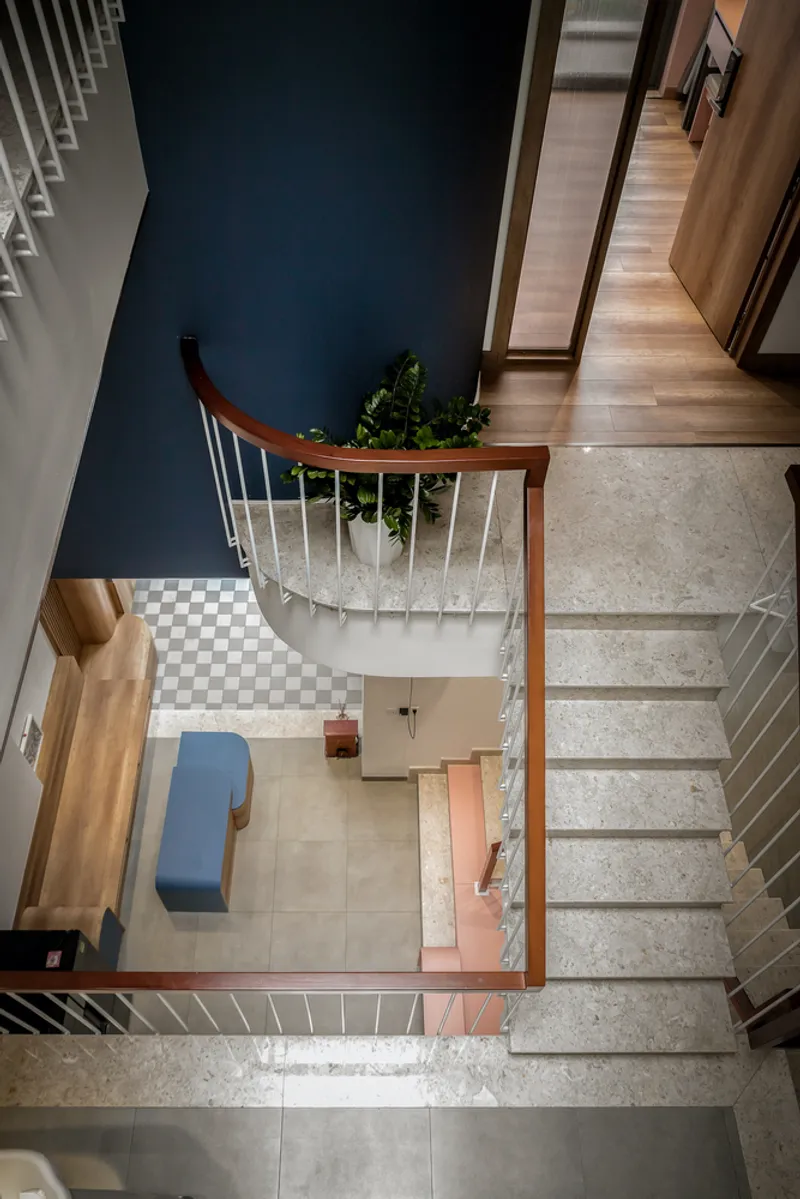
The most talked-about move in the house is the timber-edged slide that runs parallel to the concrete staircase. It is not a gimmick. In a narrow, multi-story house with four children, the staircase is the most heavily trafficked piece of infrastructure. Doubling it with a slide means kids have a dedicated, fast route down that keeps them out of the way of anyone carrying laundry or groceries up. The motion blur in one photograph tells the story: this thing gets used constantly.
The staircase itself is carefully detailed. Curved timber handrails follow the soft geometry that Time Architects applied throughout the house, eliminating sharp corners that would threaten a running child. Terrazzo landings add durability and a touch of mid-century warmth. A potted plant sits casually on one landing, proof that the circulation space is generous enough to accommodate life beyond mere transit.
Private Rooms That Stay Connected
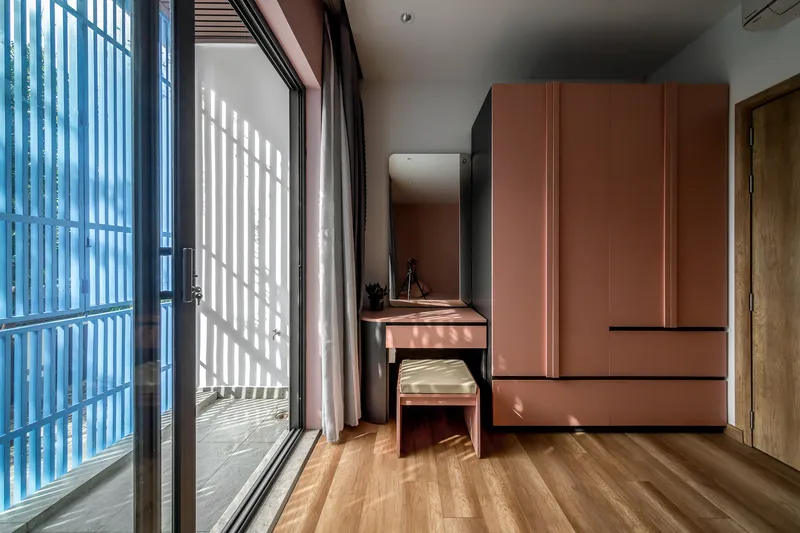
The children's bedrooms and the parents' room are positioned to balance privacy with oversight. A small transitional lobby separates the parents' space from the play areas, providing just enough acoustic distance for an adult conversation while keeping the door close enough to respond to a cry. The bedroom shown here uses terracotta-toned built-in joinery, a writing desk built into the wall, and a glass block window that casts striped shadows across the timber floor. It is compact, warm, and obviously designed for a child who needs both a place to sleep and a place to focus.
Glass block is having a moment in Vietnamese residential architecture, and Time Architects deploy it well here. It admits generous daylight while blurring views of adjacent buildings, a practical move on a dense urban plot where conventional windows would stare into a neighbor's wall. The striped light pattern it throws changes through the day, giving the room a kinetic quality that a flat pane of glass never could.
Why This Project Matters
Grow Up House tackles a problem that millions of Southeast Asian families share: how to raise a large family on a small urban lot without retreating to the suburban fringe. Time Architects' answer is vertical connectivity, the deliberate punching of voids, skylights, and visual corridors through a narrow section so that every floor participates in a single domestic ecosystem. The strategy is not new in principle, but its execution here is unusually rigorous. Every void earns its keep in ventilation, light, and family cohesion.
More broadly, the project is a rebuttal to the post-pandemic instinct to fortify. Instead of sealing the family behind thick walls and air conditioning, Time Architects opened the house to the sky, invited plants inside, and turned the staircase into a piece of play equipment. The underlying argument is optimistic: that a well-designed home does not just protect children from the world but actively helps them grow within it. For a house born from lockdown anxiety, that is a remarkably generous conclusion.
Grow Up House by Time Architects, Vietnam, 231 m², completed 2022. Photography by Minq Bui.
About the Studio
Share Your Own Work on uni.xyz
If projects like this are the kind of work you want to make, uni.xyz is a place to publish your own, find collaborators, and enter design competitions.


Popular Articles
Popular articles from the community


Juan García Correa, John González and Claudia Rueda Sink a Circular Amphitheater into a Manizales Engineering Building
On the La Nubia campus in Manizales, Colombia, the S1 Building folds labs and offices into a hillside of ramped lawns that double as a campus route.

David Ortega Stacks a Two-Story Mexico City Penthouse Around a Steel Stair and a Pergola-Shaded Roof Terrace
In Colonia Roma, a 300 m² penthouse uses oak joinery, a planted steel stair and a slatted roof pergola to make a new-build apartment feel like a house.

Jaramillo Van Sluys Arquitectura and Urbanismo Turn a Demolished Registry Lot in Quito into an Orchard Plaza
In Quito's Centro Histórico, a 2,800 m² plaza exposes the San Agustín convent wall and redraws its lost Augustinian orchard in volcanic stone.

longwave studio Reorganizes a 112 m² Tainan Apartment Around the Daily Routines of a Family and Two Cats
In Tainan, Taiwan, birch plywood, rust-red furniture and a freestanding plaster wall link arrival, storage, work and family life in one apartment.

Similar Reads
You might also enjoy these articles


Hodi-Mandai Geram
Project Function: Preservation and revitalization of the Intangible heritage and socio-spatial identity of the Hodi by Housing, Cultural Memory Center, Sacred Grove, landscape, local tourism economy


Olio Towers: A Mid-Rise for Performers That Fuses Housing, Rehearsal, and Stage
Located blocks from Houston's Theater District, this modular tower stacks living units around a central performance atrium.

Oasis: Modular Green Housing Carved into Dhaka's Urban Fabric
A shortlisted Plugin Housing entry reclaims unauthorized settlements in Dhaka with stepped concrete volumes, green roofs, and ventilation-driven design.

Black Hole: A Floating Megastructure for the Post-Physical Era
Emiliano Mazzarotto envisions a spherical, self-scaling arena where e-sports, digital hotels, and holographic stadiums replace traditional public space.

Explore Housing Competitions
Discover active competitions in this discipline

Challenge to reimagine the Iron Throne

Photograph architecture without architects

Illustrate the lost glory of Angkor Wat - Render Challenge

Design challenge to reuse E-waste
Comments (0)
Please login or sign up to add comments
No comments yet. Be the first to comment!