
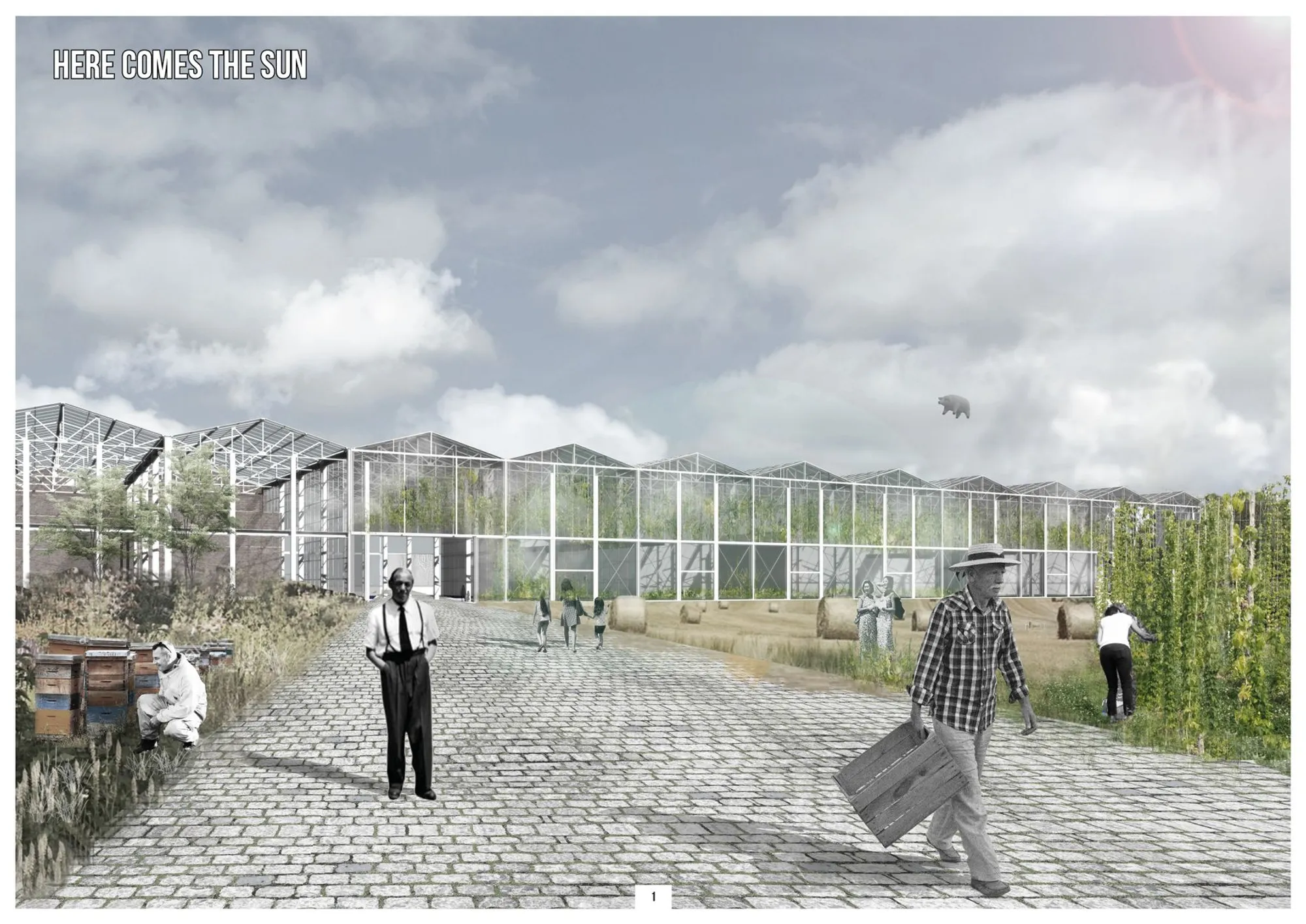
Here Comes The Sun: A Greenhouse That Fuses Urban Farming with Bioclimatic Living
A multifunctional greenhouse complex embeds local agriculture, housing, and community exchange within a sawtooth-roofed bioclimatic structure.


What if the greenhouse stopped being a peripheral agricultural shed and became the organizing principle of an entire urban block? Here Comes The Sun treats the greenhouse not as a mono-functional growing space but as a civic building type capable of holding housing, markets, workshops, restaurants, and energy systems under one sawtooth-roofed canopy. The result is a hybrid typology that collapses the distance between food production and daily urban life, turning residents into active participants in cycles of growing, processing, and consuming.
Designed by Emma Buard and Susini Paul, the project was shortlisted in the Urban Meal Mine competition, which challenged designers to reimagine sustainable farming within urban contexts. Rather than proposing a standalone vertical farm or a rooftop garden bolted onto an existing building, Buard and Paul developed a linear greenhouse complex that integrates bioclimatic strategies, local construction methods, and a rich architectural program into a single coherent structure embedded within the city fabric.
A Linear Footprint Among Urban Blocks
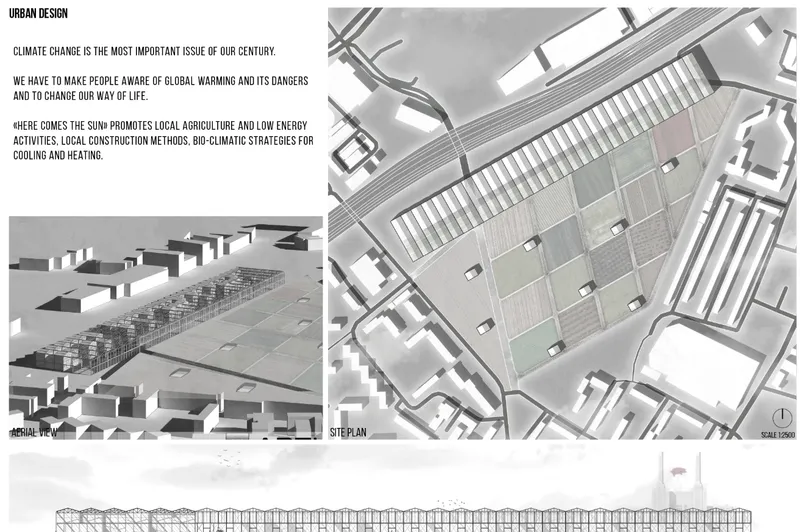
The site plan reveals the greenhouse as a long, linear form threaded into the existing urban grain. Its sawtooth roof profile distinguishes it immediately from the flat-topped residential blocks surrounding it. Rather than occupying a leftover parcel at the city's edge, the structure is positioned strategically to revitalize underutilized land, turning it into a productive, climate-resilient hub. The drawing makes clear that this is not an isolated agricultural experiment but a piece of urban infrastructure scaled to the neighborhood.
Stacking Programs Under a Sawtooth Canopy
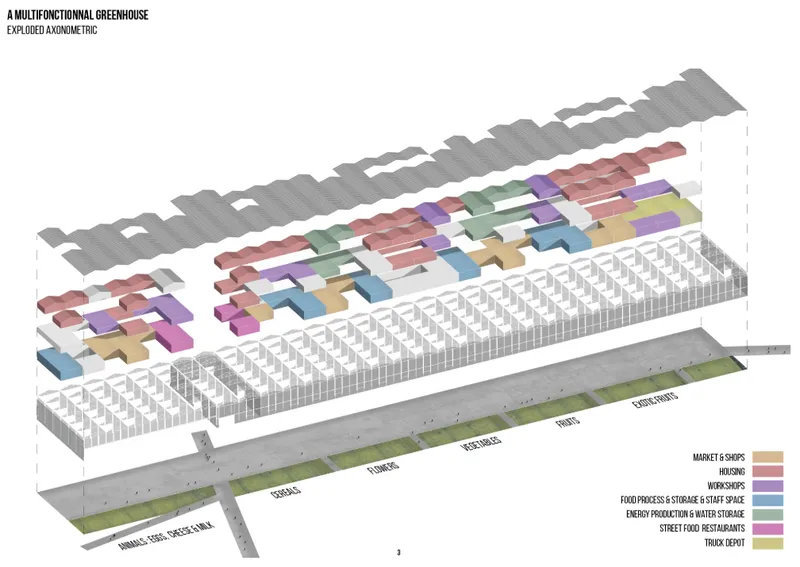
The exploded axonometric is the project's most revealing drawing. It pulls apart the structural grid from the programmatic zones stacked beneath the sawtooth roof, exposing how market and shop spaces, housing units, workshops and learning rooms, food processing and storage areas, energy and water systems, and public restaurants all coexist within a single structural framework. Each program occupies its own clearly legible band, yet none is sealed off from the others. The logic is deliberately porous: a resident walking from their housing unit to a workshop passes through planted beds and social spaces, making engagement with food production unavoidable.
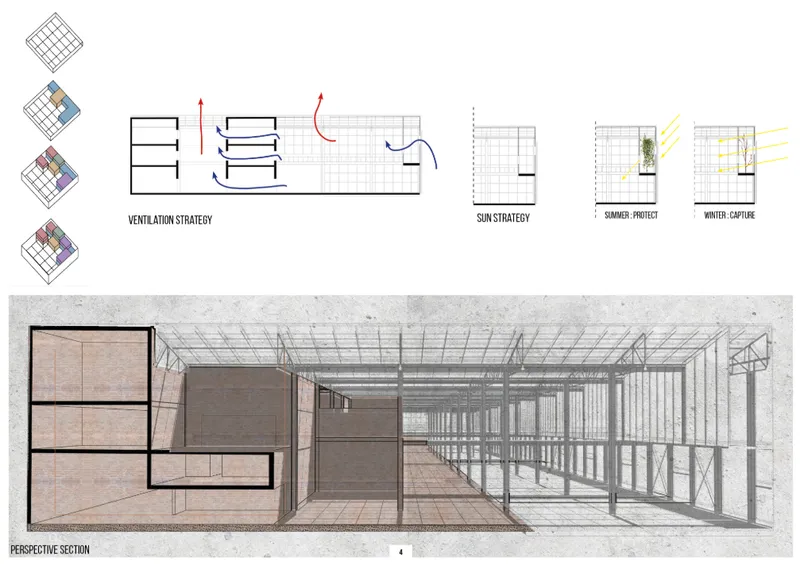
The perspective section complements this reading by illustrating the bioclimatic engine driving the whole scheme. Natural ventilation flows through the sawtooth profile, with each angled roof plane oriented to capture solar energy and exhaust warm air. Solar orientation and material efficiency reduce dependence on high-energy mechanical systems. The section shows air pathways, light penetration, and the relationship between interior planting zones and the structural envelope, confirming that the environmental strategy is not layered on top of the architecture but is inseparable from it.
Life Under Glass: An Interior Built for People and Plants
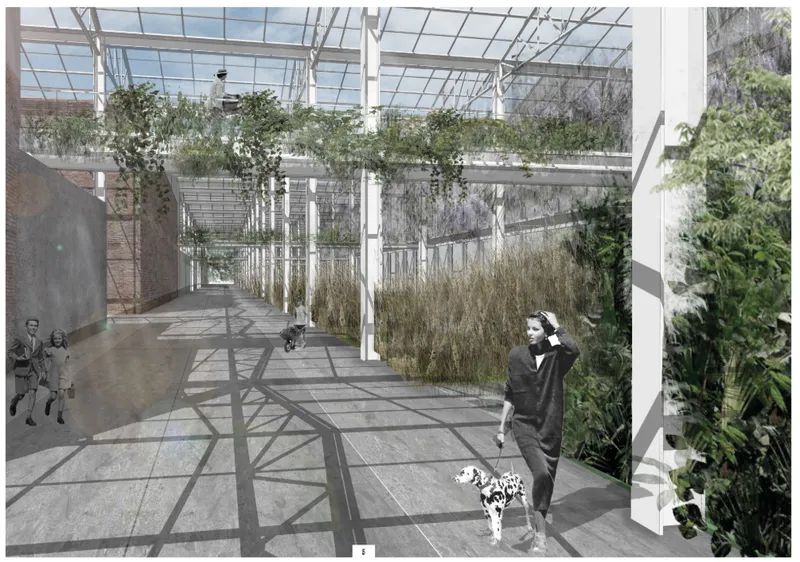
The rendered interior view delivers on the promise of the diagrams. People move through planted beds under a glazed roof, the sawtooth profile flooding the space with diffused light. A dog wanders between the rows. The atmosphere is casual, almost domestic, which is precisely the point. By making the agricultural interior feel like a public park or a living room rather than an industrial facility, the designers argue that urban farming can be woven into everyday social life. The transparency of the roof structure keeps the boundary between inside and outside almost notional, reinforcing the project's commitment to passive environmental control over sealed, climate-controlled boxes.
A Translucent Landmark Seen from the City
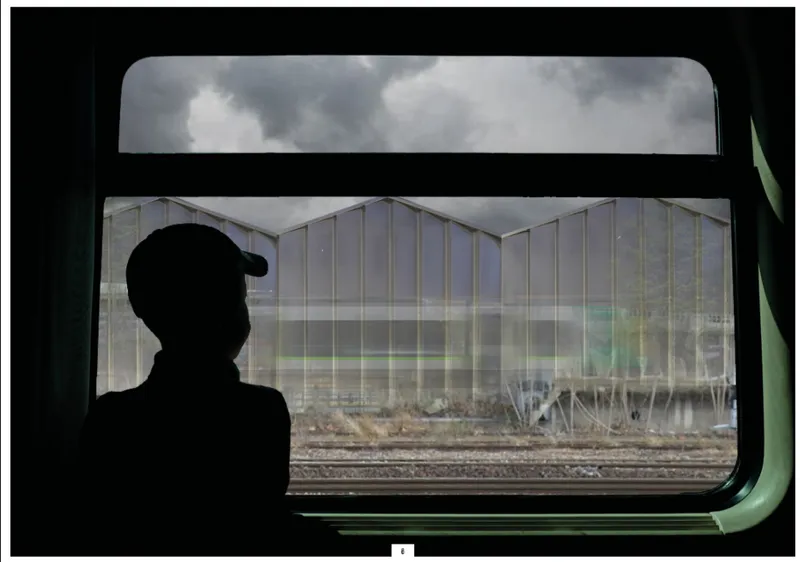
Viewed from a passing train under stormy skies, the greenhouse's translucent facade glows against its urban backdrop. The image captures something essential about the project's ambition: visibility. This is a building that wants to be seen and understood. Its transparent skin exposes the green interior to passersby, serving as a daily, physical reminder of the cycles of production happening within. Where most urban agriculture hides behind opaque walls or on inaccessible rooftops, Here Comes The Sun puts food growing on display as a civic act.
Why This Project Matters
The strength of Buard and Paul's proposal lies in its refusal to treat sustainability as a checklist of technologies. Bioclimatic cooling, local construction methods, renewable energy, and water storage are present, but they are embedded within a spatial proposition that is genuinely new: a greenhouse that functions as a neighborhood. By stacking housing, commerce, education, and food production into a single structural system, the designers offer a replicable model for how cities can integrate food security with social life and low-energy building strategies.
Too many competition entries in the urban agriculture space propose farms that look like farms, disconnected from the communities they are meant to serve. Here Comes The Sun does the opposite. It asks what happens when the greenhouse becomes the primary civic building of a block, visible from the train, open to the street, and filled with people who live, work, learn, and eat within it. That integration, more than any single sustainable feature, is what makes the project a compelling argument for the future of urban design.
View the Full Project
About the Designers
Designers: Emma Buard, Susini Paul
Enter a Design Competition on uni.xyz
uni.xyz runs architecture and design competitions year-round that reward proposals with spatial conviction and real site intelligence.
Project credits: Here Comes The Sun by Emma Buard, Susini Paul Urban Meal Mine (uni.xyz).


Popular Articles
Popular articles from the community


The Earth Pod: 3D Printed Homes for Resilient Refugee Communities
The Earth Pod reimagines refugee housing through 3D printed homes made from clay, combining resilience, self-sufficiency, and rapid shelter.

Hill & Cross Opera: Sculptural Opera House Architecture Shaped by Tallinn’s Landscape and Identity
Hill & Cross Opera reimagines opera house architecture in Tallinn through its sculptural hill, civic plaza, glass wave and a luminous cross.

Riyadh For All: Intergenerational Urban Design for Active Aging in Rabat
Riyadh For All reimagines urban design in Rabat with intergenerational co-living, adaptive courtyards, and Moroccan cultural exchange today.

Co-life: Sustainable Architecture for Age-Friendly Community Living
Co-life reimagines sustainable architecture for seniors through courtyards, rammed earth, shared gardens, and spaces designed for belonging.

Similar Reads
You might also enjoy these articles

Bao Huynh Watercolor Atelier: A Serene Art Retreat in Hội An
Bao Huynh Watercolor Atelier in Hội An blends multifunctional art spaces, sustainable design, local materials, and family-friendly living in a serene environment.

Atelier Macri Concept Store Interior Design by CASE-REAL
Atelier Macri store features a "ko" counter, walnut wood details, cork displays, blending retail, gallery, and seamless customer experiences.

Manuel Vargas Izquierdo Stadium and High-Performance Sports Center: Architectural Excellence in Jalpa de Méndez
The Manuel Vargas Izquierdo Stadium blends sustainable design, inclusive sports facilities, and cultural-inspired architecture, revitalizing Jalpa de Méndez’s public spaces.

KAKR Buluh Awar Hall: Revitalizing Community and Ecology Through Bamboo Architecture
Community built bamboo hall revitalizes Buluh Awar village, empowering youth, restoring ecology, celebrating vernacular craftsmanship through sustainable architecture and culture.





Comments (0)
Please login or sign up to add comments
No comments yet. Be the first to comment!