
Studio Toggle Carves a Climate-Smart Family Villa from Italian Travertine in Kuwait
House in Faiha stacks self-shading stone volumes around an interior pool and atrium to cool a multigenerational home in the desert.


Kuwait's Al Faiha district is not a place that forgives indifferent architecture. Summer air temperatures push well past 45°C, dust storms sandblast exposed surfaces, and urban plots demand density. Studio Toggle took all of that as starting material for House in Faiha, a multigenerational villa for a retired Kuwaiti couple and their four adult children. The firm's concept, inspired by the way running water carves formations through stone, produced a volumetrically dense stack of travertine-clad masses that shade themselves, funnel breezes, and organize six people's worth of independent living around a single climate-moderating core: a skylit swimming pool.
What makes the project worth studying is not its luxury finishes or its generous program but the precision with which Studio Toggle resolved a genuine paradox. The brief demanded that essentially every square meter of the 500-square-meter plot be built upon, yet every occupant needed spatial independence, cross ventilation, and daylight. The answer was vertical separation layered around a central void. A basement parks six cars and houses staff quarters; the ground floor is social, organized around the pool; upper floors stack five self-contained suites with increasing privacy; and the roof is kept free for future use. No corridor is redundant, no room is landlocked, and every floor reads back to the atrium that ties the section together.
Sculpted Mass on the Street
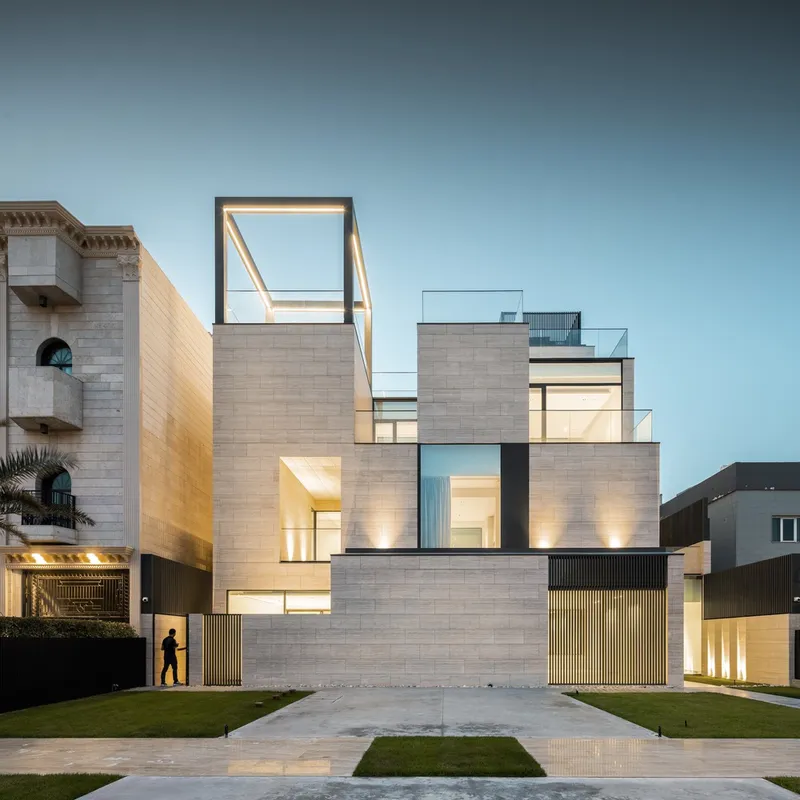
From the street, House in Faiha presents itself as a sequence of stacked stone volumes that step, cantilever, and recess to produce deep shadows at every hour of the day. Italian travertine wraps the exterior in a warm, matte surface that absorbs the low dusk light without glare, while anthracite aluminum trim outlines each opening with graphic sharpness. The cantilevers are not decorative gestures: they shade the large glazed areas on the floors below, reducing solar heat gain at precisely the locations where the envelope is most transparent.
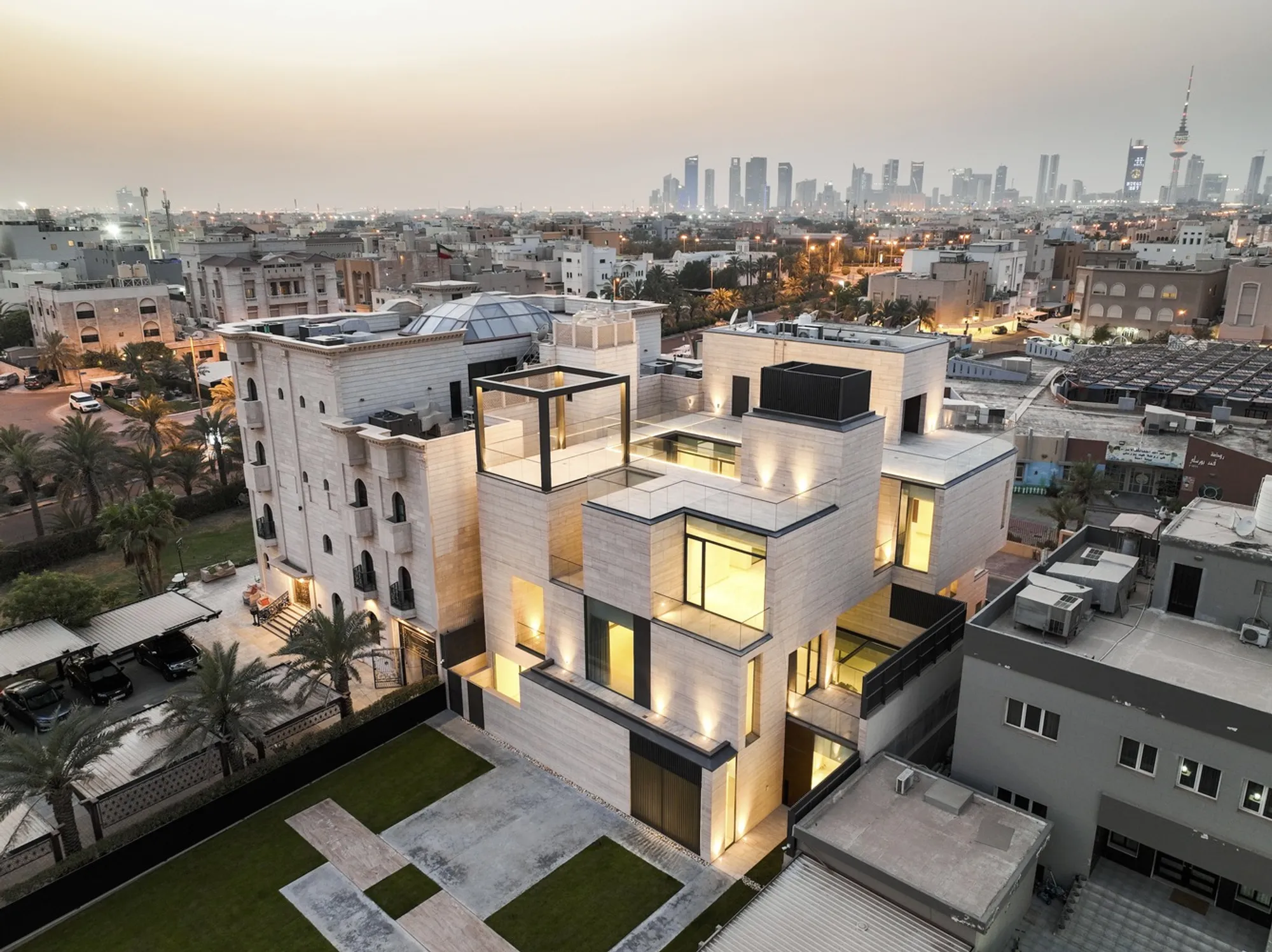
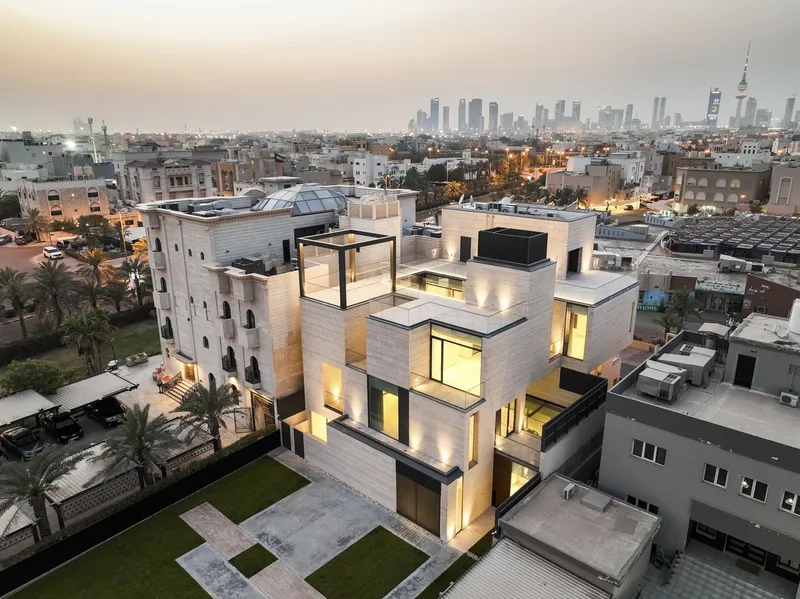
The aerial perspective confirms how tightly the massing fills the plot while still carving out pockets of outdoor space. A miniature urban garden occupies the prominent street offset, shaded by large trees in keeping with the client's brief. The roofscape, left deliberately uncluttered, reads as a clean fifth elevation against the neighborhood's rooftops.
Threshold and Entry Sequence
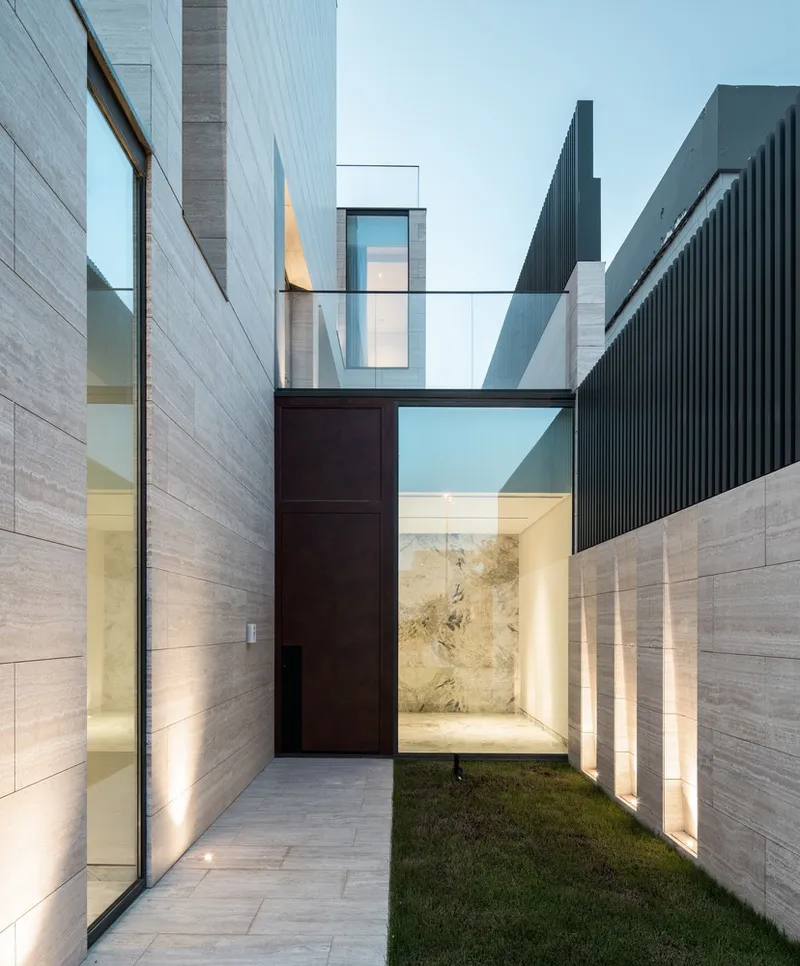
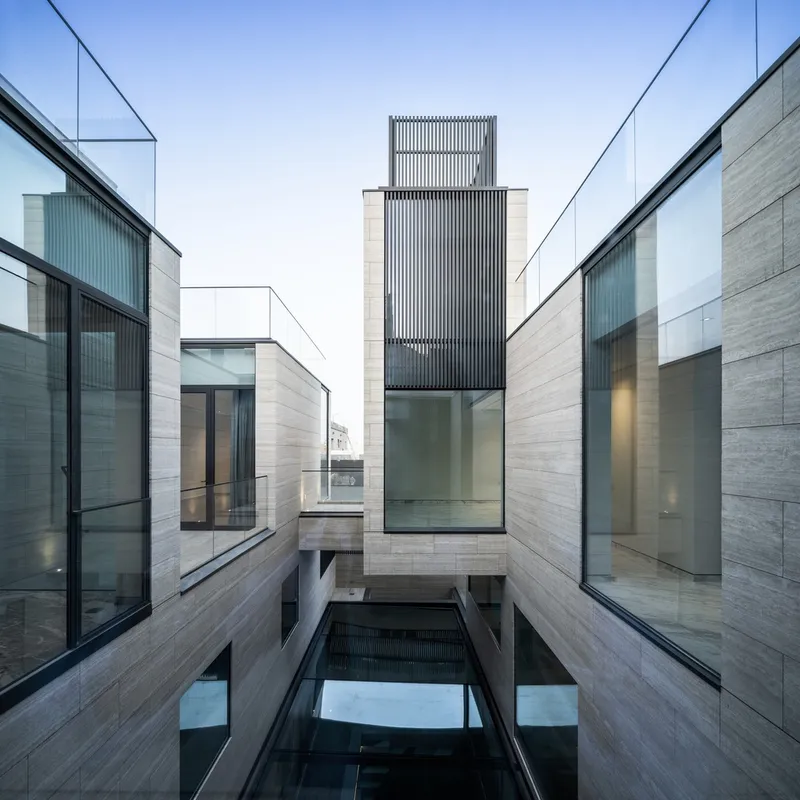
Arrival is compressed and theatrical. A narrow passage flanked by illuminated travertine walls and capped by a glass bridge overhead funnels visitors from the side entrance into a modest lobby. The proportions are deliberately tight, so the subsequent release into the double-height living area feels expansive by contrast. It is a sequence borrowed from classical architecture but executed with contemporary restraint: stone, glass, light, and not a single superfluous surface.
The sunken courtyard adjacent to the entry amplifies this compression-and-release strategy. Horizontal stone courses frame glass walls that let daylight drop deep into the ground floor while a vertical slatted tower above draws the eye upward. The effect is a building that breathes inward rather than outward, protecting its inhabitants from the harsh street environment while filling its interior with filtered natural light.
The Atrium as Climate Engine
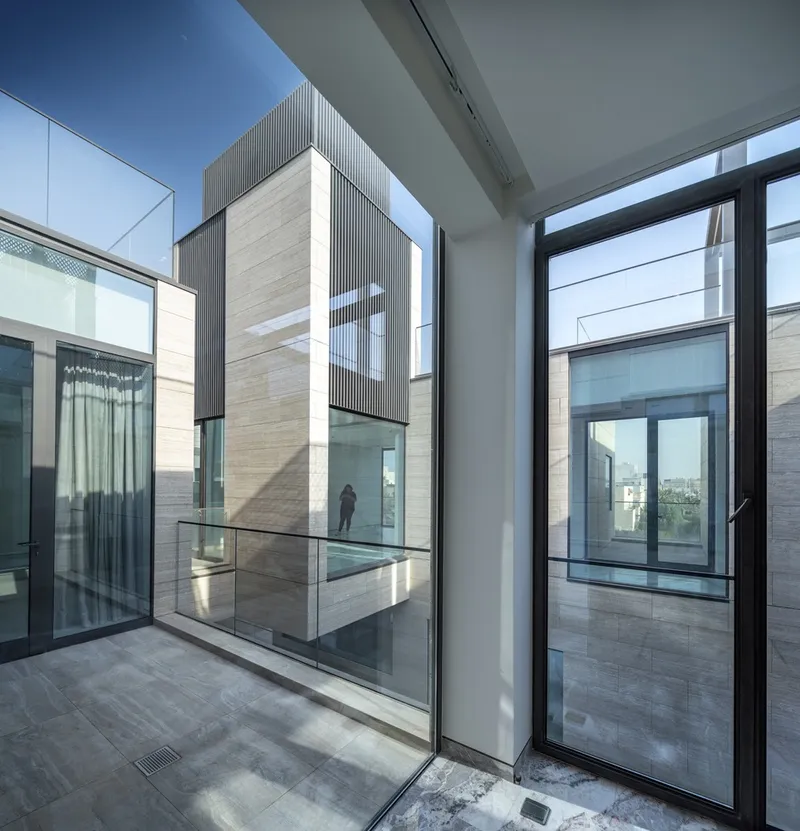
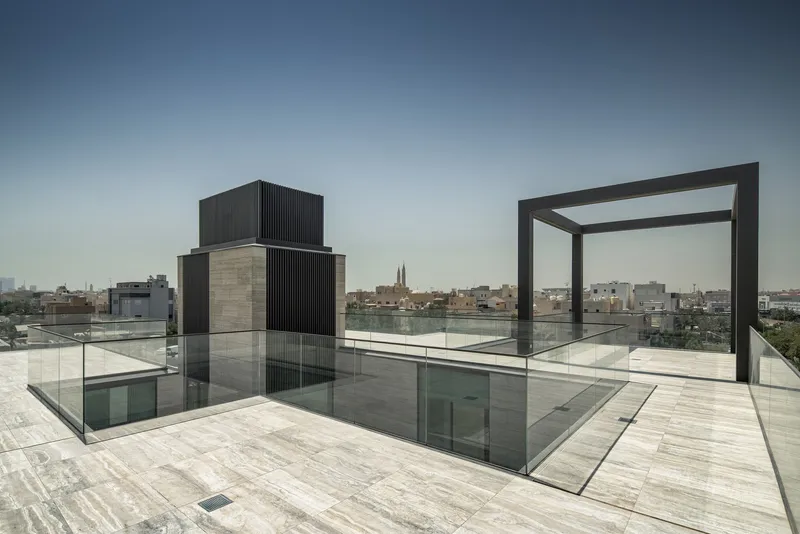
The central atrium is the organizational and environmental heart of the house. A large skylight spans its top, enclosing the climate-controlled swimming pool while guaranteeing visual connectivity across all four levels. Standing at any floor, you can look down or across the void and register the presence of other family members without sacrificing acoustic or spatial privacy. It is a social device disguised as a structural one.
Environmentally, the pool and atrium work together as a heat sink. Water's thermal mass absorbs excess warmth during the day, and evaporative cooling tempers the air that rises through the stack. Cross ventilation is integrated on every floor, and high-performance multi-glazed windows minimize conducted heat gain so that the house can reduce its dependence on mechanical cooling. The rooftop terrace, with its glass floor skylights and metal frame pavilion, caps the chimney effect while offering a panoramic retreat above the city.
Interior Material Palette
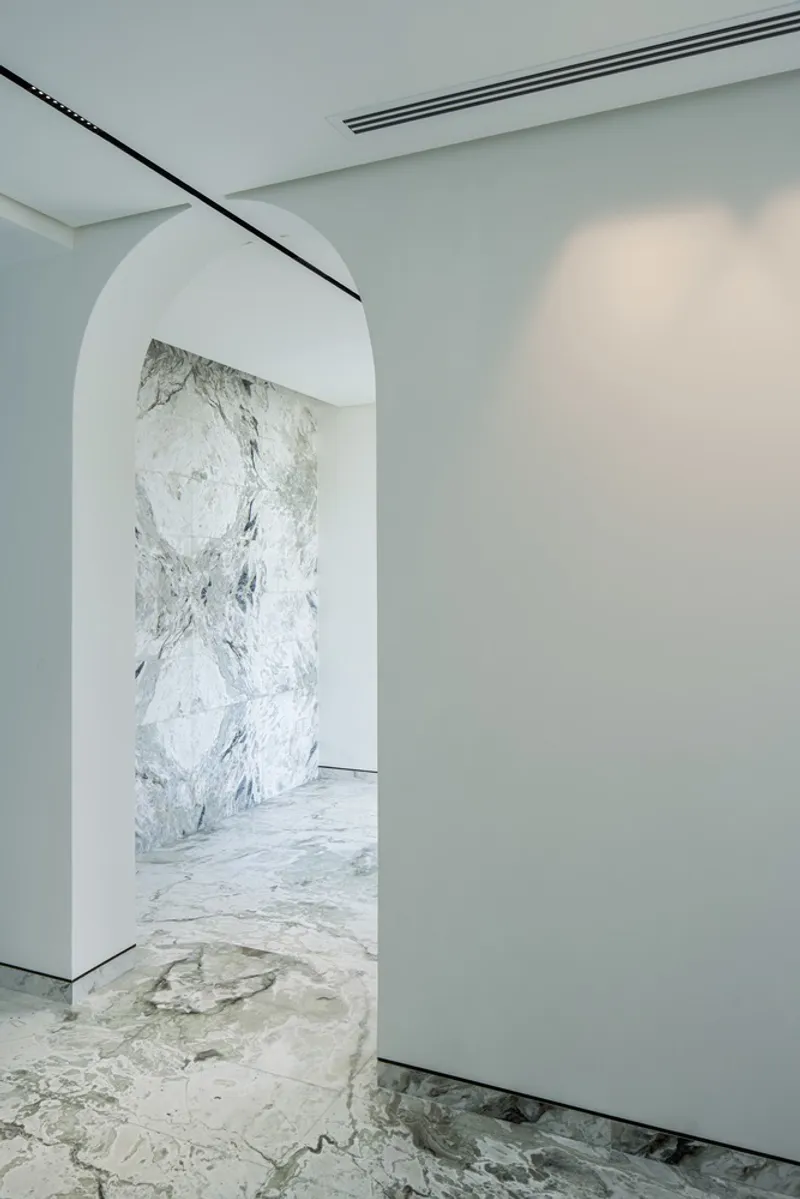
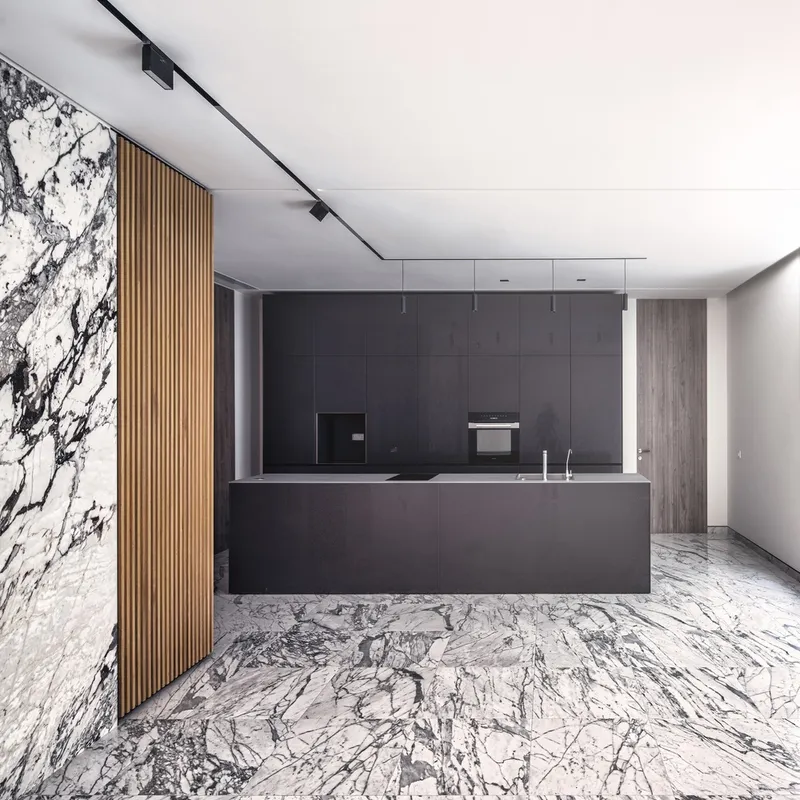
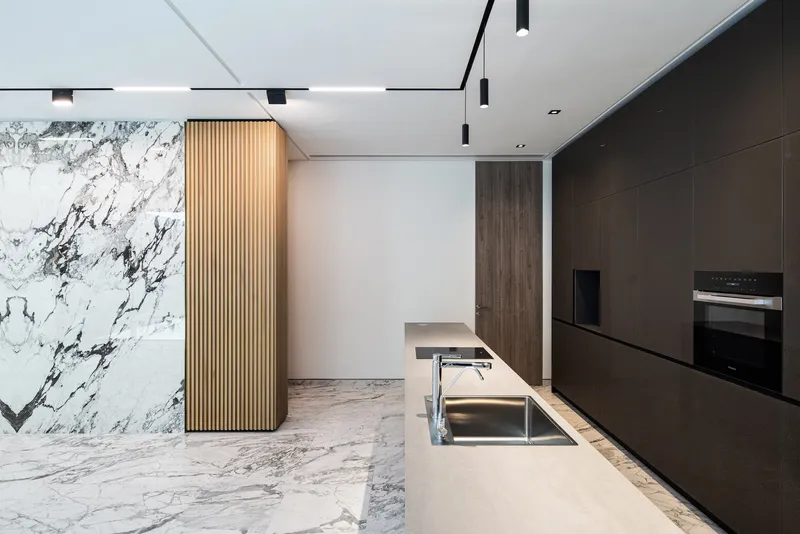
Inside, Studio Toggle strips the palette to three materials: white-painted walls, veined marble feature planes, and warm timber slats. The arched doorway that frames a marble accent wall in the corridor is one of the few overtly decorative moves, and it works because it is structurally legible rather than applied. Marble panels vary in veining pattern from room to room, giving each suite a distinct character without resorting to a different vocabulary.
The kitchen demonstrates how this restraint plays out in a functional space. A dark grey island anchors the open plan, timber battens screen service zones, and a single slab of veined marble behind the sink provides visual warmth without competing with the pool view beyond. The integration of sensor-controlled lighting and energy-efficient fixtures is invisible but essential: in a house where every surface is calibrated, exposed conduit or misaligned downlights would be unforgivable.
Why This Project Matters
House in Faiha is a convincing argument that density and comfort are not mutually exclusive, even in one of the world's most punishing climates. Studio Toggle's decision to treat the entire plot as buildable area could have produced a claustrophobic box. Instead, by organizing the section around a central void, deploying self-shading massing, and treating the swimming pool as both a social and thermodynamic asset, the firm delivered a home where six adults can live independently yet remain connected. The passive cooling strategies are not bolt-on features; they are embedded in the form itself, from the cantilevers that shade the glazing to the atrium that drives stack ventilation.
For architects working in the Gulf, the project offers a replicable logic. It proves that you can fill a tight urban site, meet a demanding multigenerational program, and still achieve meaningful environmental performance without relying solely on mechanical systems. The material palette, limited to travertine, glass, and aluminum on the outside and marble, timber, and white paint on the inside, shows that discipline in selection produces richer results than variety ever could. House in Faiha does not announce its sustainability; it simply performs it.
House in Faiha by Studio Toggle, Faiha, Kuwait. 500 m² site. Completed 2022. Photography by Nelson Garrido.
About the Studio
Share Your Own Work on uni.xyz
If projects like this are the kind of work you want to make, uni.xyz is a place to publish your own, find collaborators, and enter design competitions.




Popular Articles
Popular articles from the community


The Earth Pod: 3D Printed Homes for Resilient Refugee Communities
The Earth Pod reimagines refugee housing through 3D printed homes made from clay, combining resilience, self-sufficiency, and rapid shelter.

The Musturak Paradise: Senior Living Architecture for a Connected Future in Temara, Morocco
The Musturak Paradise reimagines senior living architecture in Temara via private homes, social spaces, culture, community, and shared care.

Hill & Cross Opera: Sculptural Opera House Architecture Shaped by Tallinn’s Landscape and Identity
Hill & Cross Opera reimagines opera house architecture in Tallinn through its sculptural hill, civic plaza, glass wave and a luminous cross.

Conexión: Biophilic Design Reimagines High-Rise Living in Hong Kong
Conexión reimagines high-rise living in Hong Kong through biophilic design, green facades, shared spaces, daylight, water and nature within.


Similar Reads
You might also enjoy these articles


Hodi-Mandai Geram
Project Function: Preservation and revitalization of the Intangible heritage and socio-spatial identity of the Hodi by Housing, Cultural Memory Center, Sacred Grove, landscape, local tourism economy


Olio Towers: A Mid-Rise for Performers That Fuses Housing, Rehearsal, and Stage
Located blocks from Houston's Theater District, this modular tower stacks living units around a central performance atrium.

Oasis: Modular Green Housing Carved into Dhaka's Urban Fabric
A shortlisted Plugin Housing entry reclaims unauthorized settlements in Dhaka with stepped concrete volumes, green roofs, and ventilation-driven design.

Black Hole: A Floating Megastructure for the Post-Physical Era
Emiliano Mazzarotto envisions a spherical, self-scaling arena where e-sports, digital hotels, and holographic stadiums replace traditional public space.


Explore Housing Competitions
Discover active competitions in this discipline



Challenge to reimagine the Iron Throne


Photograph architecture without architects


Illustrate the lost glory of Angkor Wat - Render Challenge


Design challenge to reuse E-waste
Comments (0)
Please login or sign up to add comments
No comments yet. Be the first to comment!