

BASIL Architecture Wraps a Belgian Pavilion House in Perforated Metal and Wild Meadow
House WADD clusters angular volumes around a curved courtyard, blurring the edge between interior comfort and untamed landscape in Belgium.


There is a particular kind of house that refuses to declare its boundaries. House WADD, designed by BASIL Architecture in Belgium, is one of them. Rather than presenting a single legible facade to the street, the project scatters a family of angular volumes across the site, loosely organized around a curved exterior courtyard that functions as the plan's gravitational center. The result reads less like a conventional home and more like a small campus of pavilions, each assigned a domestic task but unified by a shared material vocabulary of white render, floor-to-ceiling glass, and perforated metal cladding.
What makes it genuinely interesting is the tension between precision and wildness. The architecture is crisp, geometric, almost clinical in its detailing. But the landscape strategy is the opposite: unmowed meadow grasses and wildflower beds push right up against the glass walls, softening every edge and making the house feel as though it arrived in a field rather than the other way around. The perforated metal screens that clad the upper volumes filter light and views in a way that mirrors the dappled quality of the meadow below, tying building and ground together.
Pavilion Logic and the Curved Courtyard
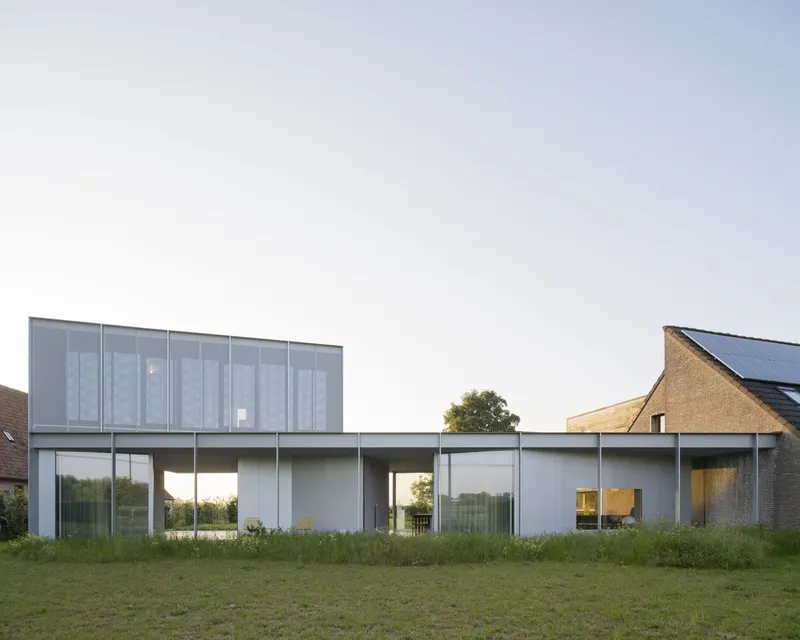
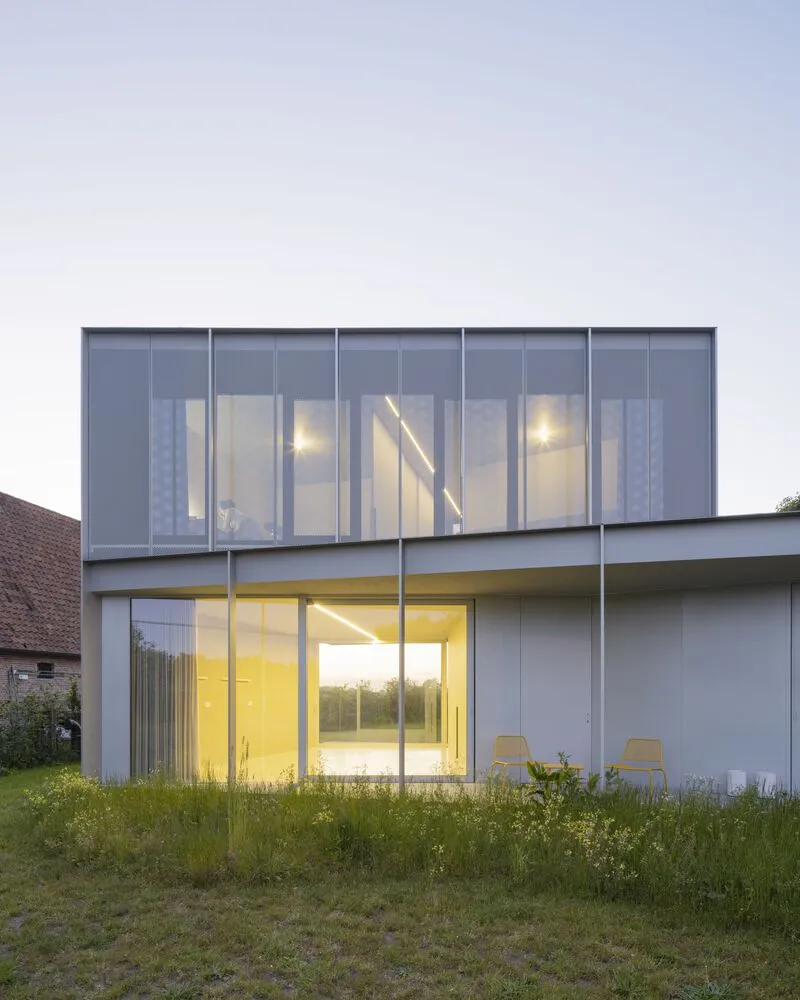
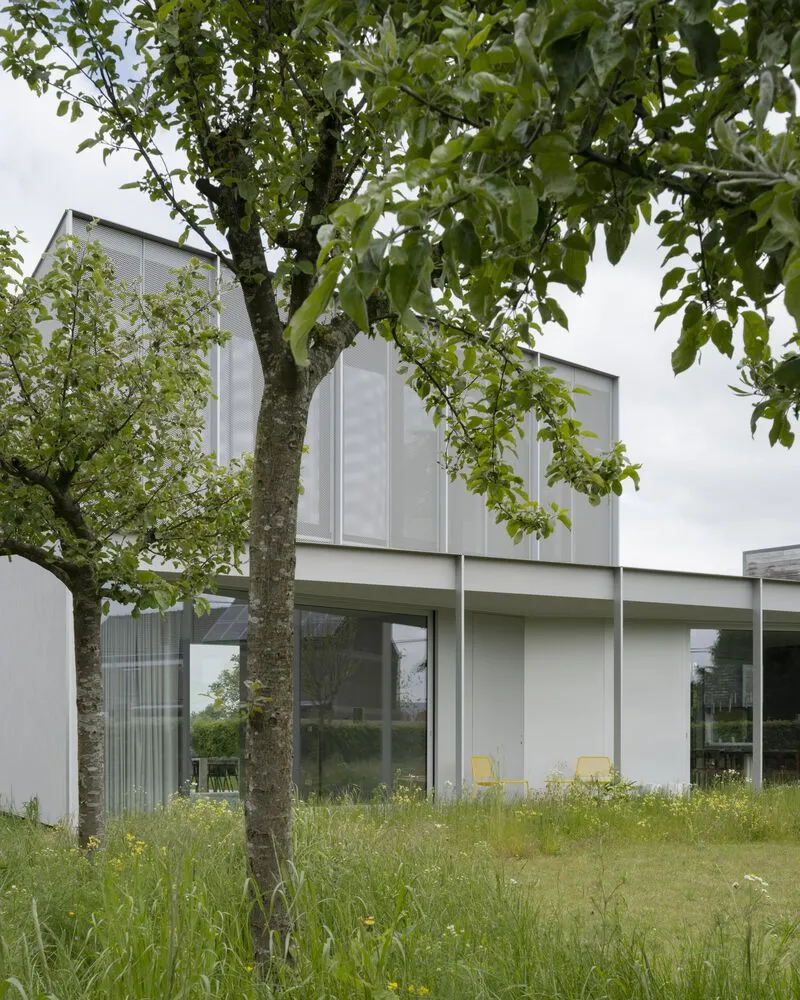
The plan operates on a principle of fragmentation. Instead of a single footprint, BASIL Architecture breaks the program into distinct volumes, each slightly angled off axis, then ties them together around a shared curved outdoor room. The effect from the garden is of a cluster rather than a block, with multiple facades catching light from different directions throughout the day. A mature fruit tree framed against the perforated screens reinforces the idea that this house negotiates with its context rather than dominating it.
From the garden side, the two-story element reads as a white box hovering above a glass plinth, its upper face sheathed in perforated metal panels. The horizontal wing extends beside it at a single story, low enough to disappear behind the tall grasses. The asymmetry is deliberate: no single vantage point reveals the whole composition, so walking around the house becomes an act of discovery.
Perforated Screens and Twilight Performance
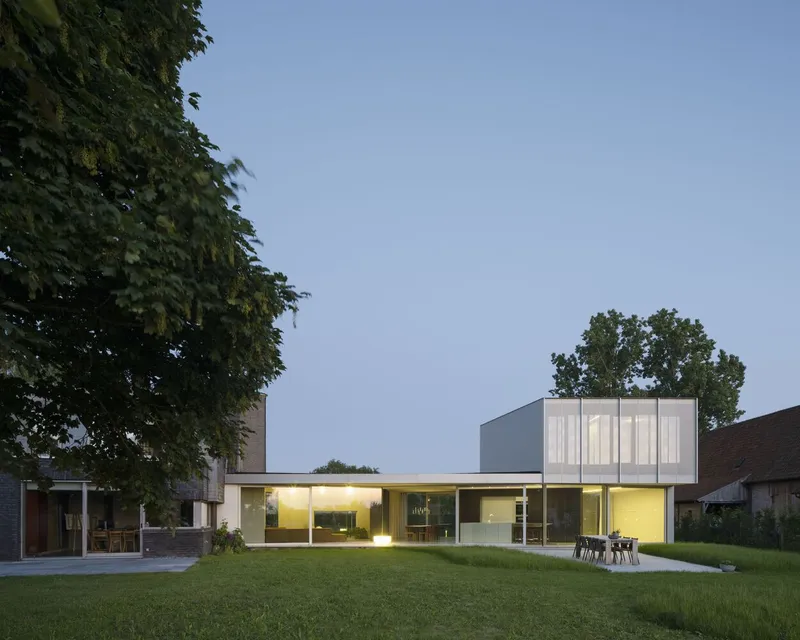
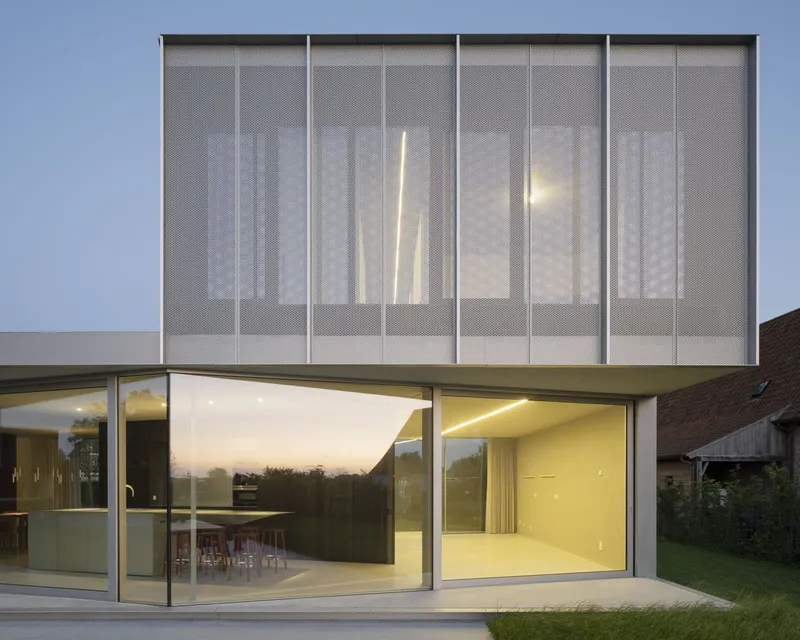
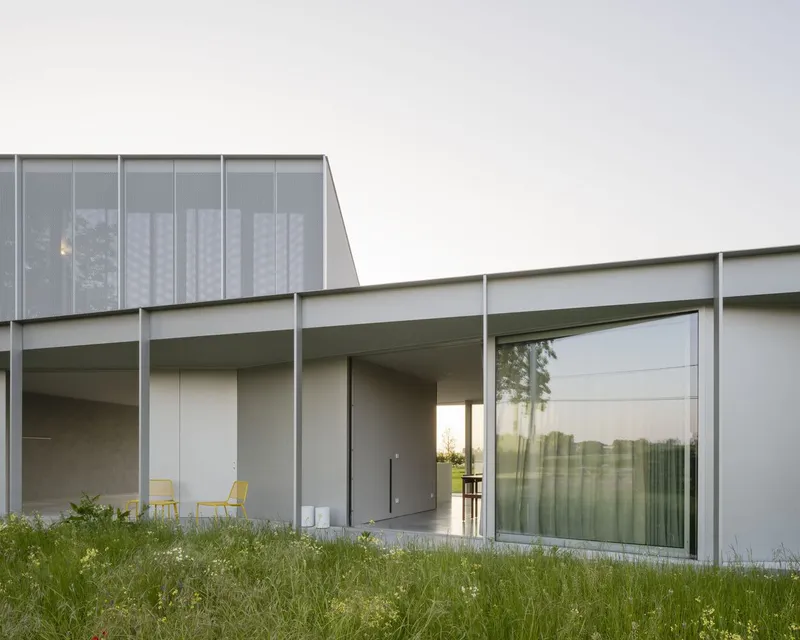
The perforated metal cladding does the heaviest architectural lifting here. During the day it functions as a solar filter, softening direct light into the upper rooms and reducing glare. But at twilight, when the interior lights come on, it transforms the upper volume into a glowing lantern. The perforation pattern is fine enough that the screens read as translucent from a distance, revealing the silhouettes of activity inside without sacrificing privacy. It is a smart, cost-effective alternative to decorative brise-soleil, and it gives the project a distinctive nighttime identity.
Corner details matter. Where the perforated volume meets the glass base, there is a clean cantilever that creates a sheltered zone beneath, blurring the threshold between inside and out. The sliding glass walls at ground level can retract fully, erasing the facade plane entirely and converting the ground floor into an open-air pavilion.
Thresholds and the Inside-Outside Blur
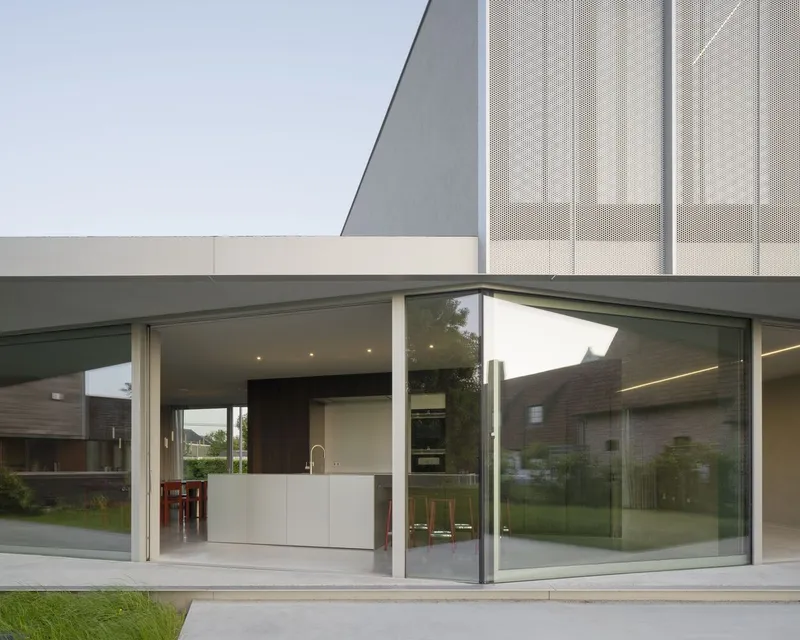
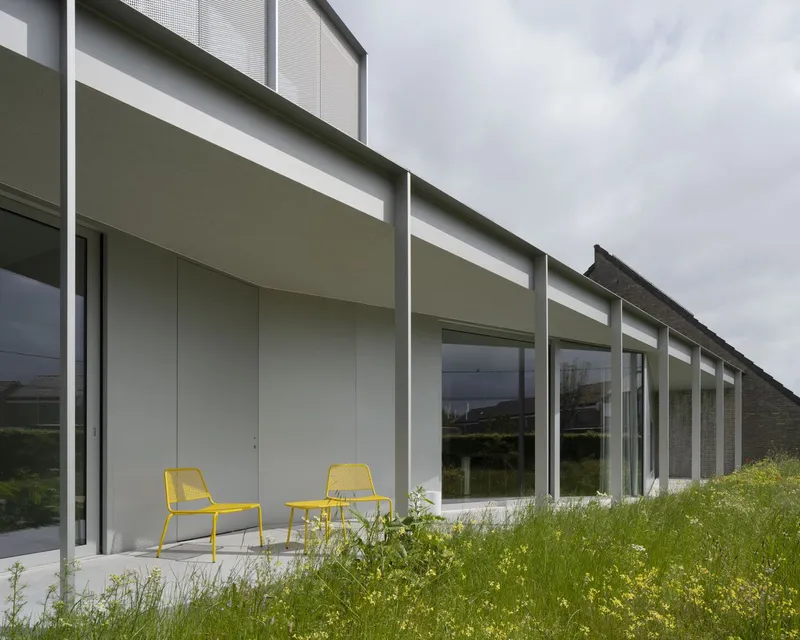
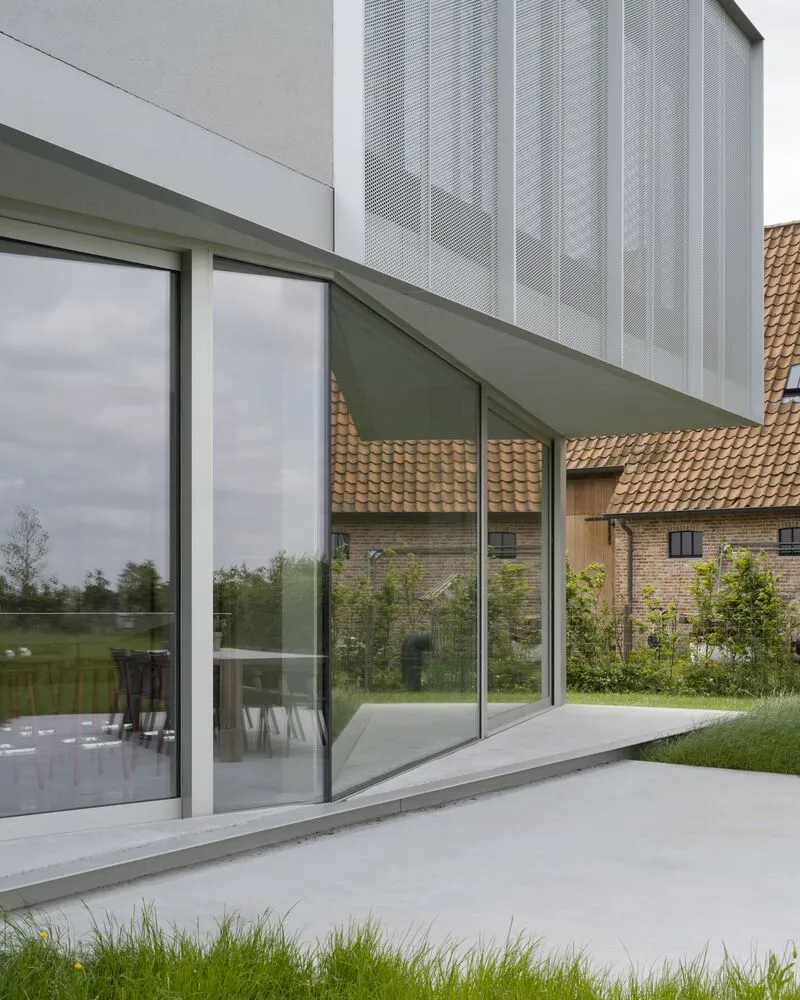
The cantilevered upper volume shelters a deep covered terrace that serves as the primary social threshold. Yellow chairs punctuate the concrete deck, a deliberate color accent that reads against the white walls and the green meadow. Sliding glass corners retract to merge kitchen and terrace into one continuous surface, and the tall wildflower meadow creates a sense of enclosure that is soft rather than hard: you are screened from neighbors by plants, not walls.
This ambiguity between shelter and exposure is the project's strongest spatial idea. Even on an overcast day, the corner glazing bounces reflections of surrounding trees across the glass, so the boundary between reflected landscape and real interior dissolves. It is a house designed to be lived in with the doors open.
Dark Timber Joinery and Interior Warmth
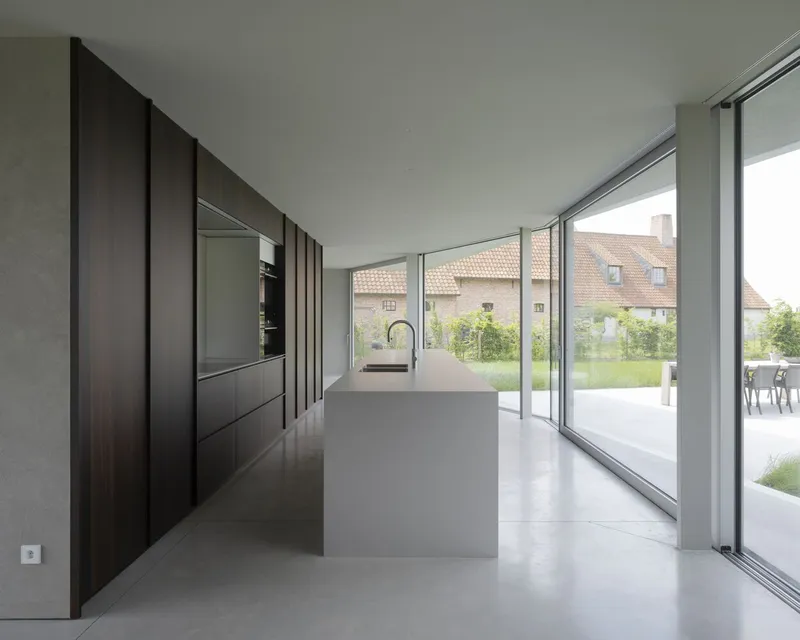
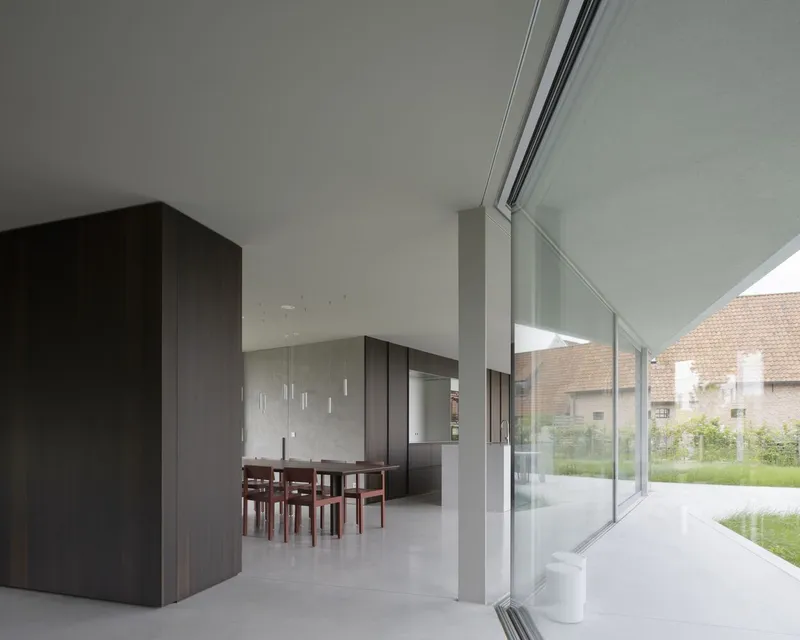
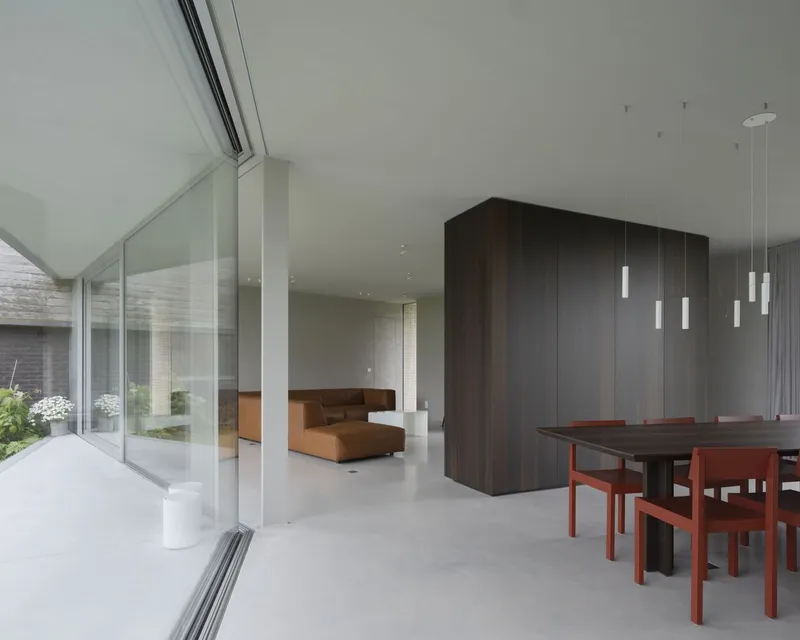
Step inside and the palette shifts. Where the exterior is white render and metal, the interior introduces dark timber joinery as the defining surface. Kitchen cabinetry, wall panelling, and a freestanding timber volume that divides the dining area from the lounge all use the same species, stained to a near-black finish. It provides warmth and visual weight to counterbalance the lightness of the glass walls, and it gives the open plan a sense of structure without resorting to solid partitions.
The kitchen island is white, long, and cantilevered off the timber volume like a countertop that floated free. Through the sliding doors behind it, the garden terrace is always visible, pulling the eye outside and keeping the plan feeling larger than its actual footprint.
Material Accents and Curated Details
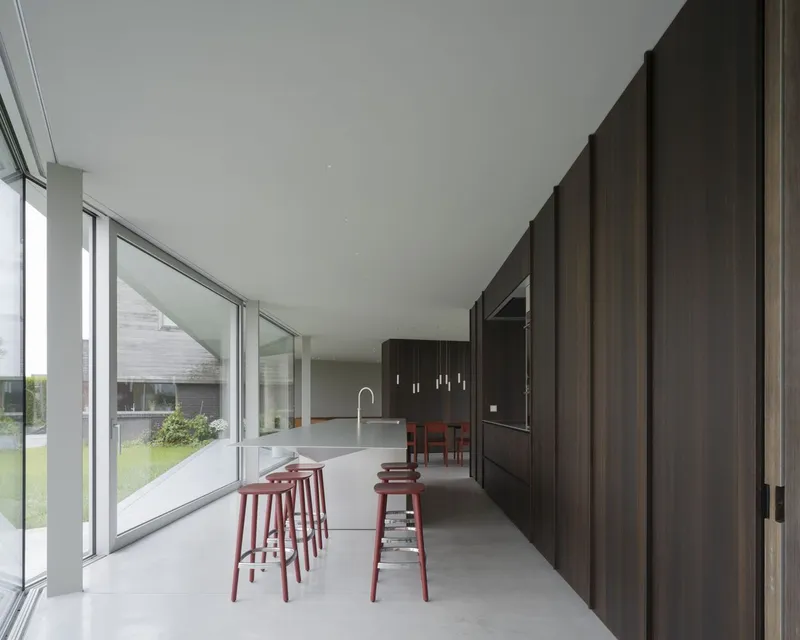
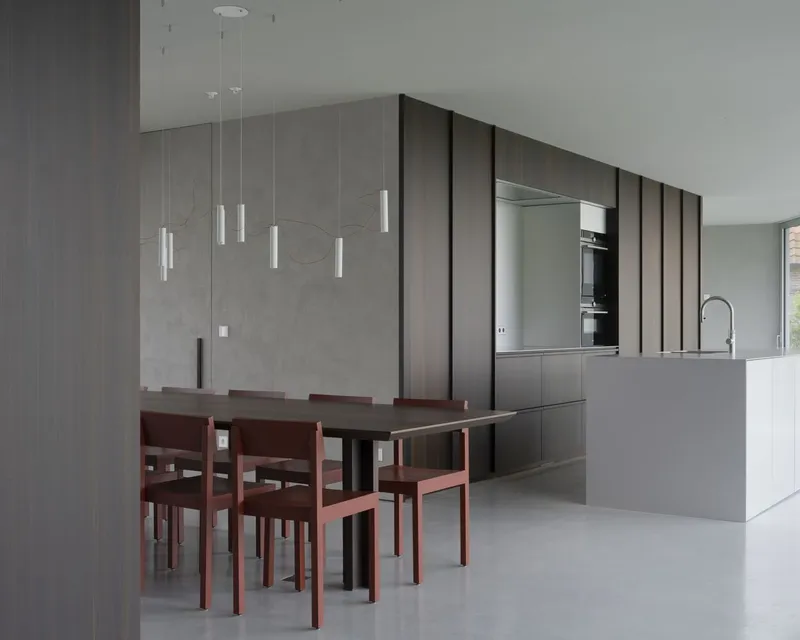
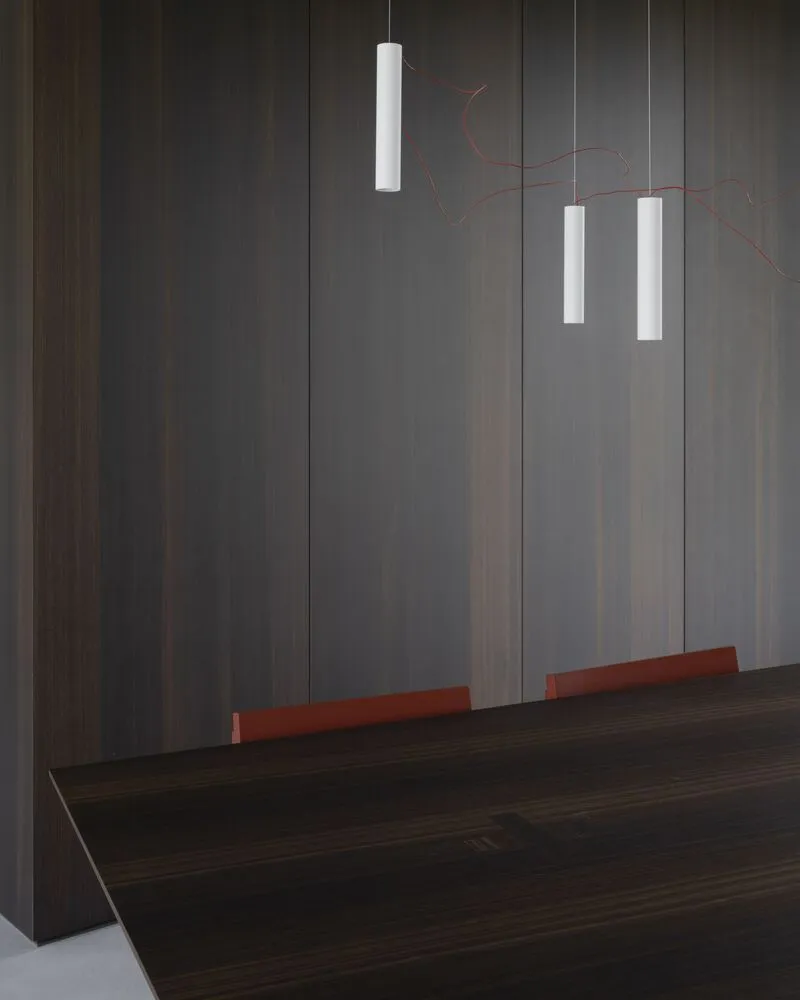
BASIL Architecture uses terracotta as a recurring secondary accent: bar stools at the kitchen counter, dining chairs, bathroom faucets. It is a warm, earthy tone that mediates between the coolness of the white surfaces and the darkness of the timber. The tubular pendant lights over the dining table, strung on red cloth cables, reinforce this palette without overdoing it. These are not decorative gestures layered on at the end. They feel integral to a color strategy that was planned from the start.
The detail of the pendant cluster against the dark timber wall panelling is particularly effective. The vertical grain of the wood, the horizontal line of the table, and the vertical drop of the pendants create a simple but satisfying composition that rewards close looking.
Corridors, Concealment, and Light
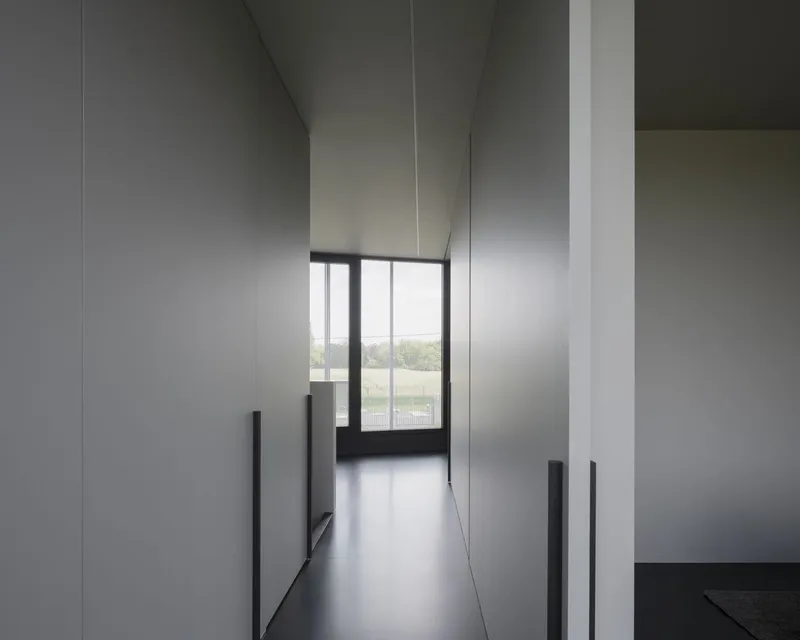
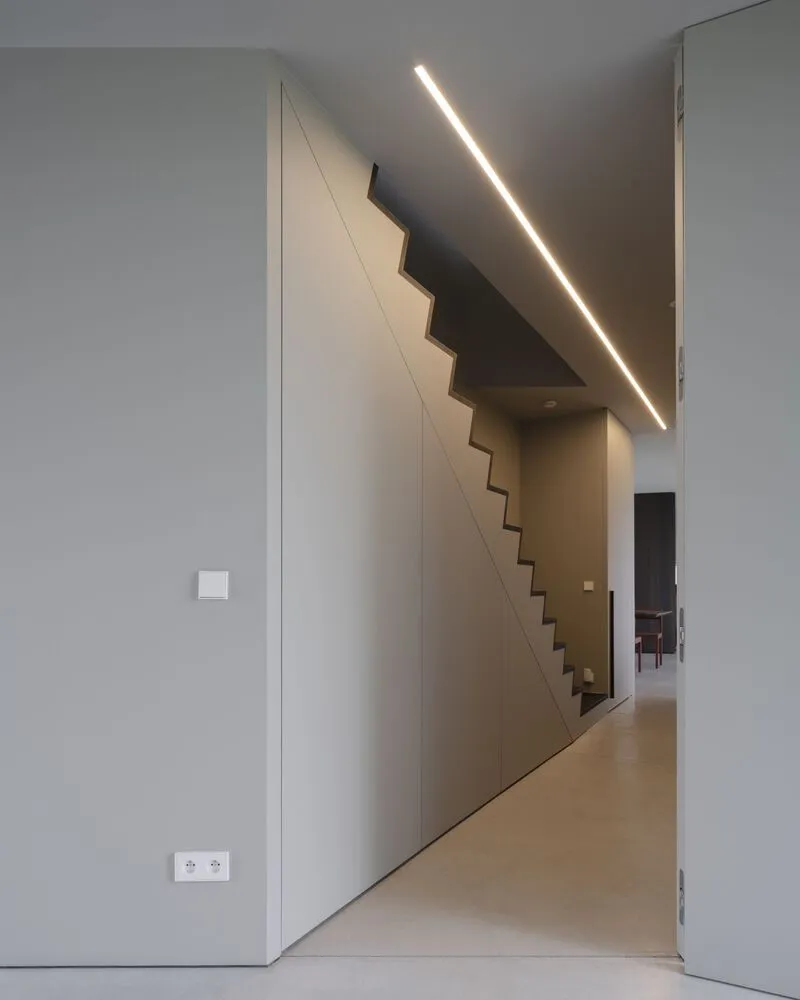
Circulation is handled with care. A corridor lined in floor-to-ceiling white panels terminates at a framed landscape window, turning a utilitarian passage into a compressed sequence that culminates in a view. The staircase is concealed behind angled white panelling, its presence signaled only by a recessed linear ceiling light. It is the kind of move that keeps the plan feeling calm and uncluttered, hiding the mechanics of vertical circulation so the open spaces can breathe.
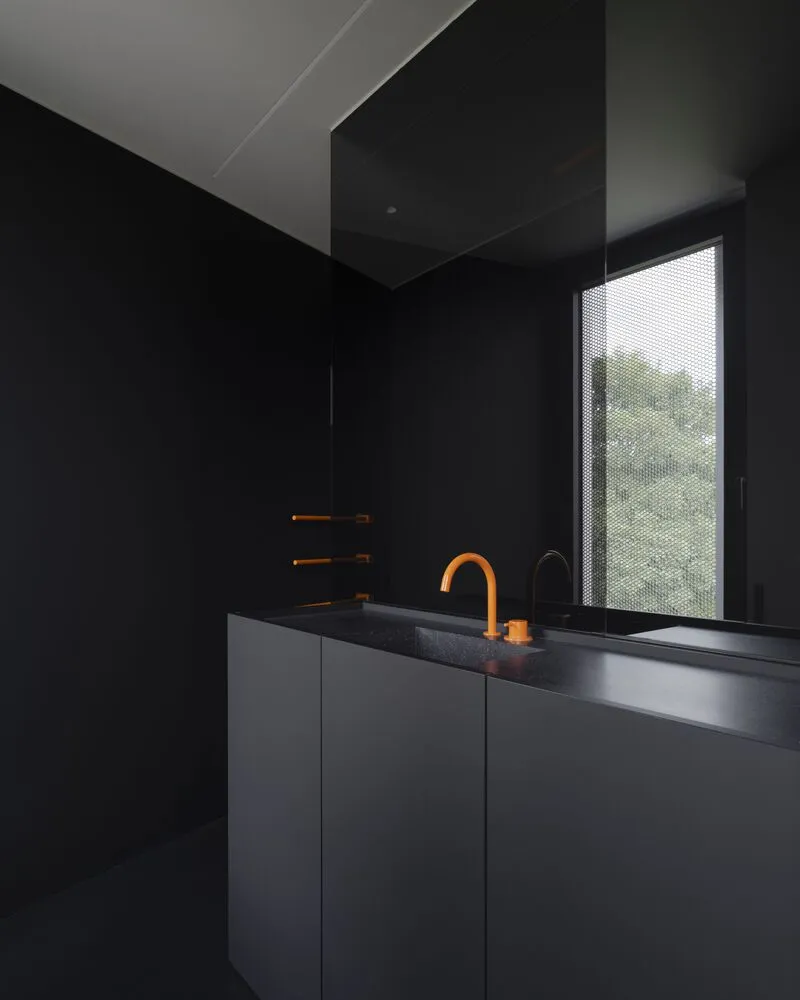
Even the bathroom participates in the architectural narrative. The vanity sits beside a perforated window screen that filters the garden view into a soft green haze, and a terracotta faucet ties back to the palette found downstairs. Privacy is achieved not through opacity but through calibrated translucency, consistent with the perforated logic of the exterior.
Plans and Drawings
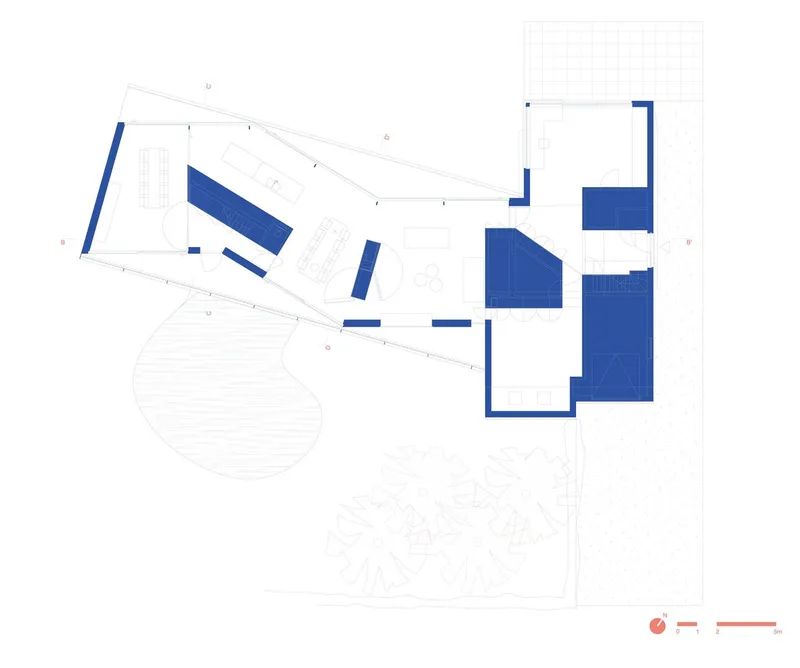
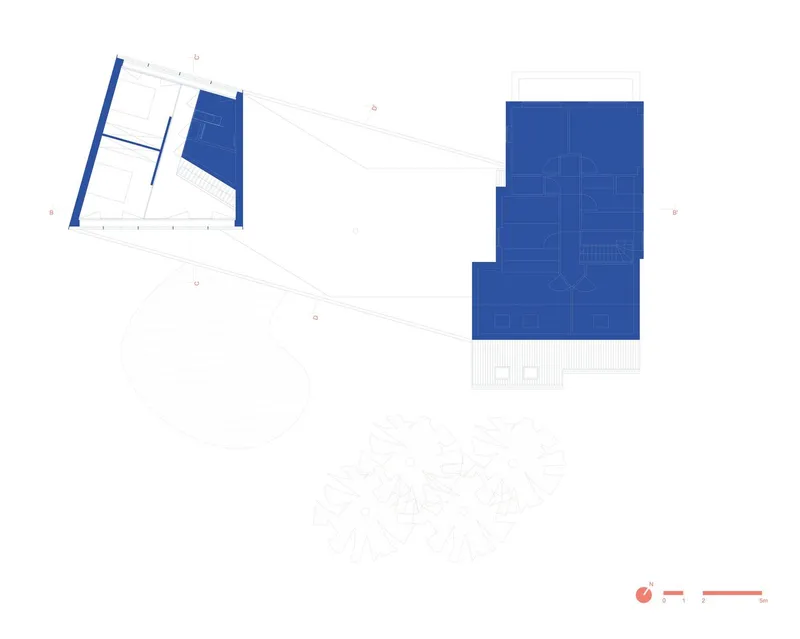
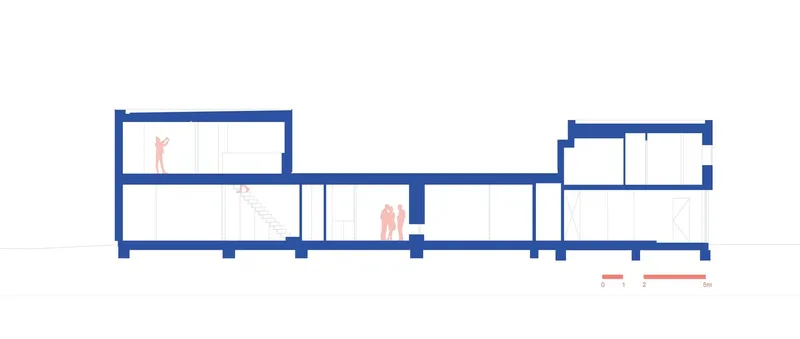
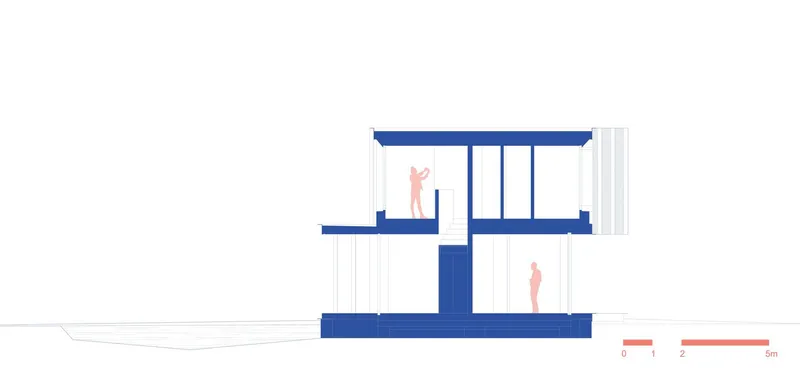
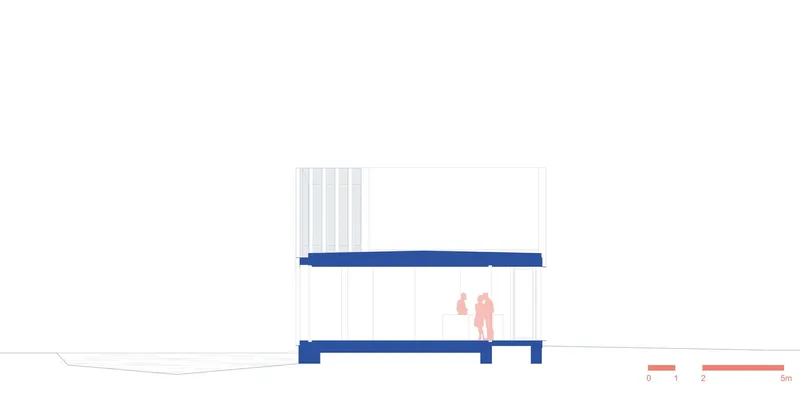
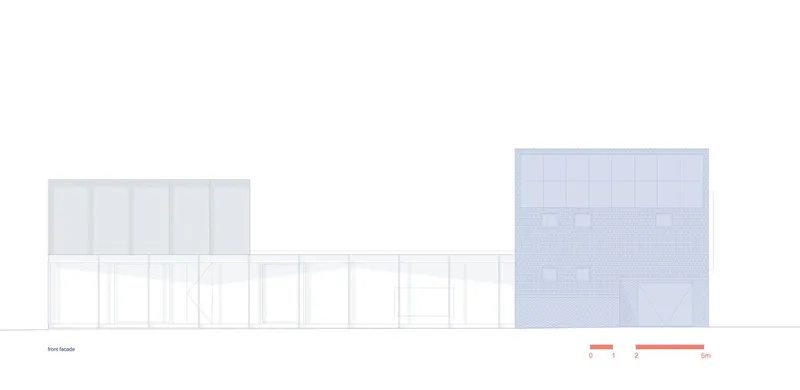
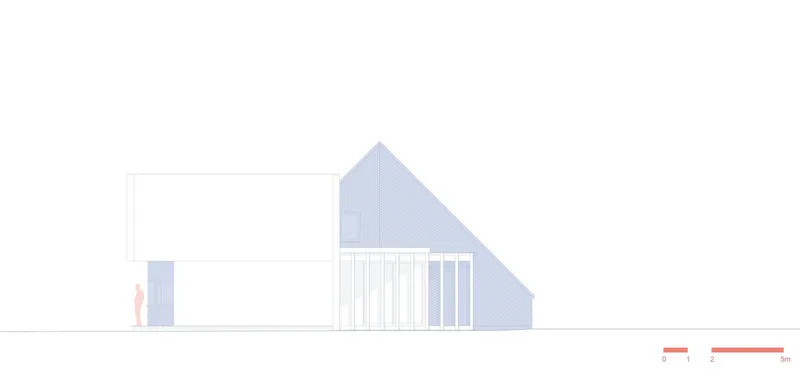
The floor plan confirms the courtyard-centric strategy: angular volumes radiate outward from a curved open-air room, with landscape threading between the gaps. The roof plan reveals the asymmetry of the composition, with a sloped linking element stitching the main volumes together. Sections show a split-level interior with offset floor plates connected by a staircase, explaining the unexpected spatial variety inside what reads from outside as a two-story box.
The elevations are perhaps most revealing. Each face of the building tells a different story: one shows the stacked horizontal volumes with vertical screening, another reveals a peaked gable form connected to a flat-roofed wing. House WADD is not a building that can be understood from a single image. The drawings make clear that its asymmetry is not accidental but deeply considered, with every angle calibrated to frame a view, shelter a terrace, or catch the light.
Why This Project Matters
House WADD is a convincing argument that domestic architecture does not need to choose between rigor and comfort. The perforated metal screens, the split-level sections, the angular plan geometry: these are precise, intellectually serious moves. But they serve a house that is plainly designed to be enjoyed, with terracotta stools, yellow chairs, and wildflowers at the door. That balance is hard to achieve, and BASIL Architecture gets it right.
More broadly, the project offers a model for contemporary suburban living that takes landscape seriously. The unmowed meadow is not a lazy gesture; it is a deliberate counterpoint to the architectural precision, a way of grounding the house in its site and reducing its visual impact. In a country where residential lots are often small and tightly packed, this strategy of fragmented volumes wrapped in filtered screens and wild planting suggests a way forward that is both ecologically responsible and architecturally compelling.
House WADD by BASIL Architecture, Belgium. Photography by Johnny Umans.
About the Studio
Share Your Own Work on uni.xyz
If projects like this are the kind of work you want to make, uni.xyz is a place to publish your own, find collaborators, and enter design competitions.


Popular Articles
Popular articles from the community


Cube Design Draws an Ecological Corridor Between Two Shenzhen Hills with the Nankai Building
Beside Shenzhen's container docks, the Nankai Building pairs stacked balconies with a climbing green screen to connect two hillsides across its height.

Juan García Correa, John González and Claudia Rueda Sink a Circular Amphitheater into a Manizales Engineering Building
On the La Nubia campus in Manizales, Colombia, the S1 Building folds labs and offices into a hillside of ramped lawns that double as a campus route.

longwave studio Reorganizes a 112 m² Tainan Apartment Around the Daily Routines of a Family and Two Cats
In Tainan, Taiwan, birch plywood, rust-red furniture and a freestanding plaster wall link arrival, storage, work and family life in one apartment.

David Macias Steps a Doorless Stone and Plaster House Down a Tropical Colombian Hillside
In the humid hills of Colombia, Threshold House replaces the front door with an open void and terraces its 850 m² down the slope instead of fighting it.

Similar Reads
You might also enjoy these articles


Hodi-Mandai Geram
Project Function: Preservation and revitalization of the Intangible heritage and socio-spatial identity of the Hodi by Housing, Cultural Memory Center, Sacred Grove, landscape, local tourism economy


Olio Towers: A Mid-Rise for Performers That Fuses Housing, Rehearsal, and Stage
Located blocks from Houston's Theater District, this modular tower stacks living units around a central performance atrium.

Oasis: Modular Green Housing Carved into Dhaka's Urban Fabric
A shortlisted Plugin Housing entry reclaims unauthorized settlements in Dhaka with stepped concrete volumes, green roofs, and ventilation-driven design.

Black Hole: A Floating Megastructure for the Post-Physical Era
Emiliano Mazzarotto envisions a spherical, self-scaling arena where e-sports, digital hotels, and holographic stadiums replace traditional public space.

Explore Architecture Competitions
Discover active competitions in this discipline

Challenge to reimagine the Iron Throne

Photograph architecture without architects

Illustrate the lost glory of Angkor Wat - Render Challenge

Design challenge to reuse E-waste
Comments (0)
Please login or sign up to add comments
No comments yet. Be the first to comment!