
007studio Layers Gardens and Gabion Walls to House Three Generations in Central Vietnam
On a trapezoidal lot in Hà Tĩnh, HT House channels traditional Vietnamese spatial sequences through a modern concrete and stone volume.


Multigenerational housing in Vietnam carries a weight that most Western residential briefs simply do not. A grandmother, a couple, and three children must coexist under one roof without friction, which means the architecture cannot rely on a single open plan or a tidy row of bedrooms. It must negotiate proximity and privacy at every turn. 007studio, led by architect Nguyen Dinh Thang, took on exactly that problem with HT House: a 238 square meter residence tucked into a quiet alley in Hà Tĩnh, built on a trapezoidal plot that refuses to cooperate with orthogonal thinking.
What makes HT House worth studying is its commitment to a sequential spatial logic borrowed from traditional Vietnamese domestic architecture. The progression from front garden to front porch to living room to dining room to back porch to back garden is not a nostalgic gesture. It is a climate strategy, a noise buffer, and a social organizer rolled into one continuous section. Every layer between street and sky does real work, and the result is a house that feels significantly larger and more generous than its footprint suggests.
Street Presence and the Gabion Boundary

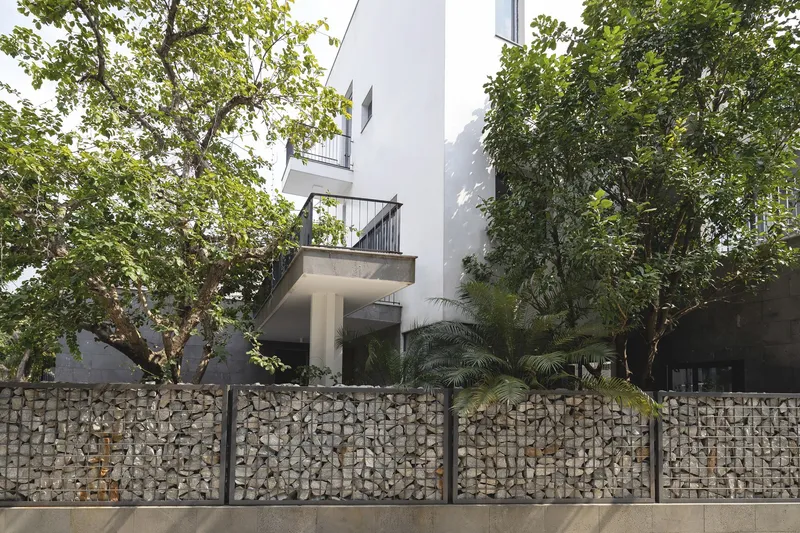
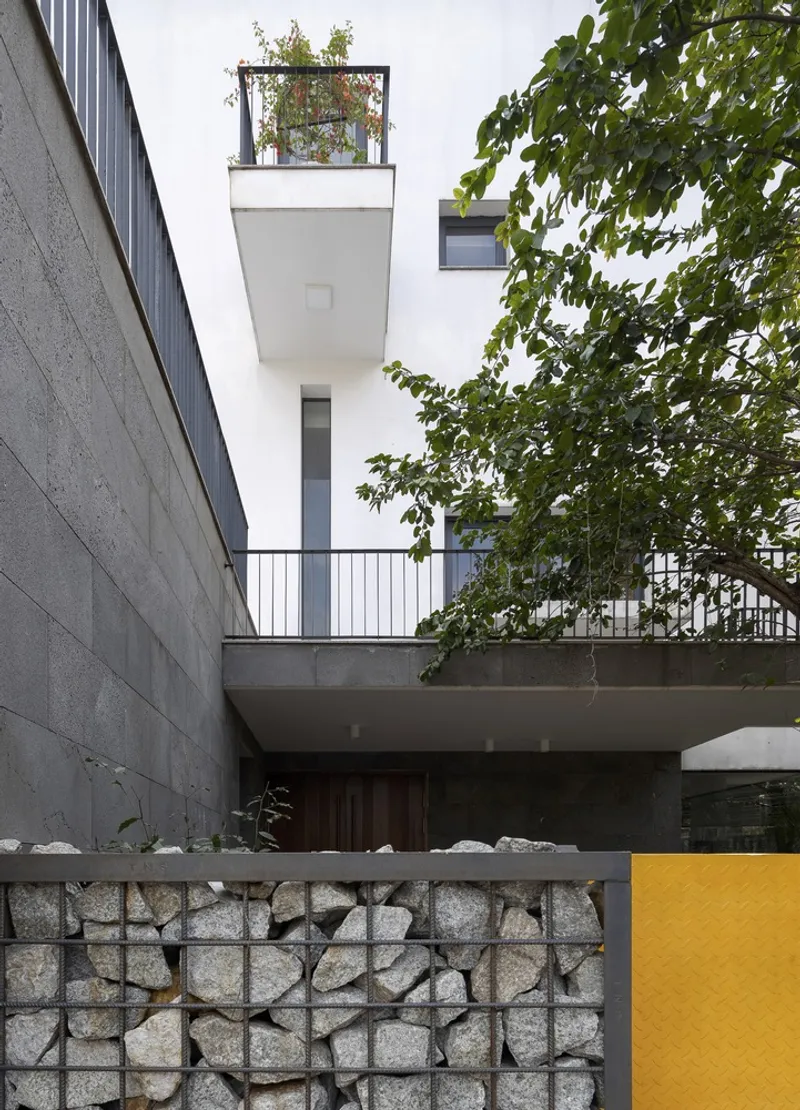
The street facade is deliberately understated. A concrete garage base grounds the composition while a white rendered volume rises above, its mass broken by cantilevered balconies that push outward into the tree canopy. The real character, though, comes from the gabion walls that wrap the lower perimeter. These cages of local stone establish a boundary that is neither hostile nor permeable. They filter views, absorb sound from the alley, and age gracefully in a climate that punishes smooth surfaces.
A yellow panel set against the gabion on one side adds a deliberate pop of color, a small signal that someone thought carefully about what you see when you walk past. The overall effect is of a house that belongs to its neighborhood rather than towering over it, despite reaching three stories. Mature trees already on the site were kept, and the architecture steps around them rather than demanding a clean slate.
The Vertical Garden Section


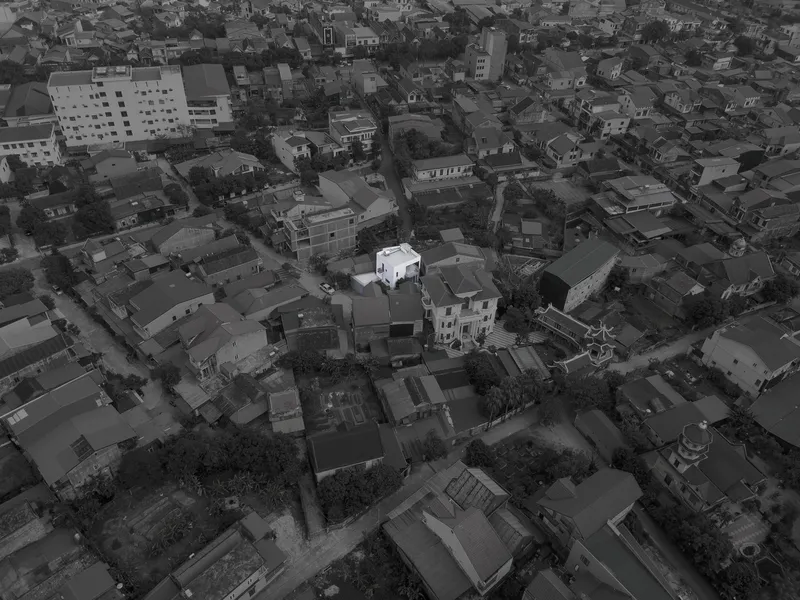
Seen from above, HT House is a white cubic form wedged into a dense tapestry of neighboring rooftops. The aerial perspective reveals just how tight the urban grain is in this part of Hà Tĩnh, and it makes the gardens threaded through the house all the more impressive. Planted terraces step up the facade, turning the building into a vertical landscape where each level has its own relationship to greenery.
The gabled volume at the top reads almost like a separate pavilion, an attic room floating above terraces thick with palms and ferns. Terrazzo cladding on the terrace surfaces provides a textured, low maintenance finish that contrasts cleanly with the white render. From the street, the layered planting and cantilevered slabs create a composition that changes with every angle, never settling into a single readable elevation.
Courtyards and Dappled Light

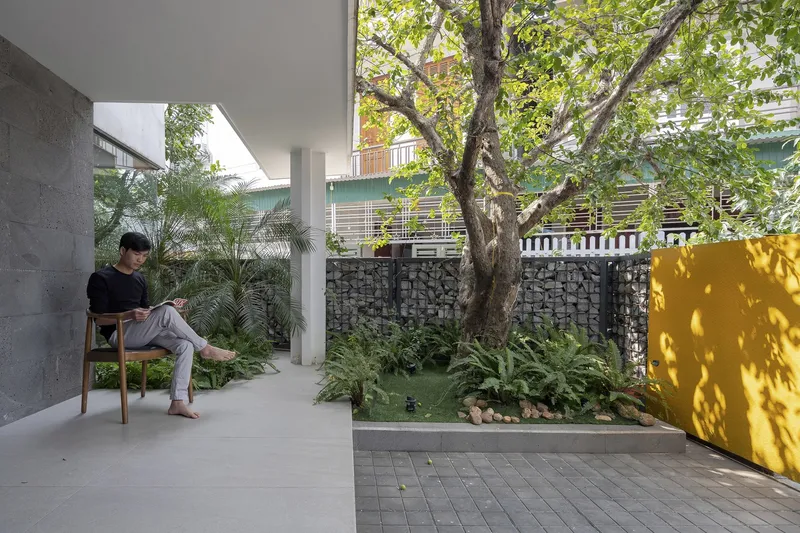
The internal courtyards are where HT House earns its reputation as a climate-responsive design. Floor-to-ceiling glazing opens directly onto planted voids filled with palms and ferns, pulling dappled light deep into the plan. In central Vietnam, where summers are brutally hot and monsoon rains hammer for months, these planted pockets act as thermal buffers. They shade glass surfaces, channel breezes through the section, and give every room something green to look at.
A covered terrace at ground level, framed by gabion walls and garden beds, offers a transitional zone that is neither fully inside nor outside. A person seated here is sheltered from rain but exposed to air movement and birdsong. It is exactly the kind of space that traditional Vietnamese houses excelled at creating, and 007studio translates it into a concrete frame without losing the essential quality of pause between thresholds.
The Dark Timber Stair as Spine
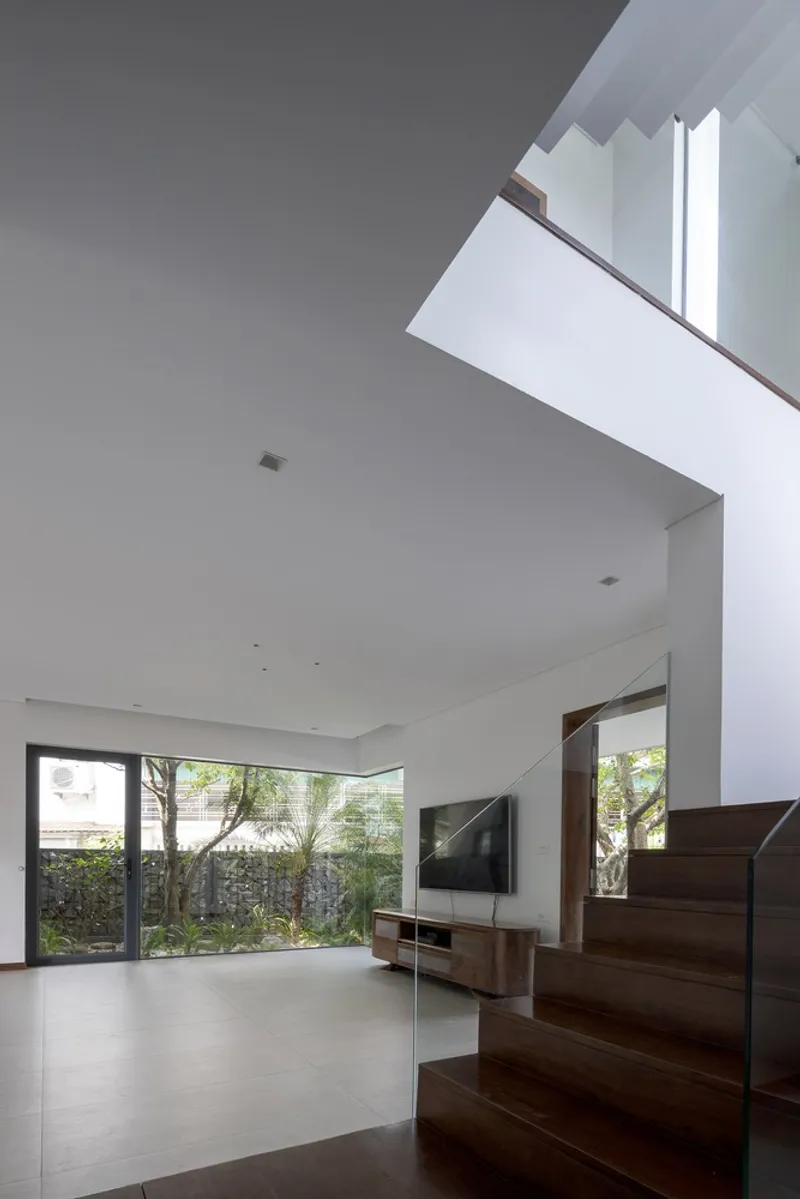
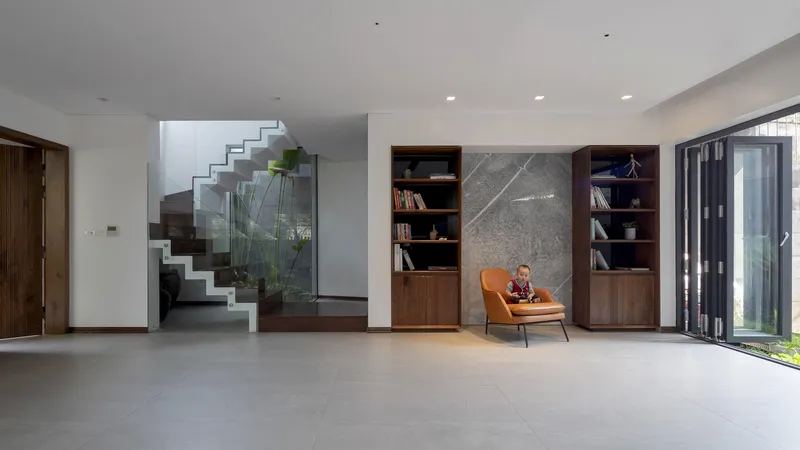
Inside, a dark timber staircase rises through a double-height void, acting as the vertical spine that connects all three floors. A skylight above washes the stair in natural light, turning what could be a utilitarian circulation element into the most dramatic moment in the house. The timber is warm against the white walls and polished concrete floors, grounding the palette and giving the interior a tactile richness that photographs only partially convey.
The ground floor plan flows openly from living to dining to kitchen, with the staircase set behind glass so it reads as a visual event from the main social space. An orange accent chair positioned nearby hints at a family that actually uses this room rather than treating it as a showpiece. The elevator, tucked discreetly into the plan, ensures the grandmother can reach every level without negotiating stairs, a practical detail that is easy to overlook but essential for genuine multigenerational comfort.
Night Readings

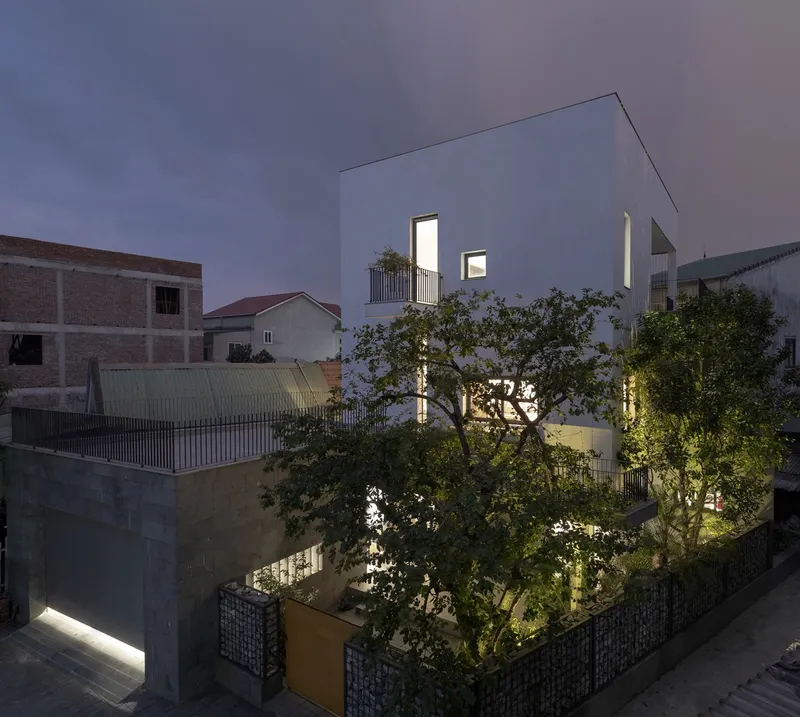
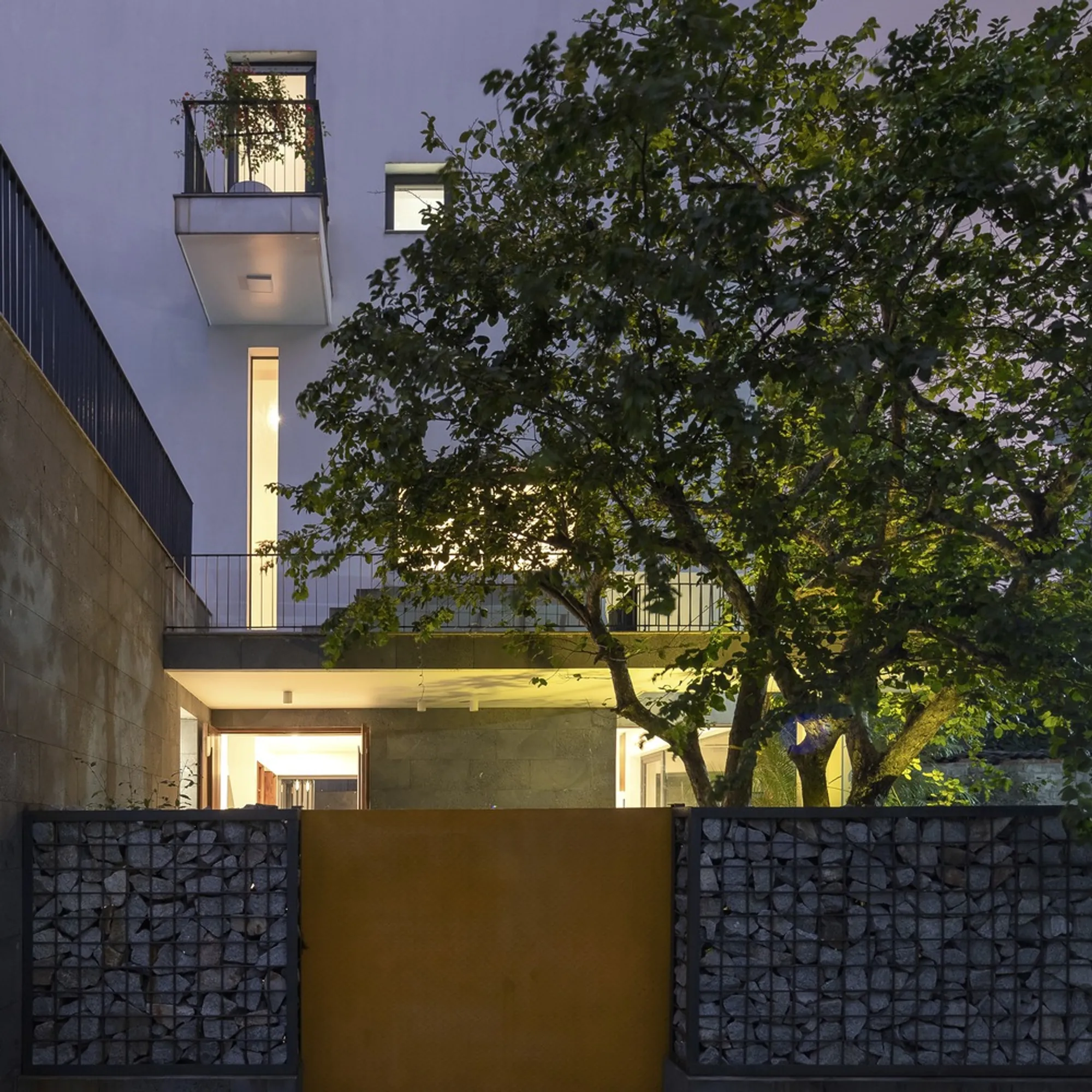
At twilight, HT House transforms. Warm artificial light spills through openings and terraces, revealing the section in ways that daylight obscures. The rear elevation, with its white tower and cantilevered terrace hovering above the gabion boundary wall, becomes almost sculptural against a darkening sky. The layered volumes read clearly: solid base, planted middle, light upper pavilion.
The night views also expose how carefully 007studio controlled the relationship between solid and void. Lit from within, the house glows without exhibitionism. Privacy is maintained by the depth of the terraces and the screening effect of mature trees, so the family lives comfortably behind layers of green and stone rather than behind curtains.
Plans and Drawings
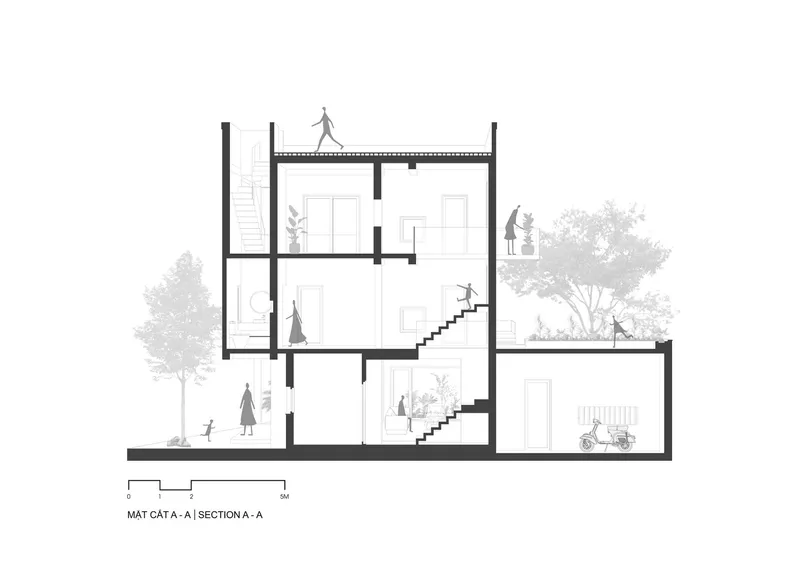
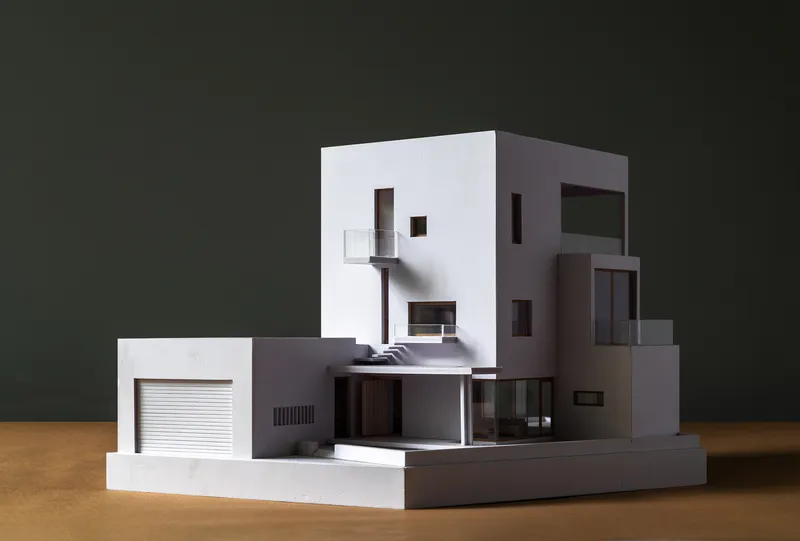
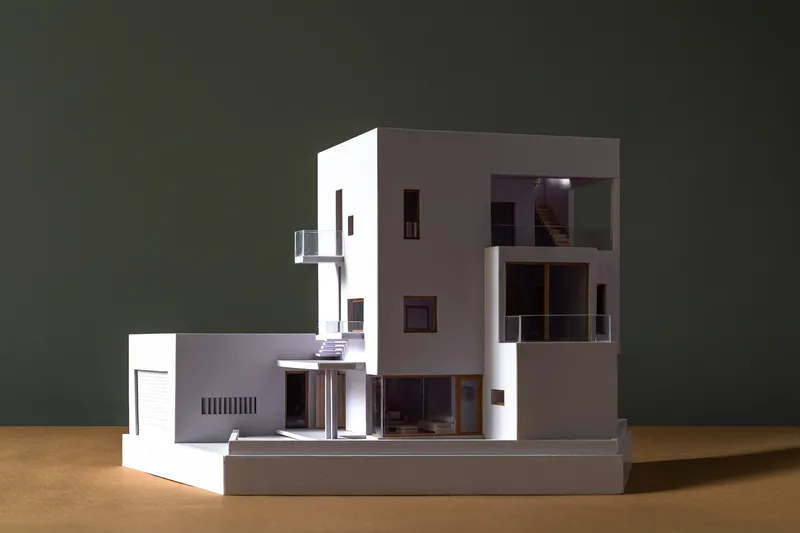
The section drawing confirms what the photographs suggest: every floor is offset or setback to create terrace space, and the staircase knits the section together while a generous void above it pulls light down through the core. Trees drawn at full mature height on both the front and rear boundaries show that the landscape was integral to the architectural concept from the start, not an afterthought applied to finished elevations.
The physical models reveal the interlocking volumes and punched openings with a clarity that renders and photos sometimes flatten. When illuminated, the model shows light penetrating through cuts and voids exactly as it does in the built house. It is a useful reminder that 007studio worked through the spatial layering in three dimensions early in the process, testing how each opening would perform before committing to concrete.
Why This Project Matters
HT House matters because it takes one of the most common briefs in Vietnamese residential architecture, a multigenerational family on a tight urban lot, and resolves it without resorting to either cramped pragmatism or wasteful showmanship. The sequential garden-to-garden section is a direct response to climate and culture, borrowed from tradition but executed in contemporary materials. Gabion walls, planted terraces, and deep porches are not decorative themes; they are the building's environmental strategy.
007studio demonstrates that a 238 square meter house on a trapezoidal plot in a provincial Vietnamese city can be genuinely inventive. The discipline here is in the section: every floor trades footprint for outdoor space, and the result is a house where no room feels landlocked. For architects working on similar briefs across Southeast Asia, HT House offers a clear, replicable lesson. Layer your transitions, keep your trees, and let the climate do half the work.
HT House by 007studio, Hà Tĩnh, Vietnam. 238 m², completed 2019. Lead Architect: Nguyen Dinh Thang. Architecture Design: Le Quy Thien, Dinh Quoc Tam. Photography by Trieu Chien.
About the Studio
Share Your Own Work on uni.xyz
If projects like this are the kind of work you want to make, uni.xyz is a place to publish your own, find collaborators, and enter design competitions.



Popular Articles
Popular articles from the community


Co-life: Sustainable Architecture for Age-Friendly Community Living
Co-life reimagines sustainable architecture for seniors through courtyards, rammed earth, shared gardens, and spaces designed for belonging.

Conexión: Biophilic Design Reimagines High-Rise Living in Hong Kong
Conexión reimagines high-rise living in Hong Kong through biophilic design, green facades, shared spaces, daylight, water and nature within.

Hill & Cross Opera: Sculptural Opera House Architecture Shaped by Tallinn’s Landscape and Identity
Hill & Cross Opera reimagines opera house architecture in Tallinn through its sculptural hill, civic plaza, glass wave and a luminous cross.

Co-Life: Senior Housing Design That Reconnects Older Adults With the City
Co-Life reimagines senior housing design through healing gardens, shared streets, workshops, and a sustainable community across generations.


Similar Reads
You might also enjoy these articles


Hodi-Mandai Geram
Project Function: Preservation and revitalization of the Intangible heritage and socio-spatial identity of the Hodi by Housing, Cultural Memory Center, Sacred Grove, landscape, local tourism economy


Olio Towers: A Mid-Rise for Performers That Fuses Housing, Rehearsal, and Stage
Located blocks from Houston's Theater District, this modular tower stacks living units around a central performance atrium.

Oasis: Modular Green Housing Carved into Dhaka's Urban Fabric
A shortlisted Plugin Housing entry reclaims unauthorized settlements in Dhaka with stepped concrete volumes, green roofs, and ventilation-driven design.

Black Hole: A Floating Megastructure for the Post-Physical Era
Emiliano Mazzarotto envisions a spherical, self-scaling arena where e-sports, digital hotels, and holographic stadiums replace traditional public space.


Explore Housing Competitions
Discover active competitions in this discipline



Challenge to reimagine the Iron Throne


Photograph architecture without architects


Illustrate the lost glory of Angkor Wat - Render Challenge


Design challenge to reuse E-waste
Comments (0)
Please login or sign up to add comments
No comments yet. Be the first to comment!