

Baumschlager Eberle Wraps a Vietnamese Lock Factory in a Climate-Tuned Concrete Veil
A 30,000-square-meter industrial campus near Hanoi uses angled concrete fins to fight monsoon heat and earn LEED Gold certification.


Factories rarely earn a second glance, let alone a magazine spread. The Huy Hoang Lock Factory, completed in 2024 on a three-hectare parcel in the Quang Minh Industrial Zone roughly 20 kilometers north of Hanoi, is the exception. Designed by Baumschlager Eberle Architekten, the 30,000-square-meter campus houses German and Italian manufacturing lines for one of Vietnam's leading lock producers, but it reads more like a civic institution than an assembly plant. The entire envelope is wrapped in a system of vertical concrete fins whose density, angle, and rhythm shift from elevation to elevation, responding directly to Hanoi's humid tropical monsoon climate. The result is a building that cools itself, protects itself from driving rain, and still lets enough daylight through to make an interior canteen feel like a gallery.
What makes the project genuinely interesting is that the passive strategy is not cosmetic. The fin angles exceed 90 degrees on the north facade to deflect cold winter winds, open wide on the south and southeast to invite cross-ventilation, and stack at their highest density on the west to block the worst afternoon thermal radiation. Every orientation has a different recipe. That discipline earned the campus LEED Gold certification for both construction and operation, a rare dual achievement for an industrial building in Southeast Asia. And because Huy Hoang Lock Co., Ltd. wanted the complex to celebrate 40 years of manufacturing history, the program stretches well beyond production: a museum hall, exhibition spaces, training rooms, a restaurant, and generous public landscapes turn the campus into something closer to an open park than a fenced compound.
A Facade That Thinks in Degrees
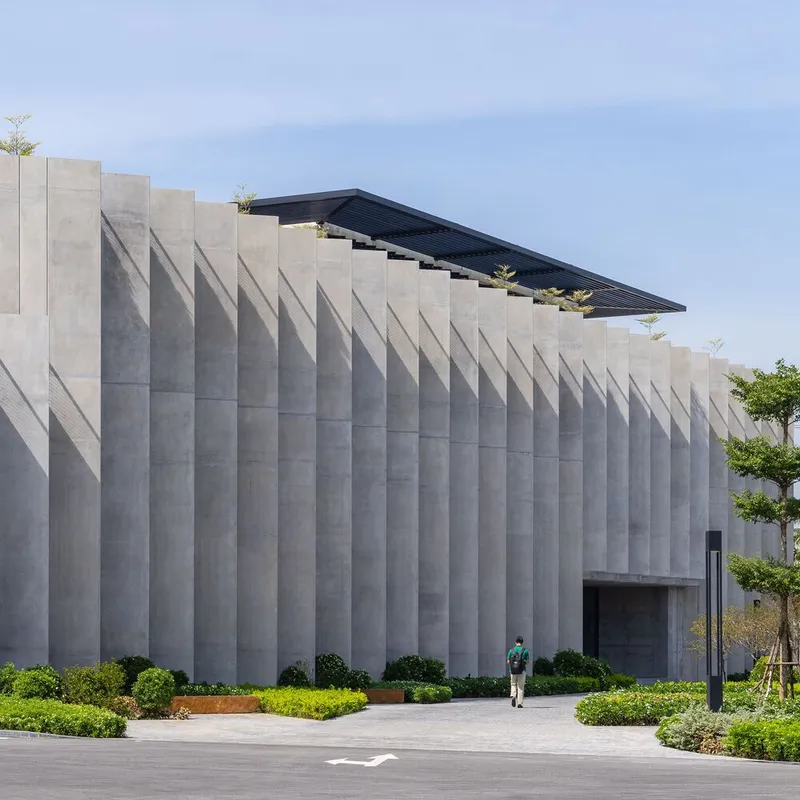

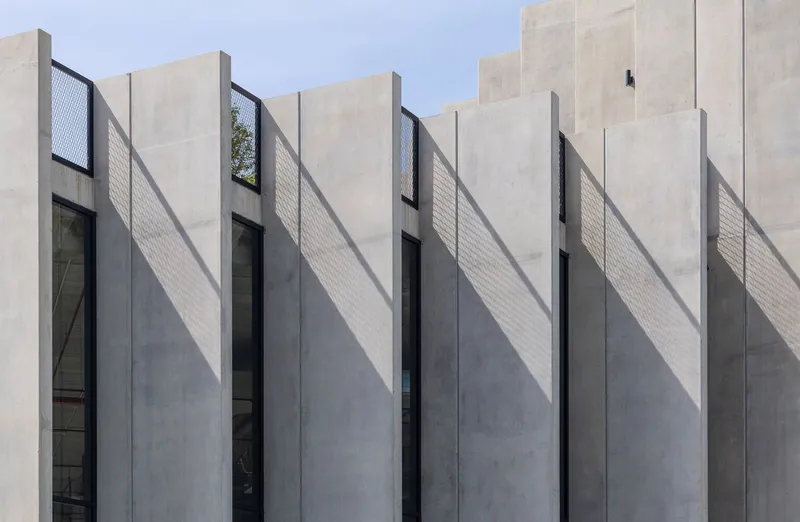
The concrete louver system is the building's signature and its hardest-working element. At ground level, the fins read as a monolithic colonnade, their deep reveals pulling visitors toward recessed entrances. Step back and the logic reveals itself: fins tilted south pull breezes inward, while those facing west are canted sharply and packed together, creating an almost solid wall that rejects solar gain during the hottest hours. The interplay between density and angle produces a facade that looks different from every cardinal direction, yet holds together as a single material gesture.
Because the fins are cast concrete rather than metal cladding, they carry real thermal mass. They absorb heat slowly during the day and release it at night, smoothing out the temperature swings that plague lightweight industrial enclosures. On overcast monsoon days the effect is subtler: the fins break wind-driven rain before it reaches the glazing behind, allowing windows to stay open longer and extending the hours of natural ventilation. It is a low-tech idea executed with high precision.
The Stepped Volume and Its Rooftop Gardens
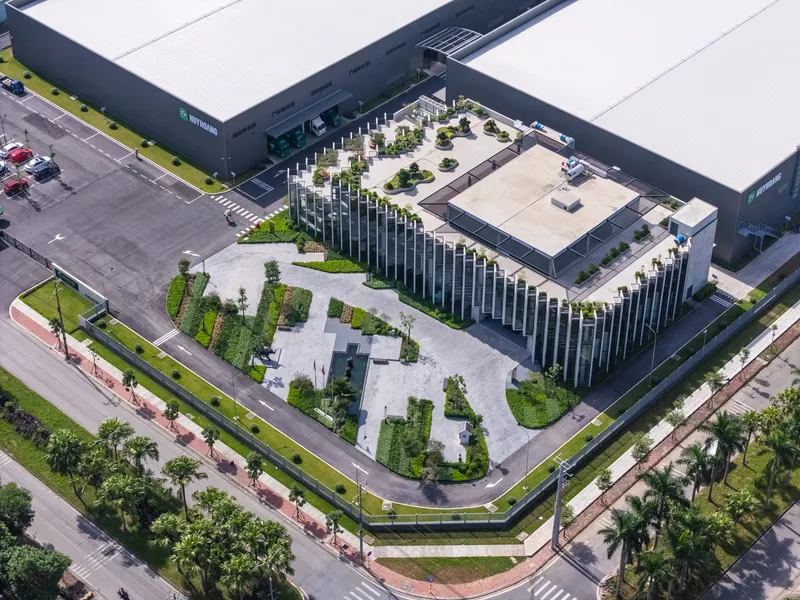
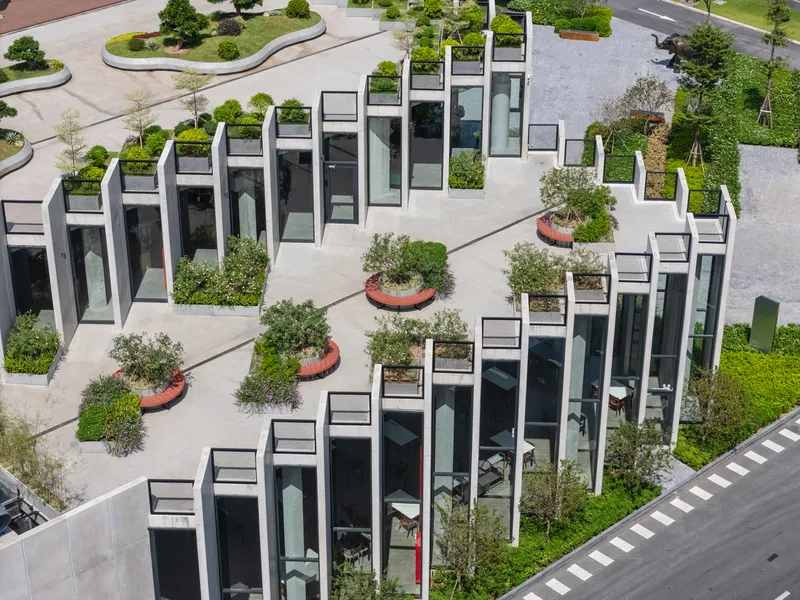
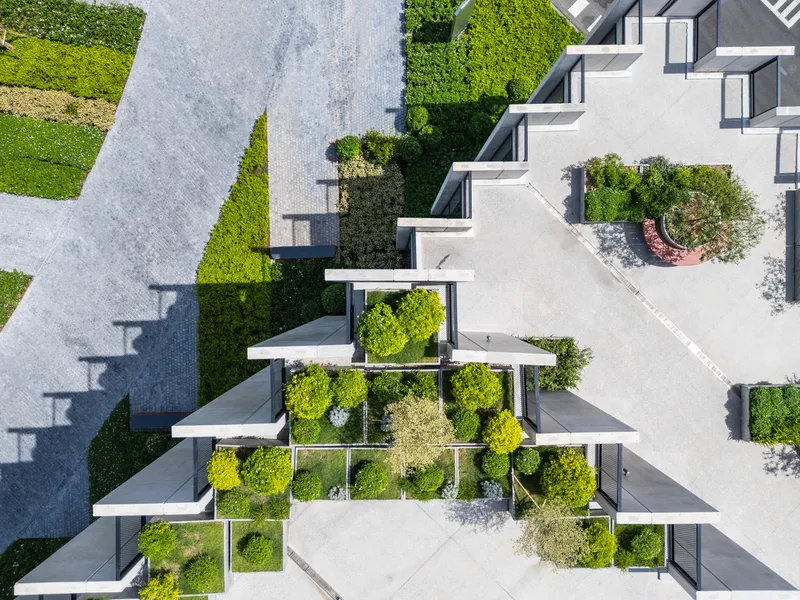
From the air, the campus reveals a second layer of climate strategy. The operating building steps down in terraces, each level holding planted beds set into concrete paving. Circular tree planters punch through the rooftop slabs, adding shade and reducing the heat-island effect that plagues Vietnamese industrial zones. The sawtooth roofline of the adjacent production halls catches north light for the manufacturing floor while channeling rainwater toward collection points.
These rooftop gardens are not decorative afterthoughts. They insulate the slab below, manage stormwater runoff, and provide breakout spaces for office workers whose desks sit on the floors directly underneath. In a country where factory workers often spend breaks in parking lots, the gesture is quietly radical.
Light, Shadow, and the Dining Hall
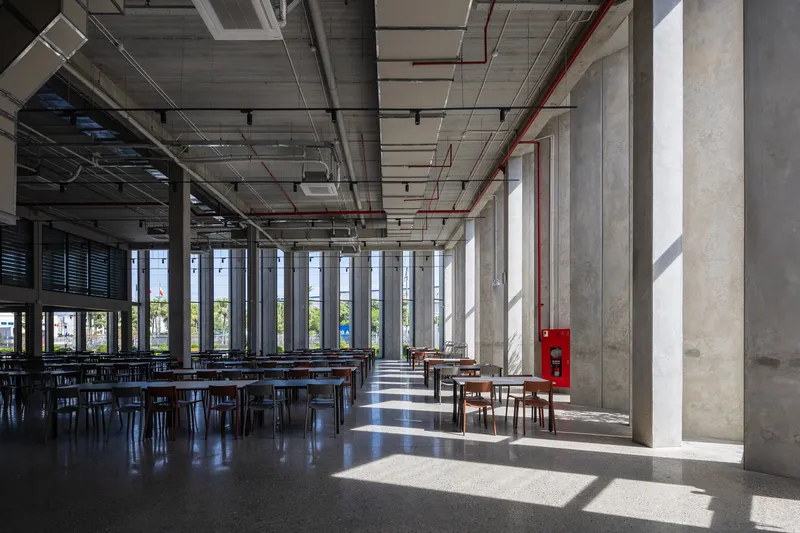


Inside the restaurant and canteen, the fin facade performs its most theatrical trick. As the sun tracks across the sky, light slices between the concrete blades and sweeps across exposed columns and polished floors, turning lunch into a slow-moving light show. The tall concrete columns that structure the interior echo the rhythm of the external fins, creating a visual continuity between envelope and structure that makes the space feel larger and more coherent than its footprint suggests.
Floor-to-ceiling glazing behind the fins floods the dining hall with diffuse daylight, reducing the need for electric lighting during working hours. The canteen serves both factory workers and visiting guests, so the quality of the space carries a dual message: it tells employees their comfort matters, and it tells visitors that Huy Hoang takes its built environment as seriously as its manufacturing tolerances.
Public Campus, Not Private Compound
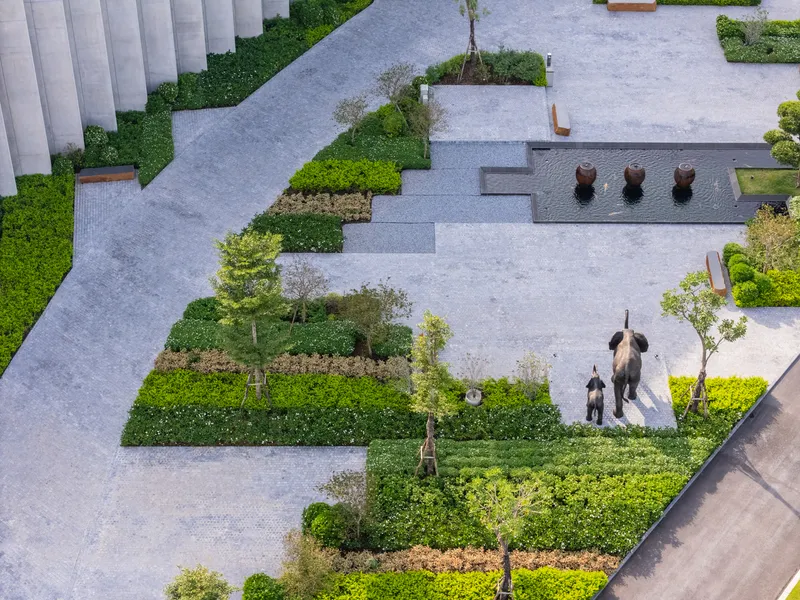
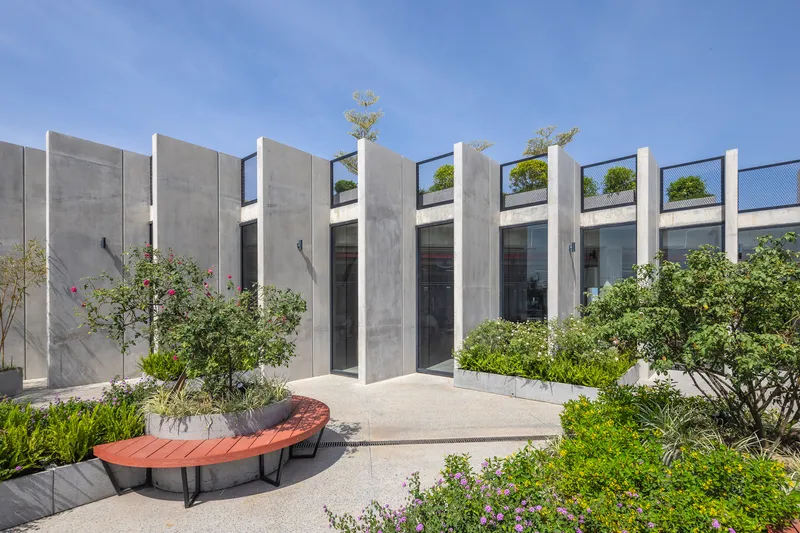
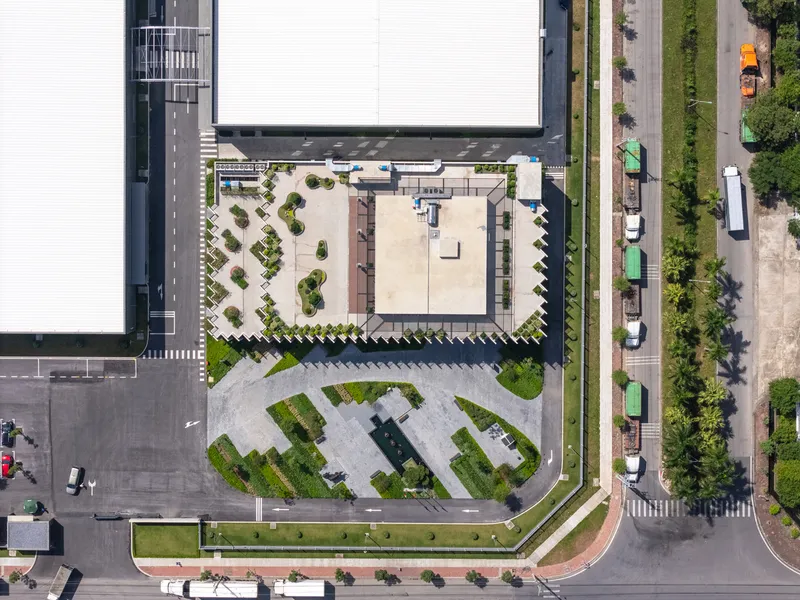
Most factories in Vietnam's industrial zones are walled off, accessible only to workers and delivery trucks. Huy Hoang's campus flips that expectation. A landscaped plaza with elephant sculptures and geometric planted beds welcomes visitors at street level. Curved benches sit among green pockets at the base of the fin facade, and the main hall doubles as a museum showcasing the company's four decades of lock-making history. The open campus concept is deliberate: the architects and client positioned public space as a core design priority, not a leftover.
Exhibition areas, training rooms, and offices occupy the third building on the campus, which connects to a multi-purpose structure at the front. The result is a gradient of access: fully public at the street edge, semi-public in the museum and restaurant, and private only where production lines demand it. That layering turns the factory into a local destination rather than a blank wall along the road.
Materiality and the Twilight Effect
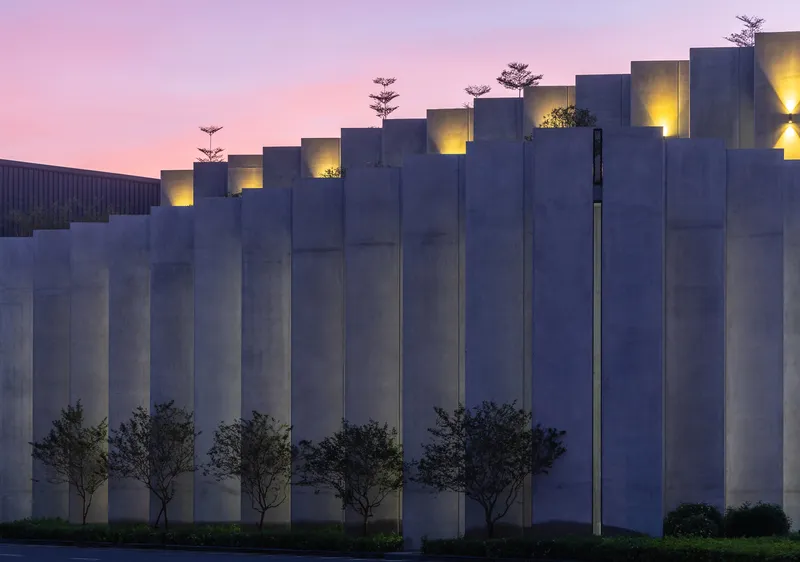
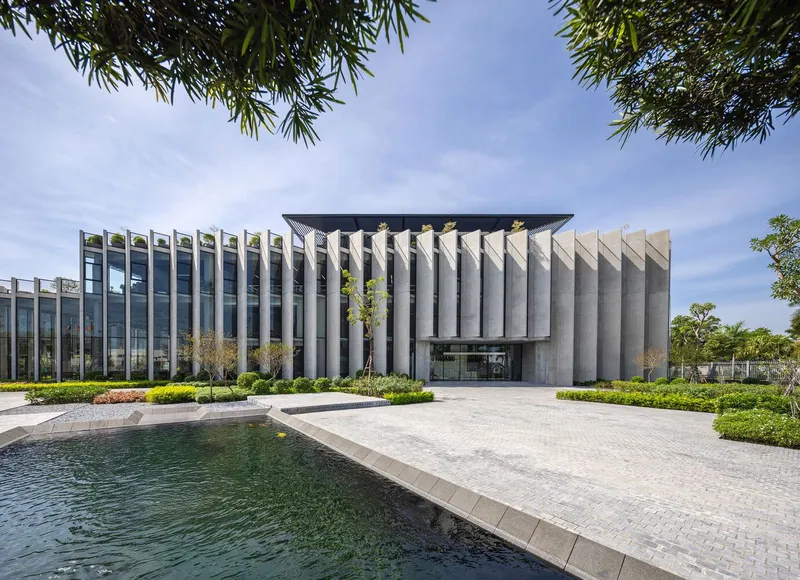
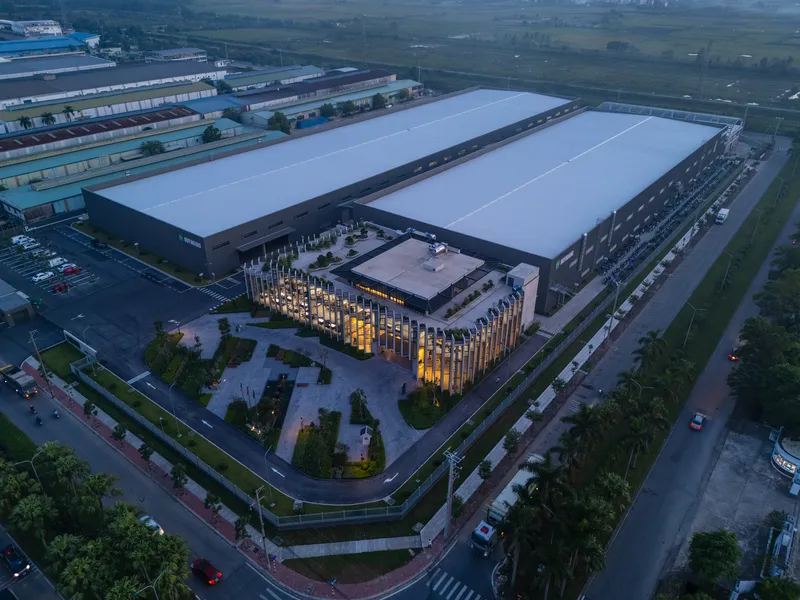
At dusk, the campus transforms. Recessed uplighting beneath the stepped fins turns the concrete blades into glowing ridges, and the reflecting pool at the main entrance mirrors the sawtooth roofline in a sheet of still water. The building shifts from a muscular daytime presence to something almost delicate, its mass dissolved by careful lighting placement. The pink tropical sky does half the work.
Concrete is the only cladding material, which keeps the palette honest and the maintenance straightforward. Over time, the tropical humidity will weather the surfaces unevenly, adding patina to the fins and softening the geometry. It is a material choice that accepts aging rather than fighting it, a rare quality in a region where glass curtain walls and painted aluminum panels dominate industrial architecture.
Detail and Texture Up Close
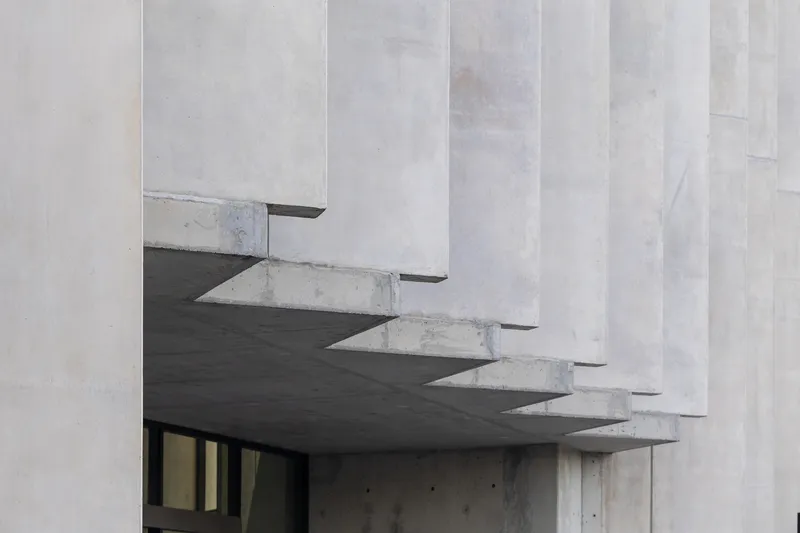
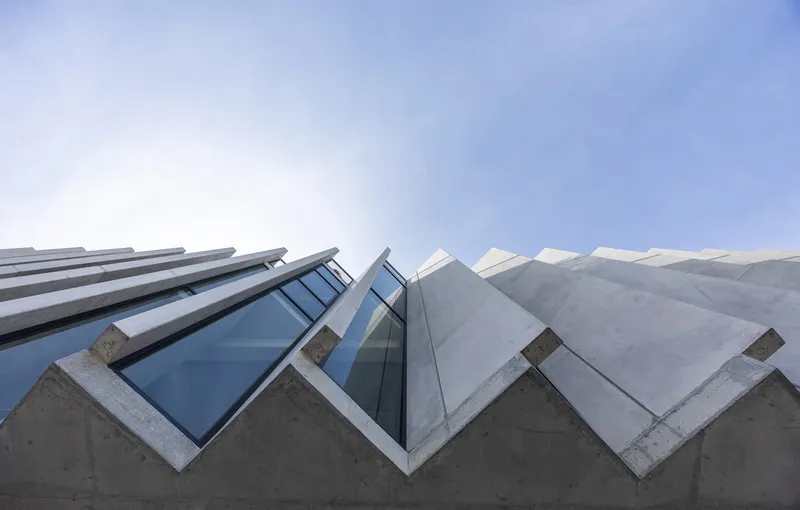
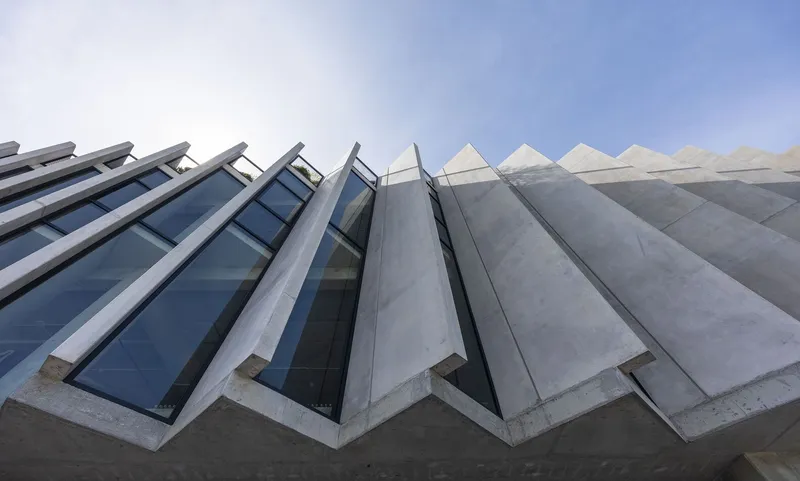
Seen from below, the sawtooth canopy reveals its structural logic: deep concrete overhangs shelter the glazed openings beneath, keeping rain off the glass and shading it from high-angle sun. The soffit is left exposed, with formwork textures visible in the cast surfaces. Where the fins meet the sky, triangular skylights slot between the zigzagging walls, introducing zenith light into upper-floor corridors without the penalty of direct solar exposure.
These close-range moments matter because they demonstrate that the climate strategy holds up at every scale. The macro logic of orientation-specific fin angles is matched by micro decisions about drip edges, shadow gaps, and glazing setbacks. Nothing is left to chance, and nothing relies on a mechanical system that could fail.
Plans and Drawings

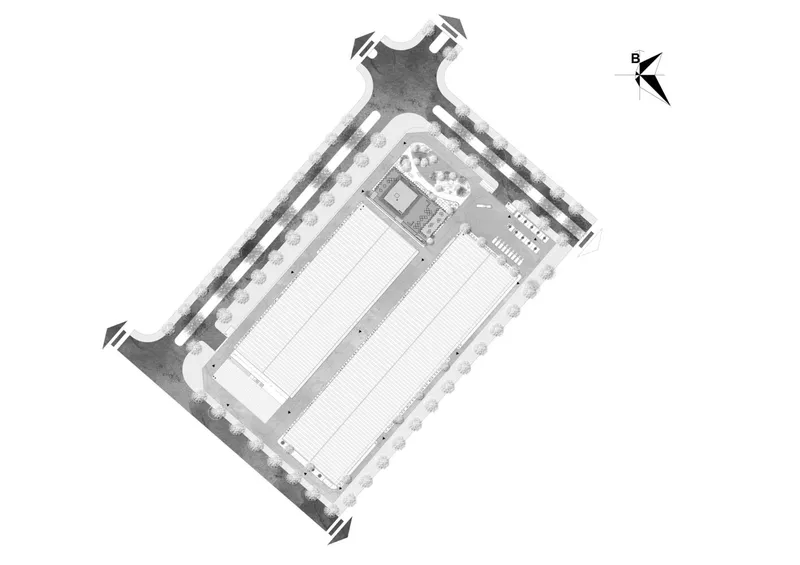
The site plans confirm the campus organization: two large rectangular warehouse volumes for production sit behind the public-facing operating building, which occupies the corner closest to the street. Perimeter landscaping buffers the complex from adjacent lots, while the entrance pavilions anchor the southwest corner where the fin facade is most visible. The diagonal orientation of the urban block means the building faces multiple compass points simultaneously, which explains why the facade system needed to vary so dramatically from one elevation to the next.
Why This Project Matters
Industrial architecture in Southeast Asia is undergoing a quiet revolution, and the Huy Hoang Lock Factory sits at its leading edge. By proving that a LEED Gold factory can be built with straightforward concrete construction and passive climate strategies, Baumschlager Eberle Architekten and their Hanoi-based project team have removed the excuse that sustainability is too expensive or too complex for manufacturing clients. The dual certification for construction and operation is especially significant: it means the building performs in practice, not just on paper.
More broadly, the project challenges the assumption that factories must be utilitarian sheds hidden behind walls. Huy Hoang's open campus, its museum hall, its rooftop gardens, and its dining hall bathed in filtered light all argue that production and public life can coexist. If a lock manufacturer 20 kilometers from Hanoi can pull this off, the industrial zones of the Global South have very few excuses left.
Huy Hoang Lock Factory by Baumschlager Eberle Architekten. Quang Minh Industrial Zone, Vietnam. 30,000 m². Completed 2024. Lead Architect: Dat Thanh Cung. Project Architects: Noi Van Tran, Tuan Quang Nguyen. Chief Design Officer: Garcia Lugo Servando. Photography by Trieu Chien.
About the Studio
Share Your Own Work on uni.xyz
If projects like this are the kind of work you want to make, uni.xyz is a place to publish your own, find collaborators, and enter design competitions.


Popular Articles
Popular articles from the community


Manzana Morphosis: Stretching Barcelona's Grid into a Living Landscape for 2050
A radical reworking of the Eixample manzana turns density into a tool for generous public space, vertical ecology, and environmental performance.

Aquadapt: An Underwater Habitat That Rewrites Its Rooms by the Hour
Curved modules ring the seabed while one shell shifts from breakfast room to cinema, farm and football pitch as residents' needs change.


Cube Design Draws an Ecological Corridor Between Two Shenzhen Hills with the Nankai Building
Beside Shenzhen's container docks, the Nankai Building pairs stacked balconies with a climbing green screen to connect two hillsides across its height.

Singing Woman: An Opera House That Performs Before the Curtain Rises
Ovidiu Cristian Pavel's conceptual opera house translates Estonia's choral identity into a sculpted waterfront landmark facing the Baltic Sea.

Similar Reads
You might also enjoy these articles


Hodi-Mandai Geram
Project Function: Preservation and revitalization of the Intangible heritage and socio-spatial identity of the Hodi by Housing, Cultural Memory Center, Sacred Grove, landscape, local tourism economy


Olio Towers: A Mid-Rise for Performers That Fuses Housing, Rehearsal, and Stage
Located blocks from Houston's Theater District, this modular tower stacks living units around a central performance atrium.

Oasis: Modular Green Housing Carved into Dhaka's Urban Fabric
A shortlisted Plugin Housing entry reclaims unauthorized settlements in Dhaka with stepped concrete volumes, green roofs, and ventilation-driven design.

Black Hole: A Floating Megastructure for the Post-Physical Era
Emiliano Mazzarotto envisions a spherical, self-scaling arena where e-sports, digital hotels, and holographic stadiums replace traditional public space.

Explore Architecture Competitions
Discover active competitions in this discipline

Challenge to reimagine the Iron Throne

Photograph architecture without architects

Illustrate the lost glory of Angkor Wat - Render Challenge

Design challenge to reuse E-waste
Comments (0)
Please login or sign up to add comments
No comments yet. Be the first to comment!