

Jan Juc House by Eldridge Anderson Architects
A contemporary coastal retreat reinterpreting the Australian beach house, balancing privacy, climate responsiveness, and ocean views through refined materials and planning.


A Contemporary Coastal Retreat Rooted in the Australian Beach House Tradition
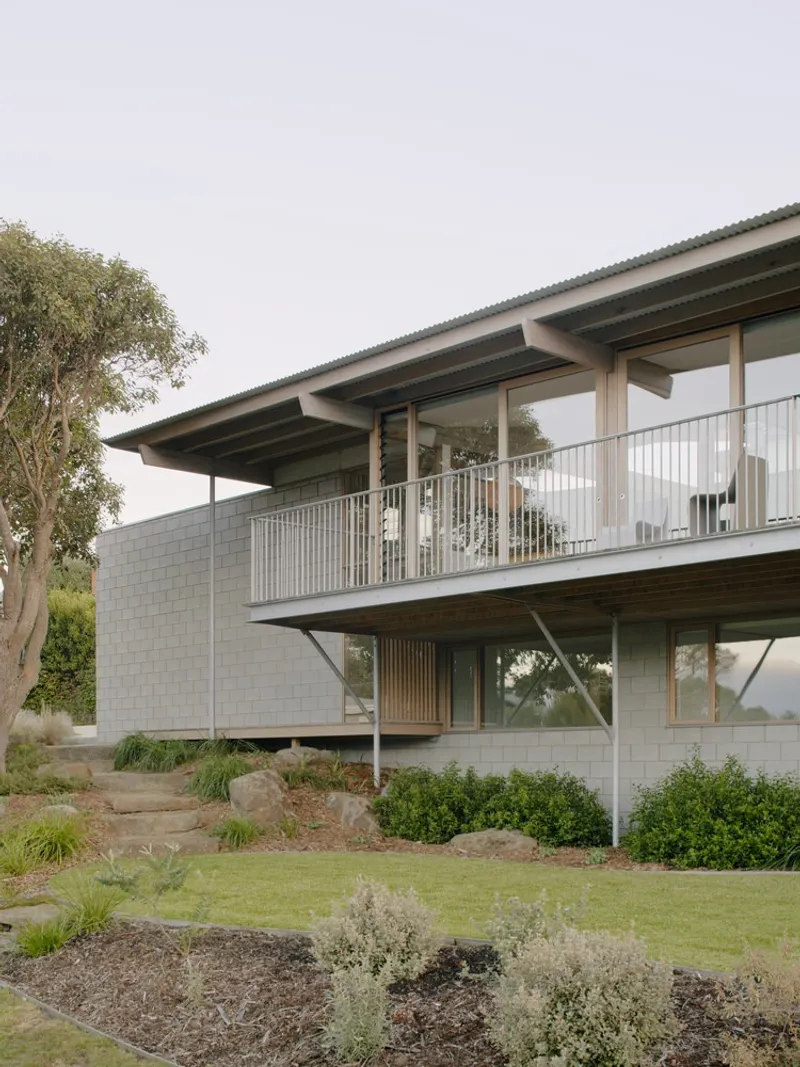
Located in the coastal suburb of Jan Juc, Australia, this thoughtfully crafted residence by Eldridge Anderson Architects reinterprets the traditional Australian beach house through a refined, contemporary lens. Set on a sloping suburban site with distant views toward coastal scrub and oblique glimpses of the ocean, the 190 m² Jan Juc House responds sensitively to both its environmental context and the evolving needs of its occupants.
Replacing a modest cement-sheet dwelling typical of the area’s early development, the new house draws inspiration from the scale, material honesty, and structural clarity of historic beach houses. Rather than replicating the vernacular, the design distills its essence: creating a calm, durable, and climatically responsive home suited for permanent retirement living.
Site Response and Architectural Strategy
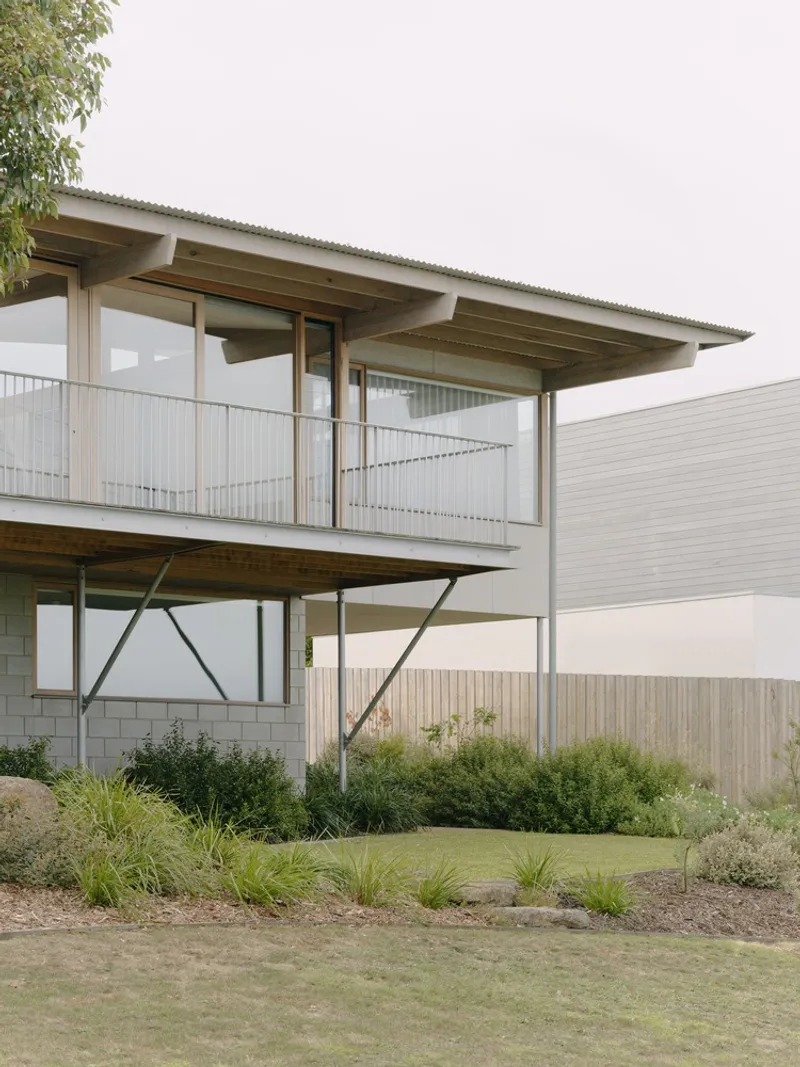
The project takes advantage of the site’s natural topography, allowing the house to step gently with the slope while preserving privacy from the street. Distant coastal views are framed deliberately, with the building’s form oriented to maximize outlook while minimizing exposure to neighboring properties. This careful balance results in a residence that feels both open and protected, connected to its surroundings yet quietly withdrawn.
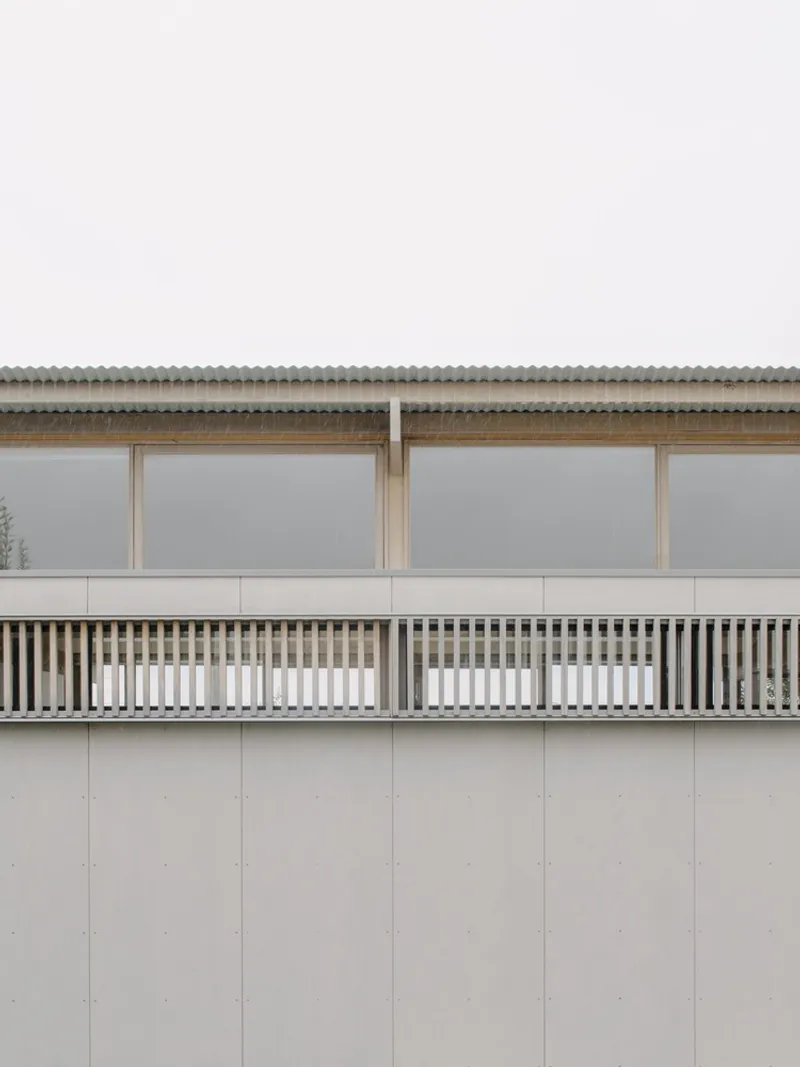
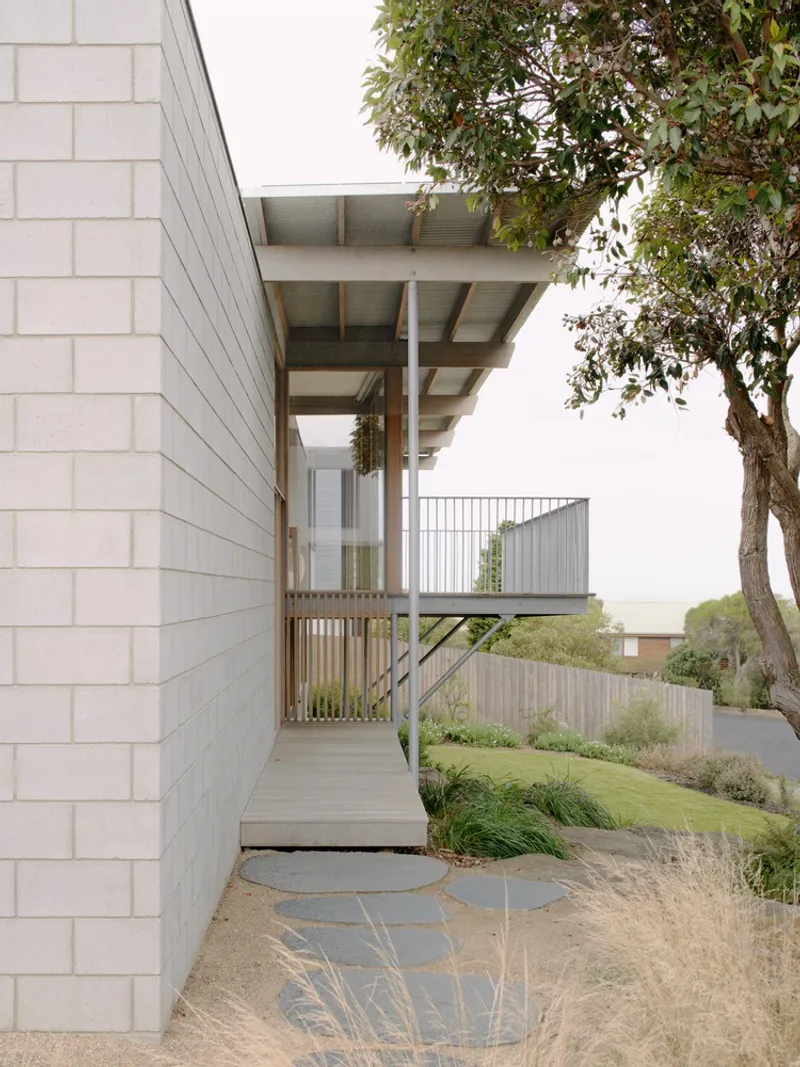
An elevated double-height entry deck establishes a generous yet understated arrival sequence. This transitional space introduces the home’s restrained material palette of timber and concrete block, while screening internal areas from direct view and reinforcing a sense of retreat.
Spatial Organization and Living Experience
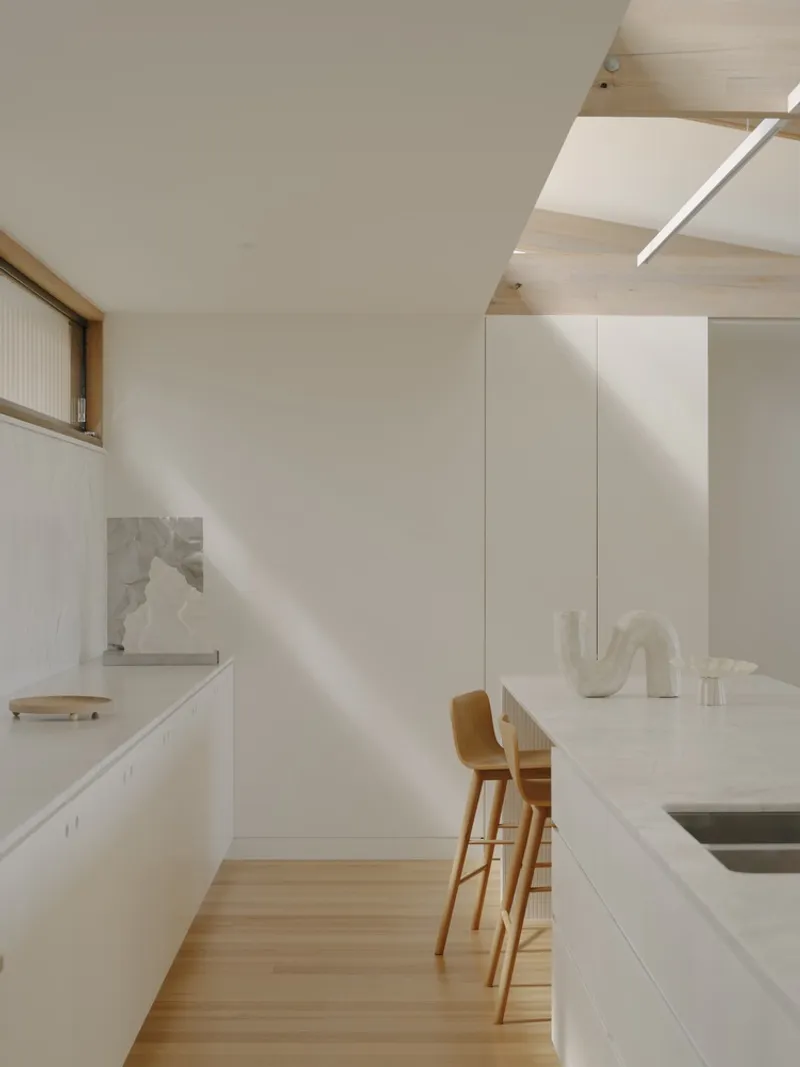
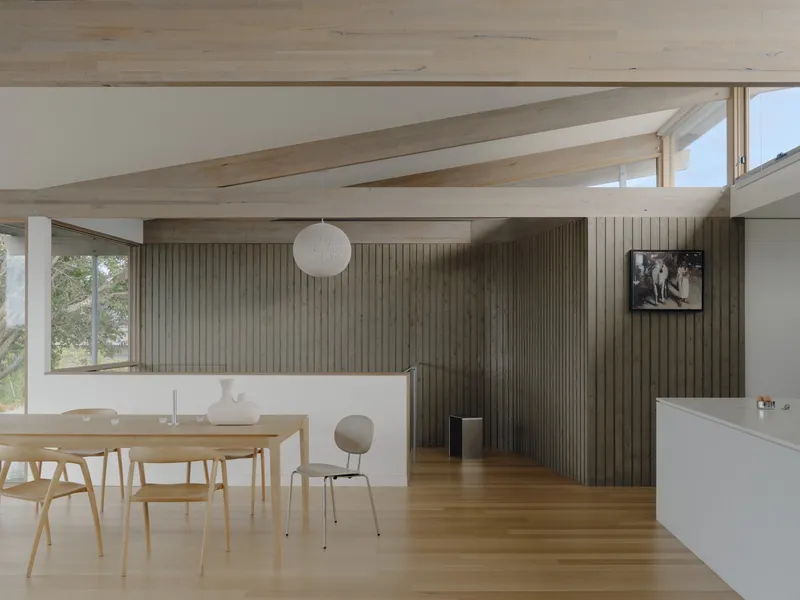
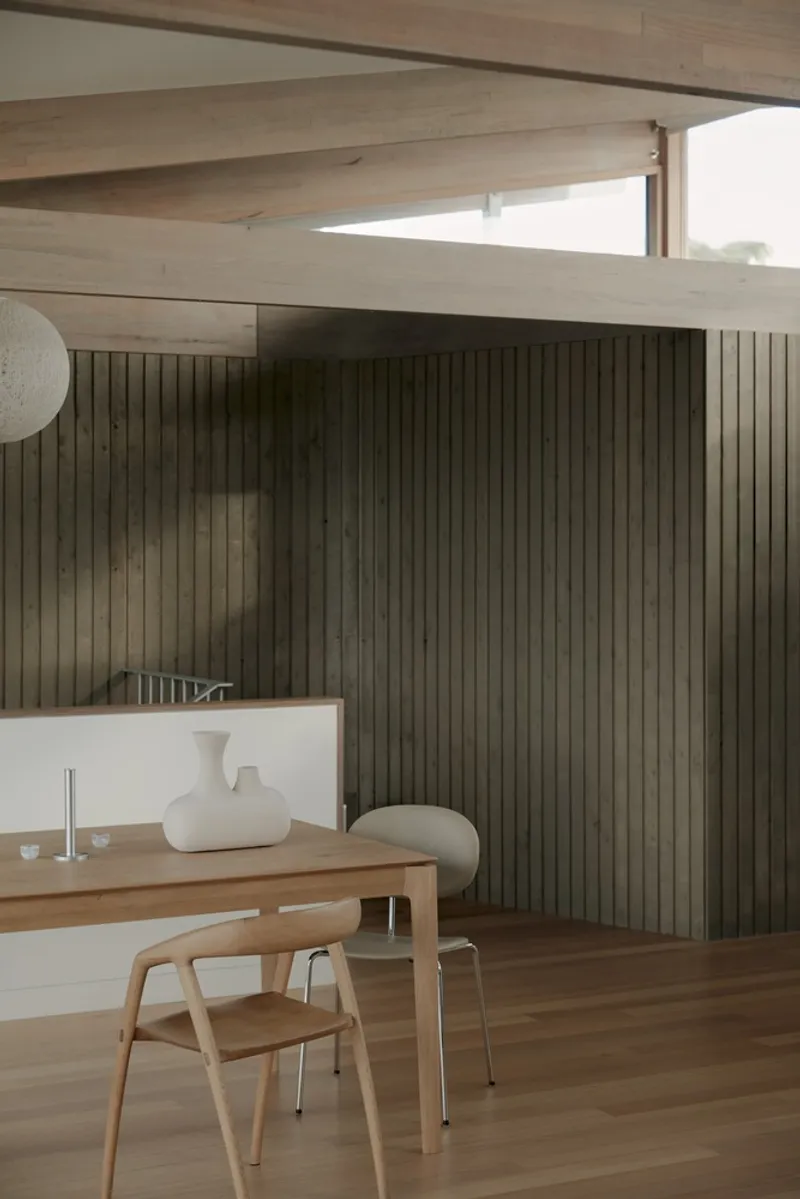
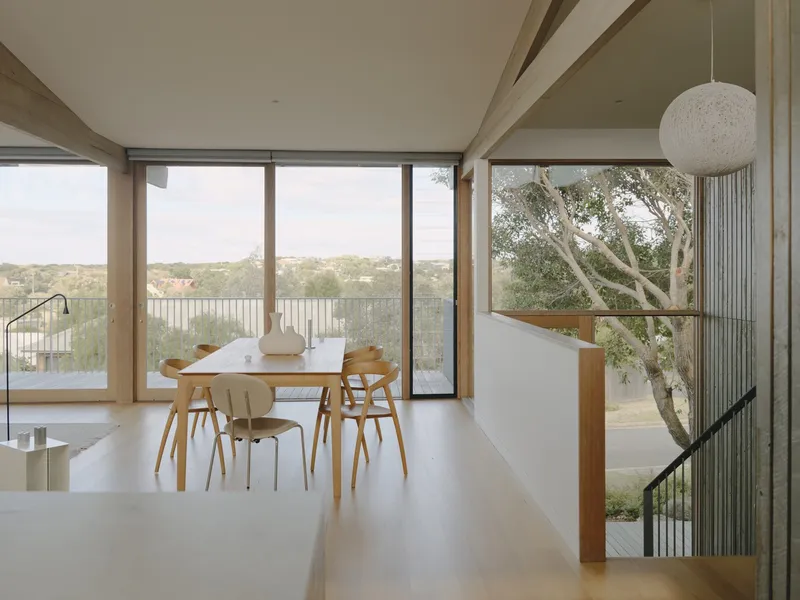
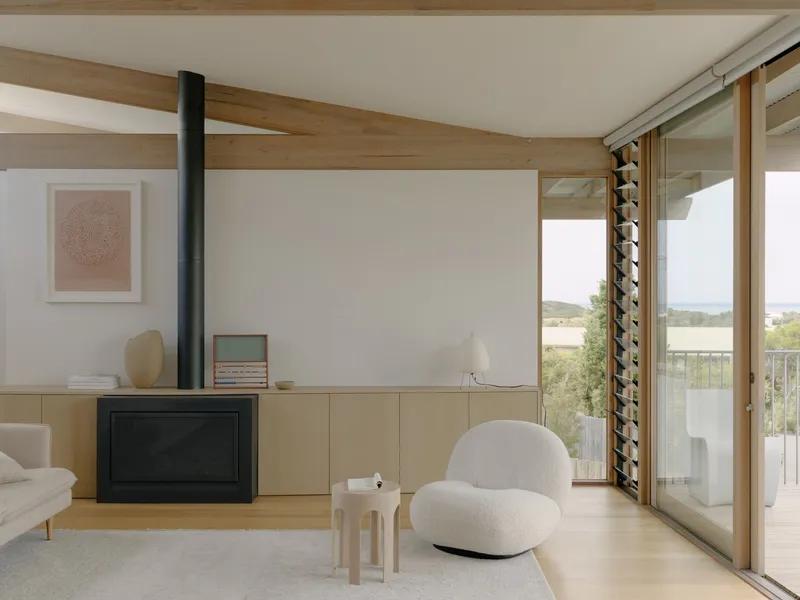
Upon entry, a circulation stair opens into a raking internal volume, enhancing the perception of space and light. The upper level is organized as the primary living zone, accommodating the kitchen, dining, living areas, and main bedroom. Here, an elongated kitchen anchors the plan, acting as both a functional workspace and a social spine.
The lower level adopts a more intimate atmosphere, housing a flexible multipurpose office or retreat alongside guest bedrooms. This arrangement allows the home to operate efficiently for a couple on a daily basis, while comfortably expanding to accommodate family and visitors with a strong sense of privacy.
Climate Responsiveness and Material Expression
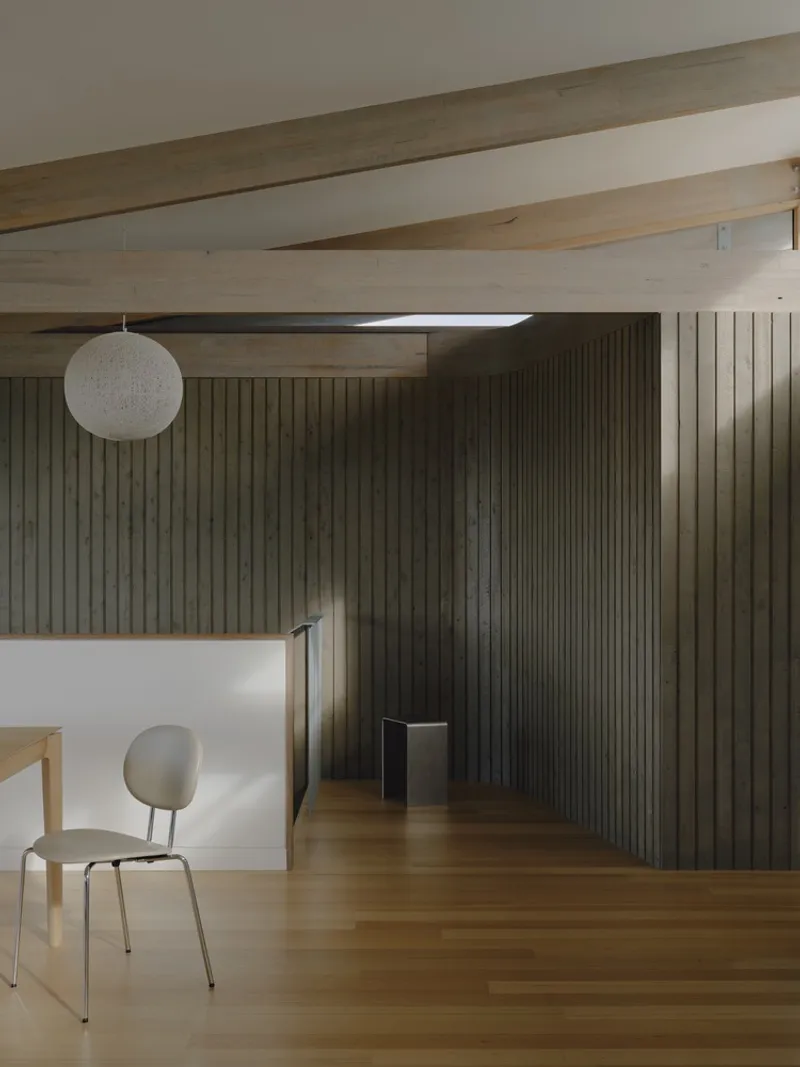
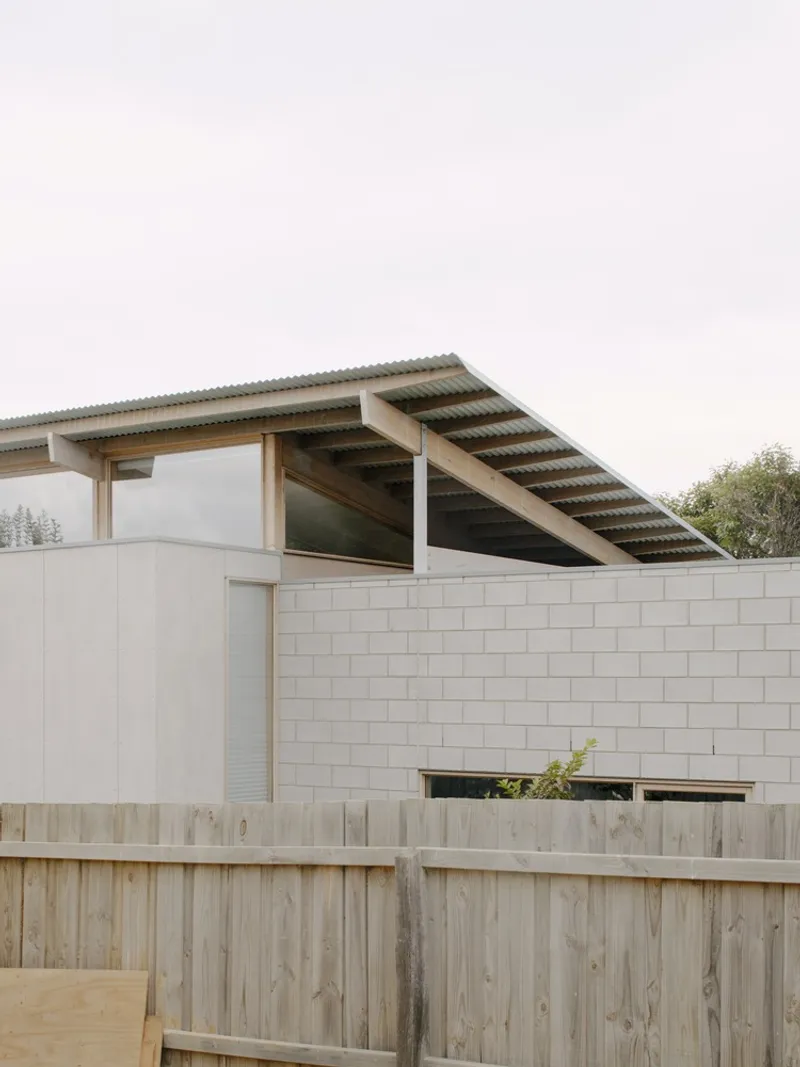
A lightweight roof structure lifts toward the north, drawing sunlight deep into the living spaces and supporting passive thermal performance. In summer, the house remains cool through shading and cross-ventilation; in winter, solar access and material mass contribute to warmth and comfort. Views are projected southward, skimming over neighboring rooftops toward the distant ocean horizon.
Material choices are intentionally modest and durable, reinforcing the building’s coastal character. Timber elements add warmth and tactility, while concrete blockwork provides robustness and visual grounding. Together, they create interiors that feel calm, honest, and timeless, well-suited to both everyday living and long-term occupation.
A Refined Coastal Dwelling
Jan Juc House exemplifies a restrained approach to coastal residential architecture, where clarity of planning, environmental responsiveness, and material simplicity combine to create a home of enduring quality. Through careful elevation, sectional design, and thoughtful spatial sequencing, Eldridge Anderson Architects deliver a contemporary beach house that feels deeply connected to place while remaining adaptable to changing patterns of use.
All photographs are works of Tom Ross


Popular Articles
Popular articles from the community


Jaramillo Van Sluys Arquitectura and Urbanismo Turn a Demolished Registry Lot in Quito into an Orchard Plaza
In Quito's Centro Histórico, a 2,800 m² plaza exposes the San Agustín convent wall and redraws its lost Augustinian orchard in volcanic stone.

Architekt Andreas Gruber Scatters 23 Dark Timber Chalets Across a South Tyrolean Forest Edge
In Molini di Tures, Amonti Chalets breaks a resort into a hamlet of gabled timber houses, with parking, storage and services pushed into the slope.

Cube Design Draws an Ecological Corridor Between Two Shenzhen Hills with the Nankai Building
Beside Shenzhen's container docks, the Nankai Building pairs stacked balconies with a climbing green screen to connect two hillsides across its height.

GROUP A Strips a 1969 Rotterdam Harbor Headquarters to Its Frame and Wraps It in Timber Louvers
In Rotterdam's M4H harbor district, Ferro Offices reuses a 1969 frame, adds one timber storey and reaches BREEAM-NL Outstanding.

Similar Reads
You might also enjoy these articles


Hodi-Mandai Geram
Project Function: Preservation and revitalization of the Intangible heritage and socio-spatial identity of the Hodi by Housing, Cultural Memory Center, Sacred Grove, landscape, local tourism economy


Olio Towers: A Mid-Rise for Performers That Fuses Housing, Rehearsal, and Stage
Located blocks from Houston's Theater District, this modular tower stacks living units around a central performance atrium.

Oasis: Modular Green Housing Carved into Dhaka's Urban Fabric
A shortlisted Plugin Housing entry reclaims unauthorized settlements in Dhaka with stepped concrete volumes, green roofs, and ventilation-driven design.

Black Hole: A Floating Megastructure for the Post-Physical Era
Emiliano Mazzarotto envisions a spherical, self-scaling arena where e-sports, digital hotels, and holographic stadiums replace traditional public space.

Explore Housing Competitions
Discover active competitions in this discipline

Challenge to reimagine the Iron Throne

Photograph architecture without architects

Illustrate the lost glory of Angkor Wat - Render Challenge

Design challenge to reuse E-waste
Comments (0)
Please login or sign up to add comments
No comments yet. Be the first to comment!