
KSM Architecture Designs an Unschooling Center 300 Meters from Chennai's Seafront
A 760-square-meter learning center in Besant Nagar uses cavity walls and wind channels to stay cool without conventional classrooms.


Most school buildings are designed around the assumption that learning happens in rows of desks, behind closed doors, on a fixed schedule. The Learning Center at Quest, designed by KSM Architecture in Besant Nagar, Chennai, starts from a different premise entirely. Built for children aged 8 to 16 who follow homeschooling or unschooling models, the center rejects the corridor-and-classroom template in favor of interconnected, free-flowing volumes organized around a full-height central atrium. Completed in 2021, the 760-square-meter building sits on a tight 540-square-meter plot just 300 meters from the Bay of Bengal, and it treats Chennai's relentless heat and generous sea breeze not as problems to solve with air conditioning but as forces to be choreographed through architecture.
What makes this project worth studying is the precision with which it aligns a progressive educational philosophy with a climate-driven building strategy. The open plan supports interest-led learning: there are no clear demarcations between spaces, so a child can drift from the amphitheater to a classroom to the library to a rooftop garden without encountering a threshold that says "stop." At the same time, the 400mm composite cavity walls on the east and west, the operable full-length windows on the north and south, and the elevated southern garden functioning as a wind channel all work together to make that openness thermally viable. The architecture does not merely symbolize freedom; it engineers it.
Arriving Through Trees and Concrete
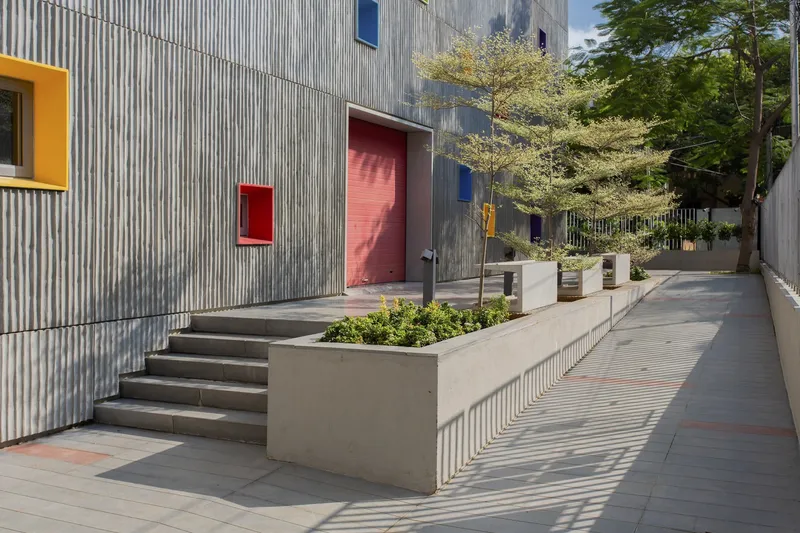

The entry sequence sets the tone. A tree-lined front court, complete with steps and a ramp, leads toward a wide concrete staircase that faces a red roll-up door opening directly onto the courtyard. The corrugated metal and GFRC facade panels, cast with bamboo shuttering, give the exterior a textured, industrial character that feels more workshop than institution. Dappled shadows from the courtyard trees soften the concrete and metal palette, and the whole arrival experience reads as informal, almost domestic, signaling to the children who use this building that it is not a conventional school.
The roll-up doors are not decorative. They allow the ground level to breathe, converting the lobby into a semi-outdoor space when conditions permit. In a city where temperatures regularly exceed 35°C, this kind of porosity is not a luxury; it is the building's primary cooling mechanism at street level.
The Atrium as Vertical Street
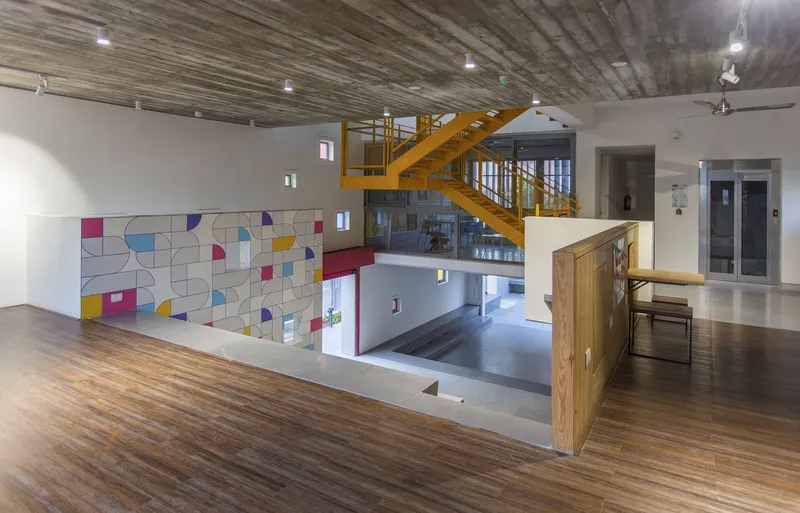

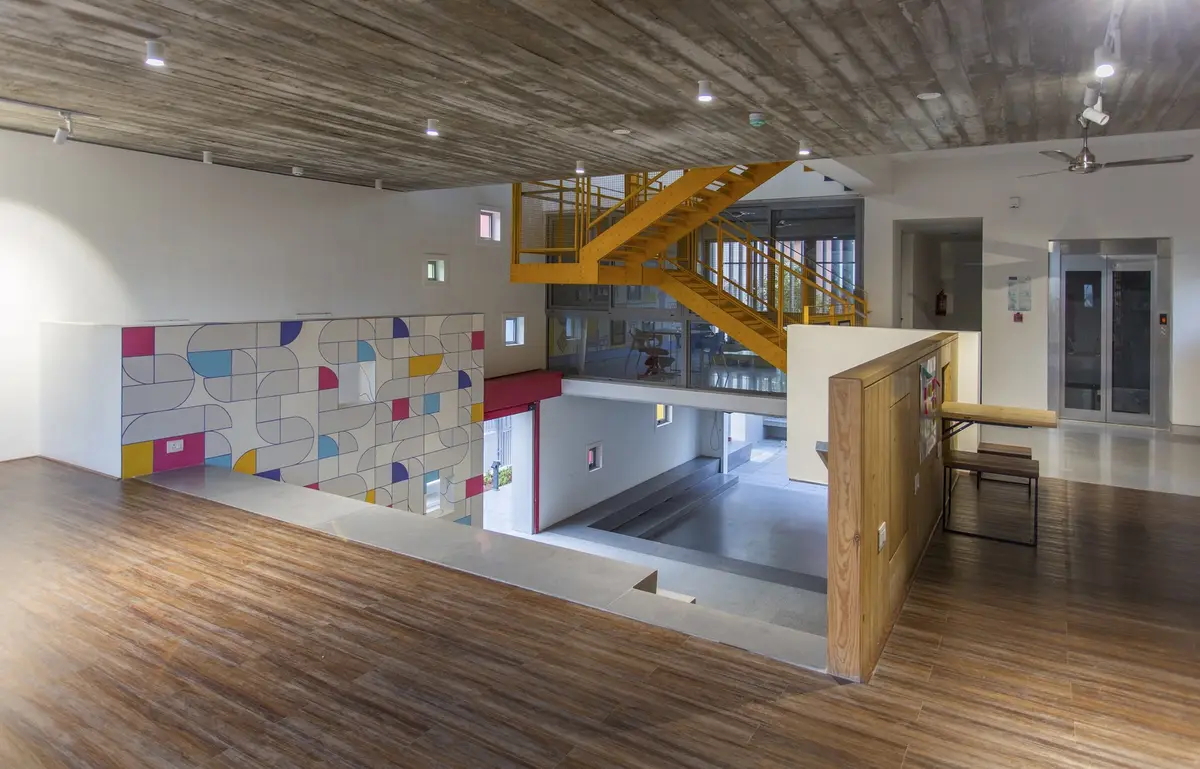
The central atrium is the spine of the building. Rising through all four levels, it connects five classrooms on either side while a winding metal staircase with open risers threads its way up to the rooftop cafeteria. The staircase, painted a vivid yellow, functions almost as a piece of furniture placed inside the void rather than a fixed piece of infrastructure. Upper-level circulation overlooks the atrium through open balconies decorated with tiled geometric murals, reinforcing the sense that every floor is visually connected to every other.
For an unschooling environment, this kind of vertical transparency is critical. A child on the third floor can see activity on the ground-level amphitheater; a teacher in the library can glance down to the gallery. The atrium converts the building's tight footprint from a limitation into an asset, stacking program vertically while maintaining the feeling of a single interconnected volume.
Classrooms Without Walls
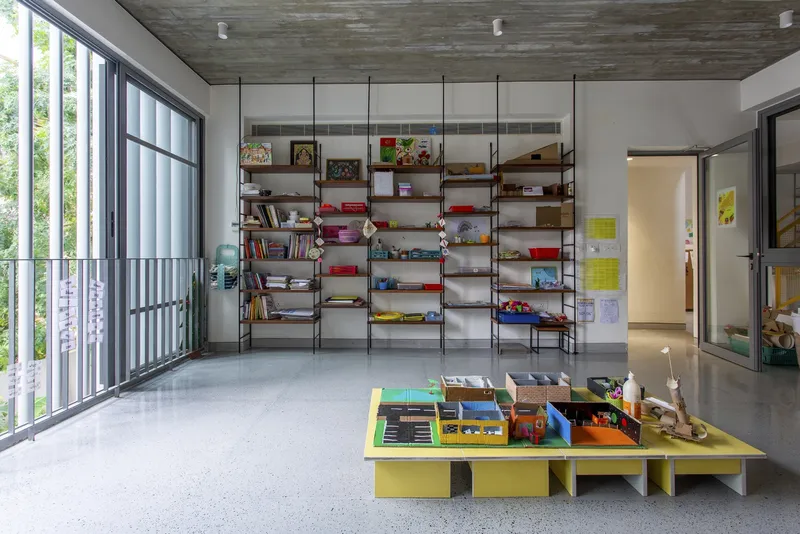

The learning spaces themselves resist the word "classroom." Low yellow tables, wall-mounted shelving systems, illustrated murals, and polished terrazzo floors create rooms that look more like studios or maker spaces. Board-formed concrete ceilings are left exposed, and the glazed facades on the north and south sides flood interiors with natural light while allowing operable windows to channel Chennai's prevailing breeze directly through the space.
KSM's decision to use no clear spatial demarcation here is deliberate. In a curriculum driven by children's interests rather than a fixed syllabus, the space needs to accommodate reading circles, group projects, solo research, and messy art-making in rapid succession. The low furniture, the absence of heavy partitions, and the generous glazing all serve that flexibility. Color is used strategically: the yellow tables and guardrails become wayfinding elements and mood-setters rather than decoration.
Keeping Cool Without Machines

The climate strategy deserves detailed attention because it is genuinely rigorous. Chennai's heat comes primarily from the east and west, so KSM designed those facades as 400mm composite cavity walls: 300mm of cavity wall with 50mm of XPS insulation and a 25mm air gap, finished with bamboo-shuttered GFRC panels that act as a self-shading rain screen. Openings on these sides are minimal. The result, according to the architects, is that the east and west walls virtually eliminate heat transmission.
The north and south facades do the opposite: they open up fully with operable windows aligned to catch the prevailing sea breeze. Vertical aluminum aerofoil louvers shade these openings against direct sun while permitting continuous airflow. The southern garden, elevated above ground level, creates a pressure differential that accelerates wind through the building. An extended road beyond the site contributes an additional wind channel. The building does not fight Chennai's climate; it sorts it, blocking heat from two directions while inviting air from the other two.
Materiality and Craft
The material palette is deliberately restrained: concrete, GFRC, metal, and timber. Bamboo shuttering on the GFRC panels leaves a textured imprint that gives the facade a handmade quality, connecting the building to regional craft traditions while using a high-performance composite material. Inside, the timber ceiling in the lobby softens the concrete, and the terrazzo floors provide thermal mass that helps moderate indoor temperatures.
Nothing here is expensive for the sake of it. The open-riser steel staircase, the roll-up garage doors, and the corrugated metal cladding all come from industrial supply chains. KSM has assembled a material strategy that reads as honest and tactile rather than polished, which is exactly right for a building where children are meant to feel free to touch, climb, and explore.
Why This Project Matters
The Learning Center at Quest matters because it takes two things that are often treated as unrelated, progressive pedagogy and passive climate design, and fuses them into a single architectural argument. The open plan is not just a gesture toward freedom; it is what allows cross-ventilation to work. The atrium is not just a social connector; it is a stack-effect chimney. Every spatial decision pulls double duty, serving both the educational philosophy and the environmental strategy simultaneously. That kind of integration is rare, and it deserves recognition.
For a city like Chennai, where temperatures are rising and energy costs are climbing, this building offers a replicable model. You do not need a massive budget or a sprawling site. You need 540 square meters, a clear understanding of local wind patterns, and the discipline to let climate logic drive form. KSM Architecture has delivered a building that is genuinely comfortable, pedagogically inventive, and climatically responsible, all on a footprint smaller than many suburban houses. That is a lesson worth learning.
Learning Center at Quest by KSM Architecture, Besant Nagar, Chennai, India. 760 sqm. Completed 2021. Photography by Sreenag BRS.
About the Studio
Share Your Own Work on uni.xyz
If projects like this are the kind of work you want to make, uni.xyz is a place to publish your own, find collaborators, and enter design competitions.


Popular Articles
Popular articles from the community

Faces of the Soviet Avant-Garde: Turning Moscow's Street Names into an Open-Air Museum
A network of sculptural installations across a Moscow residential district transforms forgotten architect names into spatial encounters with cultural memor

Temporary Home for Dogs: A Reversed Zoo Rethinks Animal Shelter Architecture
In Bucharest, a sinuous corridor and freed landscape flip the logic of containment, designing a shelter that works to make itself unnecessary.

The Amber Palace Opera: A Geological Fiction Surfaces on Tallinn's Baltic Waterfront
Pierre Brillard reimagines a Baltic legend as a public landscape, opera house, and waterfront promenade rooted in Tallinn's coastal identity.

Singing Woman: An Opera House That Performs Before the Curtain Rises
Ovidiu Cristian Pavel's conceptual opera house translates Estonia's choral identity into a sculpted waterfront landmark facing the Baltic Sea.

Similar Reads
You might also enjoy these articles


Hodi-Mandai Geram
Project Function: Preservation and revitalization of the Intangible heritage and socio-spatial identity of the Hodi by Housing, Cultural Memory Center, Sacred Grove, landscape, local tourism economy


Olio Towers: A Mid-Rise for Performers That Fuses Housing, Rehearsal, and Stage
Located blocks from Houston's Theater District, this modular tower stacks living units around a central performance atrium.

Oasis: Modular Green Housing Carved into Dhaka's Urban Fabric
A shortlisted Plugin Housing entry reclaims unauthorized settlements in Dhaka with stepped concrete volumes, green roofs, and ventilation-driven design.

Black Hole: A Floating Megastructure for the Post-Physical Era
Emiliano Mazzarotto envisions a spherical, self-scaling arena where e-sports, digital hotels, and holographic stadiums replace traditional public space.

Explore Learning Spaces Competitions
Discover active competitions in this discipline

Challenge to design public laboratory

Challenge to reimagine the Iron Throne

Photograph architecture without architects

Illustrate the lost glory of Angkor Wat - Render Challenge
Comments (0)
Please login or sign up to add comments
No comments yet. Be the first to comment!