
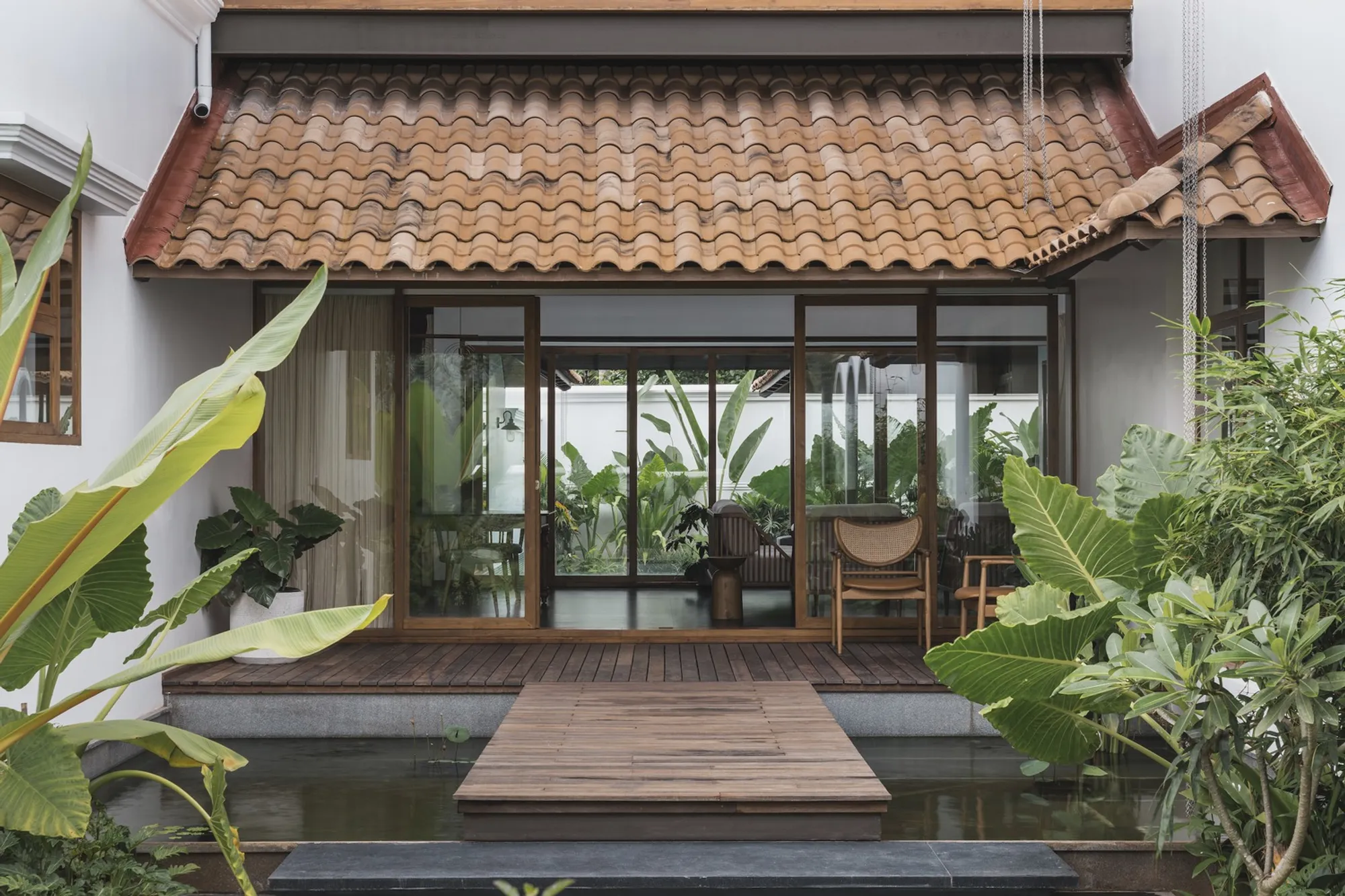
Aslam Sham Architects Weaves Water, Timber, and Courtyards into a Tropical House in Kerala
Lilly House layers koi ponds, reflecting pools, and deep timber verandas across a lush site framed by coconut palms and forested hills.


There is a strain of tropical residential architecture that treats the house as a loose confederation of pavilions rather than a sealed box. Lilly House, designed by Aslam Sham Architects in Kerala, belongs firmly to that lineage, but it pushes the idea further than most. Water is everywhere: koi ponds slip beneath timber roofs, reflecting pools bisect walkways, and a mosaic-tiled swimming pool sits among banana plants as though it grew there. The effect is less house-with-a-garden than garden-with-rooms.
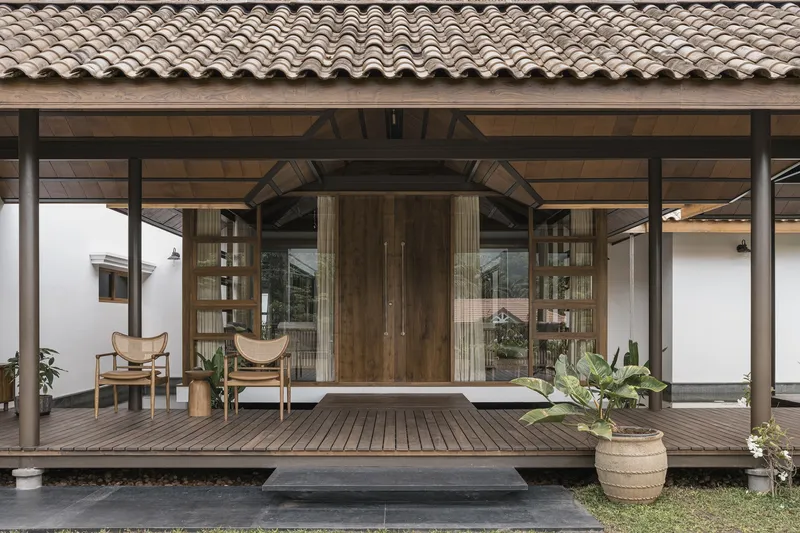
What makes the project worth studying is how disciplined the material palette remains even as the spatial sequence turns playful and almost labyrinthine. White stucco volumes, exposed timber trusses, clay tile roofs, and dark concrete or stone floors repeat across every pavilion. The consistency lets the architects introduce arched openings, hanging swings, and interior bridges without the composition ever feeling decorative or overdone. Each element earns its place through climate logic: deep overhangs shed monsoon rain, louvered shutters regulate airflow, and courtyards pull light into the plan's center.
Water as Organizing Principle
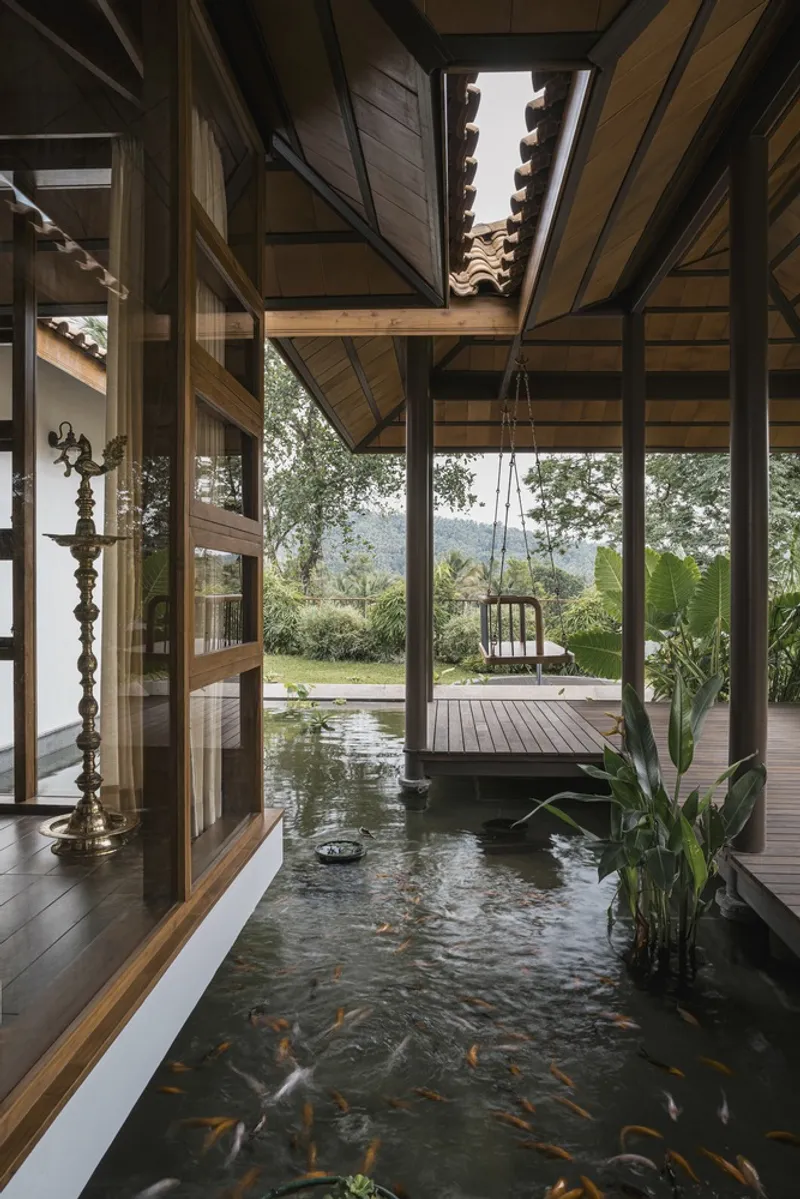
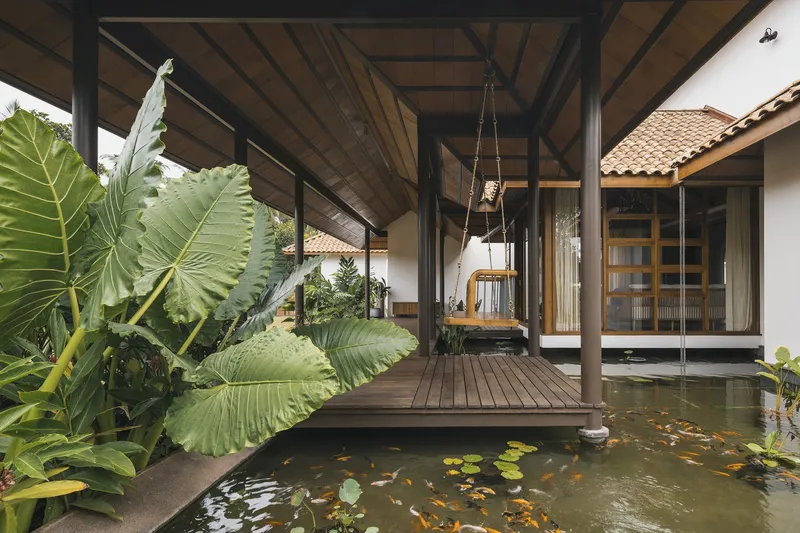
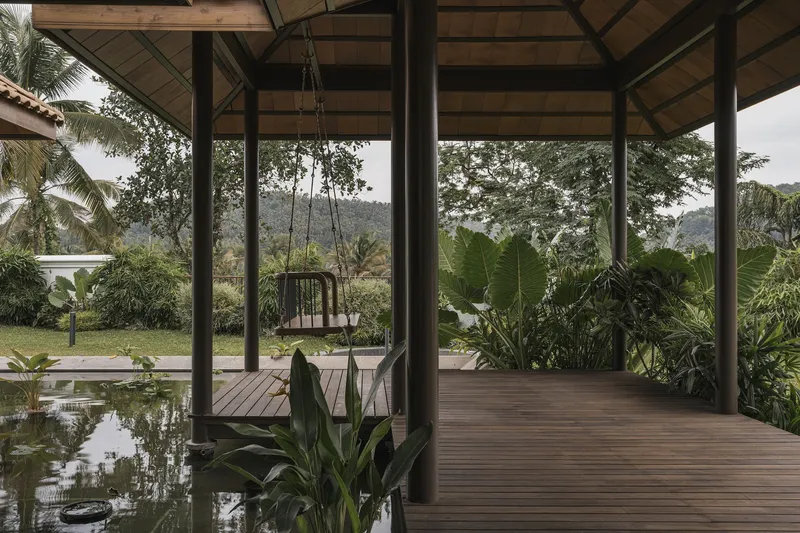
The central courtyard pond is the emotional core of the house. Koi drift beneath a timber-framed roof, lily pads crowd the surface, and a swing hangs directly over the water, turning what could be a purely ornamental feature into one you physically engage with. It is an old Kerala gesture, the interior water court, but here it is amplified. Elephant ear plants and dense planting blur the edge between pond and garden until the two merge.
A second, shallower reflecting pool runs along the approach to the living wing. Timber deck walkways cross it like bridges, and glass sliding doors on either side fold away so that the pool reads as an outdoor room. These water elements do more than cool the air. They stitch the plan together, giving orientation and rhythm to what would otherwise be a sprawling footprint.
The Arched Opening as Signature Move
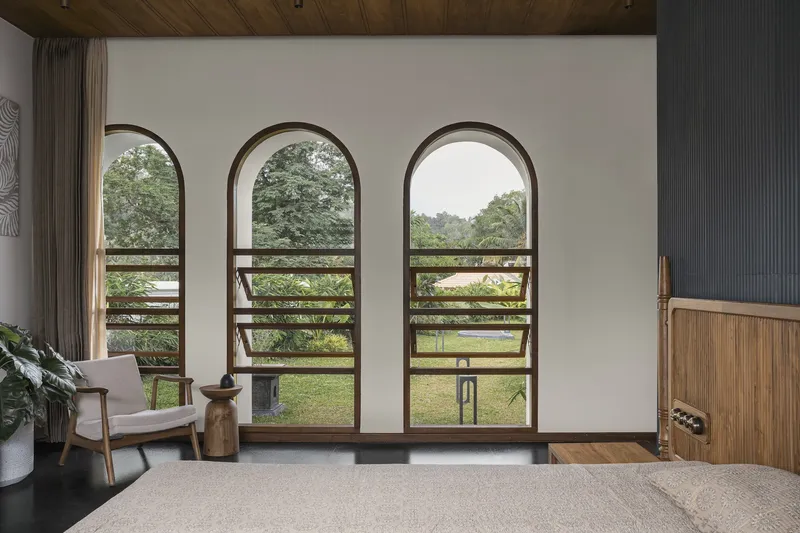
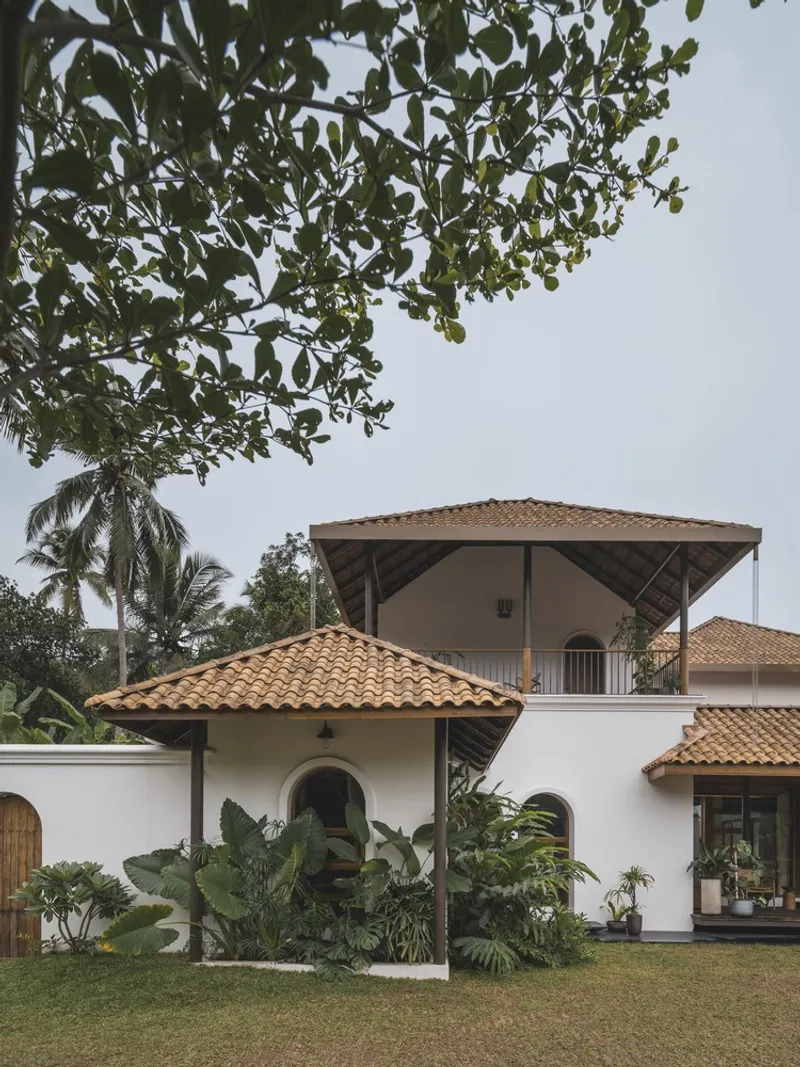
Arches appear throughout the project: in the timber-and-glass doors that open onto the lawn, in the fireplace surround of the dining hall, and in the garden-facing elevations of the white stucco volumes. They are not cosmetic. Each arched opening is sized to frame a specific view, whether that is a tree canopy, a courtyard, or a distant hillside. The proportions stay consistent, with a gentle radius that reads as structural rather than whimsical.
From the garden, the arches give the house a Mediterranean quality that sits unexpectedly well against the Kerala context. Terracotta tile roofs and palm trees bridge the two traditions. The white stucco walls amplify daylight and make the timber detailing pop, especially under overcast monsoon skies when everything else turns gray-green.
Timber Structure, Exposed and Honest
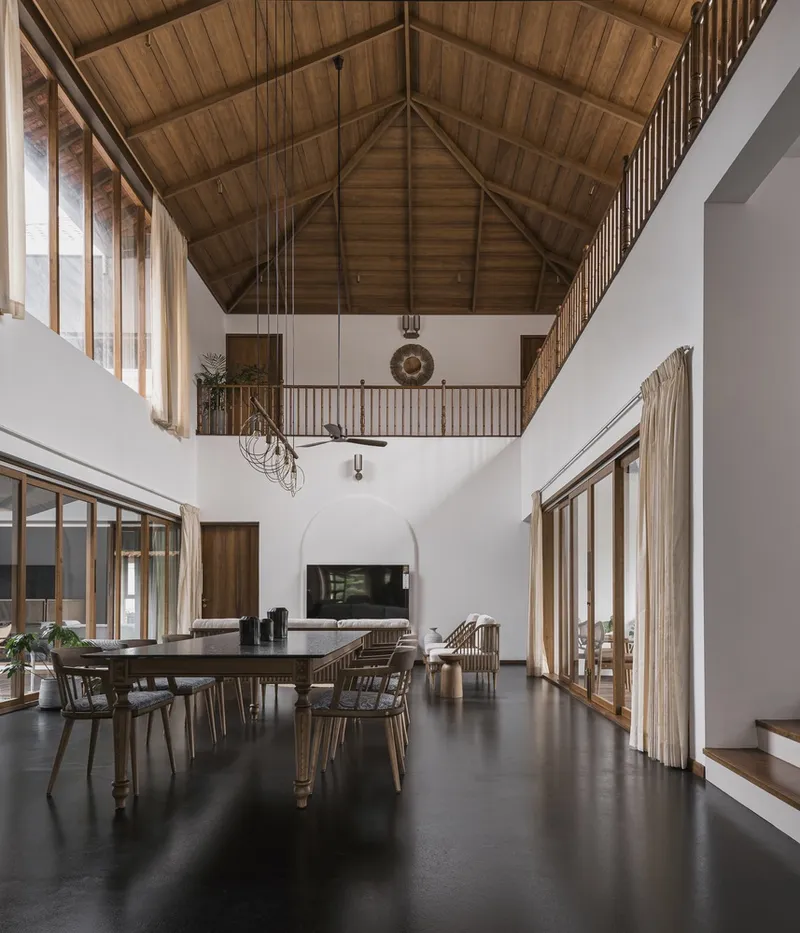
The double-height dining space is the best demonstration of the architects' commitment to legible structure. A full timber gable ceiling is left exposed, its trusses and purlins darkened to contrast with the white plaster walls below. An arched fireplace opening anchors the ground level, and the proportions of the room recall a small chapel more than a domestic space. It is generous without being grandiose.
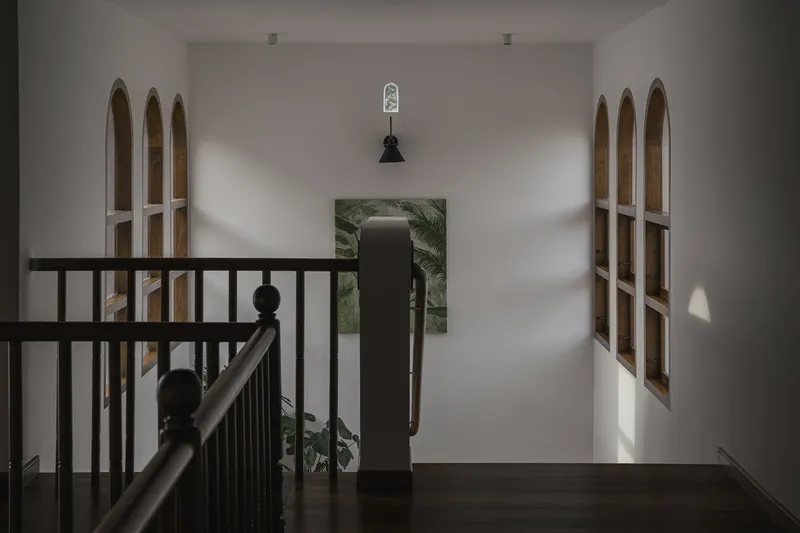
On the upper landing, dark timber railings and arched window frames catch afternoon light and throw long shadows across the floor. Outside, the covered terrace deploys steel columns and exposed timber trusses beneath a clay tile roof, a hybrid structure that keeps spans wide and the deck completely open to breeze. The material hierarchy is clear: steel carries load, timber provides warmth and grain, and tile sheds rain.
Living Between Inside and Out
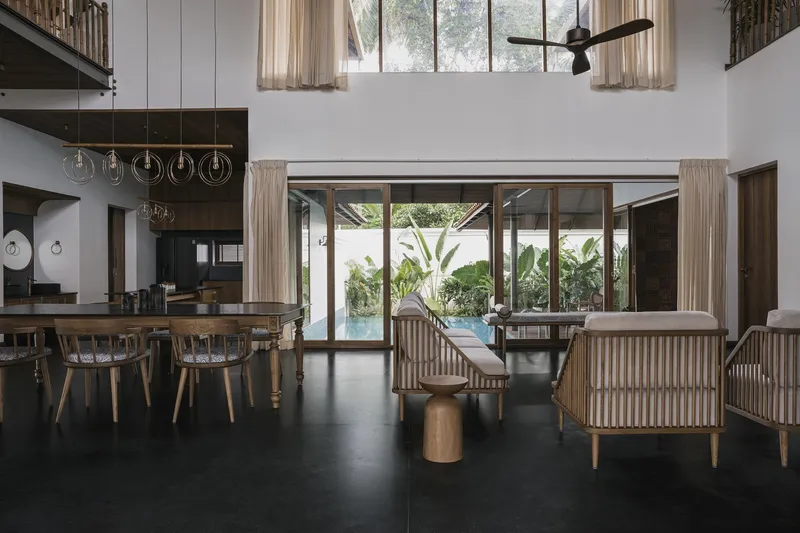
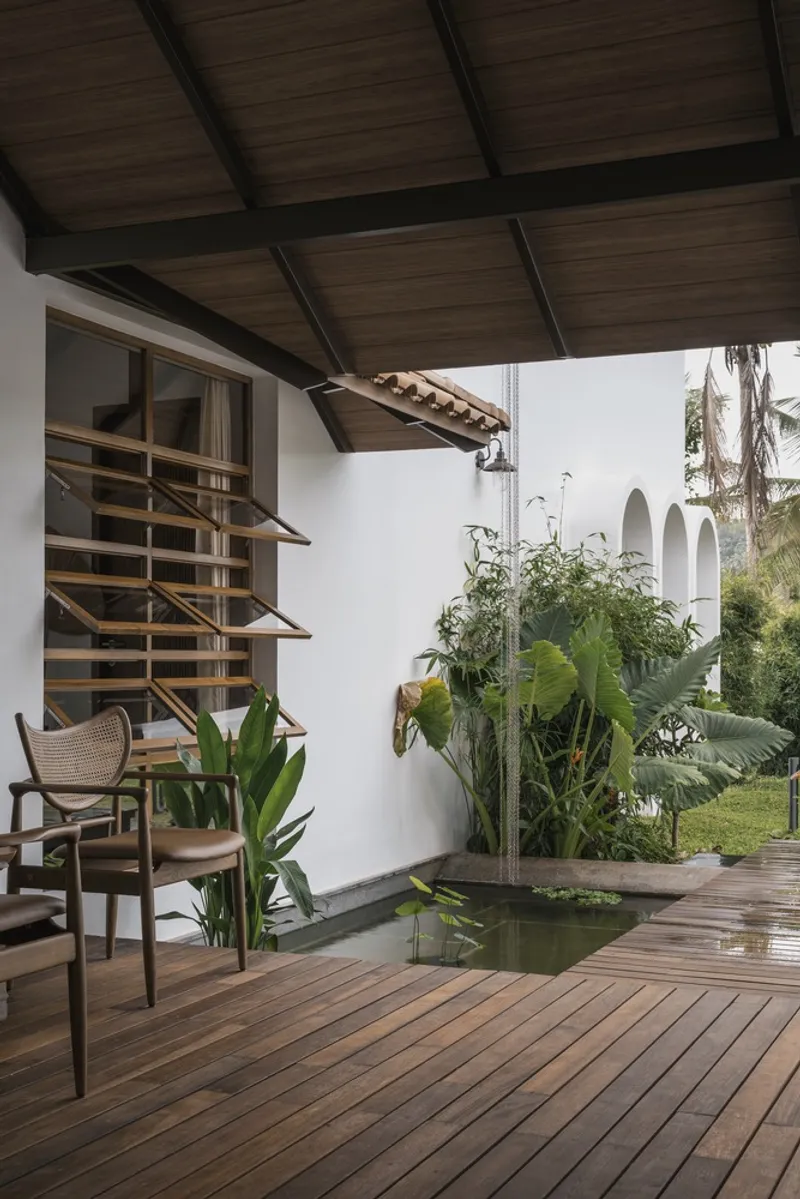
The open living area demonstrates how little barrier exists between interior and landscape. Dark concrete floors run right up to glazed doors that frame the pool and a wall of banana plants. When the doors slide open, the room and the terrace become one surface. A planted water feature on the timber deck reinforces the threshold, its greenery spilling against louvered shutters that filter light without blocking ventilation.
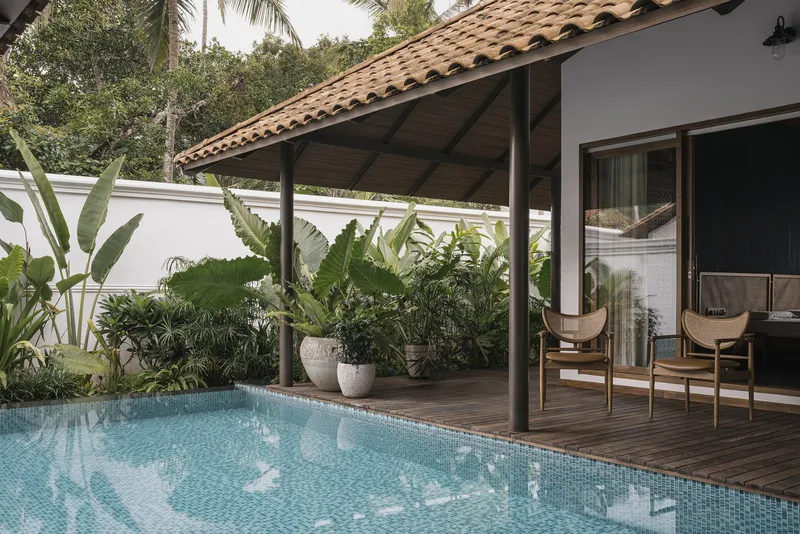
The mosaic-tiled pool occupies a covered terrace surrounded by tropical greenery so dense it functions as a privacy screen. There is no fence, no hedge line, just layered planting that closes the space inward while keeping it visually porous. It is a strategy that only works in a climate where plants grow fast and year-round, and the architects exploit that fact fully.
Retreat Spaces and Material Texture
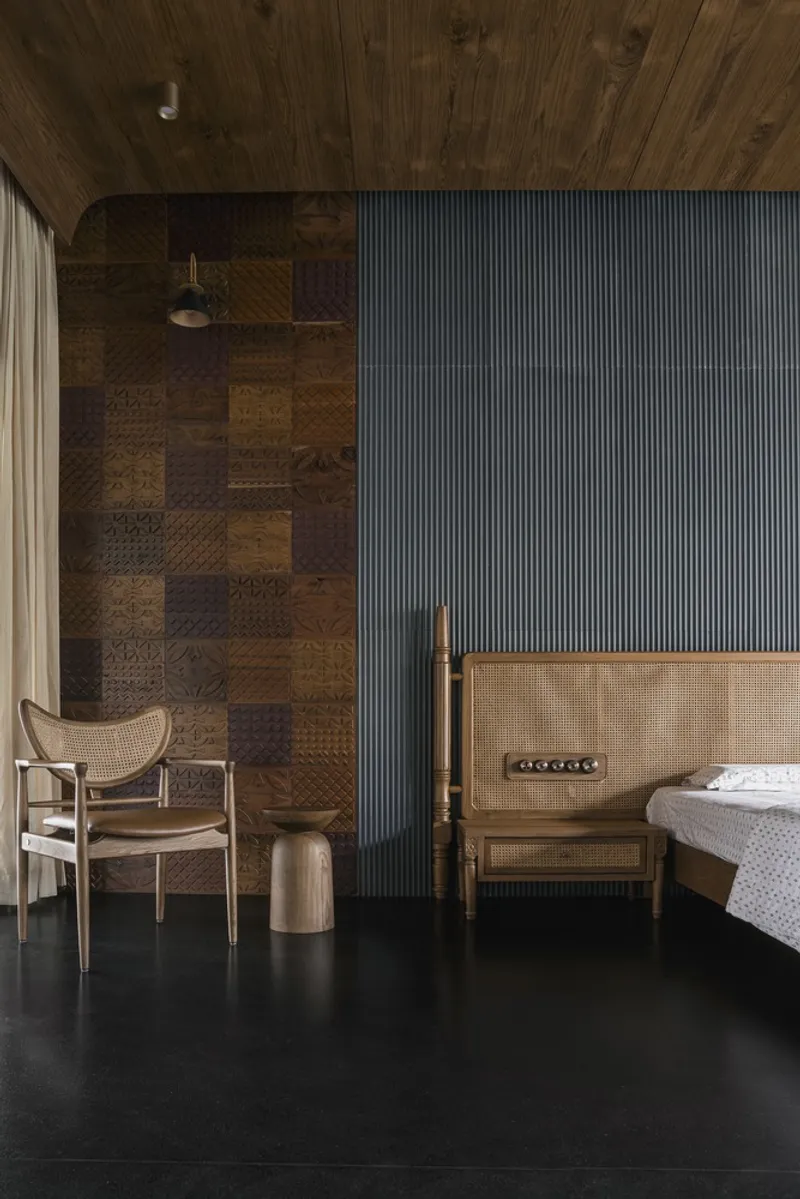
The private rooms take a different tonal register. One bedroom pairs a ribbed blue accent wall with a patchwork timber surface and black stone flooring, a combination that feels moody and tactile against the openness of the public spaces. The material richness here is deliberate: these are rooms you close off and retreat into, so the surfaces reward proximity and touch rather than panoramic views.
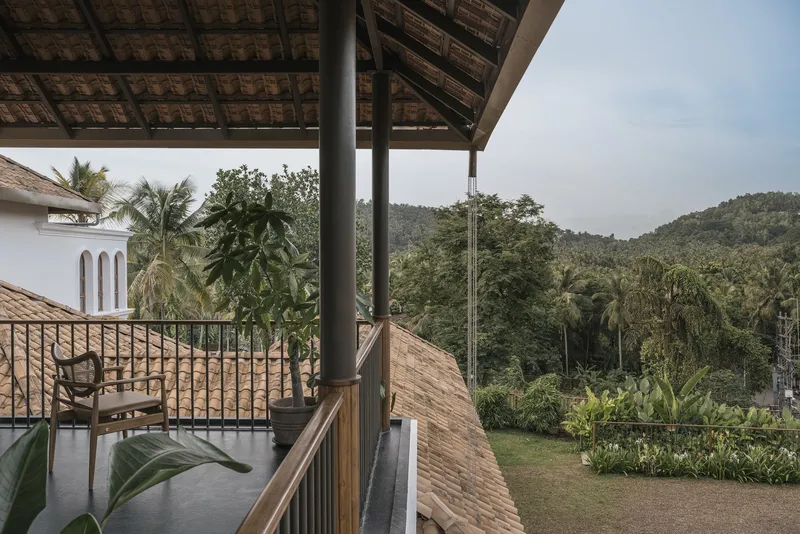
The upper-level balcony, sheltered by a clay tile roof, looks out over forested hills and provides one of the few moments of long-range prospect in a house otherwise turned inward. It functions as a decompression chamber between the intimate bedroom wing and the expansive landscape beyond.
Courtyard Composition and the Garden Facade
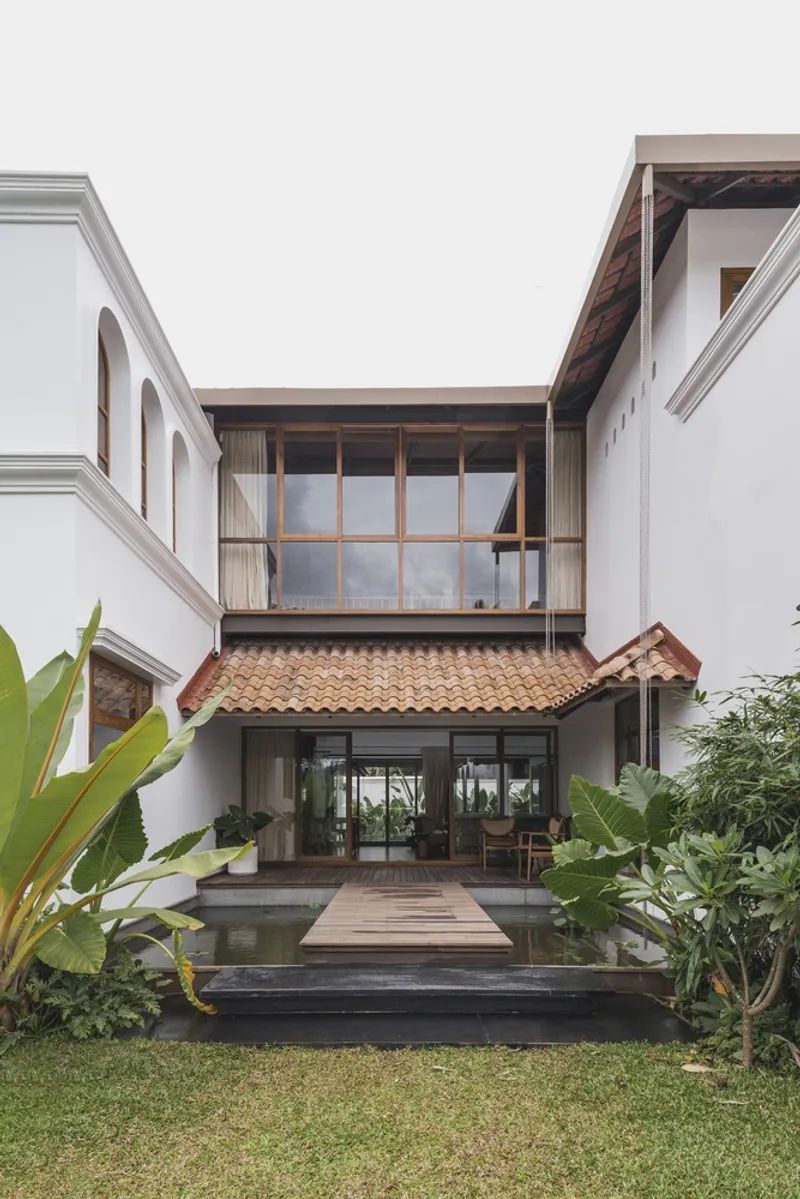
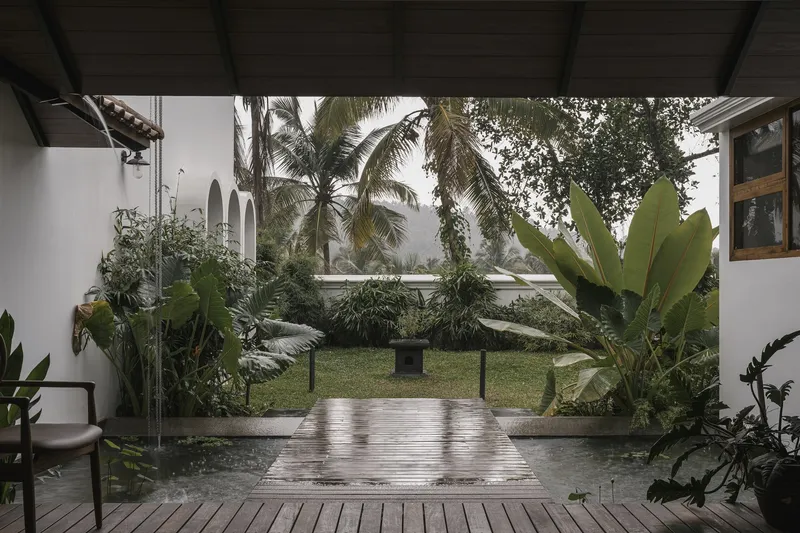
Seen from across the lawn, the house resolves into a clear courtyard composition: white stucco walls and clay tile roofs flank a central green space, connected at the upper level by a timber bridge. The bilateral symmetry is loose rather than rigid, allowing each wing to vary in height and massing while still reading as a pair. Rain darkens the terracotta and soaks the lawn, and the whole ensemble settles into its site with the quiet inevitability of something that was always meant to be there.
Why This Project Matters
Lilly House is a reminder that tropical architecture does not need to choose between tradition and ambition. Aslam Sham Architects draw on Kerala's long history of courtyard houses, timber construction, and climate-responsive design without producing a replica. The arched openings, the water courts, the layered verandas all have precedent, but their combination here is contemporary and precise. The material discipline is the key: by limiting the palette to stucco, timber, clay tile, stone, and concrete, the architects ensure that spatial variety never tips into visual noise.
More broadly, the project demonstrates what happens when landscape is treated not as decoration but as infrastructure. Water cools, plants screen, courtyards ventilate, and deep roofs shelter. Every green element does real work. In a moment when sustainability rhetoric often floats above the buildings it describes, Lilly House offers something rarer: a house where the sustainable strategy is the architecture, inseparable from its form and pleasure.
Lilly House by Aslam Sham Architects, Kerala, India. Photographs by Ishita Sitwala.
About the Studio
Share Your Own Work on uni.xyz
If projects like this are the kind of work you want to make, uni.xyz is a place to publish your own, find collaborators, and enter design competitions.




Popular Articles
Popular articles from the community


Conexión: Biophilic Design Reimagines High-Rise Living in Hong Kong
Conexión reimagines high-rise living in Hong Kong through biophilic design, green facades, shared spaces, daylight, water and nature within.

Hill & Cross Opera: Sculptural Opera House Architecture Shaped by Tallinn’s Landscape and Identity
Hill & Cross Opera reimagines opera house architecture in Tallinn through its sculptural hill, civic plaza, glass wave and a luminous cross.

Co-life: Sustainable Architecture for Age-Friendly Community Living
Co-life reimagines sustainable architecture for seniors through courtyards, rammed earth, shared gardens, and spaces designed for belonging.

Co-Life: Senior Housing Design That Reconnects Older Adults With the City
Co-Life reimagines senior housing design through healing gardens, shared streets, workshops, and a sustainable community across generations.


Similar Reads
You might also enjoy these articles


Hodi-Mandai Geram
Project Function: Preservation and revitalization of the Intangible heritage and socio-spatial identity of the Hodi by Housing, Cultural Memory Center, Sacred Grove, landscape, local tourism economy


Olio Towers: A Mid-Rise for Performers That Fuses Housing, Rehearsal, and Stage
Located blocks from Houston's Theater District, this modular tower stacks living units around a central performance atrium.

Oasis: Modular Green Housing Carved into Dhaka's Urban Fabric
A shortlisted Plugin Housing entry reclaims unauthorized settlements in Dhaka with stepped concrete volumes, green roofs, and ventilation-driven design.

Black Hole: A Floating Megastructure for the Post-Physical Era
Emiliano Mazzarotto envisions a spherical, self-scaling arena where e-sports, digital hotels, and holographic stadiums replace traditional public space.


Explore Architecture Competitions
Discover active competitions in this discipline



Challenge to reimagine the Iron Throne


Photograph architecture without architects


Illustrate the lost glory of Angkor Wat - Render Challenge


Design challenge to reuse E-waste
Comments (0)
Please login or sign up to add comments
No comments yet. Be the first to comment!