
Rama Architects Wraps a Three-Storey Clareville Home in Cascading Greenery and Brazilian Modernist Calm
M House on Sydney's Northern Beaches channels Niemeyer and Bo Bardi through concrete, tallowwood, and deep sheltering eaves.


On a sloping block in Clareville, where ancient bangalay trees push through dense spotted gum forest toward the waterline, Rama Architects has replaced a dilapidated waterfront shack with a three-storey concrete house that seems determined to disappear inside its own landscape. M House borrows its philosophical DNA from Brazilian modernism, the school of Niemeyer and Bo Bardi, and applies it to a site where the subtropical climate of Sydney's Northern Beaches makes the translation surprisingly direct. The result is a building governed by deep eaves, continuous tallowwood battens, and a planting strategy so aggressive that concrete parapets drip with foliage from roof to ground.
What makes M House genuinely compelling is not the greenery alone but the structural logic that enables it. Balcony beams are turned upward rather than down, forming integrated planter beds along every edge. Grey sandstone offcuts from the locally quarried cladding become aggregate for garden beds and a green roof. These are not decorative gestures tacked onto a finished building; they are embedded in the construction sequence, which means the vegetation is load-bearing in both a literal and conceptual sense. The house is conceived as armature for growth, and the architecture is frank about that dependency.
Living Under a Timber Canopy
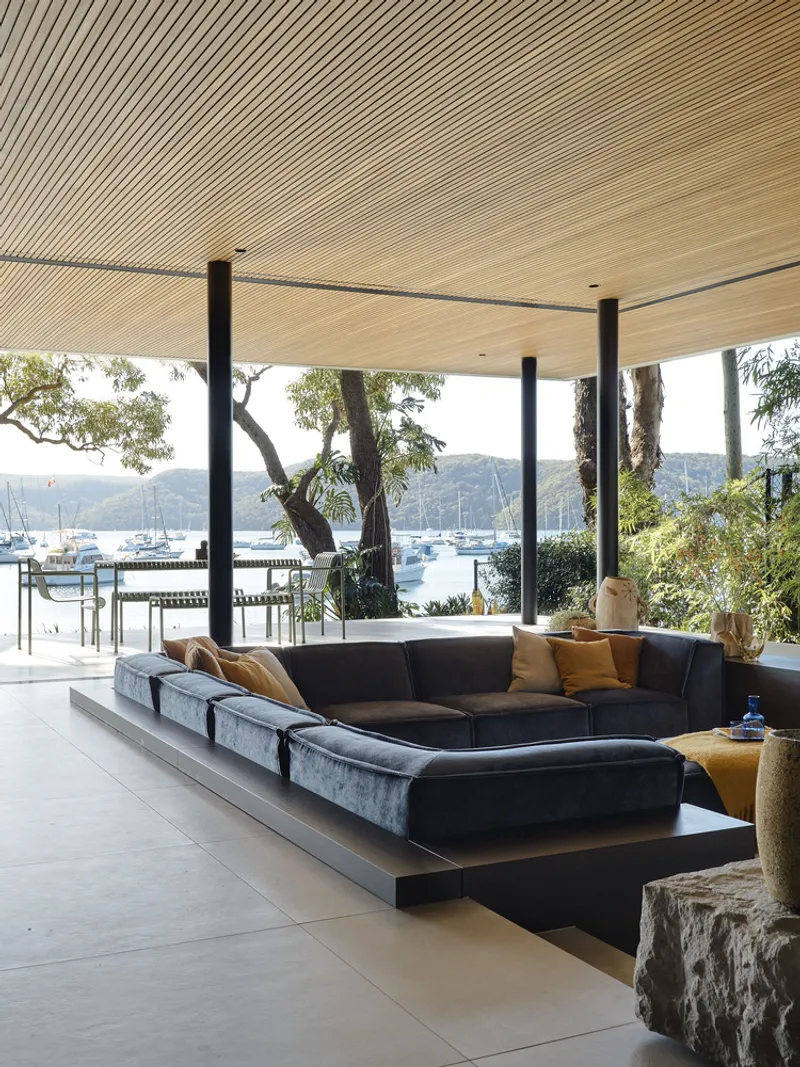
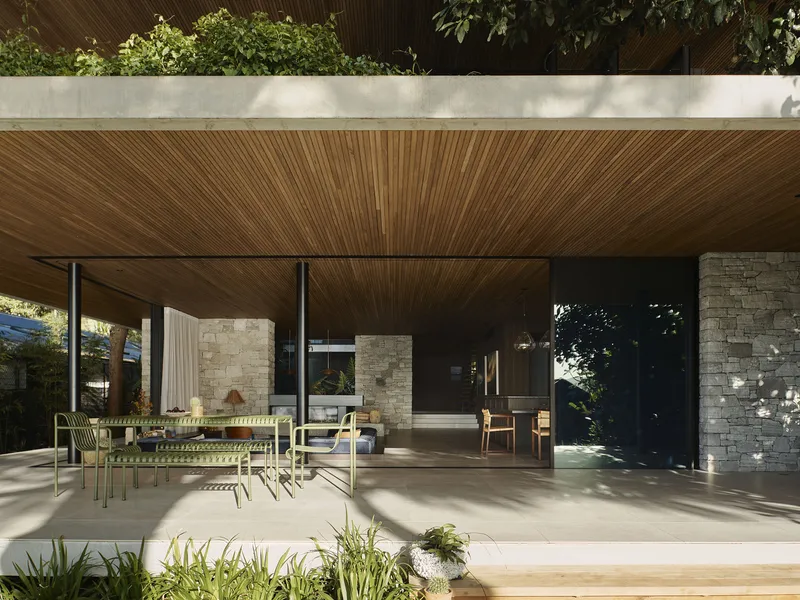
The slender tallowwood battens that line the ceilings do not stop at the glass line. They run continuously from interior rooms out through covered terraces, dissolving the threshold between conditioned space and open air. Beneath them, dark stained timber columns and stone piers define zones without enclosing them. The covered outdoor lounge at the harbour side reads less like a deck appended to a house and more like a room that simply decided not to have walls.
Dappled afternoon light filters through existing tree canopies onto these terraces, producing a layered shade condition that the deep eaves reinforce rather than replace. This is passive cooling made tangible: the concrete mass absorbs heat slowly, the eaves block high summer sun, and cross-ventilation does the rest. It is a strategy that works because the architects committed to it structurally, not just diagrammatically.
The Planted Courtyard as Organizing Heart
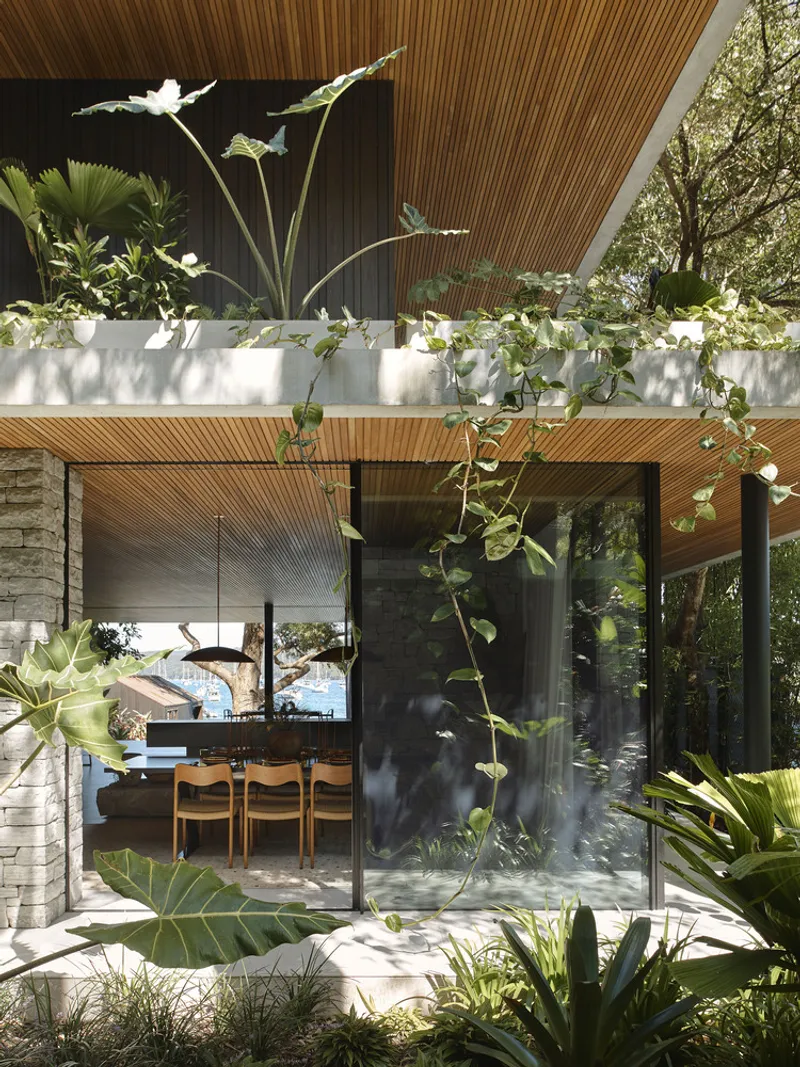
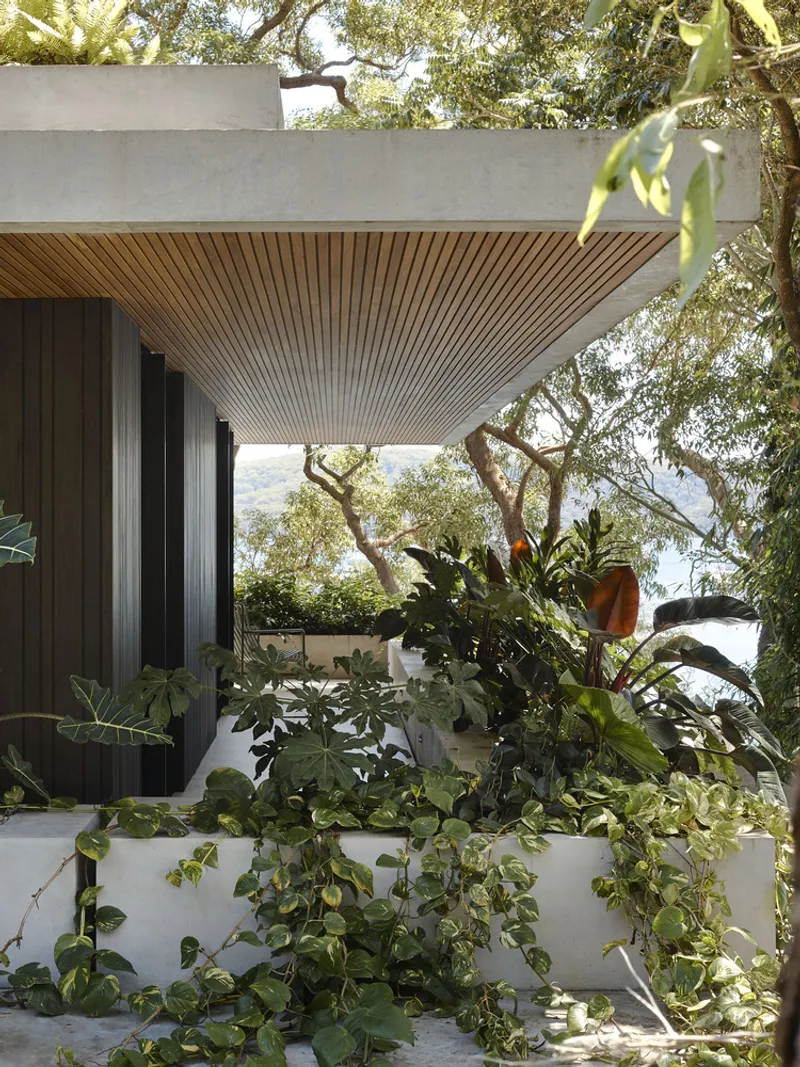
M House wraps itself around an internal courtyard that was designed to protect and celebrate the bangalay trees already on site. Rather than clearing the block and replanting later, Rama Architects kept every native specimen and removed only the exotic species that had approval for felling. The courtyard became the spatial hinge of the plan: living areas face it from the front, bedrooms look into it from above, and climbing vines scale its edges to knit building and garden into a single green mass.
The view through the courtyard toward the dining room, framed by a tallowwood soffit and threaded with climbing plants, reveals how seriously the landscape architects at Sprout Studio and Reflective Gardens took the brief. Bird-of-paradise and mature natives sit in raised beds that are integral to the concrete structure, their soil held by those inverted balcony beams. Greenery here is not scenery; it is infrastructure.
Hard and Soft in the Double-Height Living Space
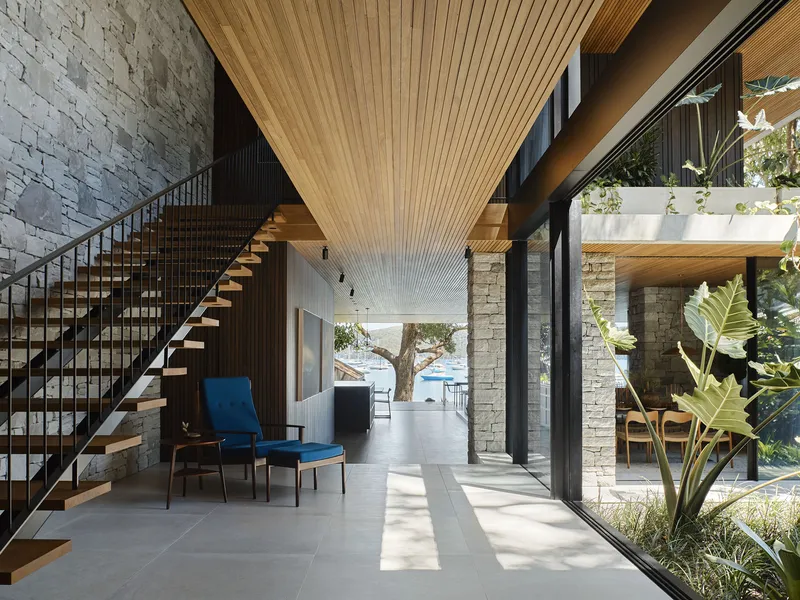
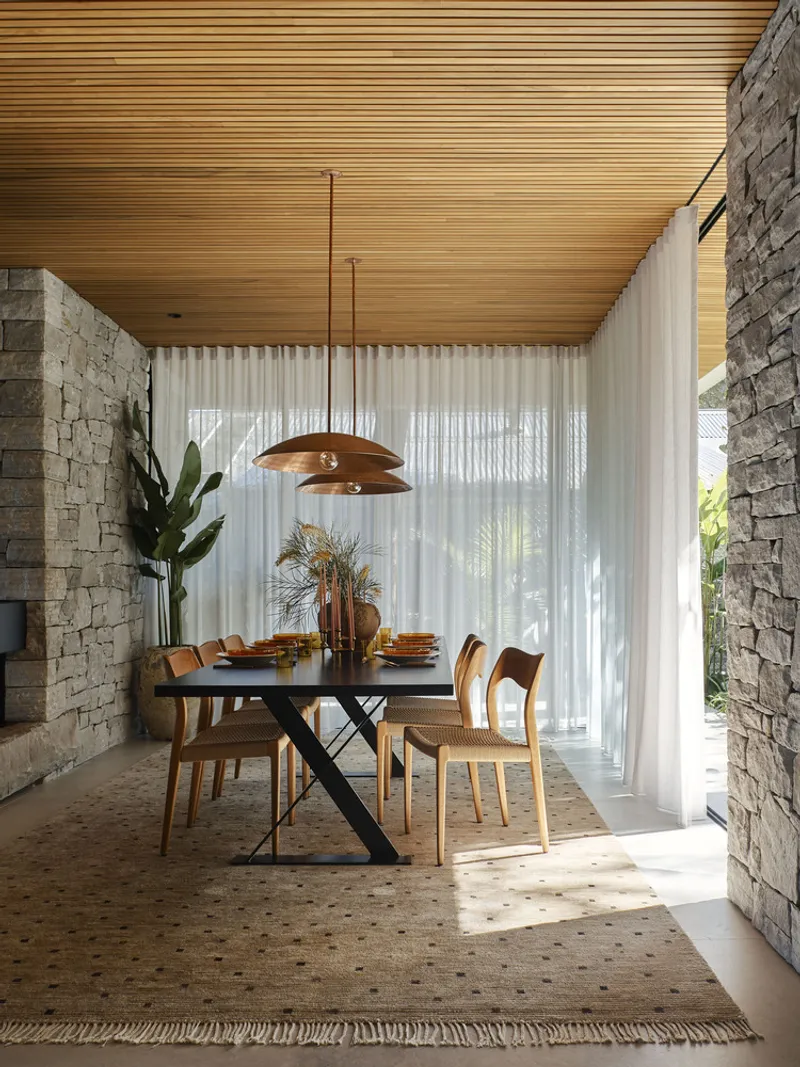
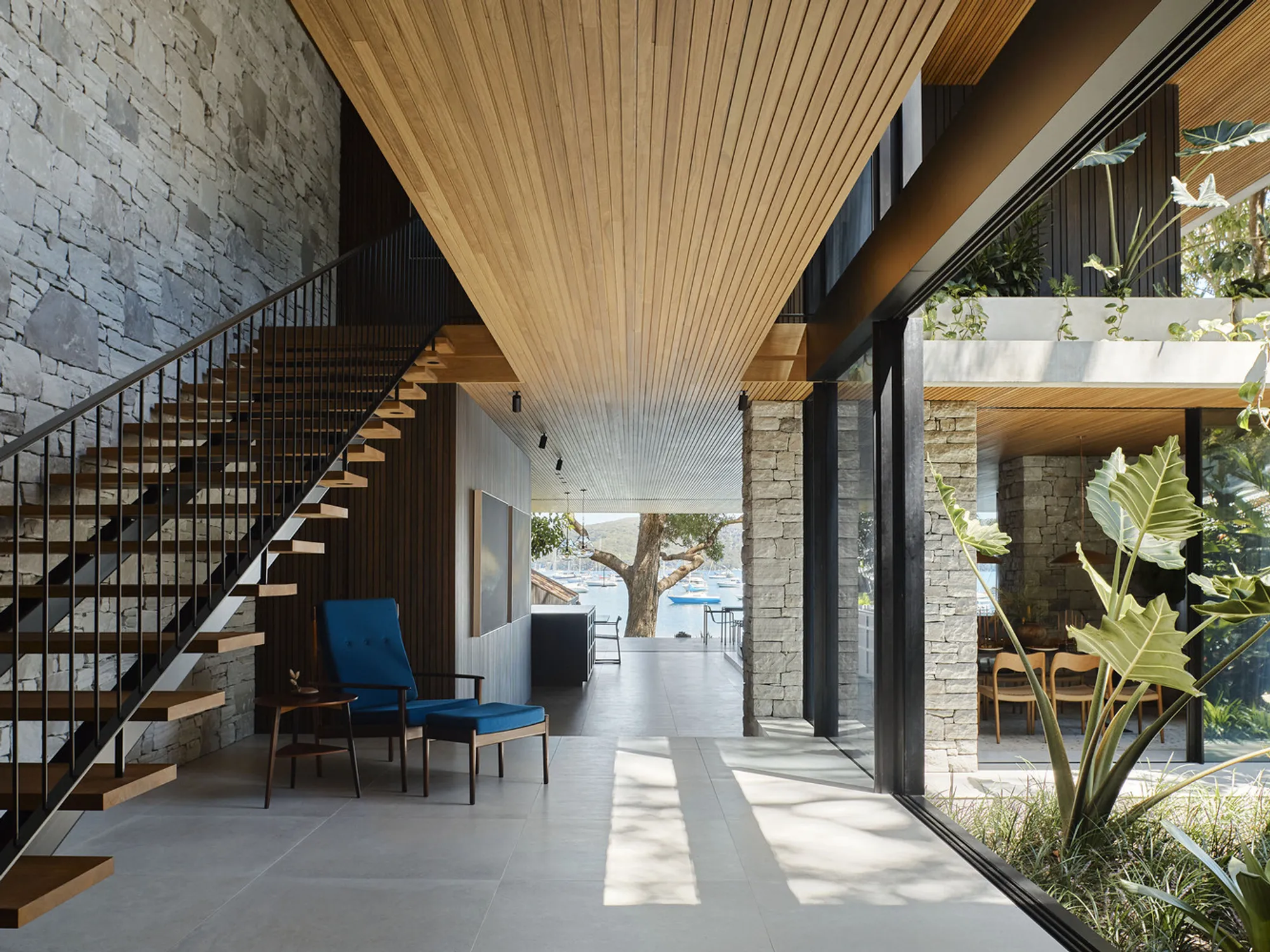
The double-height living space is the clearest expression of the project's governing tension between hard and soft. Concrete and locally quarried grey sandstone define the walls. Tallowwood battens line the ceiling. A slender open staircase in timber connects levels without interrupting sightlines to the planted courtyard beyond floor-to-ceiling glazing. The room feels tall and grounded at the same time, an effect that comes from the material contrast: warm timber overhead, cool stone at your back.
In the dining room, sandstone walls carry much of the atmospheric weight. A pendant light drops from the slatted ceiling, and sheer curtains filter daylight into a soft wash. The driveway stone, reclaimed from the previous dwelling, reappears here as a tactile link to the site's past. It is a quiet detail, but it signals an architecture that values continuity over spectacle.
Cascading Green Edges
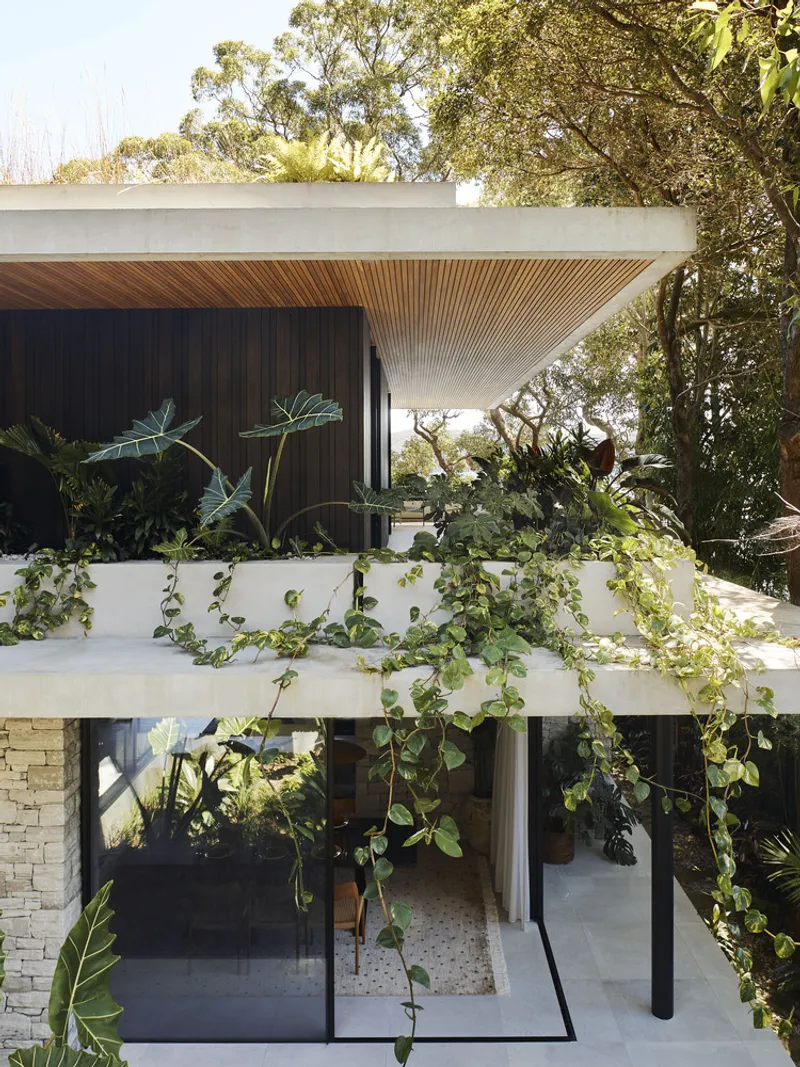
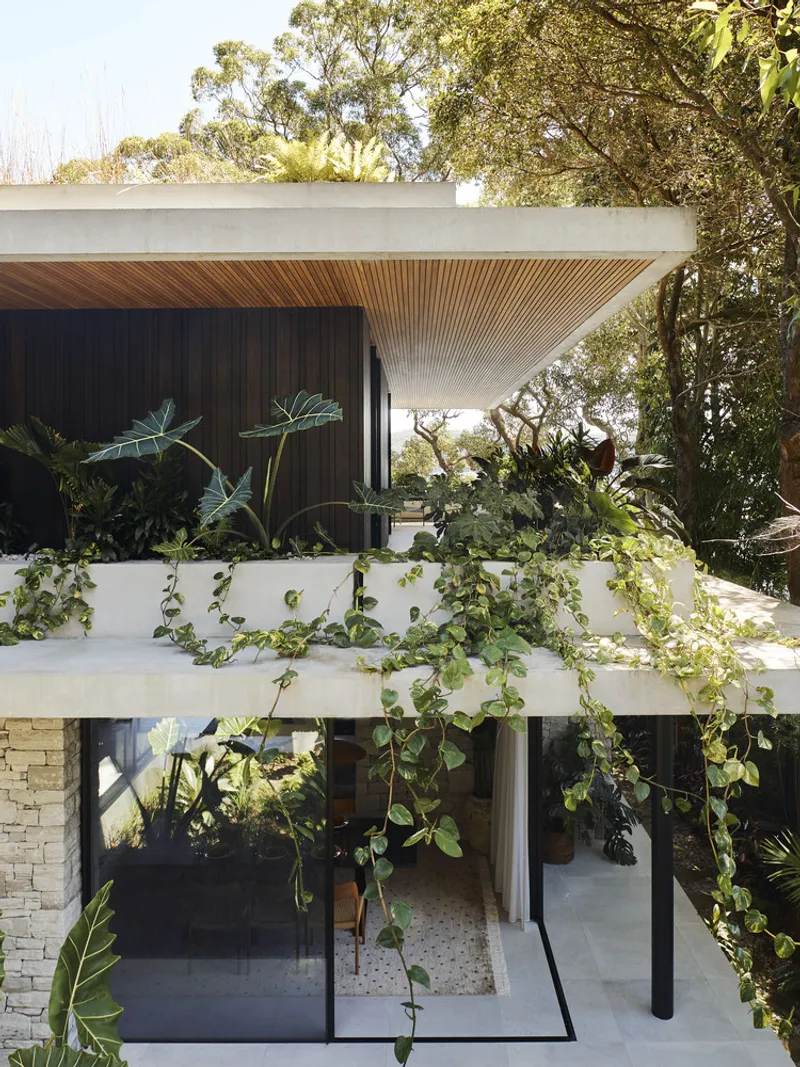
From the upper terraces, trailing vines cascade over concrete parapets and steel rails, creating a living screen that softens the building's profile and provides privacy to the rooms behind. The effect is cumulative: one level of planting spills down to the next, and from the street the house reads as a tiered garden rather than a three-storey concrete volume. Dark stained exterior timber helps the built mass recede further, letting foliage take the foreground.
The upward-turned beam detail is doing real work here. By inverting the structural convention, each balcony edge becomes a continuous planter of meaningful depth, capable of supporting root systems that will only thicken with time. It is the kind of move that separates genuine biophilic design from the decorative pot-on-a-ledge approach that populates most developer brochures.
Private Retreats in Timber and Light
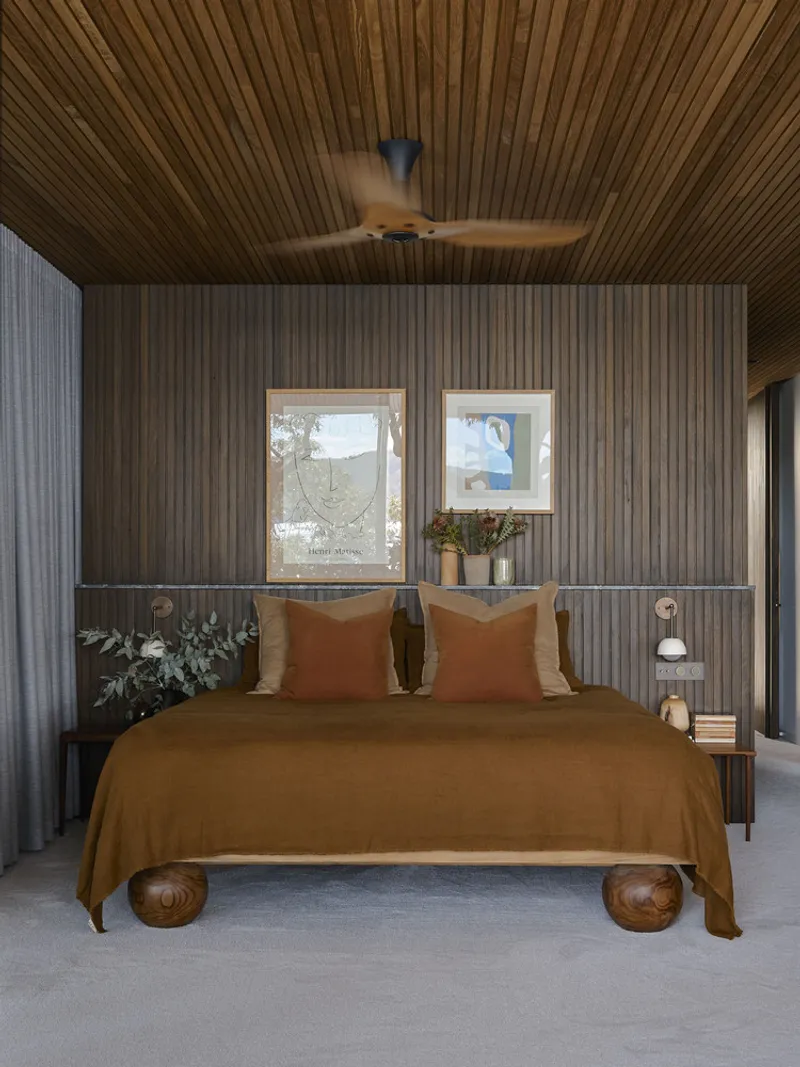
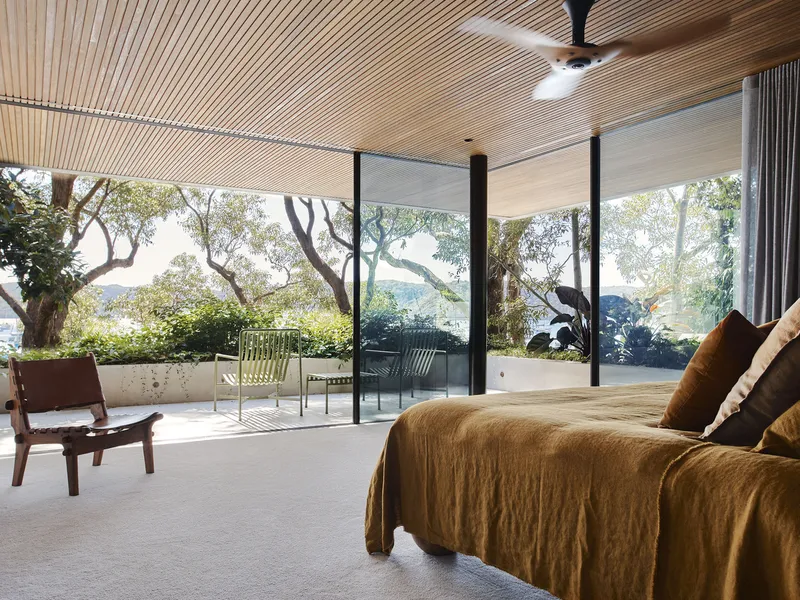
The bedrooms occupy a quieter register. Vertical timber cladding wraps walls and ceilings in a warm grain, while spinning ceiling fans recall a tropical vernacular that suits the Brazilian modernist reference without mimicking it. One bedroom opens through glass doors onto a covered terrace overlooking established trees and a forested hillside; another sits deeper in the plan, sheltered and introspective. The separation of adult and children's zones gives each wing a distinct quality of retreat.
What carries through every room is the ceiling. That continuous tallowwood batten system is the house's most legible unifying element, tying outdoor terraces to living rooms to bedrooms in a single rhythmic plane. It provides acoustic warmth, visual continuity, and a directional grain that draws the eye toward landscape at every turn.
Why This Project Matters
M House matters because it treats vegetation as a structural collaborator rather than a finishing touch. The inverted beams, the sandstone offcut aggregate, the retained native trees: these are design decisions baked into the engineering, not applied afterward by a landscape consultant working from a separate brief. Rama Architects have demonstrated that biophilic ambitions only hold up when they are embedded in the construction logic from day one.
The Brazilian modernist reference is also worth taking seriously. Sydney and São Paulo share a humid, warm climate, and the formal vocabulary of deep eaves, open plans, and concrete frames translates with surprising fidelity. By grounding that vocabulary in local sandstone, native planting, and tallowwood, M House avoids pastiche and becomes something site-specific: a house on the Northern Beaches that feels like it grew there, which, given a few more seasons of vine growth, it very nearly will have.
M House by Rama Architects, Clareville, New South Wales, Australia. Photography by Anson Smart.
About the Studio
Share Your Own Work on uni.xyz
If projects like this are the kind of work you want to make, uni.xyz is a place to publish your own, find collaborators, and enter design competitions.




Popular Articles
Popular articles from the community


Lunar Spiral: Space Architecture Shaped by the Mathematics of the Universe
Lunar Spiral reimagines space architecture through Fibonacci geometry, lunar regolith, levitating habitats, and self-sustaining Moon living.

Conexión: Biophilic Design Reimagines High-Rise Living in Hong Kong
Conexión reimagines high-rise living in Hong Kong through biophilic design, green facades, shared spaces, daylight, water and nature within.

The Ocean Hive: Sustainable Architecture for a Self-Sufficient Civilization at Sea
The Ocean Hive imagines sustainable architecture at sea, where modular habitats, algae, wave power and ocean waste sustain a growing colony.

Riyadh For All: Intergenerational Urban Design for Active Aging in Rabat
Riyadh For All reimagines urban design in Rabat with intergenerational co-living, adaptive courtyards, and Moroccan cultural exchange today.


Similar Reads
You might also enjoy these articles


Hodi-Mandai Geram
Project Function: Preservation and revitalization of the Intangible heritage and socio-spatial identity of the Hodi by Housing, Cultural Memory Center, Sacred Grove, landscape, local tourism economy


Olio Towers: A Mid-Rise for Performers That Fuses Housing, Rehearsal, and Stage
Located blocks from Houston's Theater District, this modular tower stacks living units around a central performance atrium.

Oasis: Modular Green Housing Carved into Dhaka's Urban Fabric
A shortlisted Plugin Housing entry reclaims unauthorized settlements in Dhaka with stepped concrete volumes, green roofs, and ventilation-driven design.

Black Hole: A Floating Megastructure for the Post-Physical Era
Emiliano Mazzarotto envisions a spherical, self-scaling arena where e-sports, digital hotels, and holographic stadiums replace traditional public space.

Explore Architecture Competitions
Discover active competitions in this discipline



Challenge to reimagine the Iron Throne


Photograph architecture without architects


Illustrate the lost glory of Angkor Wat - Render Challenge


Design challenge to reuse E-waste
Comments (0)
Please login or sign up to add comments
No comments yet. Be the first to comment!