

Metro Wind Pavilion: Transforming Urban Infrastructure Through Color and Connection
Colorful aluminum facades transform Shenzhen metro ventilation pavilions into vibrant urban landmarks connected by grille corridors, celebrating infrastructure as public art.


Introduction: Infrastructure as Urban Canvas
In the rapidly evolving cityscape of Shenzhen, China, where technological innovation and urban development proceed at unprecedented velocity, even the most utilitarian infrastructure becomes subject to reimagination. The Metro Wind Pavilion, designed by Mur Mur Lab for the Shenzhen Joy City development, transforms what could have been merely functional ventilation structures for Metro Line 12's Lingzhi Station into vibrant urban interventions that engage the public realm through color, connectivity, and symbolic presence.
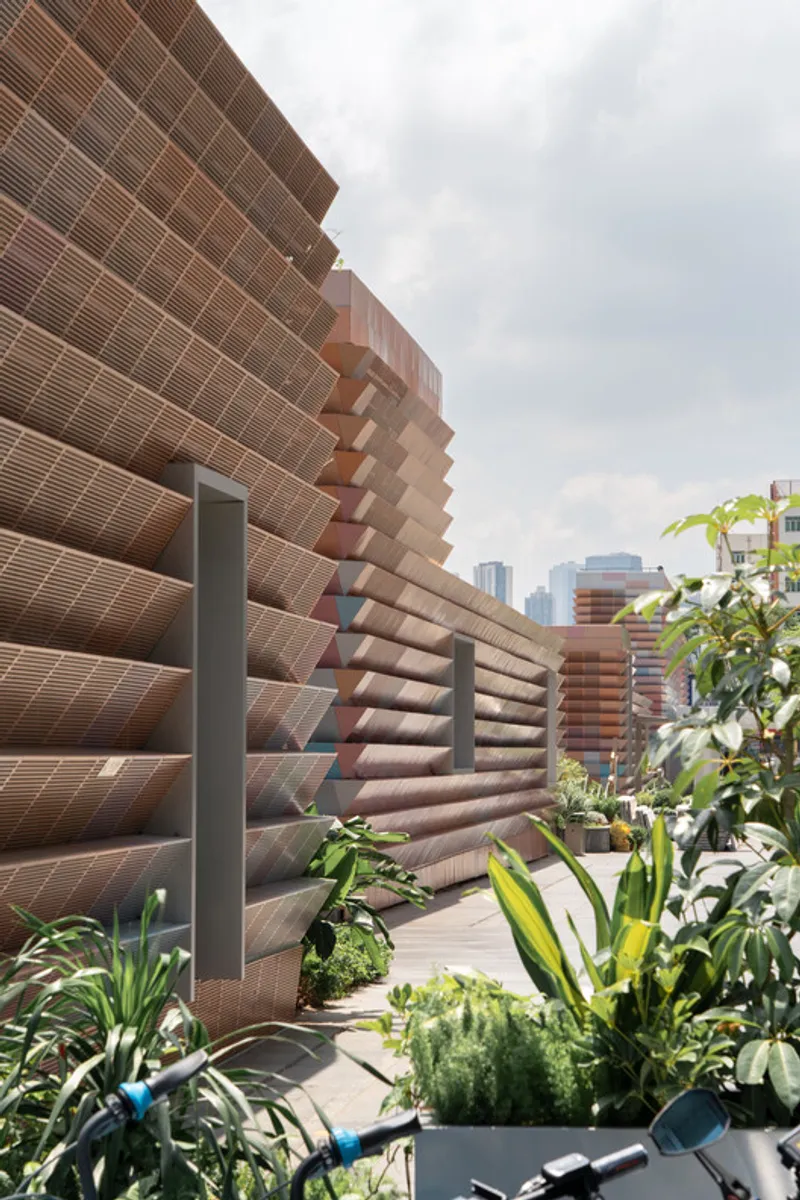
Comprising 2,400 square meters of renovated infrastructure, the project challenges conventional approaches to industrial architecture that typically prioritize functional efficiency while relegating aesthetic considerations to secondary status. Instead, Mur Mur Lab embraces the ventilation pavilions' prominent urban position as an opportunity to create visual landmarks that punctuate the commercial streetscape with abstract colored facades reminiscent of sunset glows. The project demonstrates how thoughtful design can elevate necessary urban infrastructure from invisible background elements into active participants in city life.


Site Context: Memory and Transformation in Old Bao'an District
The Metro Wind Pavilion sits within Shenzhen Joy City, located in the old Bao'an District's Zone 25—an area steeped in local memory and community history. Unlike Shenzhen's newer districts that emerged almost instantaneously during China's rapid urbanization, this neighborhood carries the layered experiences of long-time residents whose connections to place span decades rather than years.
This context profoundly shaped Mur Mur Lab's design approach. The architects recognized that urban renewal in such neighborhoods cannot proceed through wholesale erasure and replacement—the strategy that has characterized much Chinese urban development. Instead, renewal must acknowledge and engage with existing memory structures, physical conditions, and community patterns. The challenge becomes how to introduce contemporary interventions that revitalize without destroying, that add new layers to the urban palimpsest rather than scraping it clean.
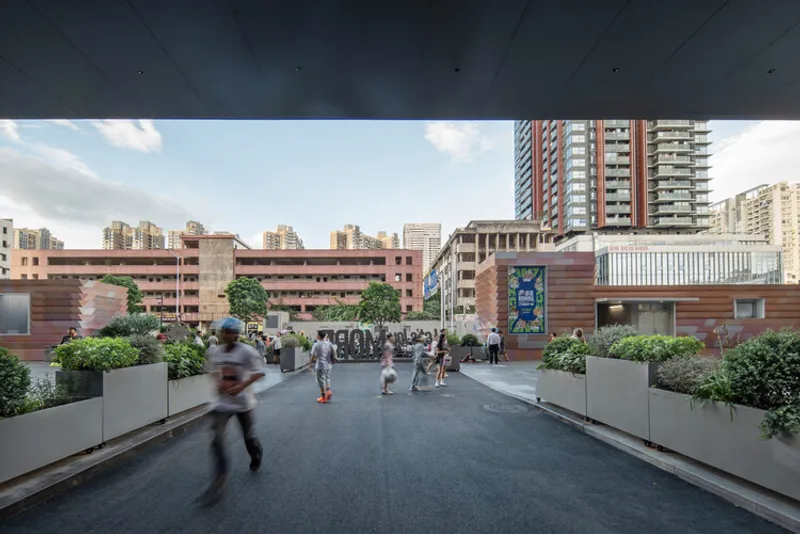
The ventilation pavilions themselves emerged from a protracted construction process marked by repeated delays—a circumstance that left these structures in an ambiguous state between infrastructure and urban void. Their functional necessity (providing essential ventilation for the underground metro system) conflicted with their problematic street presence: tall, enclosed masses standing mutely before bustling commercial activity, creating dead zones in what should be vibrant pedestrian environments.
Philosophical Framework: Memory, System, and Everyday Life
Mur Mur Lab's approach to this renovation emerges from sophisticated thinking about urban experience and collective memory. The architects articulate a philosophy recognizing that "human memory can be unreliable"—individual recollections fade, distort, and reconstruct themselves over time. What anchors memory and creates lasting emotional connections to place is not abstract nostalgia but rather tangible interaction with environmental systems.
This insight reframes urban renewal fundamentally. Rather than conceiving it as physical transformation alone, the architects understand renewal as "weaving a collective everyday existence." The goal becomes creating conditions where ordinary daily activities—walking to shops, waiting for friends, passing through streets—generate experiences that accumulate into meaningful relationships with place.

The design team initially entertained ambitious visions for radical transformation but came to recognize such approaches as "overly radical" within an established urban system. Through ongoing discussions and site analysis, they arrived at a more nuanced position: "to glean a few insights from it or to restore a certain equilibrium." This philosophy eschews dramatic demolition or sweeping changes in favor of careful interventions that work with existing conditions.
The architects describe their approach as "by nature, an ongoing process"—acknowledging that urban environments evolve continuously rather than arriving at static end states. This temporal understanding liberates the design from needing to solve every problem or anticipate every future use. Instead, the intervention focuses on immediate improvements that create frameworks for future adaptation.
Design Strategy: From Void to Canvas
The existing ventilation pavilions presented specific challenges. Rising to heights equivalent to three-story buildings, these structures dominated the streetscape through sheer mass. Functional requirements dictated that they remain almost entirely enclosed—ventilation systems cannot operate effectively with large openings that would compromise airflow dynamics. The result: monolithic volumes standing as "silent voids left in the cityscape," dead spaces that pedestrians hurried past rather than lingered near.
Mur Mur Lab's key conceptual insight transformed this challenge into opportunity: "voids are ideal for drawing." If the structures must remain largely solid and enclosed, their extensive wall surfaces become urban-scale canvases. Rather than fighting the pavilions' nature as closed volumes, the design embraces this quality and activates the surfaces themselves.
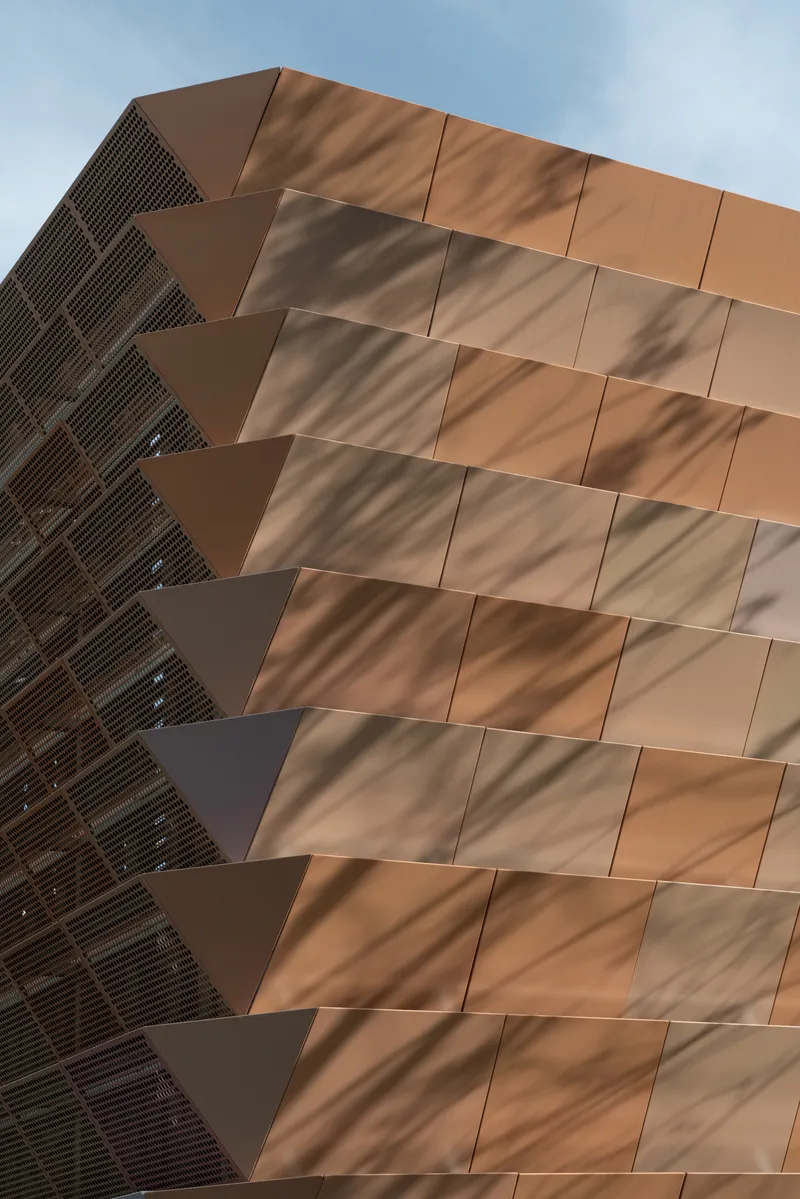
The renovation strategy proceeds through three primary moves, described by the architects as "not radical" but rather pragmatic and achievable. First, the team streamlined the existing masses of the multiple ventilation pavilions, simplifying their forms and integrating them visually as much as functional requirements permitted. This consolidation reduced visual clutter and created clearer geometric relationships between structures.
Second, using an illustration by artist Murong as the primary color reference, the architects developed a series of abstract colored aluminum panel facades. This decision to derive colors from an existing artwork rather than generating them through architectural logic alone signals the project's symbolic rather than purely functional orientation. The panels transform the pavilions from utilitarian infrastructure into large-scale public art installations.
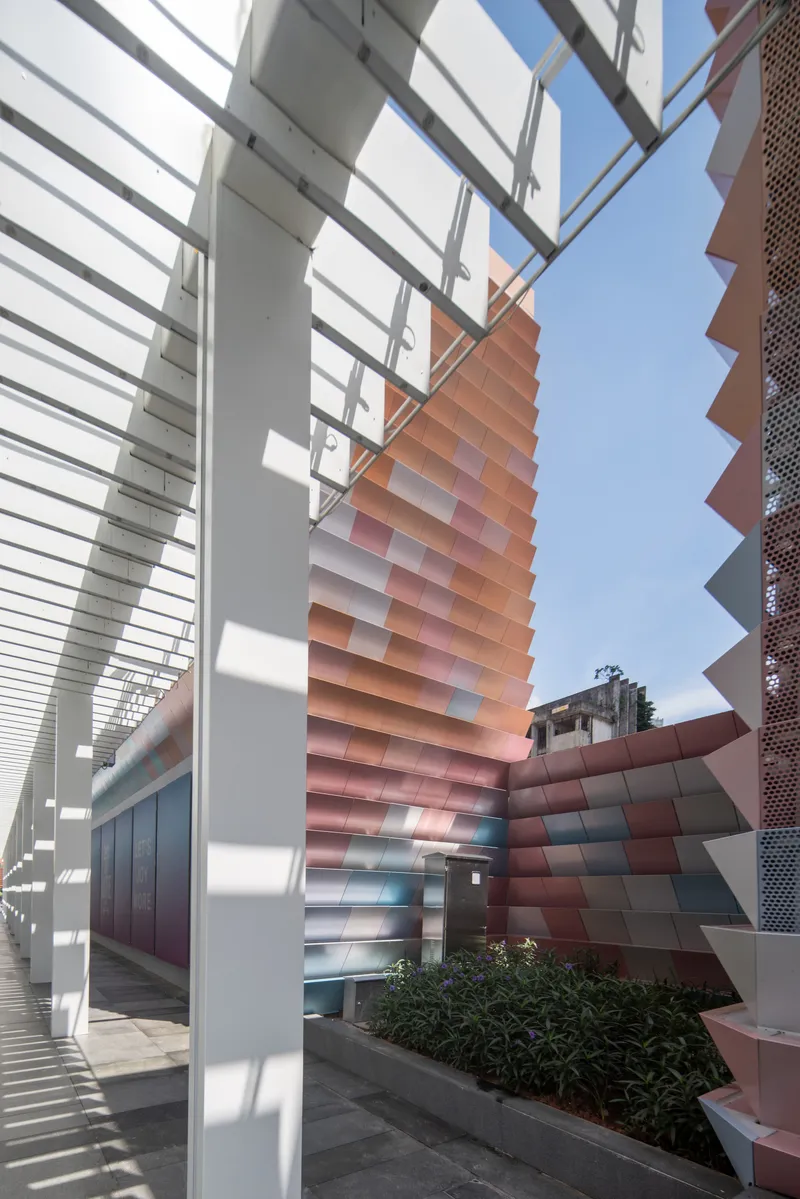
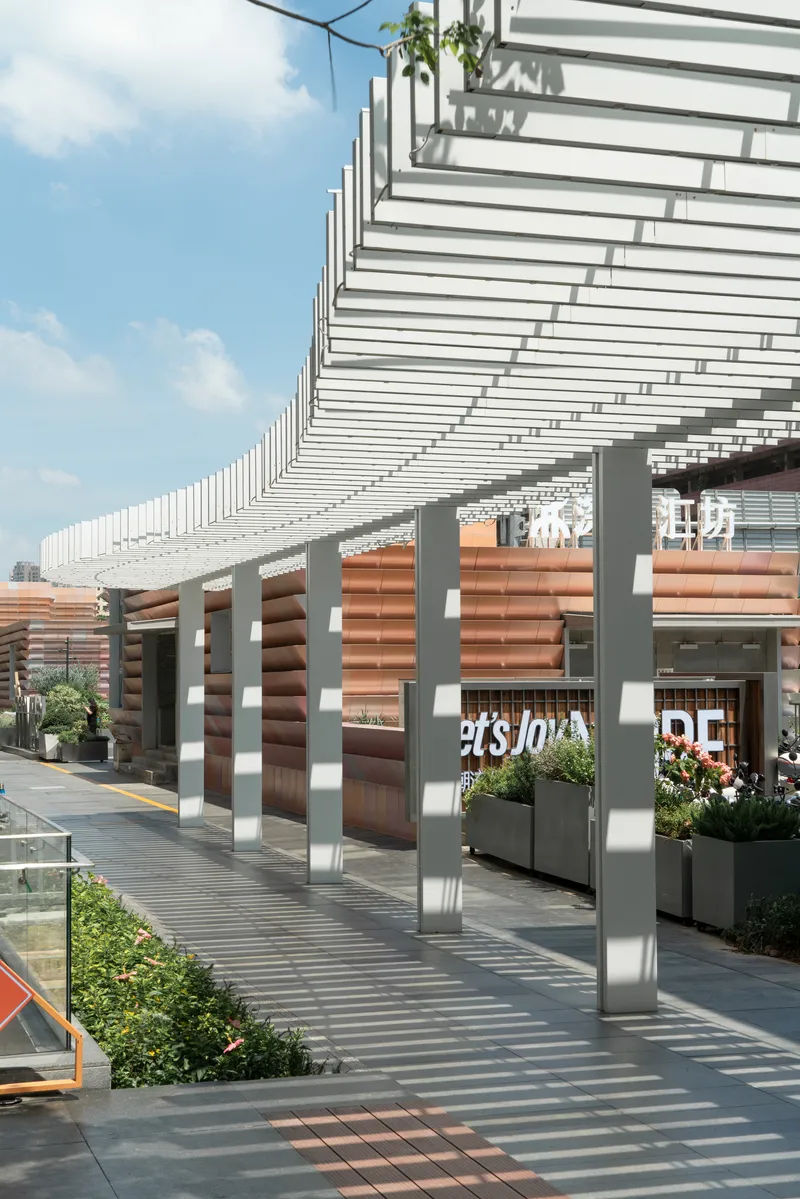
Third, and perhaps most significantly for urban experience, the design introduces grille corridors connecting the multiple ventilation pavilion groups. These circulation elements convert what had been isolated objects into a linked system that pedestrians can move through and around, creating new pathways and gathering spaces within the commercial district.
Symbolic Approach: Color as Urban Intervention
Mur Mur Lab explicitly acknowledges that their design "does not originate from the fundamental architectural concerns of 'space, structure, and behavioral activities,' but rather employs a colored painting as a direct 'symbolic' approach." This statement positions the project within broader debates about architecture's priorities and methods.
Traditional architectural thinking privileges spatial configuration, structural expression, and functional accommodation as primary generators of form. The Metro Wind Pavilion inverts this hierarchy, using visual symbolism—specifically color and abstract composition—as the driving design force. The architects recognize this approach as "somewhat daring," acknowledging that it challenges conventional professional values.
Yet within the "eclectic existing environment of the old town," this strategy proves remarkably effective. The old Bao'an District features the visual complexity typical of Chinese urban areas that developed organically over decades: mixed building types and scales, varied materials and colors, abundant signage and commercial graphics, and dense layering of uses and activities. Within such contexts, subtle architectural interventions risk invisibility—their refinement lost amid visual cacophony.
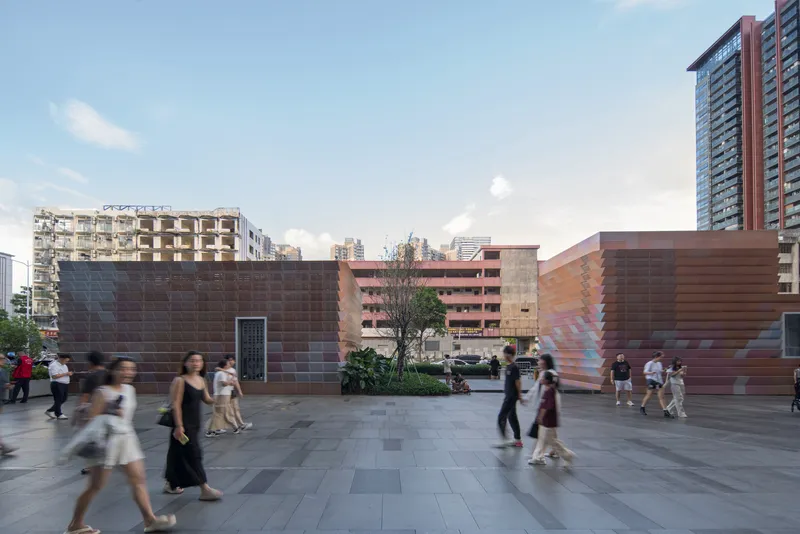
The introduction of what the architects term "minimalist symbols"—the bold colored facades—cuts through this complexity to "infuse the site with significant immediate visual impact." The pavilions become recognizable landmarks, orientation points that help residents and visitors navigate the district while creating memorable visual experiences that distinguish this place from generic commercial zones.
Material Development: Calibrating Color and Composition
The colored aluminum panel facades required extensive development to achieve the desired effects. The design process demonstrates the technical precision necessary to translate artistic vision into architectural reality at urban scale.
Initial work occurred digitally, with the team simulating different color blocks and combinations on computer models. This phase explored compositional relationships: how various hues interact when placed adjacent to each other, how color proportions affect overall perception, how viewing distances and angles alter appearance, and how lighting conditions throughout the day would transform the facades' character.

Parallel to color composition studies, the team examined construction techniques for the unit aluminum panels. This technical investigation ensured that the desired visual effects remained achievable within budget constraints and local fabrication capabilities. The material selection of aluminum panels offers practical advantages—durability, weather resistance, relatively simple installation, and potential for precise color matching through powder coating or similar finish systems.
The prototyping stage involved careful color calibration through physical mockups. The team compared 1:1 scale color paper prints with actual panel samples, making adjustments to account for differences between printed media, digital renderings, and finished materials. This iterative process addressed the notorious difficulty of color matching across different media—a challenge familiar to anyone who has specified finishes and discovered that physical reality diverges from digital representations.
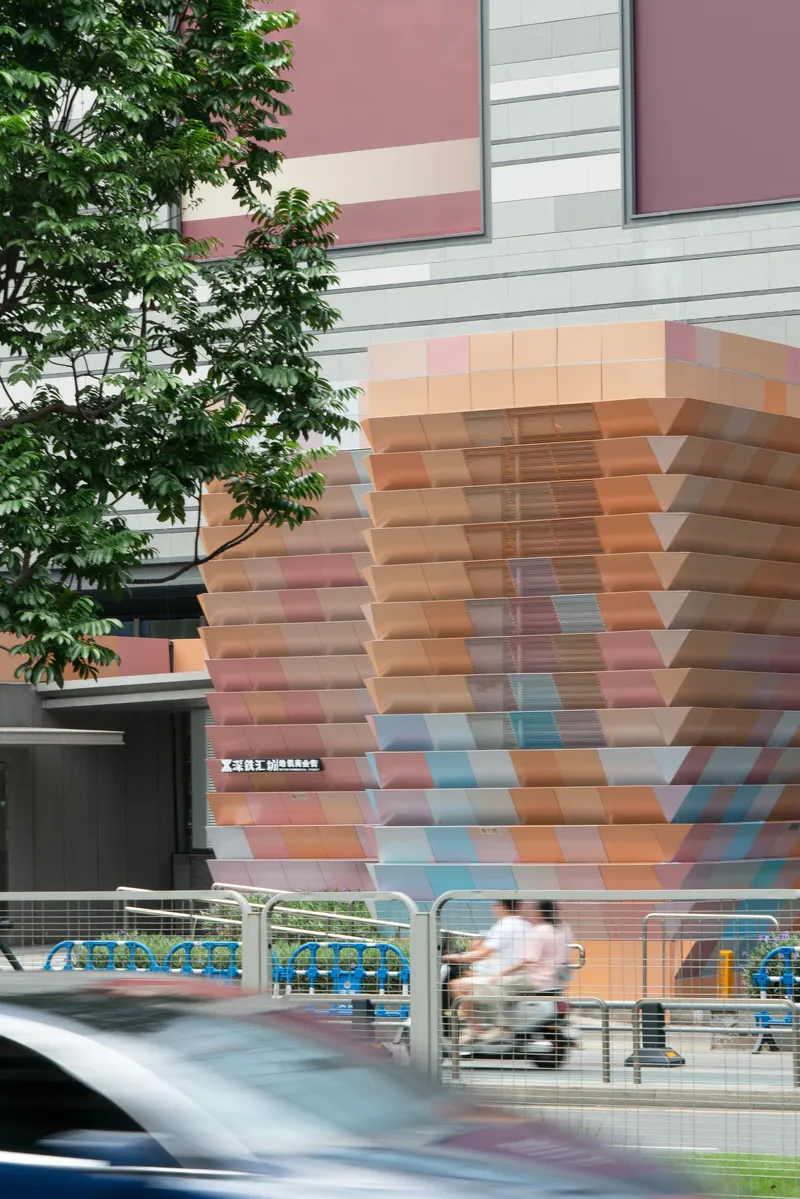
The completed facades evoke "the image of a sunset glow"—an apt description capturing the warm gradations and atmospheric quality of the color composition. This natural phenomenon reference grounds the abstract composition in universal human experience. Sunsets provoke emotional responses across cultures; by echoing this imagery, the pavilions tap into shared aesthetic associations.
The color palette appears to feature warm tones—oranges, pinks, reds, yellows—that create visual warmth in contrast to the often cool, gray urban environment of commercial districts. These hues also ensure visibility and impact, drawing attention even amid the district's visual complexity.
Grille Corridors: Creating Connection and Permeability
The grille corridors connecting the ventilation pavilions represent the project's most significant spatial intervention. These elements transform the pavilions from isolated objects into an interconnected system that pedestrians can engage with directly rather than merely viewing from a distance.
The corridors serve multiple functions simultaneously. Practically, they provide shaded circulation routes through the commercial district, offering respite from Shenzhen's intense sun and subtropical heat. This environmental comfort increases pedestrians' willingness to linger in the area, supporting commercial activity and social interaction.
Spatially, the corridors create thresholds and transitional zones between the pavilions and surrounding streetscape. Rather than abrupt boundaries, these gradual transitions make the infrastructure feel more accessible and less imposing. The grille construction maintains visual permeability—allowing views through while still defining space—preventing the claustrophobic feeling that solid corridors might create.

Socially, these circulation elements generate opportunities for casual encounter and public activity. People meet while walking through the corridors, pause to converse in the shade, or use the spaces for brief rest during shopping trips. These micro-activities accumulate into the "collective everyday existence" that the architects identify as urban renewal's core purpose.
The corridors also create compositional relationships between the colored pavilion facades, establishing viewing sequences and framing perspectives that enhance the visual experience. As pedestrians move through the linked spaces, the colored surfaces reveal themselves from changing angles, creating dynamic rather than static perception.
Urban Temporality: Infrastructure and the Long Game
Mur Mur Lab articulates an important observation about urban renewal: "A defining feature of urban renewal is its typically lengthy cycle." This temporal dimension profoundly affects how interventions should be conceived and evaluated.
The architects recognize that when design elements "dissolve and dissipate into a longer time frame, they will participate more extensively in urban public activities, bringing surprises into people's daily lives." This perspective values gradual accumulation of experience over immediate dramatic impact. It suggests that the most successful urban interventions aren't necessarily those that create instant spectacle but rather those that remain engaging through repeated encounters over months and years.

The Metro Wind Pavilion's colored facades exemplify this long-term engagement strategy. Initially striking, they continue revealing new qualities through extended familiarity. Different lighting conditions—morning sun, midday glare, evening glow, night illumination—transform their appearance daily. Seasonal variations in weather and vegetation alter their context. The changing commercial activities and pedestrian patterns around them create ever-shifting relationships between infrastructure and urban life.
This temporal sophistication distinguishes thoughtful infrastructure design from merely functional engineering. Rather than solving the ventilation requirement and moving on, Mur Mur Lab creates architecture that participates actively in urban experience across time scales—daily rhythms, seasonal cycles, and the multi-year processes of community development and memory formation.
Public Presence: Infrastructure as Civic Architecture
The project's core question, as framed by the architects, concerns "the public presence it should embody as an urban infrastructure." This inquiry positions ventilation pavilions not as purely technical necessities but as civic architecture with responsibilities to the public realm.
Traditional infrastructure design typically prioritizes efficiency and reliability while minimizing visibility. The ideal, from this perspective, is infrastructure that functions perfectly while remaining unnoticed—underground utilities, hidden mechanical systems, structures that blend seamlessly into backgrounds.
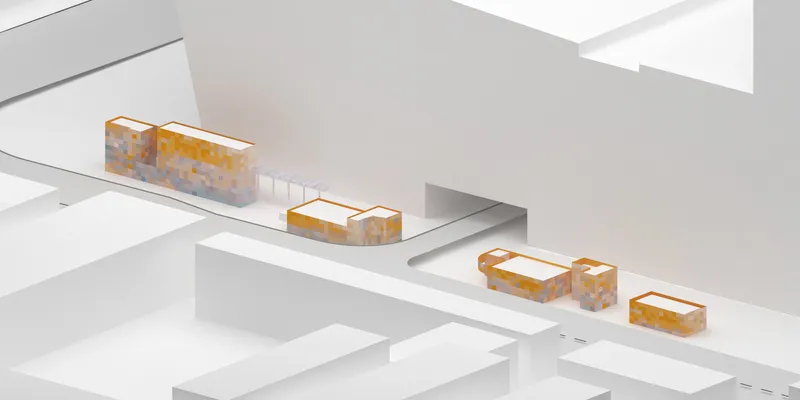
Mur Mur Lab proposes an alternative approach: infrastructure that acknowledges its urban presence and transforms necessity into opportunity. The ventilation pavilions must exist and occupy significant ground area regardless of aesthetic treatment. Given this inevitability, why not leverage their presence to create public value beyond mere functional performance?
The colored facades convert required infrastructure into visual landmarks that orient navigation, create memorable places, and contribute beauty to daily experience. The grille corridors transform necessary clearances around ventilation equipment into usable public space. The integrated composition of multiple pavilions creates urban rhythm and spatial definition where isolated structures would produce fragmentation.
This approach aligns with emerging thinking about infrastructure's civic role. As cities recognize that massive investments in transit systems, utility networks, and other infrastructure shape urban character as powerfully as any buildings, demands grow for infrastructure that serves social and aesthetic functions alongside technical ones. The Metro Wind Pavilion demonstrates one model for achieving this integration.
Construction and Realization: Navigating Complexity
Realizing the Metro Wind Pavilion required navigating the complex realities of infrastructure renovation within an active urban environment. The ventilation systems serve essential functions for Metro Line 12; any construction work must proceed without compromising subway operations or public safety.
The aluminum panel facade system needed to attach to existing structures without penetrating weatherproofing or interfering with ventilation performance. Structural engineers calculated wind loads and seismic requirements, ensuring the new facades would withstand typhoons and earthquakes common in coastal Shenzhen.

Coordination with the Shenzhen Metro authority, Joy City developers, municipal agencies, and various contractors required careful management. Each stakeholder brought different priorities and constraints; reconciling these competing demands while maintaining design integrity challenged the architects throughout the project.
The "repeated delays" mentioned in the project description suggest construction challenges typical of infrastructure work—schedule conflicts with subway operations, material delivery issues, weather delays, bureaucratic approvals, and the inevitable complications of renovating rather than building new.
That the project reached successful completion despite these obstacles testifies to Mur Mur Lab's persistence and the client's commitment to design quality. Many infrastructure projects abandon aesthetic ambitions when faced with budget pressures or schedule demands; that the Metro Wind Pavilion retained its colored facade concept through completion represents a significant achievement.
Broader Implications: Models for Infrastructure Design
The Metro Wind Pavilion offers valuable precedents for cities globally grappling with how to integrate necessary infrastructure into urban fabric without creating dead zones or visual blight. Several principles emerge from the project's approach:
Embrace necessity as opportunity: Rather than concealing required infrastructure, acknowledge its presence and transform it into positive urban contribution. The ventilation pavilions must exist; making them beautiful and engaging costs relatively little beyond standard functional solutions.

Prioritize public experience: Evaluate infrastructure design not only by technical performance but also by impacts on pedestrian activity, visual quality, and social interaction. The grille corridors exemplify adding public value through modest interventions.
Work with existing conditions: In established urban areas, radical transformation often proves impossible or undesirable. Careful interventions that enhance rather than replace can achieve significant improvements while respecting context and memory.
Use color strategically: In visually complex environments, bold color can create impact and clarity where subtle architectural refinement would disappear. The colored facades demonstrate how symbolic approaches can succeed where traditional architectural methods might fail.
Design for temporal engagement: Consider how interventions will be experienced repeatedly over extended periods, not just initially. Elements that reveal new qualities through continued familiarity sustain interest better than one-time spectacles.
Cultural Context: Infrastructure Design in Contemporary China
The Metro Wind Pavilion reflects broader patterns in contemporary Chinese architecture and urban design. As Chinese cities mature beyond the rapid development phase of recent decades, attention shifts from pure quantity of construction toward quality of urban environment and experience.
Projects like the Metro Wind Pavilion represent this maturing sensibility—using design to enhance daily life rather than merely accommodating growth. The emphasis on color, public space, and pedestrian experience signals priorities beyond functional efficiency and economic development.

The project also reflects growing recognition in China of infrastructure's urban impacts. With massive investments in metro systems, elevated highways, utility corridors, and other infrastructure transforming Chinese cities, designers and officials increasingly acknowledge these elements' effects on neighborhoods and demand better integration with surrounding urban fabric.
Mur Mur Lab's approach—using local artist Murong's illustration as color source, engaging with neighborhood memory and context, prioritizing everyday experience—demonstrates architecture practice grounded in specific place rather than imposing universal solutions. This contextual sensitivity represents an important direction for Chinese architecture as the country develops distinctive design cultures rather than merely importing international styles.
All the Photographs are works of WDi


Popular Articles
Popular articles from the community


Singing Woman: Contemporary Architecture Inspired by Estonia’s Voice and the Sea
Singing Woman turns Estonia’s song culture into flowing opera house architecture, blending public life, landscape, sea, and national memory.

Tsunami Convergenics: Turning Catastrophic Ocean Forces into Underwater Housing Infrastructure
A speculative underwater settlement off the coast of Onagawa, Japan, treats tsunamis and typhoons as energy sources rather than threats.

Faces of the Soviet Avant-Garde: Turning Moscow's Street Names into an Open-Air Museum
A network of sculptural installations across a Moscow residential district transforms forgotten architect names into spatial encounters with cultural memor

Opera on the Sea: Driftwood Logic Shapes a Timber Opera House on Estonia's Coast
Trevor Orgill's opera house translates the entangled drift of floating timber into a civic building where wood, water, and music converge.

Similar Reads
You might also enjoy these articles


Hodi-Mandai Geram
Project Function: Preservation and revitalization of the Intangible heritage and socio-spatial identity of the Hodi by Housing, Cultural Memory Center, Sacred Grove, landscape, local tourism economy


Olio Towers: A Mid-Rise for Performers That Fuses Housing, Rehearsal, and Stage
Located blocks from Houston's Theater District, this modular tower stacks living units around a central performance atrium.

Oasis: Modular Green Housing Carved into Dhaka's Urban Fabric
A shortlisted Plugin Housing entry reclaims unauthorized settlements in Dhaka with stepped concrete volumes, green roofs, and ventilation-driven design.

Black Hole: A Floating Megastructure for the Post-Physical Era
Emiliano Mazzarotto envisions a spherical, self-scaling arena where e-sports, digital hotels, and holographic stadiums replace traditional public space.

Explore Urban Infrastructure Competitions
Discover active competitions in this discipline

Challenge to reimagine the Iron Throne

Photograph architecture without architects

Illustrate the lost glory of Angkor Wat - Render Challenge

Design challenge to reuse E-waste
Comments (0)
Please login or sign up to add comments
No comments yet. Be the first to comment!