

DADA Partners Carves Light and Void into a White Stucco Residence in India
An L-shaped house on a half-acre plot uses courtyards, terraces, and planar volumes to turn minimalism into a lived experience.


Minimalism in residential architecture risks becoming a brand exercise: white walls, blank faces, interiors that look great in photographs and feel sterile in person. The White House by DADA Partners, led by architect Mukul Arora, sidesteps that trap by treating minimalism not as an aesthetic endpoint but as a spatial strategy. Built on a half-acre parcel in India, the 9,000 sq.ft. residence uses an L-shaped plan to wrap around a central green courtyard, generating a sequence of indoor and outdoor rooms that shift in character as the sun moves through the day.
What makes the project genuinely interesting is the discipline of its solid-void composition. The white stucco envelope reads as a single monolithic mass from the street, punctured by only a single corner window on the east-facing front elevation. Step inside or around to the garden, and that mass fractures into terraces, glazed slots, planted courtyards, and a narrow swimming pool that reflects the volumes back at themselves. The architecture rewards proximity: the closer you get, the more it reveals.
A Guarded Front, an Open Core
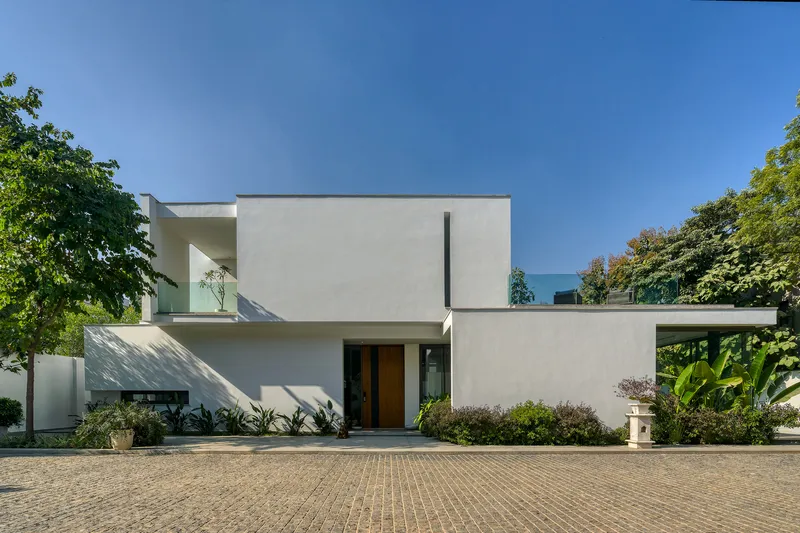

From the street, the White House offers almost nothing. The entrance facade is a composition of flat white planes, a recessed carport, and brick paving that leads the eye toward a barely visible entry. There are no picture windows announcing the life inside, no cantilevered balconies signaling ambition. One corner window breaks the surface, and that restraint is the point. The house protects its occupants' privacy while setting up a powerful contrast with what lies behind the wall.
At dusk, the strategy becomes even clearer. The stucco catches ambient light and the planted beds at the base soften the geometry just enough to keep it from feeling clinical. The entry slot glows, hinting at depth without disclosing the courtyard sequence beyond.
The Courtyard as Climate Device and Spatial Anchor
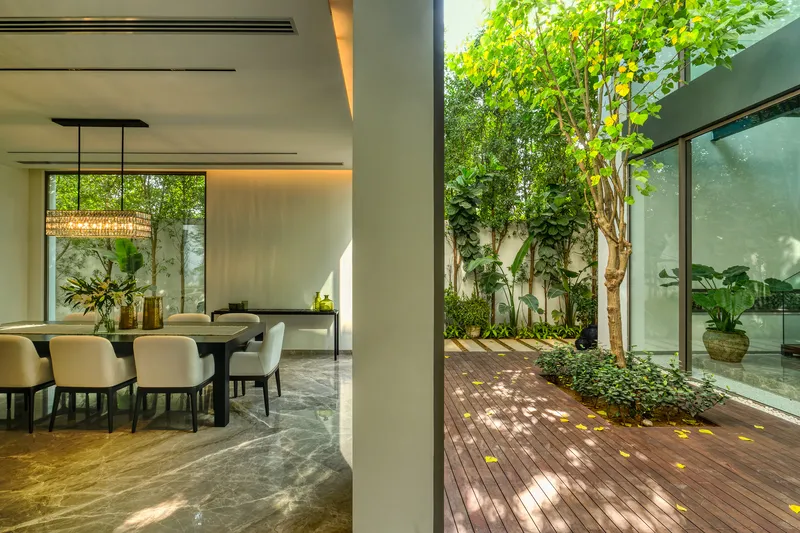
The central green courtyard is the organizing principle of the entire plan. The L-shaped layout bends around it, placing the formal lounge at the front with views on three sides, the bar and family lounge in the central zone overlooking the court, and bedrooms at the southern end. The courtyard is not decorative; it is infrastructure. It drives cross-ventilation, pulls daylight into the center of the floor plate, and establishes a microclimate that tempers the Indian heat.
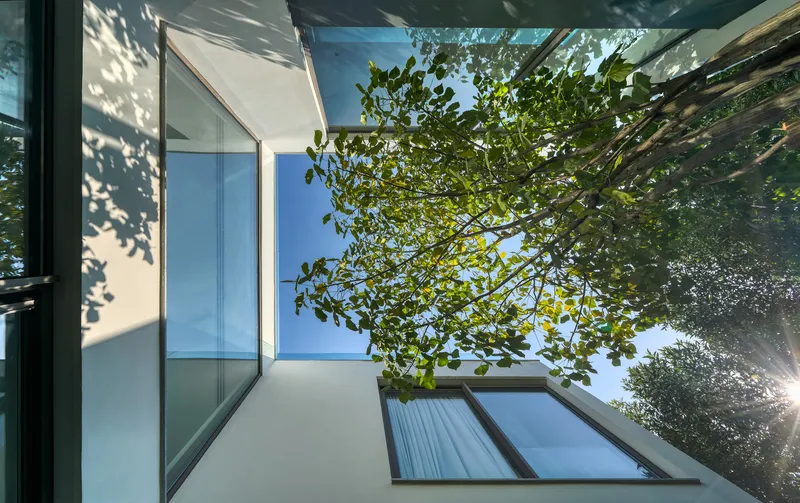
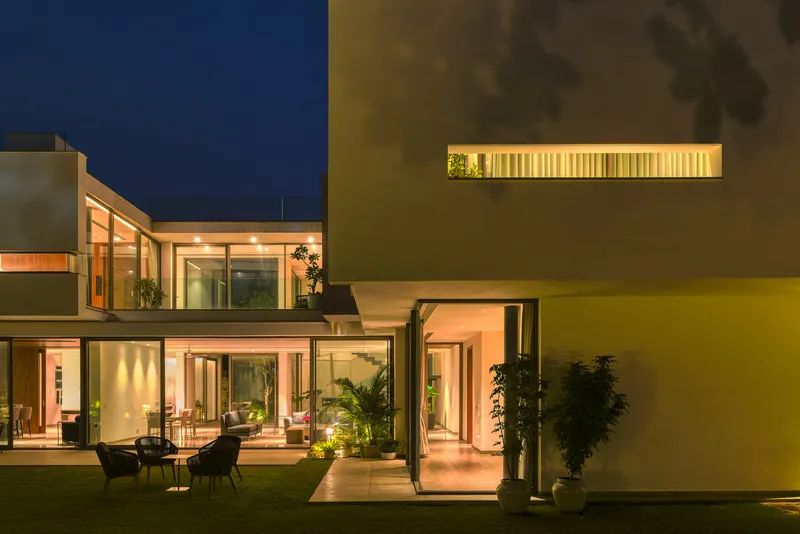
Multiple smaller courtyards and terraces echo this move at different scales, punching voids into the solid mass wherever the plan allows. Looking straight up through one of these openings, you see tree canopy and sky framed by white walls, a vertical slice of landscape that changes with weather and season. At night, a backlit horizontal window slot and a yellow-painted wall plane inject controlled color into what is otherwise a rigorously monochrome palette. The yellow reads as a deliberate accent, proof that minimalism here is a choice, not a limitation.
Garden Elevations and the Pool as Mirror
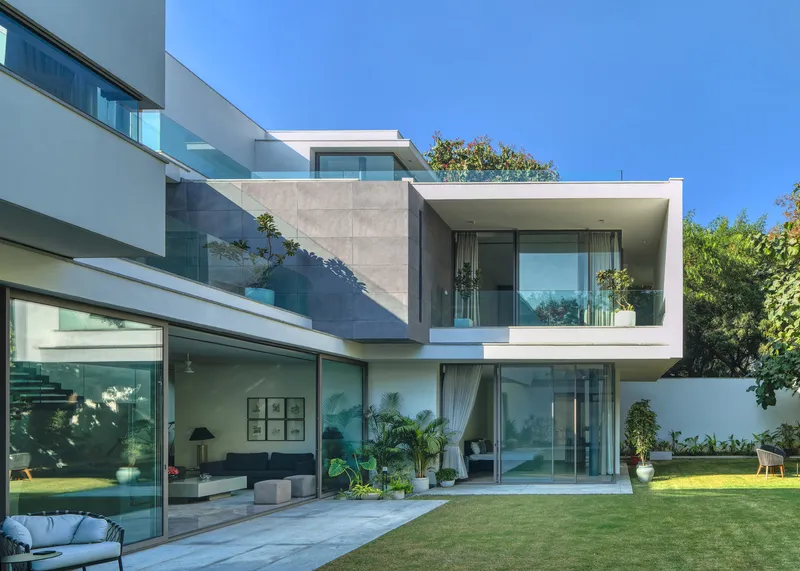
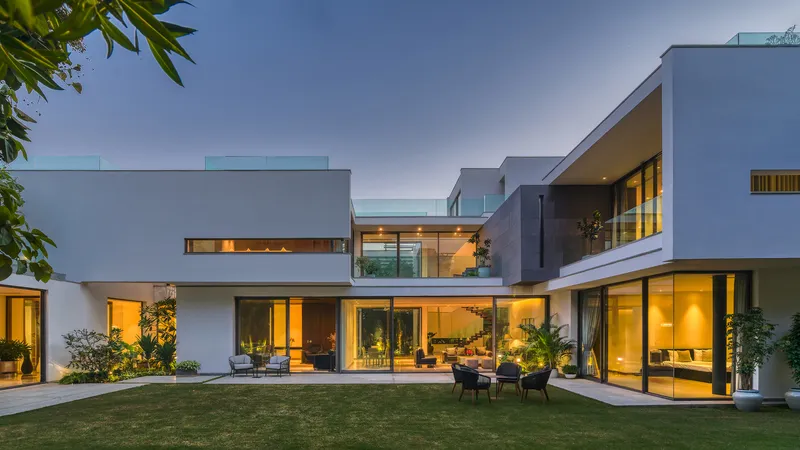
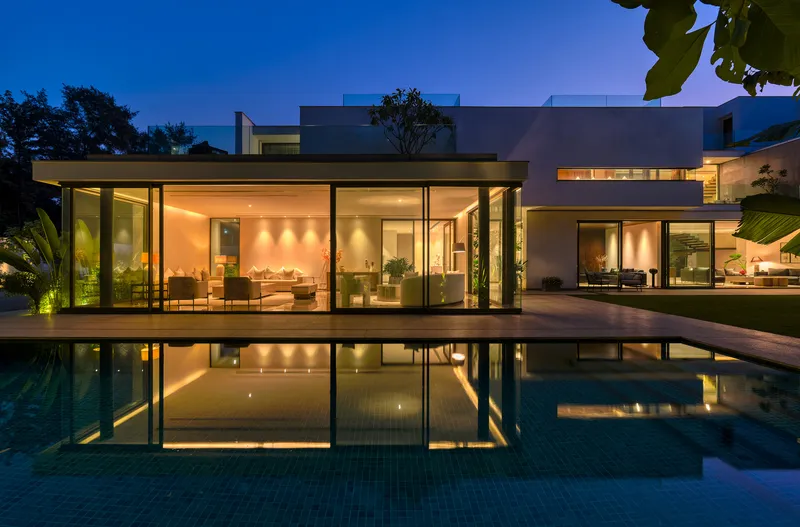
The garden side of the house is the architectural opposite of the street face. Stacked concrete volumes open up through floor-to-ceiling glazing, exposing the interior life of the house to the lawn and pool. The terraced massing steps back at upper levels, creating outdoor rooms for the four upstairs bedrooms and a family lounge. At dusk, the illuminated interiors turn the building into a lantern, and the narrow swimming pool stretches along the courtyard edge, its surface doubling the volumes in reflection.
The twilight pool shot is the image that encapsulates the project's ambition. A glass pavilion hovers at the water's edge, interior lighting turning the space amber, the reflection breaking the rigid geometry into something more liquid and atmospheric. It is a moment that shows DADA Partners thinking beyond plan and section into the experiential register of time and mood.
Circulation as Experience
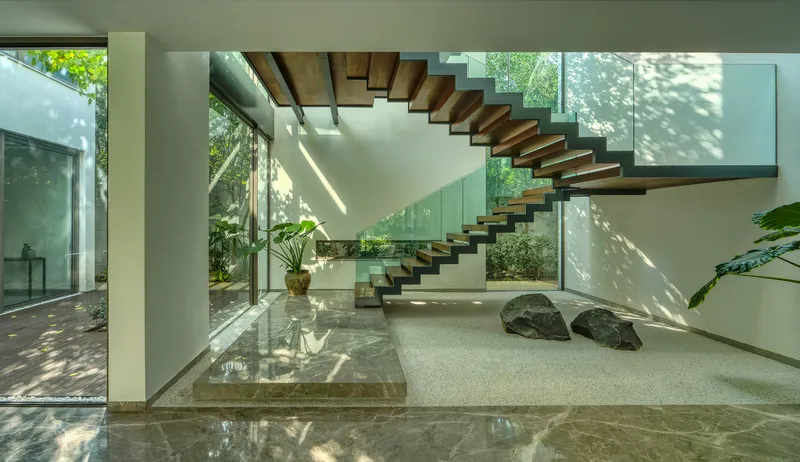
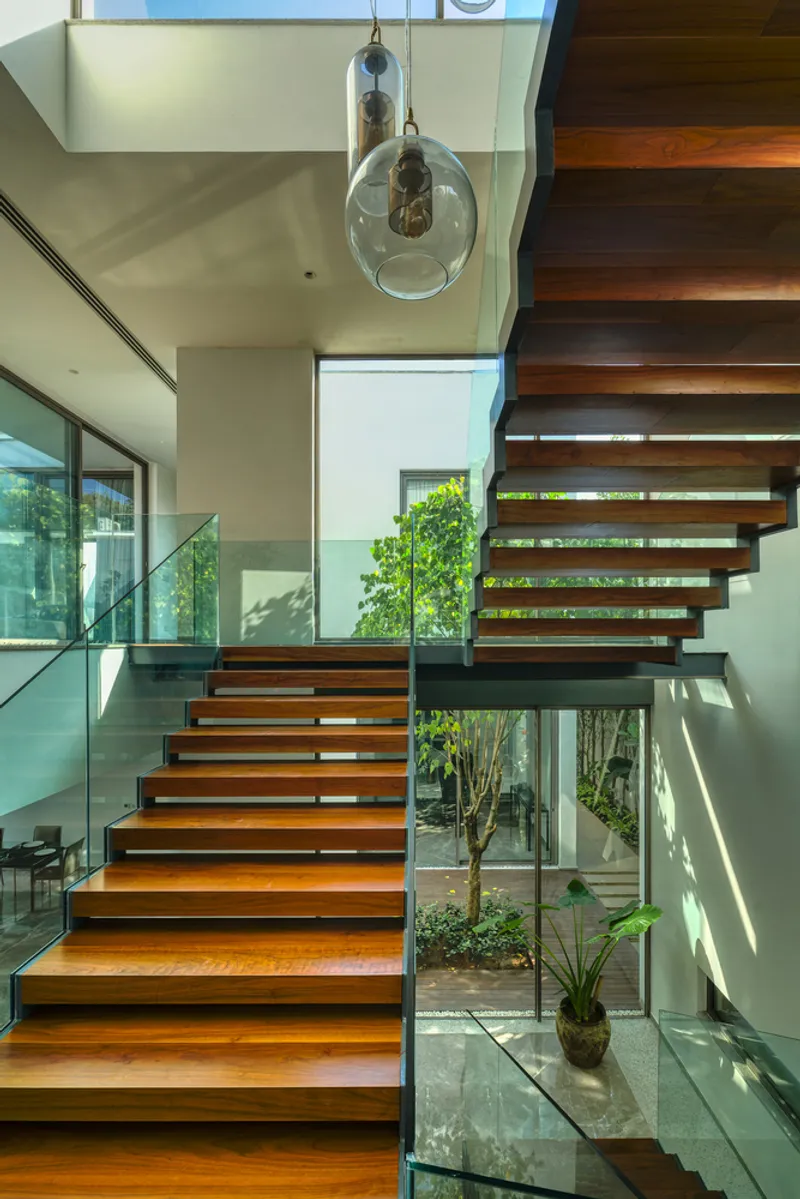
The floating timber staircase is the most photogenic element in the house, and it earns its prominence. Set within a double-height courtyard, it ascends through dappled sunlight, its glass balustrade dissolving the boundary between stair and void. Pendant lights drop into the vertical space, reinforcing the scale. The stair is not tucked away; it is placed at the intersection of the ground-floor social zones, making vertical circulation a visual event rather than a utilitarian corridor.
Two views of the same stair, one in daylight and one with artificial light, reveal how the architects calibrated the space for both conditions. In sun, the tree canopy outside casts moving shadows onto the white walls. At night, the pendant fixtures and warm timber treads shift the mood from meditative to intimate. The glass balustrade works in both scenarios, maintaining transparency without competing with the light.
Interior Calm
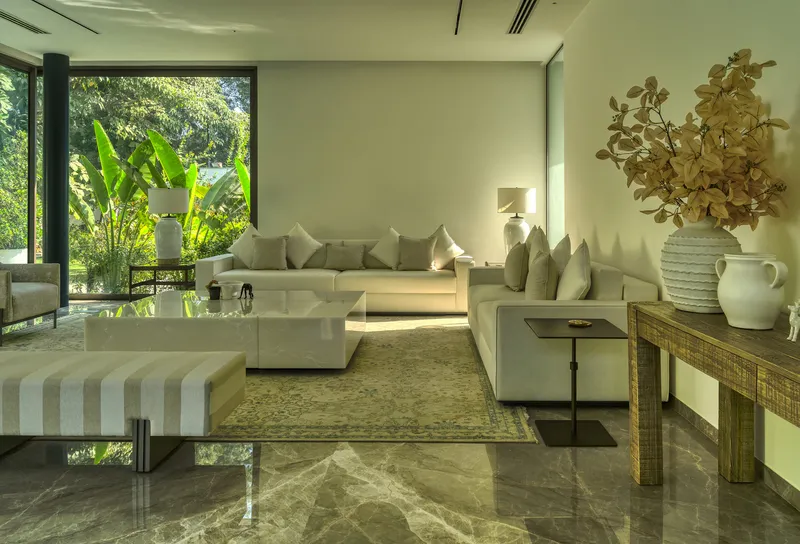
Inside, the material palette stays tight: polished stone floors, white walls, timber accents, and full-height glazing that treats the garden as a mural. The living room opens directly onto the lawn, its ceiling plane continuing the line of the exterior soffit to blur the threshold. Furniture is sparse, placed to direct the eye outward rather than inward. The planted courtyard visible through the timber-decked terrace brings greenery into the frame at every turn.
The restraint pays off because it is consistent. There is no moment where a decorative flourish breaks the logic. Even the manufacturers, from Alcoi India stone to Modifloat Glass, were chosen to maintain that material coherence. The softscape design by Greenology India and pool and hardscape by DADA and Loci Landscape work within the same register, keeping planting controlled and surfaces clean.
Plans and Drawings
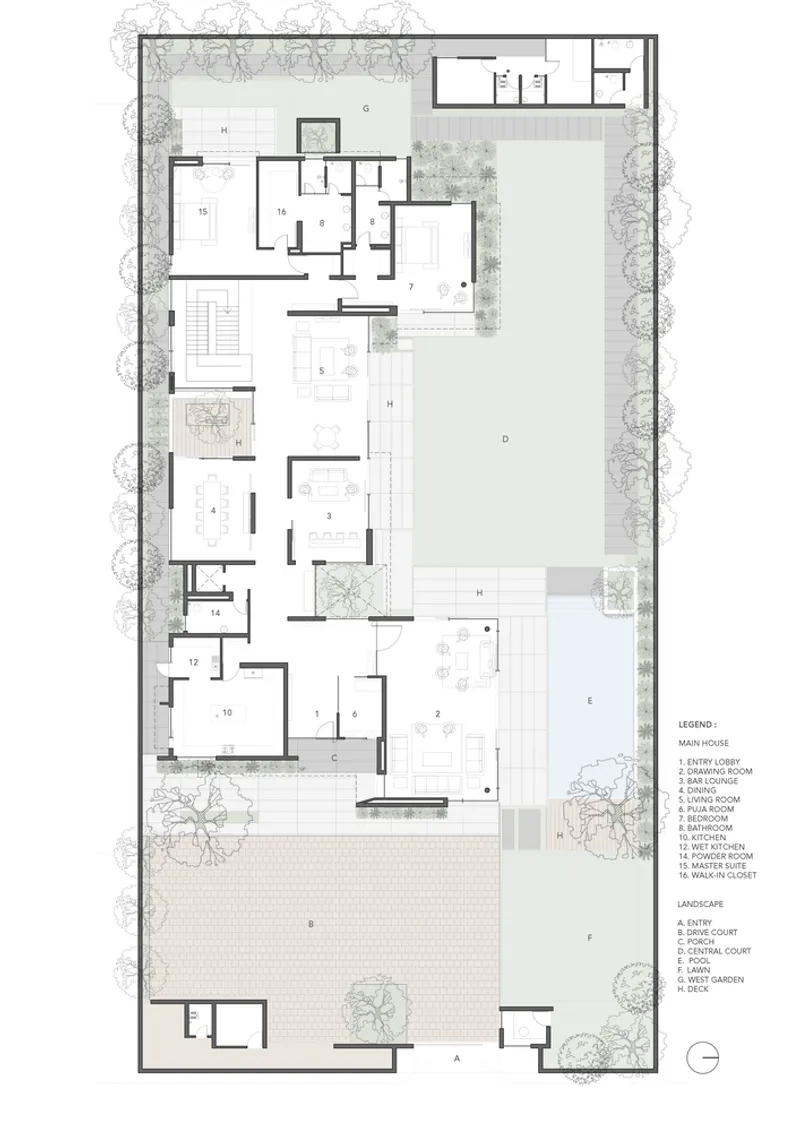
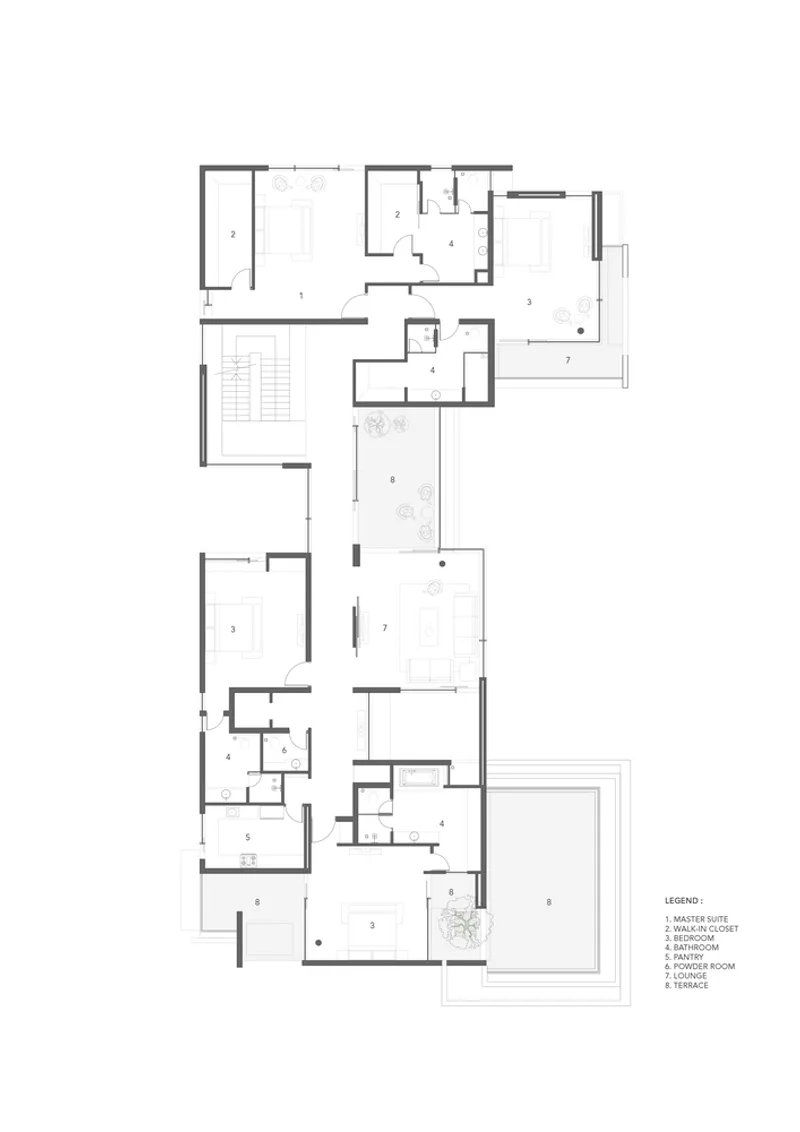
The floor plans confirm what the photographs suggest: the L-shaped layout is not a gesture but a functional decision. On the ground floor, rooms are arranged around the central courtyard and pool, with the formal lounge at the east-facing front and the dining and family zones mediating between courtyard and garden. The upper floor distributes four bedrooms around a central family lounge, each opening onto terraces that are carved from the building mass rather than added to it.
Reading the plans alongside the elevations, you can see how the voids are distributed to prevent the solid white mass from becoming oppressive. Every terrace and courtyard corresponds to a specific interior condition: a bedroom that needs morning light, a stair hall that needs vertical drama, a dining area that needs a green view. The plan is the argument, and it holds up.
Why This Project Matters
Minimalist residential design in India faces a particular challenge. The climate demands porosity, cross-ventilation, and shade, while the cultural context often favors ornament, layered materiality, and visible richness. The White House by DADA Partners resolves this tension by making the void do the work. The courtyards, terraces, and glazed openings are not reductions; they are active elements that regulate light, air, and privacy. The white stucco envelope is a canvas, not a finish, and the architecture that plays across it is written in sunlight and shadow.
For architects and students working on residential projects in warm climates, the takeaway is specific: minimalism works when it is a plan strategy, not a surface treatment. DADA Partners achieved a house that is calm without being cold, open without sacrificing privacy, and rigorously composed without feeling rigid. That is a harder trick than it looks, and the White House pulls it off with clarity.
White House by DADA Partners, India. 9,000 sq.ft. Completed 2022. Lead architect: Mukul Arora. Softscape design: Greenology India (Neha Mehta). Pool and hardscape: DADA and Loci Landscape. Photography by Ranjan Sharma / Lightzone India.
About the Studio
Share Your Own Work on uni.xyz
If projects like this are the kind of work you want to make, uni.xyz is a place to publish your own, find collaborators, and enter design competitions.




Popular Articles
Popular articles from the community


Hill & Cross Opera: Sculptural Opera House Architecture Shaped by Tallinn’s Landscape and Identity
Hill & Cross Opera reimagines opera house architecture in Tallinn through its sculptural hill, civic plaza, glass wave and a luminous cross.
EW PARK: Sustainable Architecture Reimagines the Future of Urban Parking
EW PARK reimagines city parking as a modular wooden tower combining automation, solar energy, electric mobility, and adaptable urban design.

Conexión: Biophilic Design Reimagines High-Rise Living in Hong Kong
Conexión reimagines high-rise living in Hong Kong through biophilic design, green facades, shared spaces, daylight, water and nature within.

Co-life: Sustainable Architecture for Age-Friendly Community Living
Co-life reimagines sustainable architecture for seniors through courtyards, rammed earth, shared gardens, and spaces designed for belonging.

Similar Reads
You might also enjoy these articles


Hodi-Mandai Geram
Project Function: Preservation and revitalization of the Intangible heritage and socio-spatial identity of the Hodi by Housing, Cultural Memory Center, Sacred Grove, landscape, local tourism economy


Olio Towers: A Mid-Rise for Performers That Fuses Housing, Rehearsal, and Stage
Located blocks from Houston's Theater District, this modular tower stacks living units around a central performance atrium.

Oasis: Modular Green Housing Carved into Dhaka's Urban Fabric
A shortlisted Plugin Housing entry reclaims unauthorized settlements in Dhaka with stepped concrete volumes, green roofs, and ventilation-driven design.

Black Hole: A Floating Megastructure for the Post-Physical Era
Emiliano Mazzarotto envisions a spherical, self-scaling arena where e-sports, digital hotels, and holographic stadiums replace traditional public space.


Explore Minimalism Competitions
Discover active competitions in this discipline



Challenge to reimagine the Iron Throne


Photograph architecture without architects


Illustrate the lost glory of Angkor Wat - Render Challenge


Design challenge to reuse E-waste
Comments (0)
Please login or sign up to add comments
No comments yet. Be the first to comment!