
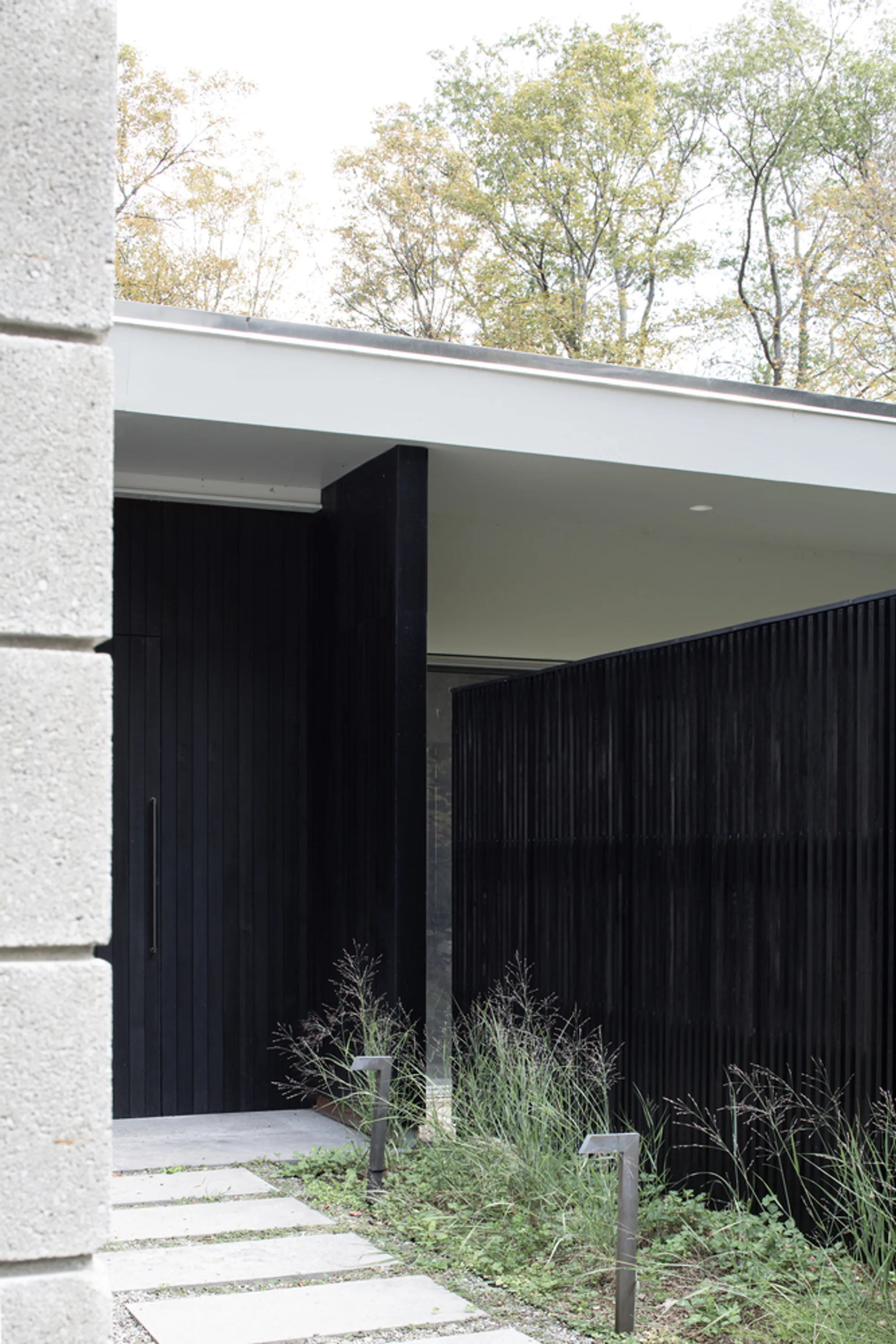
TAKATINA Weaves a Japanese-Inspired Garden Pavilion into a Cold Spring Hilltop Home
A 2004 residence on six wooded acres in Cold Spring, New York, gets a meditative renovation rooted in material contrast and seasonal awareness.


Renovation projects often aim to modernize, but the best ones reframe how a house is experienced from the very first step. At the CS Residence in Cold Spring, New York, TAKATINA has done exactly that, turning a 2004 hilltop home on six wooded acres into something closer to a ritual sequence than a floor plan update. The 3,400-square-foot renovation centers on two deliberate insertions: a blackened cedar garden pavilion that redefines the entry, and a glazed dining pavilion that replaces a former sunroom. Both moves are modest in footprint but radical in how they reshape the relationship between the house and its landscape.
What makes this project worth studying is its restraint. TAKATINA borrows from the spatial logic of Kyoto tea pavilions, not as aesthetic quotation, but as an operational strategy. The entry is deliberately indirect. Views are sequenced, not given away. Materials are few but sharply juxtaposed. The result is a home that earns its calm rather than purchasing it through square footage.
An Entry That Hides Before It Reveals
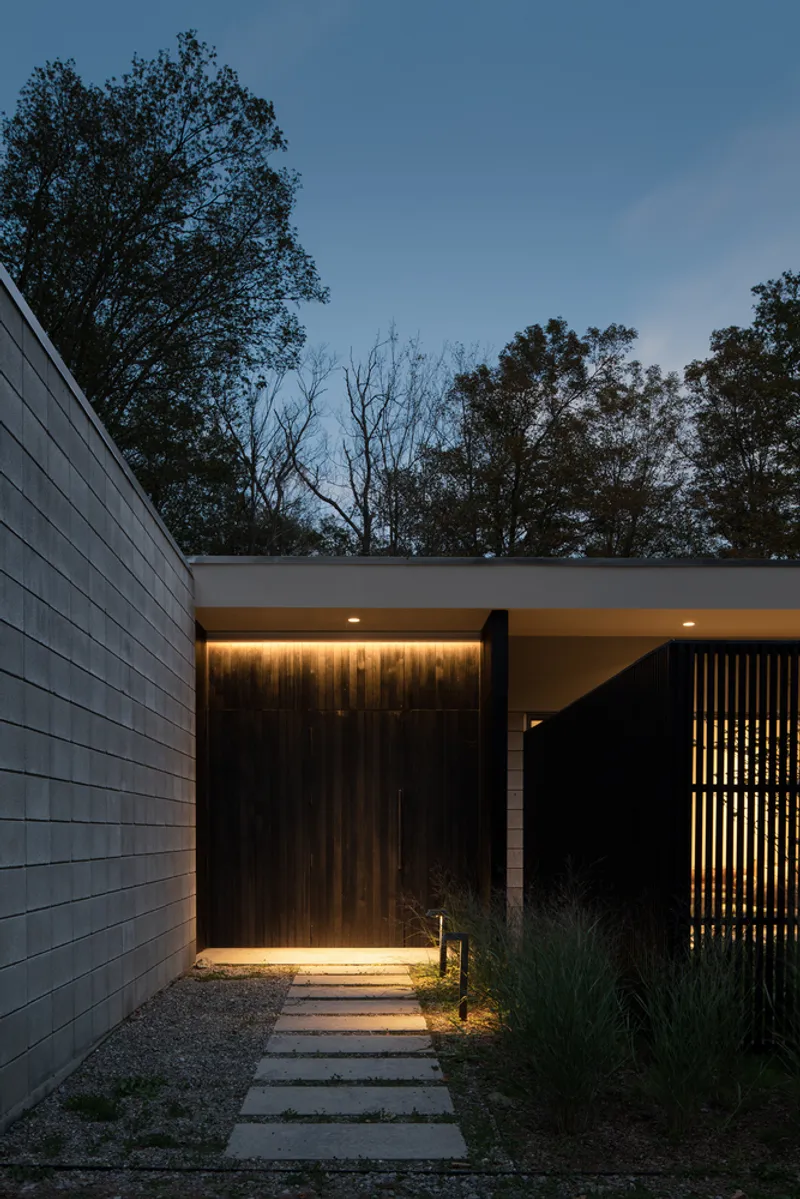

The approach to CS Residence is a choreographed act of concealment. An L-shaped fence of blackened cedar slats runs alongside concrete masonry unit walls, carving a narrow pathway that separates the carport from the living spaces. Pietra Royal stepping stones set into the ground lead visitors toward a blackened cedar entrance door that remains hidden until you are nearly upon it. The slat fence allows fractured glimpses of the garden beyond, a teasing preview that builds anticipation.
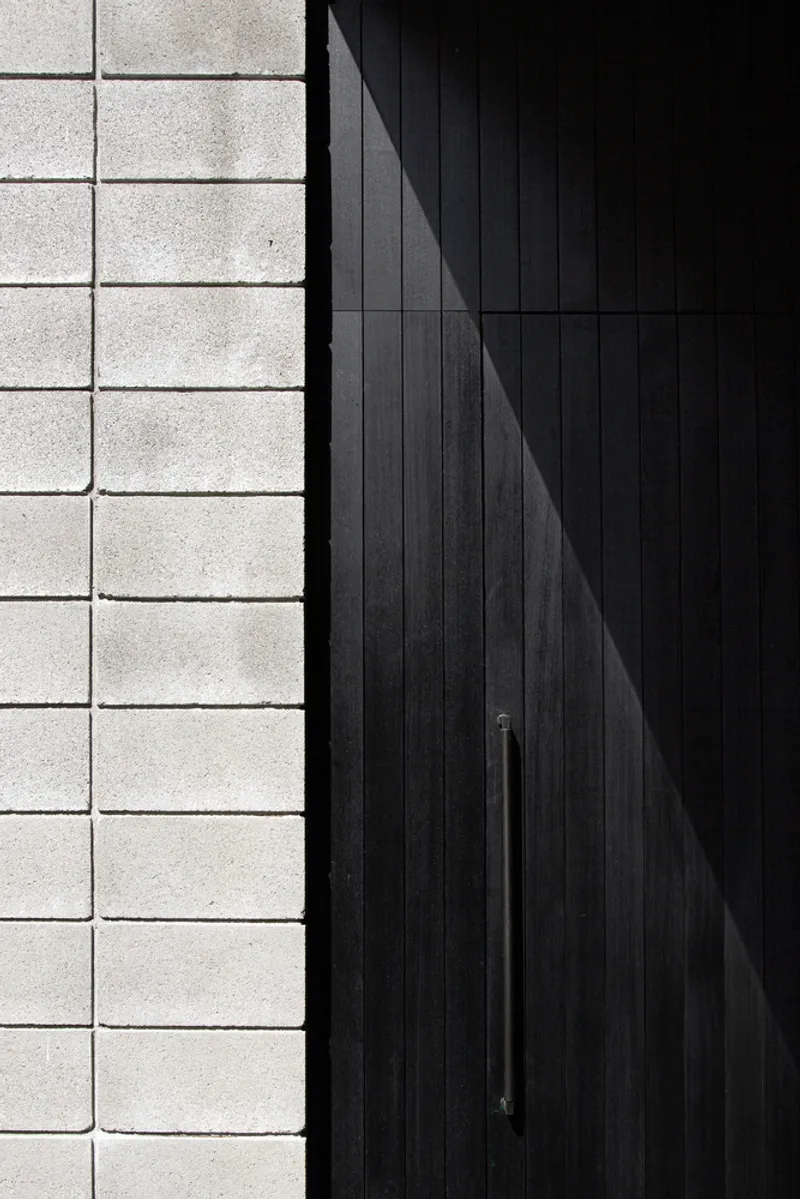
The contrast between materials here is the entire argument. Dark, linear cedar slats meet pale, monolithic CMU blocks, and neither tries to be the other. One is warm, textured, directional; the other is cool, massive, planar. The meeting point, caught in direct sunlight, becomes its own kind of ornament. It is a detail that reads from across the yard and rewards a closer look in equal measure.
The Garden Pavilion as Spatial Anchor
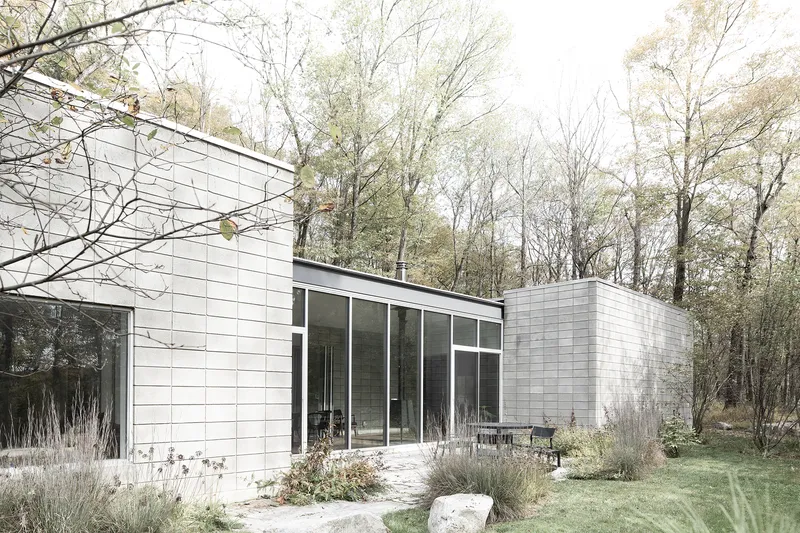
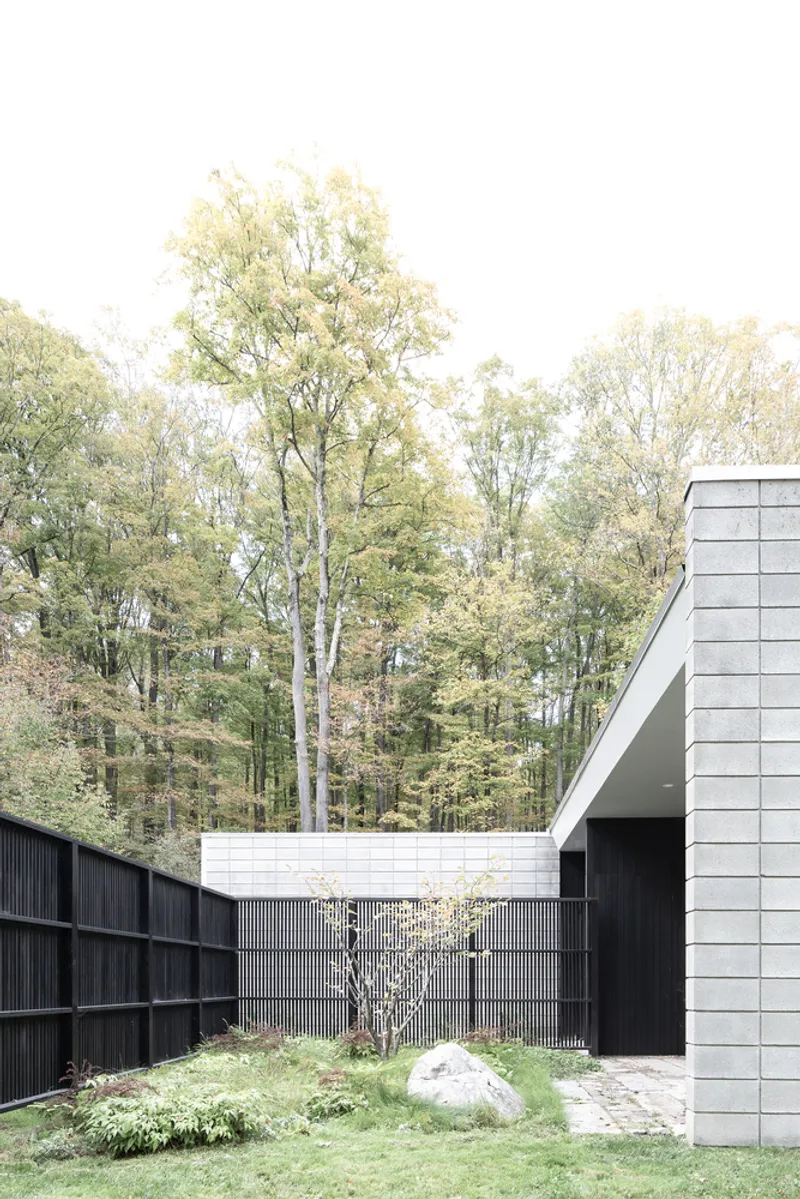
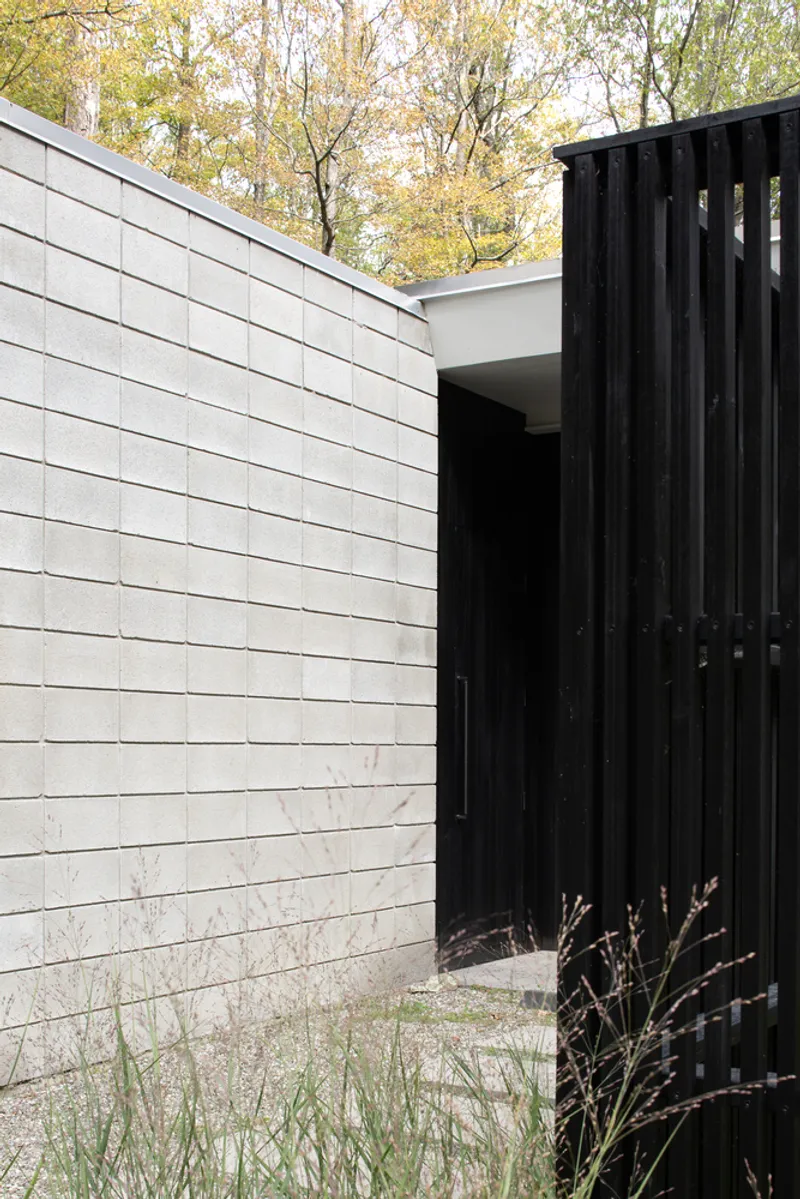
TAKATINA positions the Japanese-inspired garden pavilion not as a standalone folly but as a hinge that connects entry, garden, and living room into one continuous sequence. The courtyard it defines, enclosed by corrugated black metal fencing and flanked by pale tiled volumes, creates a pocket of stillness within the larger wooded site. Naturalistic plantings of grasses and boulders ground the composition without mimicking the surrounding forest.
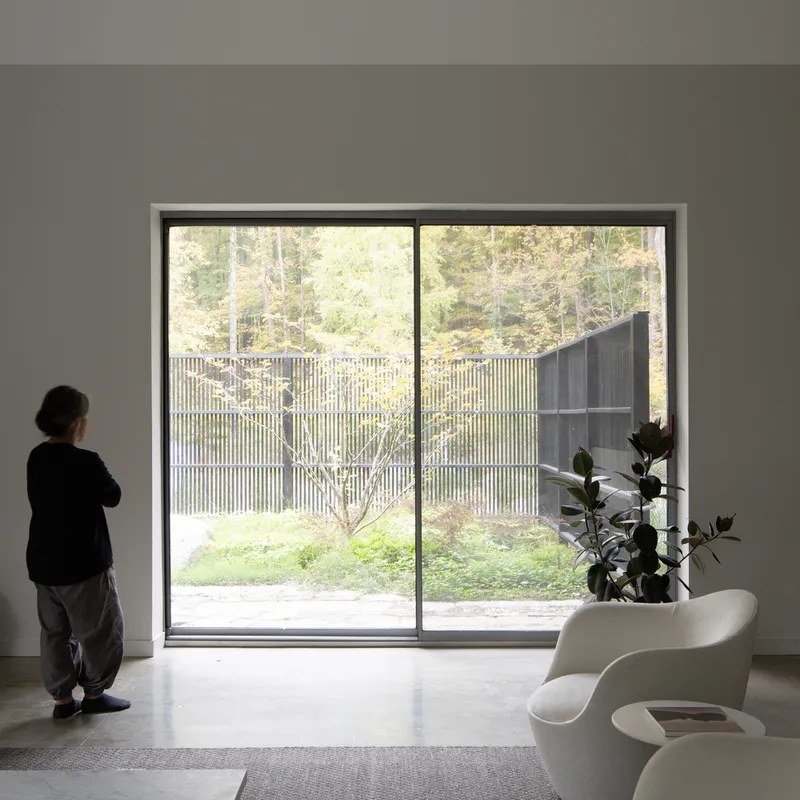
From the living room, the pavilion serves as a visual anchor visible through a sliding door. It frames seasonal change: autumn color, winter snow, the slow green return of spring. The idea is not new, but TAKATINA's execution is disciplined. The pavilion enriches the interior view without overwhelming it, functioning as a garden room you can contemplate from a distance or step into when the season allows.
A Dining Pavilion Built for Southern Light
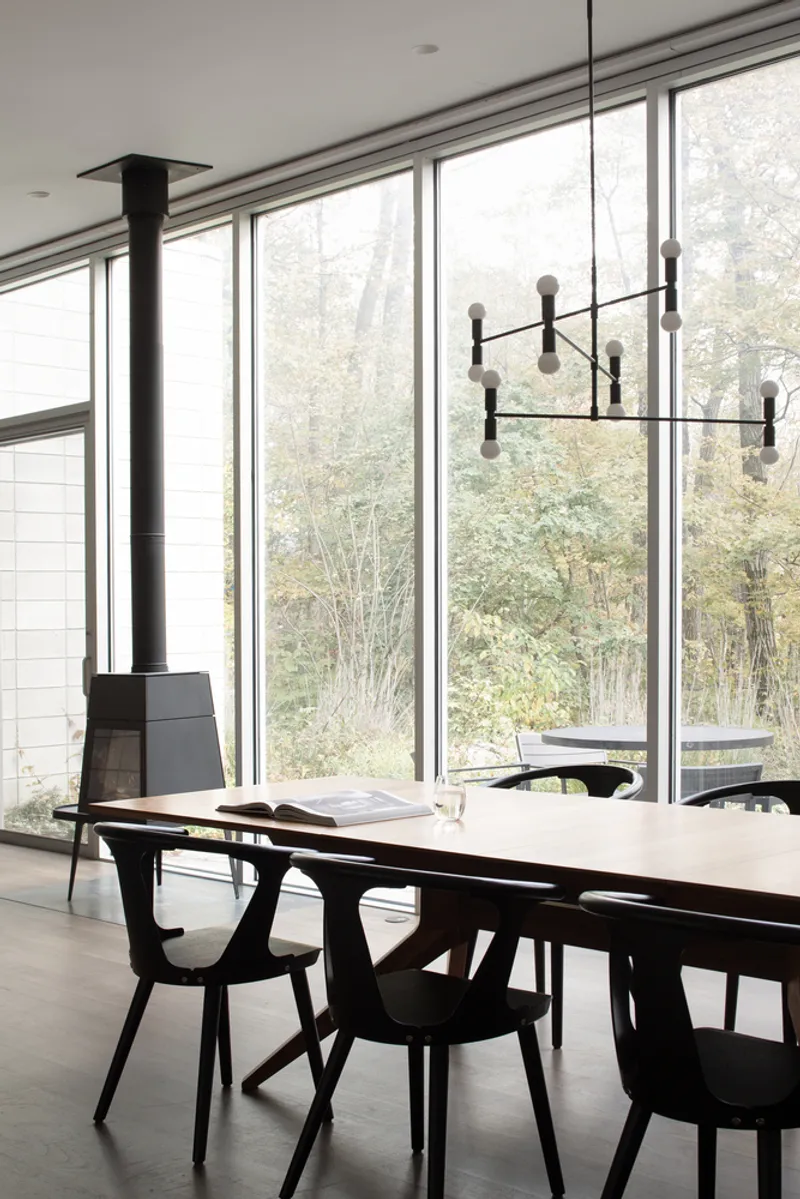
The former sunroom, a standard feature of the original 2004 house, has been replaced by a dining pavilion wrapped in floor-to-ceiling aluminum storefront glazing. The glass system frames the southern tree canopy and opens directly onto a stone garden terrace, collapsing the boundary between meal and landscape. A sculptural multi-arm chandelier hangs above the table, its dark silhouette reading clearly against the bright glass envelope.
Inside, walnut wood flooring is set against the polished concrete of the adjacent living spaces. The material shift is a simple but effective way to signal a change in atmosphere without erecting a wall. The dining pavilion feels slightly elevated in register, a room for gathering rather than passing through. Its small seating area at one end suggests that TAKATINA designed it as much for lingering after dinner as for the meal itself.
Living Spaces Tuned to the Forest
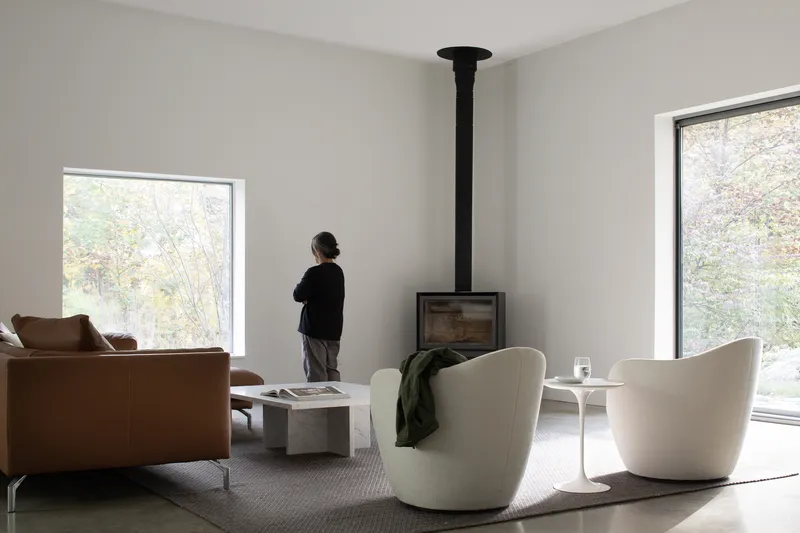
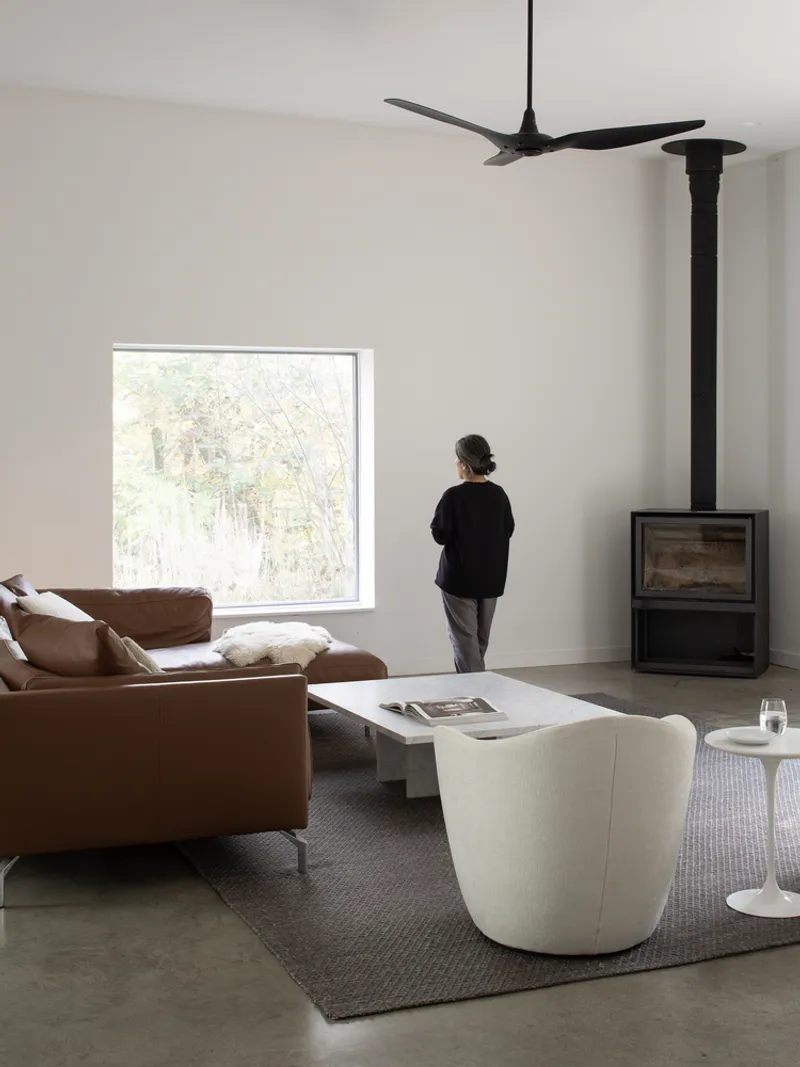

The living room anchors the interior program with two focal points: a freestanding wood stove with a black pipe rising to the ceiling, and a square window that frames the surrounding forest like a landscape painting. TAKATINA treats these elements as counterweights. The stove radiates warmth and draws the eye inward; the window pulls attention outward toward the trees. Standing at the glass, a person becomes part of the composition, scaled against the vastness of the six-acre wooded property.
Furnishings are deliberately tactile and few. A white marble coffee table sits beside a chocolate-colored leather sofa, catching natural afternoon light. The palette avoids the gallery-white sterility that often accompanies minimalism. Instead, TAKATINA achieves warmth through material honesty: the grain of the leather, the veining of the marble, the patina of polished concrete underfoot. Every surface has been chosen for how it feels as much as how it looks.
The Hilltop Context

From the street, CS Residence presents a deliberately understated face. A white-painted brick garage volume and the blackened screened pavilion sit within a canopy of autumn trees, reading as simple geometric solids rather than as an architectural statement. The house does not compete with its site. Positioned atop a hill and surrounded by abundant tree cover, the building earns its privacy through topography and vegetation rather than through tall walls or deep setbacks.
The interplay of light grey horizontal brick meeting black vertical timber screen at the building's corners reveals how carefully TAKATINA has considered the exterior as a composition of planes. Each material wraps its respective volume cleanly, and the junction between them is left sharp and unadorned. It is a detail that gives the house its quiet graphic identity from a distance.
Plans and Drawings
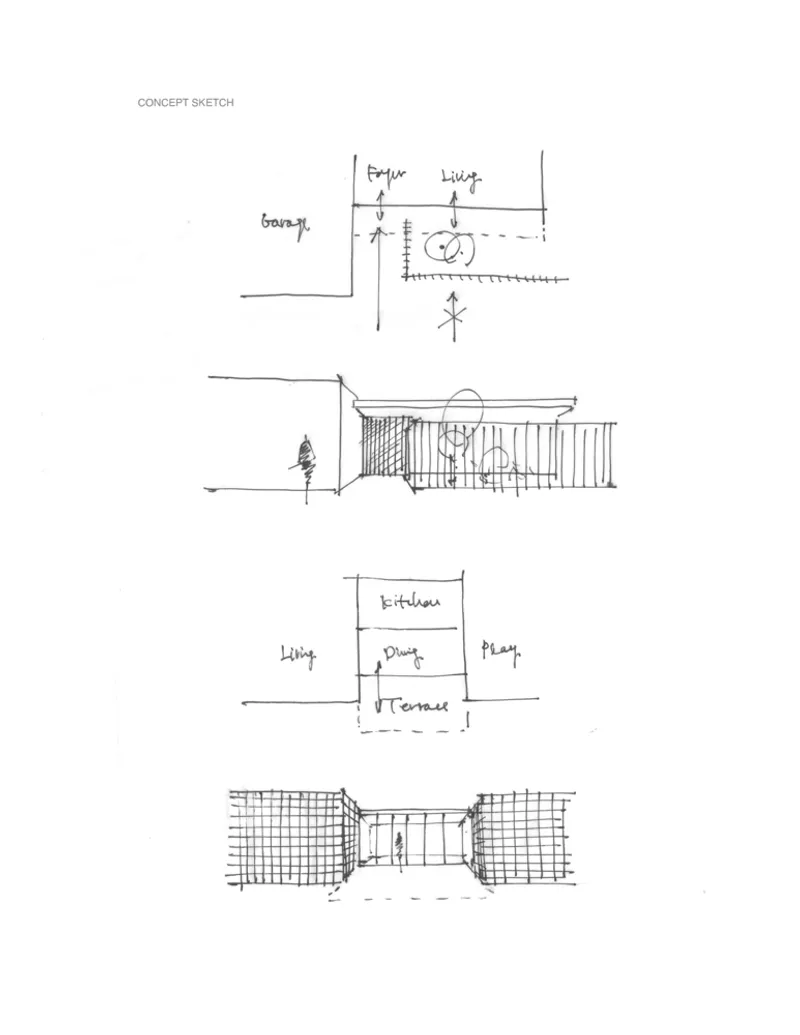

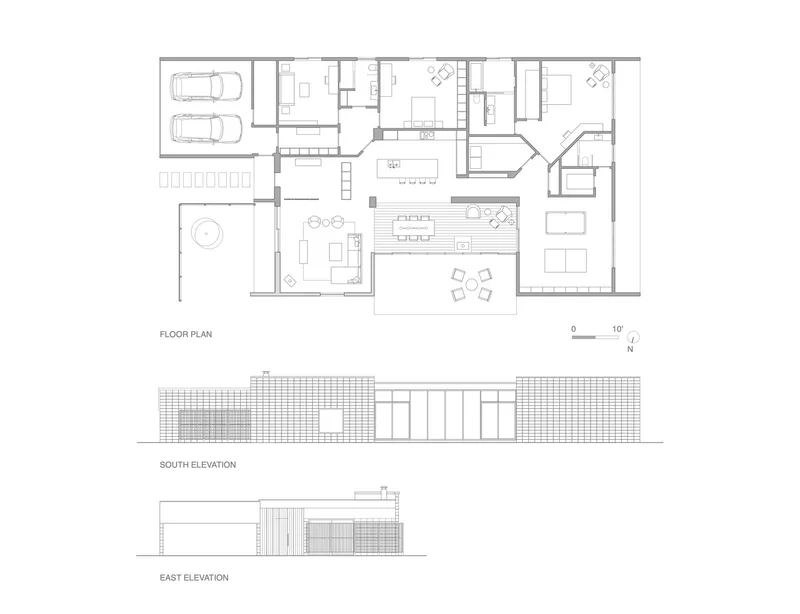
TAKATINA's concept sketch reveals the thinking behind the plan: annotated studies of living spaces, a terrace, and the cedar screening that organizes the entry. The site plan shows the building's position on a hillside defined by topographic contour lines and an adjacent road, confirming how much the design relies on the natural slope for both drainage and privacy. The floor plan and elevations together make clear how the garage, open living areas, and screened walls work as a single composition, with southern and eastern exposures driving the placement of glazed pavilions.
Why This Project Matters
CS Residence demonstrates that renovation does not need to be comprehensive to be transformative. TAKATINA's two pavilion insertions, one for dining and one for contemplation, fundamentally alter how the house is entered, inhabited, and perceived from within. The design borrows from Japanese spatial traditions without turning the project into pastiche, deploying indirection, material contrast, and seasonal framing as tools rather than decorative motifs.
As a phased master plan with kitchen and bathroom renovations still to come, CS Residence also offers a model for how architects can work incrementally on existing houses. Rather than gutting and rebuilding, TAKATINA has identified the two moves that yield the greatest experiential return: a meditative entry and a light-filled dining room open to the landscape. The lesson is one of precision over ambition, and it is a lesson worth repeating.
CS Residence by TAKATINA. Located in Cold Spring, New York, United States. 3,400 square feet. Completed 2024.
About the Studio
Share Your Own Work on uni.xyz
If projects like this are the kind of work you want to make, uni.xyz is a place to publish your own, find collaborators, and enter design competitions.




Popular Articles
Popular articles from the community


The Musturak Paradise: Senior Living Architecture for a Connected Future in Temara, Morocco
The Musturak Paradise reimagines senior living architecture in Temara via private homes, social spaces, culture, community, and shared care.

The Ocean Hive: Sustainable Architecture for a Self-Sufficient Civilization at Sea
The Ocean Hive imagines sustainable architecture at sea, where modular habitats, algae, wave power and ocean waste sustain a growing colony.

Hill & Cross Opera: Sculptural Opera House Architecture Shaped by Tallinn’s Landscape and Identity
Hill & Cross Opera reimagines opera house architecture in Tallinn through its sculptural hill, civic plaza, glass wave and a luminous cross.

Conexión: Biophilic Design Reimagines High-Rise Living in Hong Kong
Conexión reimagines high-rise living in Hong Kong through biophilic design, green facades, shared spaces, daylight, water and nature within.


Similar Reads
You might also enjoy these articles


Hodi-Mandai Geram
Project Function: Preservation and revitalization of the Intangible heritage and socio-spatial identity of the Hodi by Housing, Cultural Memory Center, Sacred Grove, landscape, local tourism economy


Olio Towers: A Mid-Rise for Performers That Fuses Housing, Rehearsal, and Stage
Located blocks from Houston's Theater District, this modular tower stacks living units around a central performance atrium.

Oasis: Modular Green Housing Carved into Dhaka's Urban Fabric
A shortlisted Plugin Housing entry reclaims unauthorized settlements in Dhaka with stepped concrete volumes, green roofs, and ventilation-driven design.

Black Hole: A Floating Megastructure for the Post-Physical Era
Emiliano Mazzarotto envisions a spherical, self-scaling arena where e-sports, digital hotels, and holographic stadiums replace traditional public space.


Explore Architecture Competitions
Discover active competitions in this discipline



Challenge to reimagine the Iron Throne


Photograph architecture without architects


Illustrate the lost glory of Angkor Wat - Render Challenge


Design challenge to reuse E-waste
Comments (0)
Please login or sign up to add comments
No comments yet. Be the first to comment!