

Modular Extreme Habitat: Fractal Logic Grows an Arctic City from a Single Cell
Prefabricated octagonal modules, snow-block tunnels, and seasonal terraces form a distributed settlement that dissolves centrism in the Arctic.


What if a city could grow the way a crystal forms: starting from a single seed, repeating its geometry outward until an entire settlement materializes across the ice? The Modular Extreme Habitat takes that question seriously, proposing a fractal urbanism where compact octagonal modules replicate from a core station into an expanding network of living clusters. There is no master plan in the conventional sense. Instead, the city writes itself through repetition, each new unit dissolving the centricity of the one before it until the settlement becomes a distributed organism adapted to one of the harshest climates on Earth.
Designed by Valeriya Vihtinskaya, Alexander Fil, and Yuliia Fedorenko, this shortlisted entry in the EHC - Arctic competition reimagines modular housing not as a catalogue of prefab parts but as a survival mechanism encoded with social ambition. The Arctic context is extreme: subzero temperatures, months of darkness, relentless wind. Rather than retreating into bunker-like enclosures, the designers lean into community, crafting shared terraces, snow-block tunnels, and seasonal public zones that turn isolation into closeness.
Geodesic Clusters Glowing on the Ice
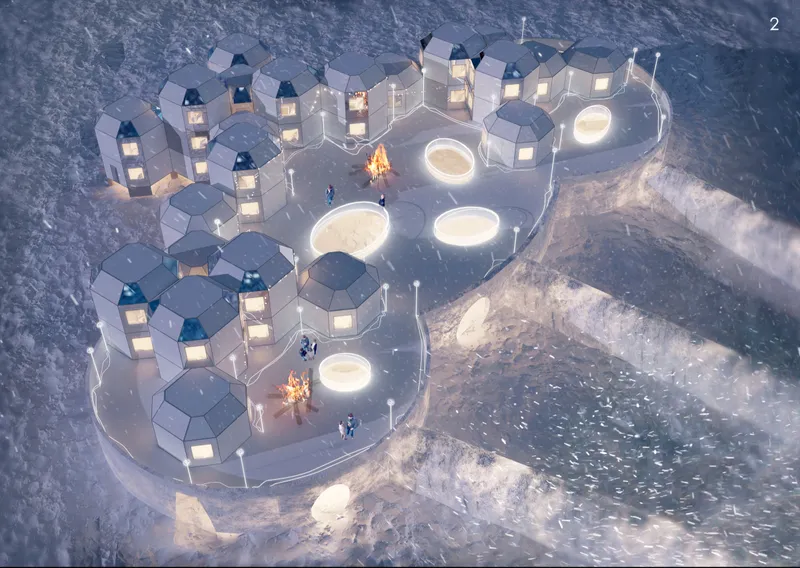
From above, the settlement reads as a constellation of domed clusters punctuated by circular skylights that glow warm against the snow. The aerial view reveals how the fractal logic plays out spatially: modules group into pods, pods cluster into neighborhoods, and neighborhoods radiate outward without a single dominant center. The illuminated rings are not merely aesthetic. They signal the presence of inhabited zones across an otherwise featureless white plane, a wayfinding strategy built into the architecture itself. The geodesic envelopes provide structural efficiency against wind loads while maximizing interior volume relative to surface area, a critical ratio when every square meter of exposed skin bleeds heat.
Hexagonal Plans and Snow-Block Arteries
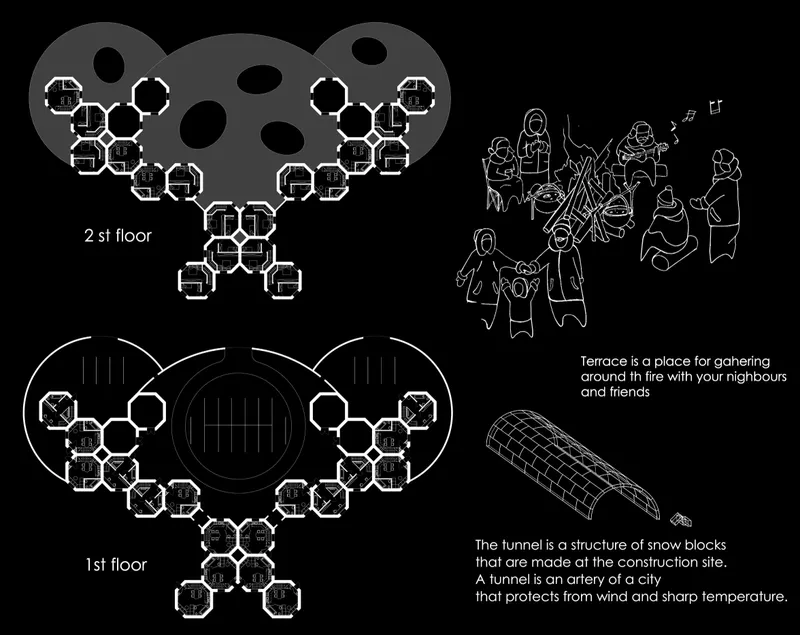
The plan drawings expose the organizational DNA of the project. Hexagonal unit arrangements accommodate three distinct typologies: single-user housing, family units, and co-housing clusters. Each configuration snaps into the larger network through shared walls and circulation spines. Annotated sketches detail the construction of tunnels made from compacted snow blocks. These are not improvised igloo corridors; they serve as windbreakers and protected arteries connecting housing pods to communal facilities. The material logic is deliberate: plywood frames, stucco cladding, and foam glass concrete infill deliver insulation and rapid assembly in conditions where every hour of exposed construction time is a liability.
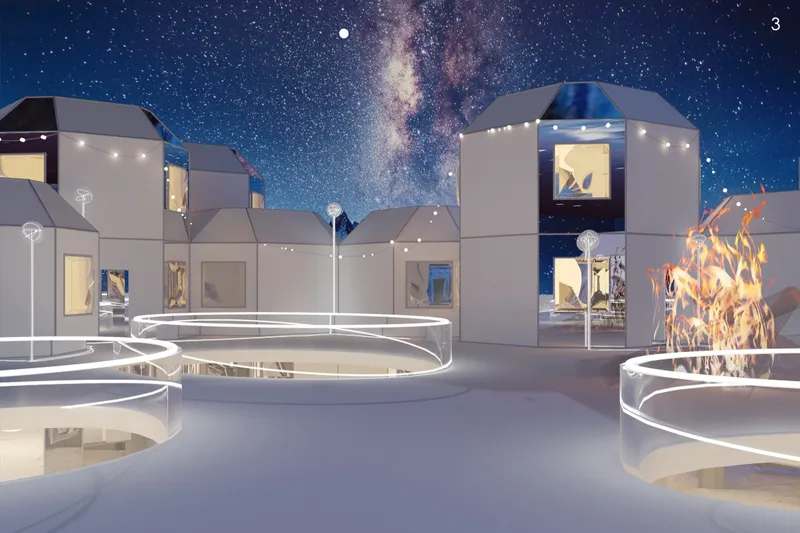
The central courtyard image captures the social payoff of all that structural discipline. Beneath a sky dense with stars, residents gather around a firepit ringed by concentric light installations. The terrace, a key urban feature of the design, functions as a seasonal platform that transforms into an ice rink, performance arena, or communal gathering spot depending on the time of year. It is this kind of programmable shared space that elevates the project beyond mere shelter into something closer to a civic framework.
Curved Pathways and Distributed Infrastructure
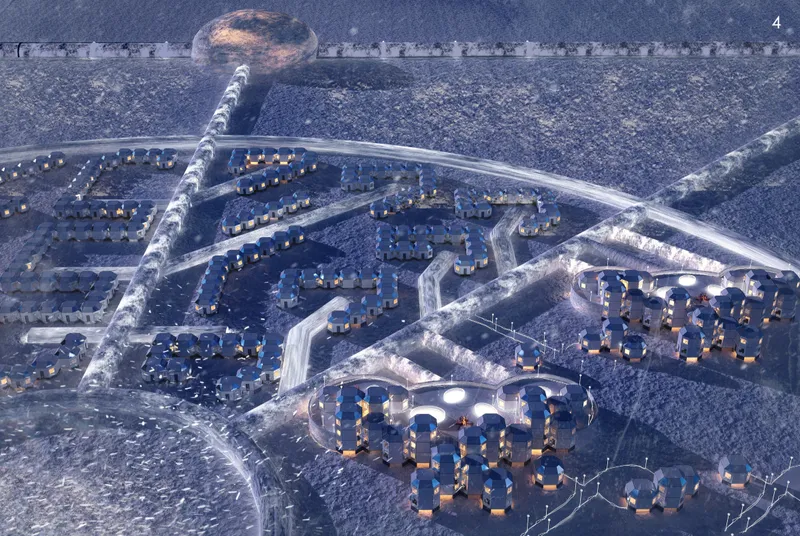
A drone perspective shows how curved pathways stitch the hexagonal clusters together across the landscape, with a covered tunnel cutting through the snow to provide weather-protected movement between zones. The organic routing reinforces the anti-grid philosophy: there are no straight axes or monumental vistas, only branching connections that respond to topography and wind patterns. The settlement hugs the terrain rather than imposing geometry on it.
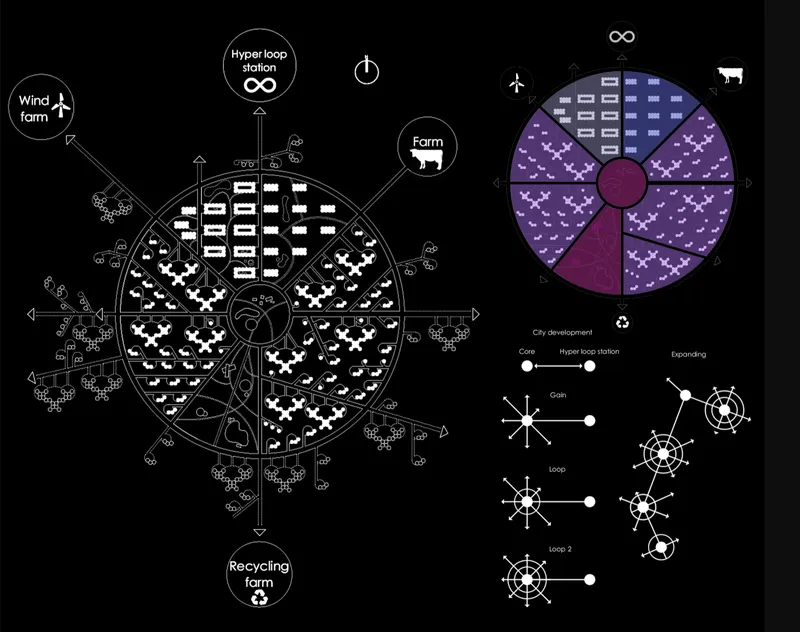
The site plan diagram makes the infrastructure strategy legible. A radial organization distributes essential systems across labeled zones: a wind farm for energy generation, a hyperloop station for long-distance transit, agricultural areas for food security, and recycling stations for waste processing. Growth is spontaneous in appearance but deliberately infrastructured underneath. The radial layout ensures that no cluster sits too far from energy or transit, while the looped and cellular development pattern allows new modules to plug in without overloading existing networks. It is city planning that acknowledges uncertainty, designing for a future that cannot be fully predicted but can be structurally prepared for.
Why This Project Matters
Extreme environment design often defaults to two modes: the heroic megastructure or the minimal survival pod. The Modular Extreme Habitat refuses both, proposing instead a middle ground where small, repeatable units aggregate into a richly social urban fabric. The fractal logic is more than a formal conceit. It encodes scalability, redundancy, and adaptability into the settlement's genetic code, qualities that any community at the edge of habitability desperately needs.
What sets the work of Vihtinskaya, Fil, and Fedorenko apart is their insistence that survival is not enough. Snow tunnels double as social connectors. Terraces shift from ice rink to town square. Lit facades catch the aurora and turn a frozen outpost into something worth calling home. The Arctic demands minimalism, but within that constraint the designers find room for generosity, proving that architecture in extremity does not have to be austere in spirit.
View the Full Project
About the Designers
Designers: Valeriya Vihtinskaya, Alexander Fil, Yuliia Fedorenko
Enter a Design Competition on uni.xyz
uni.xyz runs architecture and design competitions year-round that reward proposals with spatial conviction and real site intelligence.
Project credits: Modular Extreme Habitat by Valeriya Vihtinskaya, Alexander Fil, Yuliia Fedorenko EHC - Arctic (uni.xyz).


Popular Articles
Popular articles from the community

Faces of the Soviet Avant-Garde: Turning Moscow's Street Names into an Open-Air Museum
A network of sculptural installations across a Moscow residential district transforms forgotten architect names into spatial encounters with cultural memor

Cloaked Colonization: A Mobile Underwater Habitat That Moves Like a Fish
Micah Abaya's shortlisted EHC Pacific entry reimagines ocean settlement as a dispersed network of self-sustaining architectural organisms.

Singing Woman: An Opera House That Performs Before the Curtain Rises
Ovidiu Cristian Pavel's conceptual opera house translates Estonia's choral identity into a sculpted waterfront landmark facing the Baltic Sea.
Extended Shell: Retrofitting Kolkata's Balconies as Living Urban Thresholds
A modular retrofit system recovers the social and environmental intelligence of Kolkata's historic verandas for contemporary Park Street residents.

Similar Reads
You might also enjoy these articles

Pixel Gardens: One Repeated Module Stacked Into a Terraced Social Housing Tower for Famagusta
Salem Bader's shortlisted housing tower builds a vertical neighbourhood from one repeated module, offsetting units to carve terraces, light and air.

Bao Huynh Watercolor Atelier: A Serene Art Retreat in Hội An
Bao Huynh Watercolor Atelier in Hội An blends multifunctional art spaces, sustainable design, local materials, and family-friendly living in a serene environment.

Atelier Macri Concept Store Interior Design by CASE-REAL
Atelier Macri store features a "ko" counter, walnut wood details, cork displays, blending retail, gallery, and seamless customer experiences.

Manuel Vargas Izquierdo Stadium and High-Performance Sports Center: Architectural Excellence in Jalpa de Méndez
The Manuel Vargas Izquierdo Stadium blends sustainable design, inclusive sports facilities, and cultural-inspired architecture, revitalizing Jalpa de Méndez’s public spaces.


Comments (0)
Please login or sign up to add comments
No comments yet. Be the first to comment!