
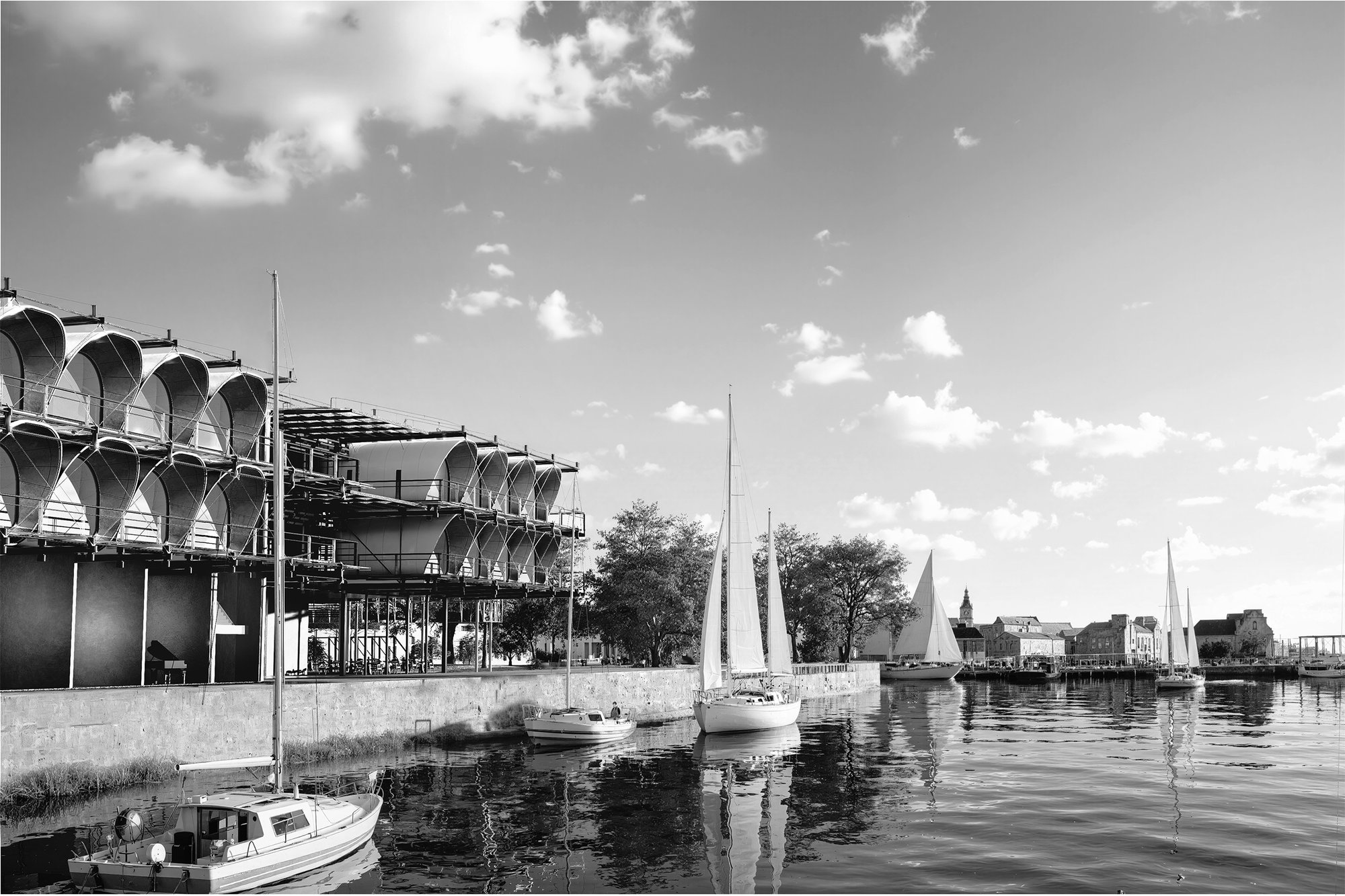
Music School on Jaskółcza Island
The project envisions a 2nd-level music school in Szczecin, combining parametric design and advanced acoustic optimization. Located in the historic industrial district known as the “Szczecin Venice".

The subject of this thesis is the design of a secondary-level music school on Jaskółcza Island in Szczecin – a place where history intertwines with the potential of contemporary technologies. Once the industrial heart of the city, the island today remains neglected and forgotten. The project aims to restore its value by creating a building that fulfills educational, cultural, and social functions. The music school is intended to become a new landmark on the map of Szczecin, a city attractor, and a catalyst for the revitalization of the area known as the “Szczecin Venice.”
The building program is diverse and adapts to the rhythm of urban life. In the afternoon, its primary function is didactic, focused on music education. At other times of day, the building transforms into an open public space – with a café overlooking the Oder River and St. James Cathedral, an audiotheque, and exhibition areas. The complex is complemented by thematic gardens inspired by musical tempos, encouraging visitors to spend time on the island beyond the school’s interior.
One of the key design challenges was acoustics – both in the external context (the proximity of railway tracks) and the internal one (different requirements for various musical spaces). To address these challenges, I employed parametric design tools and a data-oriented design approach. Genetic algorithms were used in an iterative process to analyze the acoustic and geometric parameters of the rooms, generating their optimized forms.
In the practice rooms, the “form-finding” process resulted in tubular modules with rounded corners, which reduce standing waves and evenly disperse sound. Each module was designed as an independent prefabricated unit, combining high acoustic insulation with structural lightness. This solution merges the precision of computational design with the logic of industrial production.
A similar approach was applied in the design of the concert hall – the heart of the entire complex. Its organic form, inspired by the waves of the Oder River, was shaped through computer simulations analyzing reverberation time (RT60), sound propagation patterns, and the uniformity of acoustic diffusion. The parametric geometry, based on fluid lines and smooth transitions, not only meets the highest acoustic standards but also imbues the hall with a sculptural and emotional character, turning it into an architectural interpretation of music.
The architecture of the building embodies a dualistic concept – on the side facing the historic “Szczecin Venice,” brick textures and massive forms dominate, while on the eastern façade, the modern tubular practice rooms are exposed as an honest reflection of advanced design processes. The double-skin façade, functioning simultaneously as a thermal and acoustic buffer, serves as another tool that unites tradition with innovation.
The project, however, goes beyond architecture alone. It also seeks to fill the gap in Szczecin’s music education infrastructure, addressing the city’s high demand for artistic training. By providing space for both learning and cultural activities accessible to a wider public, the building becomes a place of year-round activity.



Popular Articles
Popular articles from the community

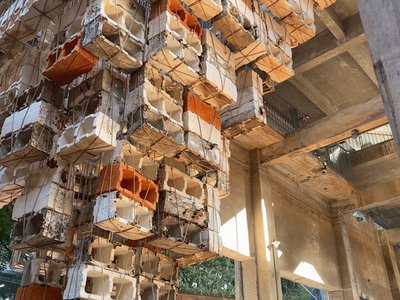
Inverted Architecture Installation by Studio Link-Arc: Exploring the Intersection of Architecture and Living Organisms
Inverted Architecture Installation by Studio Link-Arc blends mycelium, sustainability, inverted design, ecological cycles, and urban adaptive architecture in Shenzhen.

Free Architecture Competitions You Can Enter Right Now
No entry fees, real prizes. Here are the best free architecture competitions open for submissions in 2026.

Solar Steam: A Climate-Responsive Architecture That Redefines the Monument
A climate-responsive memorial architecture that transforms heat, decay, and time into a living system reflecting humanity’s ecological impact.


Similar Reads
You might also enjoy these articles
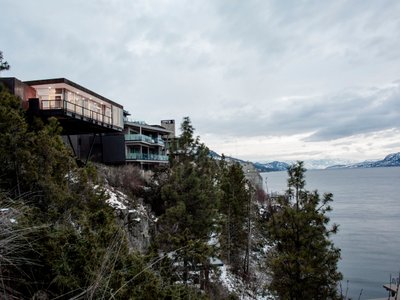
Alton Cliff House: A Harmonious Retreat by f2a Architecture in Lake Country, Canada
Alton Cliff House blends corten steel, prefabrication, and sustainable design, creating a luxurious, energy-efficient retreat perched on Canadian cliffs.


The Ken Roberts Memorial Delineation Competition (Krob)
As the most senior architectural drawing competition currently in operation anywhere in the world, it draws hundreds of entries each year, awarding the very best submissions in a series of medium-based categories.
A Contemporary Take on Iranian Residential Architecture
A modern interior design in Mashhad that reinterprets brick, light, and spatial flow to create a warm, contemporary residential architecture.
Franche-Comté Advanced School of Engineering by Dominique Coulon & associés, Besançon
A flexible engineering school immersed in woodland, combining concrete minimalism, adaptable spaces, and natural light to support evolving educational environments.


Explore Computational Design Competitions
Discover active competitions in this discipline







Comments (0)
Please login or sign up to add comments
No comments yet. Be the first to comment!