
Urko Sanchez Architects Builds a Temporary Forest School in Nairobi for $250 per Square Meter
A Waldorf school in Karen disperses 24 organic classrooms through a dense forest using living walls, recycled materials, and Maasai-inspired planning.


There is a persistent assumption in school design that permanence equals seriousness. A proper school should be concrete, institutional, anchored to the ground for generations. The Nairobi Waldorf School, completed in 2024 by Urko Sanchez Architects in the Karen neighborhood of Nairobi, rejects that assumption entirely. The 3,162-square-meter campus is deliberately temporary, designed with a 10-year lifespan that matches the lease on the forested plot. Every structure is conceived for disassembly, reuse, and eventual disappearance. The budget was $250 per square meter. That is not a constraint the architects tolerated; it is the generative logic of the entire project.
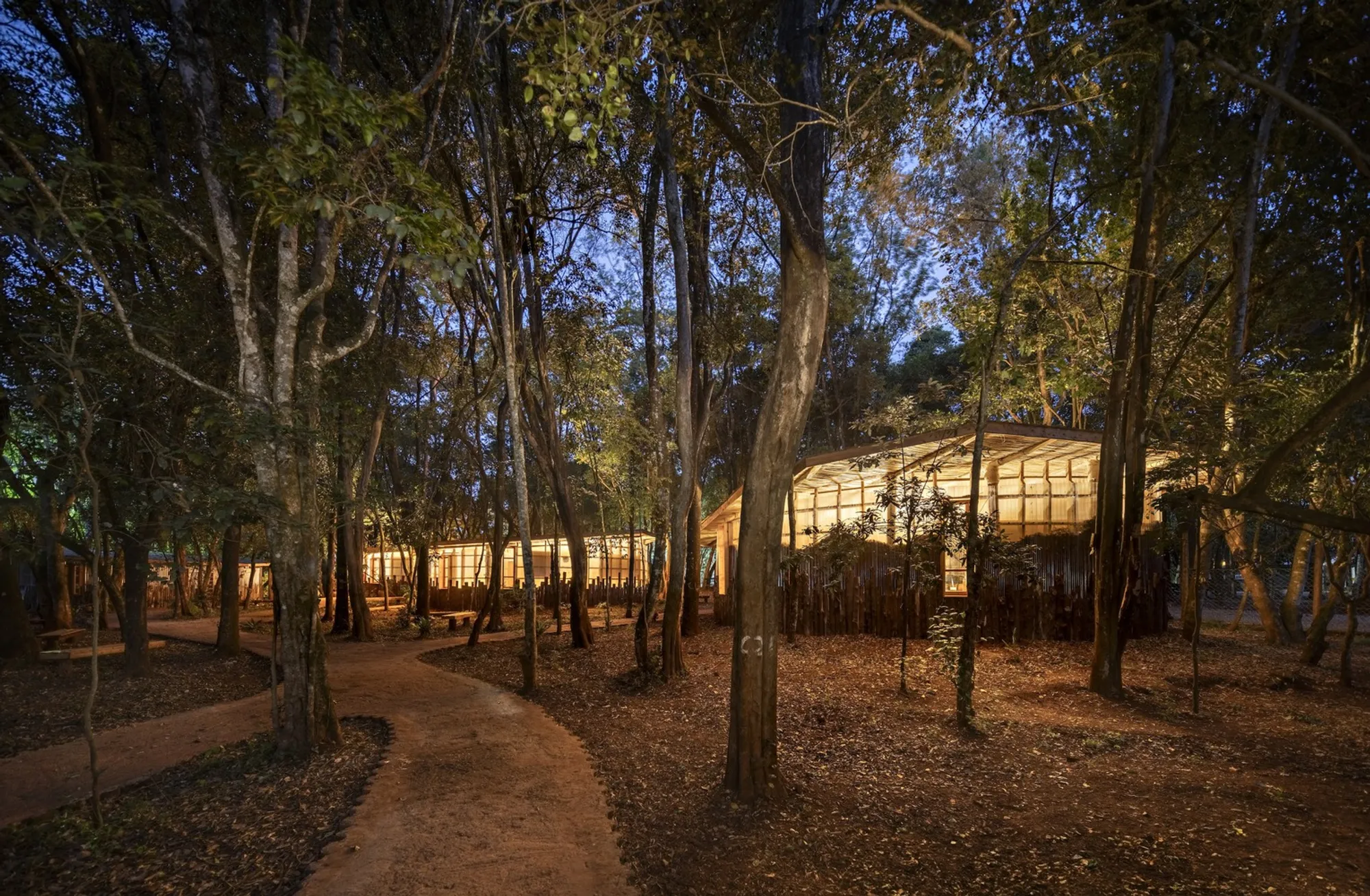
What makes the project worth serious attention is the way it transforms scarcity into an architectural language. Approximately 24 classrooms of varying organic shapes spiral through existing forest clearings, preserving every mature tree on the site. The plan references Maasai manyatas and Kenyan vernacular settlement patterns, clustering classrooms for pre-primary, primary, and secondary students into distinct villages with enclosed open spaces for safe play. Walls are literally alive, filled with red laterite soil that hosts microorganisms, plant roots, and insects over time. A shipping container from the old school became the library. Oil drums became toilet sinks. Students, parents, and teachers filled the walls by hand. The line between building and pedagogy dissolves.
A Village Scattered Through the Trees
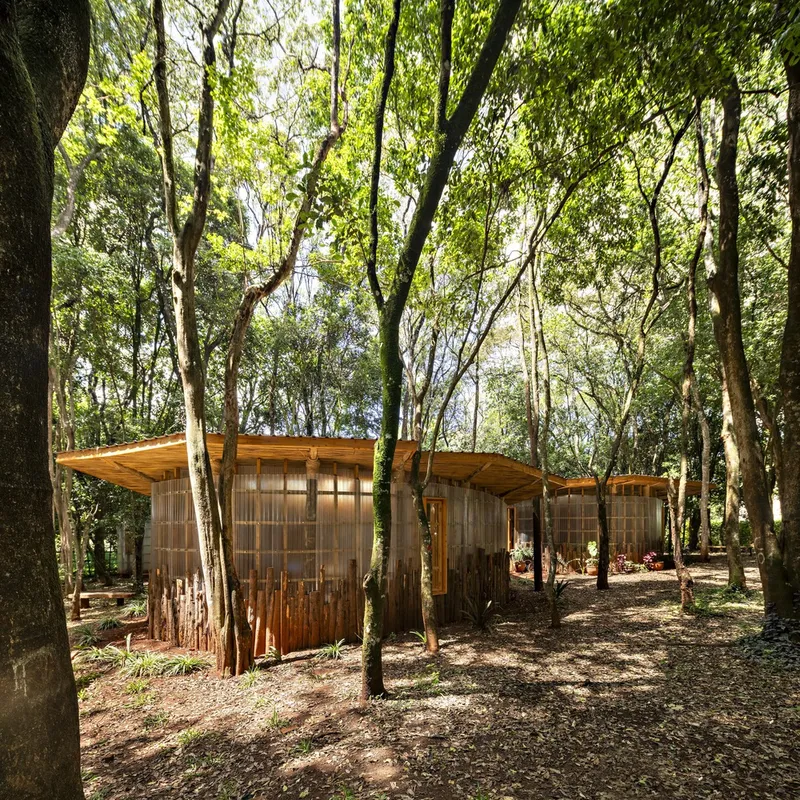
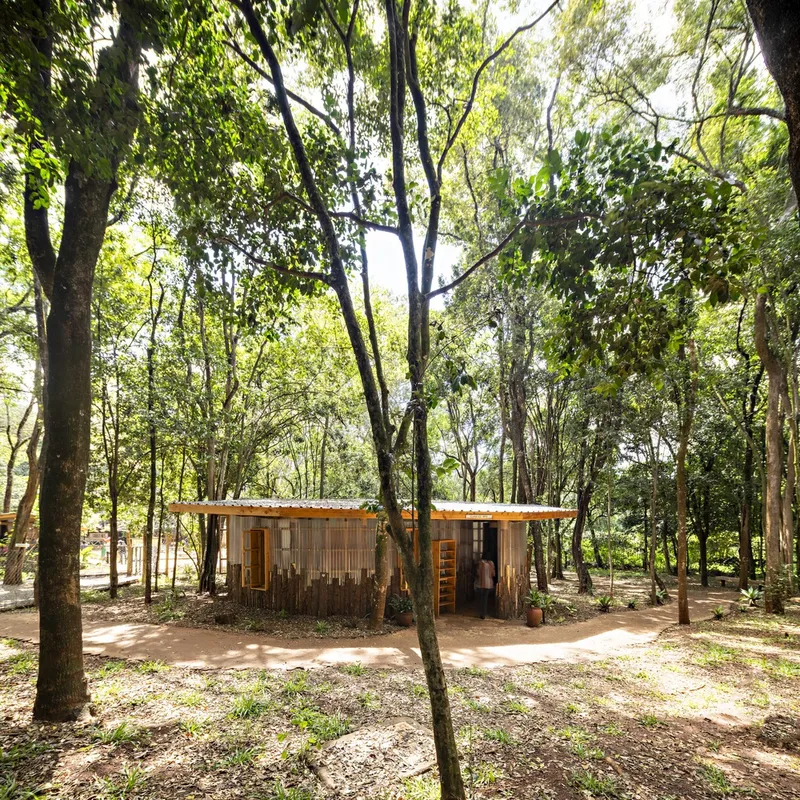
The site strategy is the project's strongest move. Rather than clearing the forest to create a conventional campus footprint, the architects dispersed pavilions into natural clearings, threading paths between them through dense foliage. You approach from a central drop-off area that opens onto an existing structure (an old house on the site, preserved to accommodate additional classrooms and services), and then the school reveals itself gradually, classroom by classroom, as you move deeper into the trees. The spiral configuration means sightlines shift constantly, and each cluster feels like its own small world.
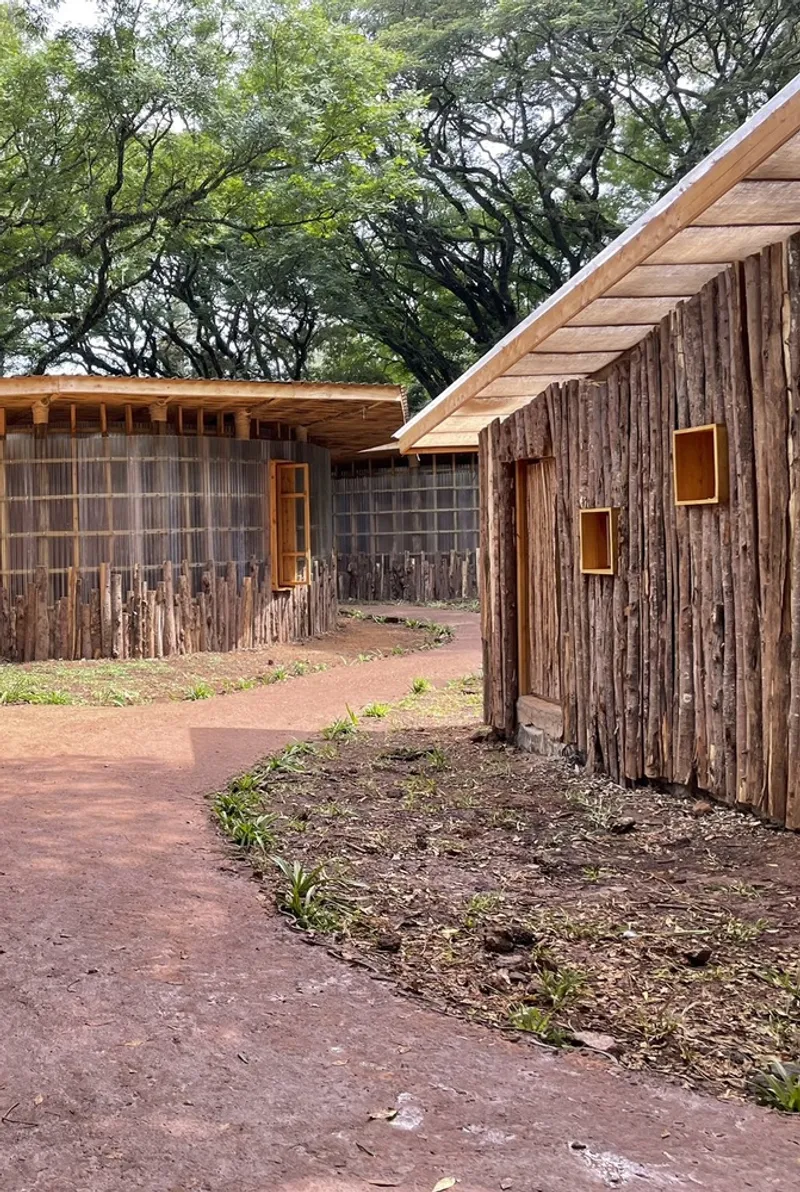
The pavilions sit low, their curved roofs barely rising above the understory. Vertical log cladding on some structures makes them read as extensions of the surrounding eucalyptus trunks. Corrugated metal and polycarbonate panels keep the construction lightweight and fast, while large roof overhangs protect the walls from rain and create shaded thresholds. The architecture does not compete with the forest. It borrows the forest's spatial logic of clearings and canopy, path and enclosure.
Living Walls as Pedagogy
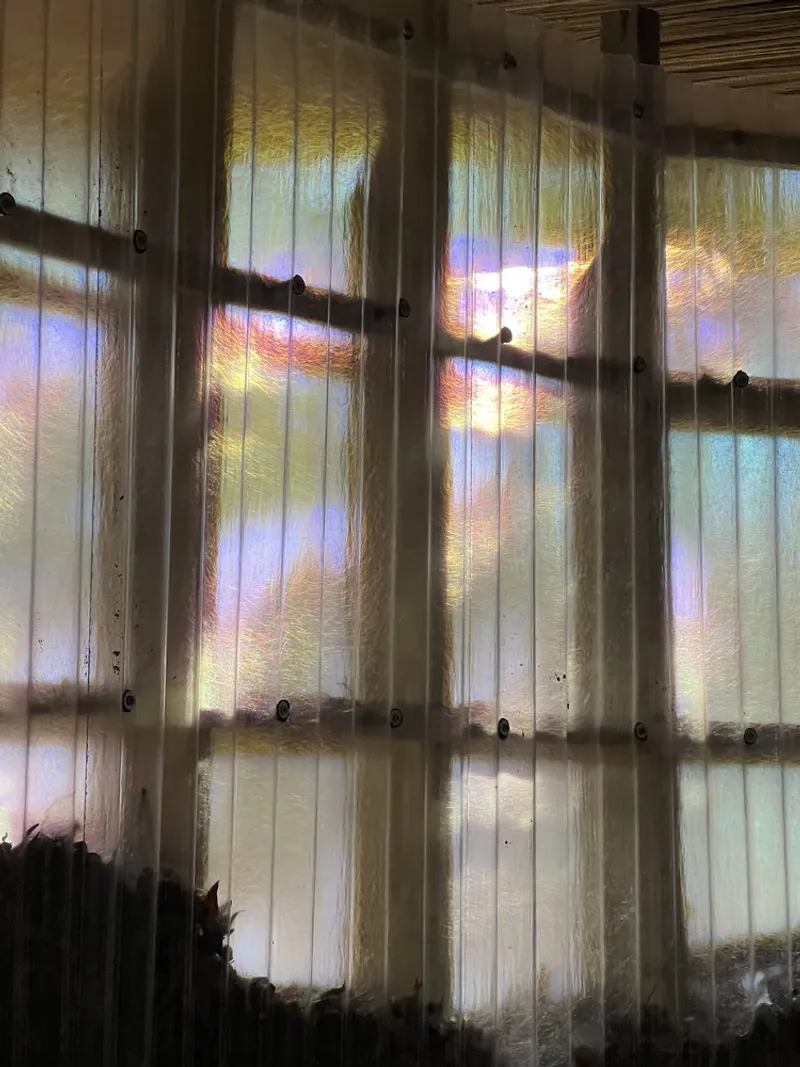
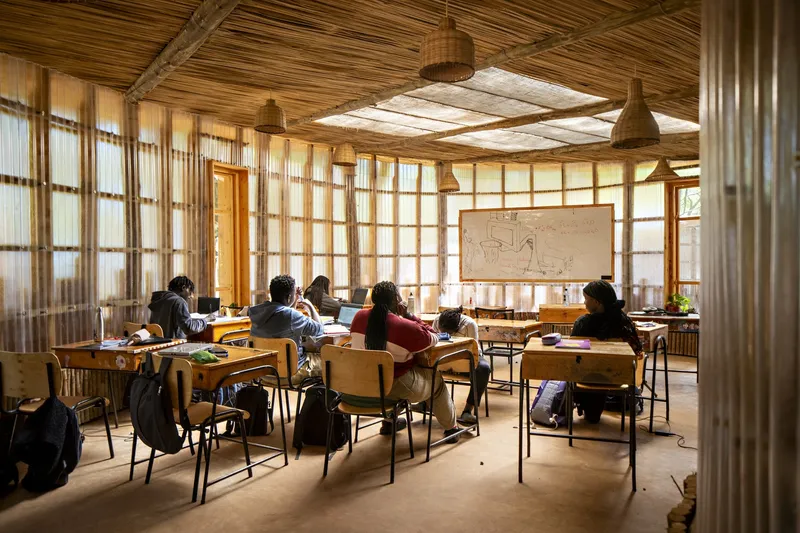
The defining material innovation here is the living wall system. Red laterite soil excavated on site is compacted between two sheets of translucent polycarbonate, supported by lightweight metal frames. Over time these walls become biological habitats: roots push through, insects colonize, microorganisms settle. The polycarbonate makes this process visible from the inside, casting prismatic light patterns across classroom interiors while giving students a literal cross-section of the soil ecosystem. In a Waldorf pedagogy grounded in Anthroposophy, where direct engagement with the natural world is foundational, this is not decoration. It is curriculum embedded in the wall.
The translucency also solves a practical problem. At $250 per square meter, conventional glazing is a luxury. Polycarbonate delivers abundant daylight at a fraction of the cost, and the soil infill provides thermal mass that moderates interior temperatures. The walls insulate, illuminate, and educate simultaneously. It is one of the more resourceful envelope solutions in recent school architecture anywhere.
Structure from Salvage and Site
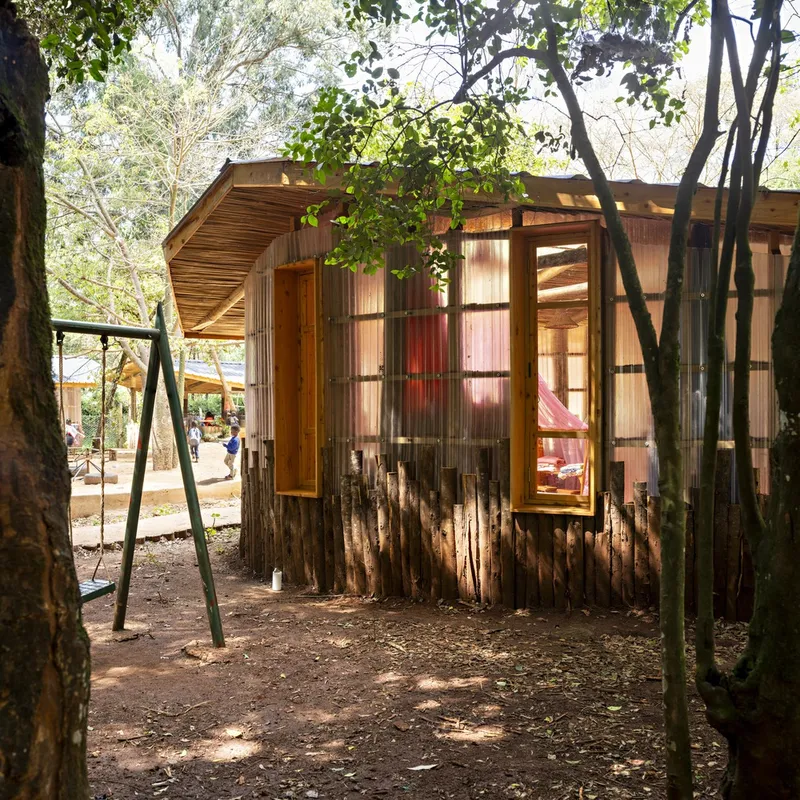
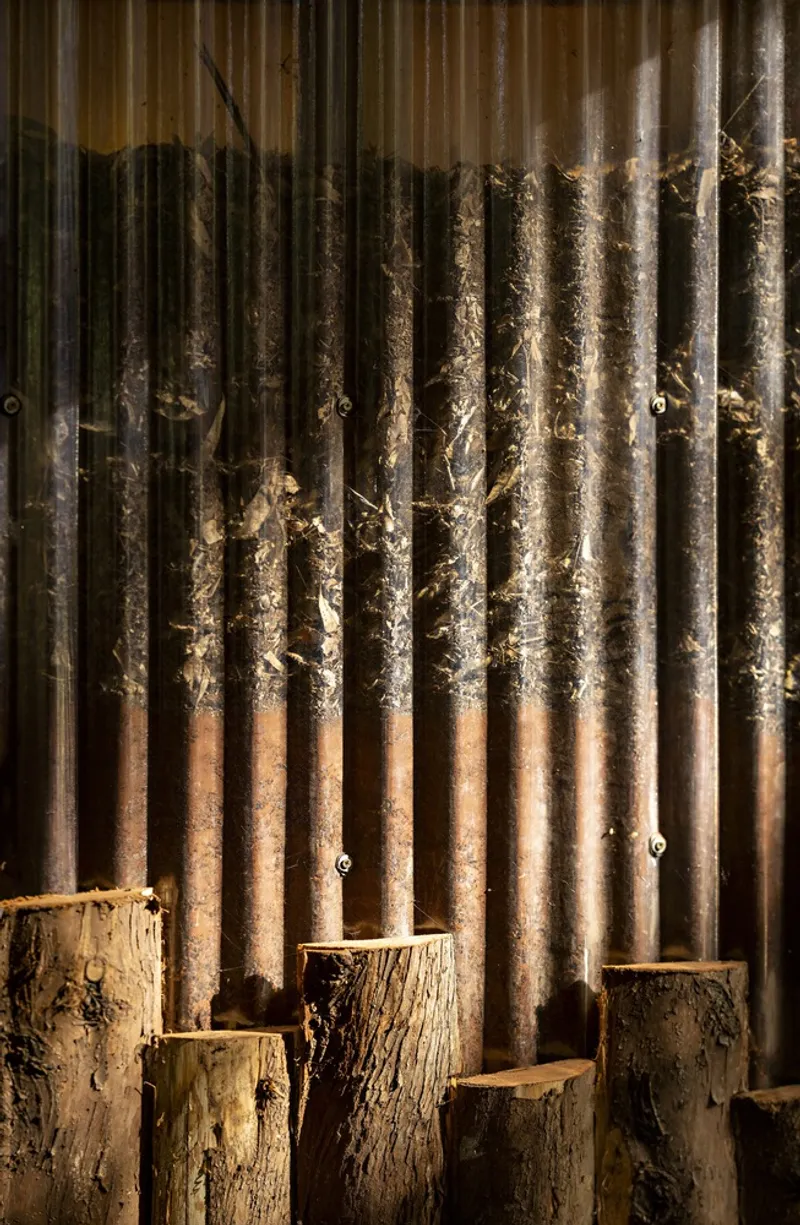
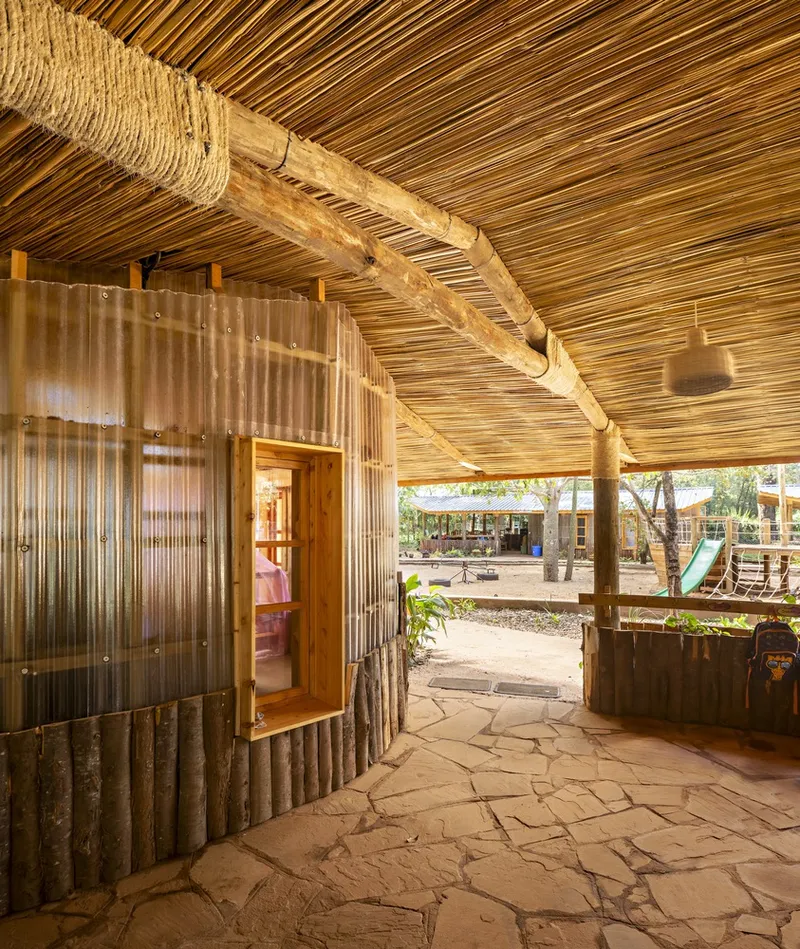
The material palette reads like an inventory of what was already on hand. Wooden floors and walls from dismantled classrooms were recut into parapets. Roof tiles from demolished structures became path boundaries. Tree trunks that had been felled before the architects arrived (cleared for a sports field) were repurposed as screens in the dining hall and as seating elements along corridor walls, where moss has begun to colonize their surfaces. The tall wooden logs that support the lofty roof of the existing structure remain in place, integrated into the new program.
Concrete appears only where structurally unavoidable: in slabs and access roads, mixed with excavated soil to reduce cement content. The rest of the structural system relies on lightweight metal frames filled with compacted earth. The approach is not anti-technology; it is anti-waste. Every decision routes material from demolition or excavation back into the construction cycle, and the community's direct involvement in building (filling walls, sorting salvaged timber) turns the construction process itself into a collective act.
Interior Life Under Canopy Roofs
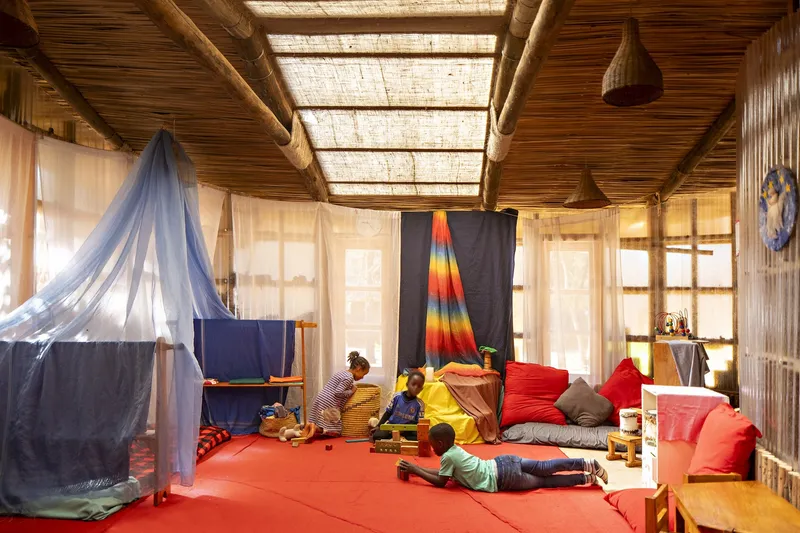
Inside the classrooms, the architecture recedes. Woven reed panels filter light through skylights. Rope-wrapped timber rafters and bamboo slat ceilings create warm, textured surfaces overhead without any applied finish. Red floor cushions replace rigid furniture in activity rooms, reinforcing the Waldorf emphasis on movement and sensory learning. The interiors are informal without being chaotic, structured without being rigid.
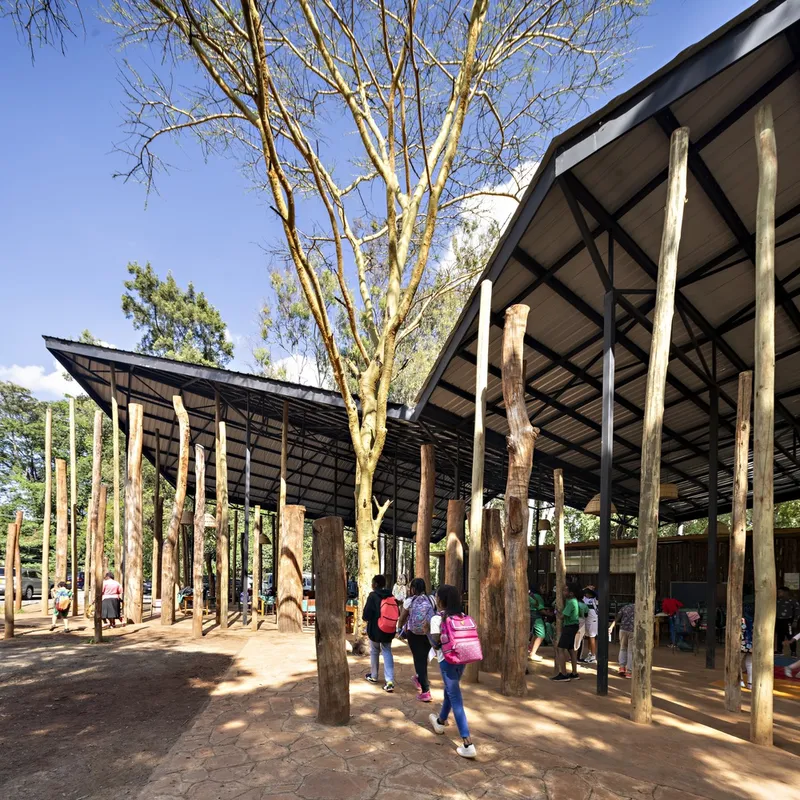
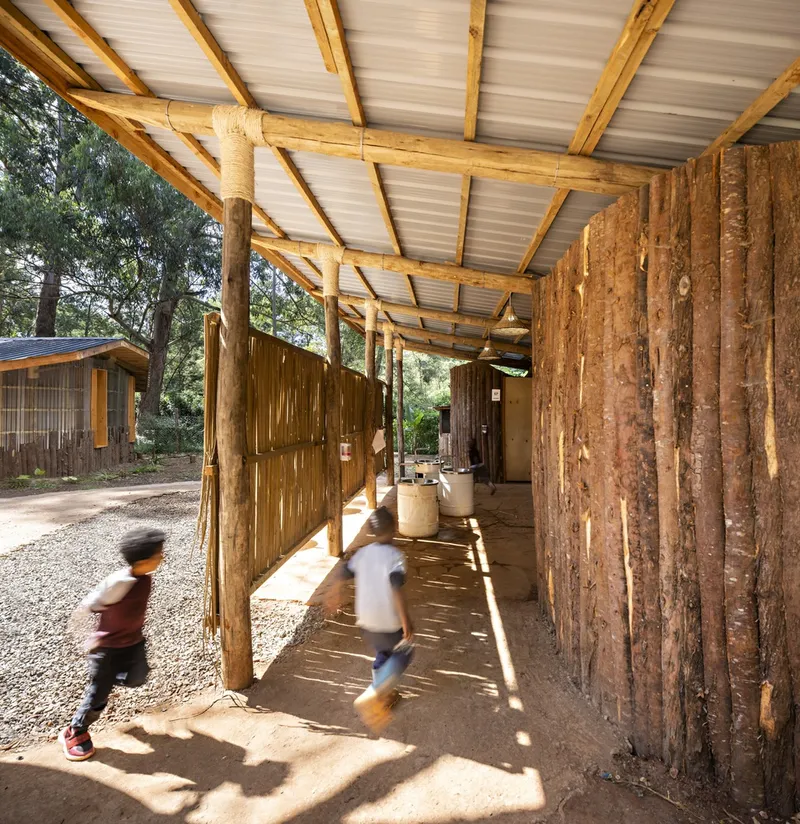
Covered courtyards and corridors act as social connective tissue between classrooms. Eucalyptus trunk columns hold up black steel roof planes that shade but do not enclose, letting children move between indoors and outdoors with minimal transition. The covered walkways, with their translucent roofing, catch dappled forest light and amplify it. Running through these corridors, as the children in the photographs clearly enjoy doing, feels closer to running through a forest trail than walking a school hallway.
Dusk Reveals the Logic
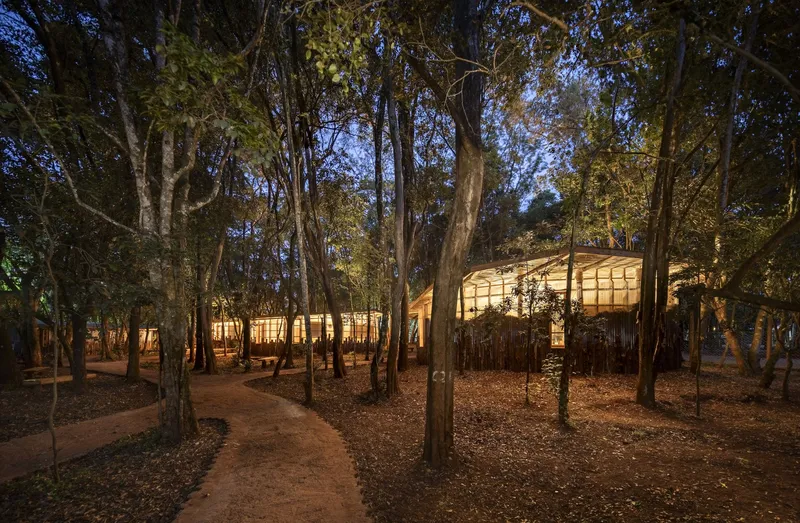
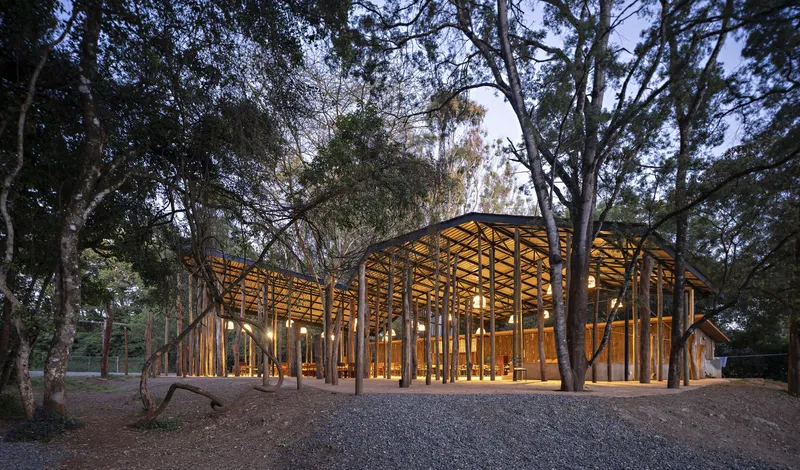
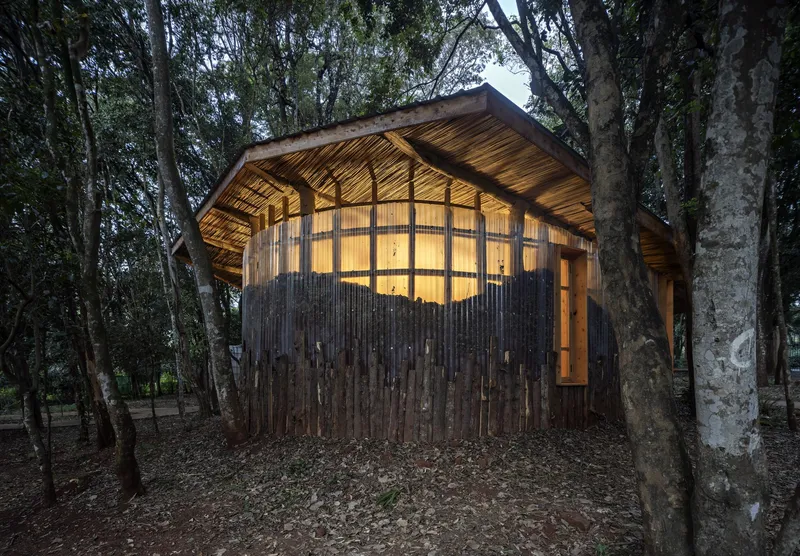
The evening photographs are revelatory. When the polycarbonate walls glow from within, each pavilion becomes a lantern among the tree trunks, and the campus reads as a constellation of inhabited clearings rather than a singular building. The exposed steel truss roofs of open pavilions become geometric counterpoints to the organic canopy above them. The contrast between the warm internal light and the darkening forest makes the temporary, lightweight construction feel unexpectedly substantial.
These images also clarify the spatial relationships that are harder to read in daylight. The pavilions are close enough to form clusters but far enough apart to maintain the forest's continuity. Earthen pathways connect them without hardscaping the entire ground plane. The architecture occupies the site lightly, literally and visually, and the dusk views make that lightness into something poetic rather than merely pragmatic.
The Facade as Forest Edge
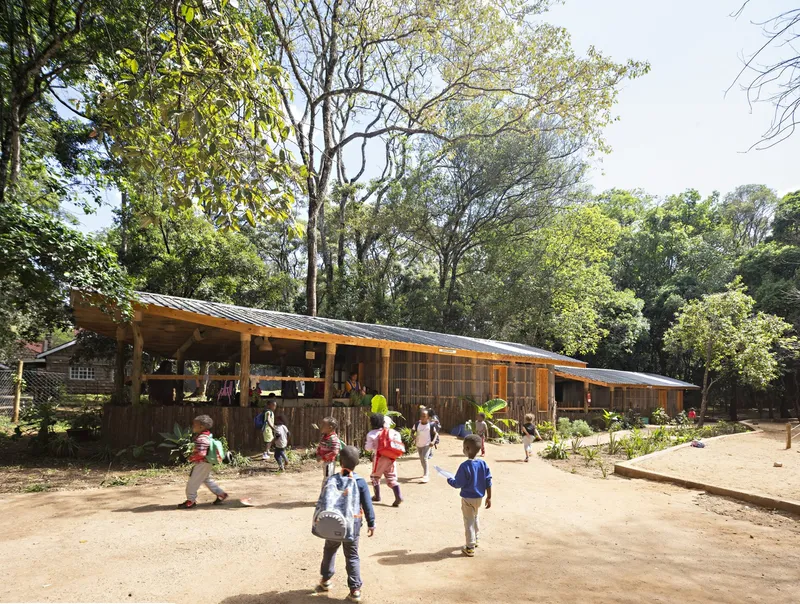
The long facade of the primary classroom block, with its corrugated panels and cantilevered metal roof canopy, is the closest the project comes to a conventional school elevation. Children walk across the clearing with backpacks, and the building reads as a simple, clear figure against the tree line. But even here, the architecture remains porous. The roof extends well beyond the wall plane, creating a deep threshold zone that is neither interior nor exterior. The building does not present a face to the world so much as offer a sheltered edge.
Plans and Drawings
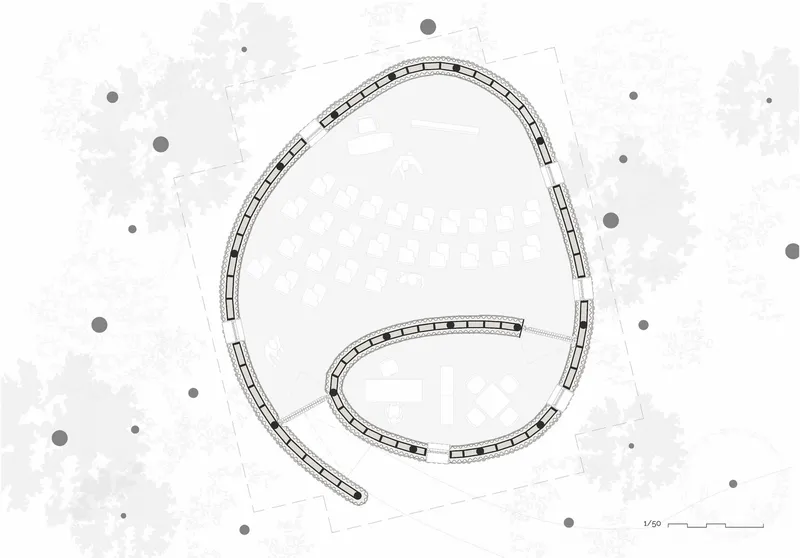
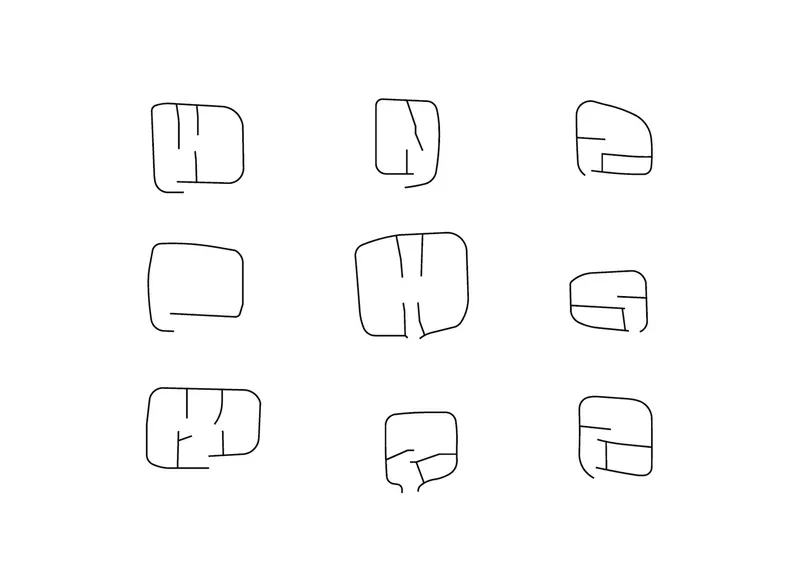
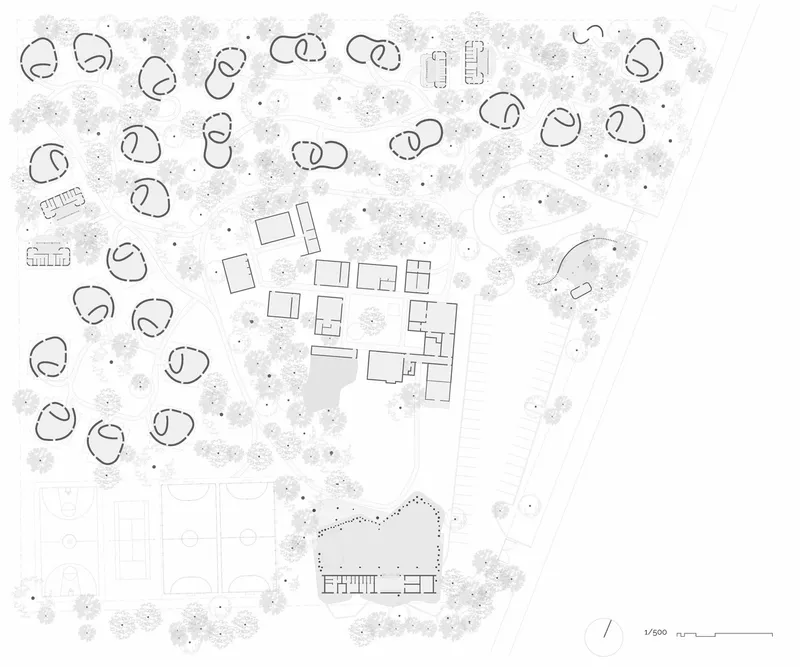
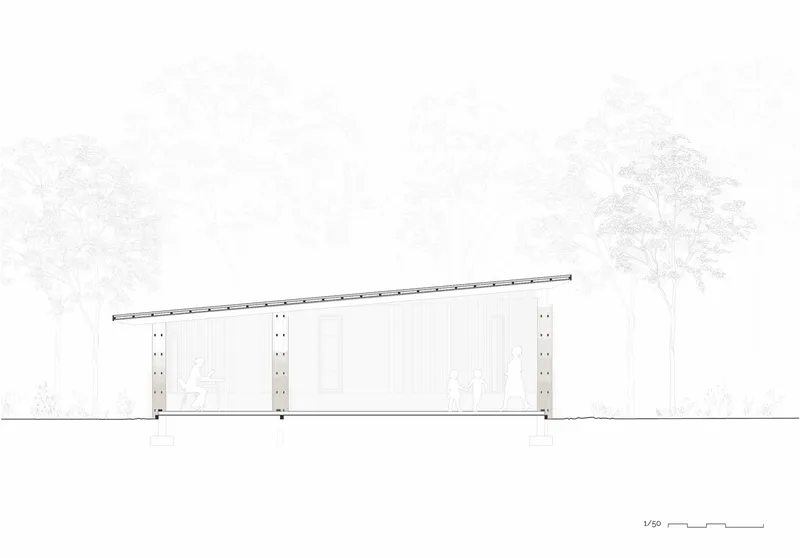
The floor plan of a single classroom reveals the petal-shaped geometry that characterizes the project. Curving walls eliminate corners, which aligns with Waldorf spatial principles (sharp angles are avoided in early childhood environments) while also distributing structural loads more evenly across the lightweight metal frame. The sketch diagrams showing nine plan variations suggest a modular design process: a basic rounded rectangular footprint is subdivided and recombined to accommodate different class sizes and programs. The site plan makes the dispersal strategy legible, with clustered pavilions sitting among circular tree canopy projections and one larger curving structure anchoring the composition. The elevation drawing confirms the low profile: slanted roofs, vertical cladding, and a building that barely exceeds the height of the surrounding trees.
Why This Project Matters
The Nairobi Waldorf School matters because it demonstrates that radical economy and genuine architectural ambition are not in conflict. At $250 per square meter, using soil from the site, salvaged timber, and community labor, Urko Sanchez Architects produced a campus that is spatially rich, pedagogically coherent, and environmentally responsible. The living walls alone constitute a material innovation worth studying far beyond the Waldorf context. The decision to design for a 10-year lifespan, with full disassembly and material reuse planned from the outset, challenges the profession's default orientation toward permanence.
More broadly, the project offers a counter-model to the institutional school typology that dominates education architecture globally. Instead of a single large building with corridors and identical classrooms, here is a forest village where each classroom occupies its own clearing, children move through nature between lessons, and the walls themselves are ecosystems. Led by architect Jaime Velasco with a team including Kelvin N'dungu, Esther Karanja, Nicholas Simwichi, and Linda Muriuki, the project proves that constraints of budget, time, and impermanence can generate architecture that is more inventive, more site-specific, and more humane than buildings with ten times the resources.
Nairobi Waldorf School by Urko Sanchez Architects, Karen, Nairobi, Kenya. 3,162 m². Completed 2024. Photography by Javier Callejas.
About the Studio
Share Your Own Work on uni.xyz
If projects like this are the kind of work you want to make, uni.xyz is a place to publish your own, find collaborators, and enter design competitions.



Popular Articles
Popular articles from the community


The Earth Pod: 3D Printed Homes for Resilient Refugee Communities
The Earth Pod reimagines refugee housing through 3D printed homes made from clay, combining resilience, self-sufficiency, and rapid shelter.

Lunar Spiral: Space Architecture Shaped by the Mathematics of the Universe
Lunar Spiral reimagines space architecture through Fibonacci geometry, lunar regolith, levitating habitats, and self-sustaining Moon living.

The Musturak Paradise: Senior Living Architecture for a Connected Future in Temara, Morocco
The Musturak Paradise reimagines senior living architecture in Temara via private homes, social spaces, culture, community, and shared care.

The Ocean Hive: Sustainable Architecture for a Self-Sufficient Civilization at Sea
The Ocean Hive imagines sustainable architecture at sea, where modular habitats, algae, wave power and ocean waste sustain a growing colony.


Similar Reads
You might also enjoy these articles


Hodi-Mandai Geram
Project Function: Preservation and revitalization of the Intangible heritage and socio-spatial identity of the Hodi by Housing, Cultural Memory Center, Sacred Grove, landscape, local tourism economy


Olio Towers: A Mid-Rise for Performers That Fuses Housing, Rehearsal, and Stage
Located blocks from Houston's Theater District, this modular tower stacks living units around a central performance atrium.

Oasis: Modular Green Housing Carved into Dhaka's Urban Fabric
A shortlisted Plugin Housing entry reclaims unauthorized settlements in Dhaka with stepped concrete volumes, green roofs, and ventilation-driven design.

Black Hole: A Floating Megastructure for the Post-Physical Era
Emiliano Mazzarotto envisions a spherical, self-scaling arena where e-sports, digital hotels, and holographic stadiums replace traditional public space.
Explore Architecture Competitions
Discover active competitions in this discipline



Challenge to reimagine the Iron Throne


Photograph architecture without architects


Illustrate the lost glory of Angkor Wat - Render Challenge


Design challenge to reuse E-waste
Comments (0)
Please login or sign up to add comments
No comments yet. Be the first to comment!