
Atelier FCJZ Weaves a Brick Neighborhood Center into the Dense Fabric of Shenzhen's Nantou Old Town
A community building shaped by courtyards, perforated brick screens, and winding staircases negotiates centuries of urban layering in Nantou.


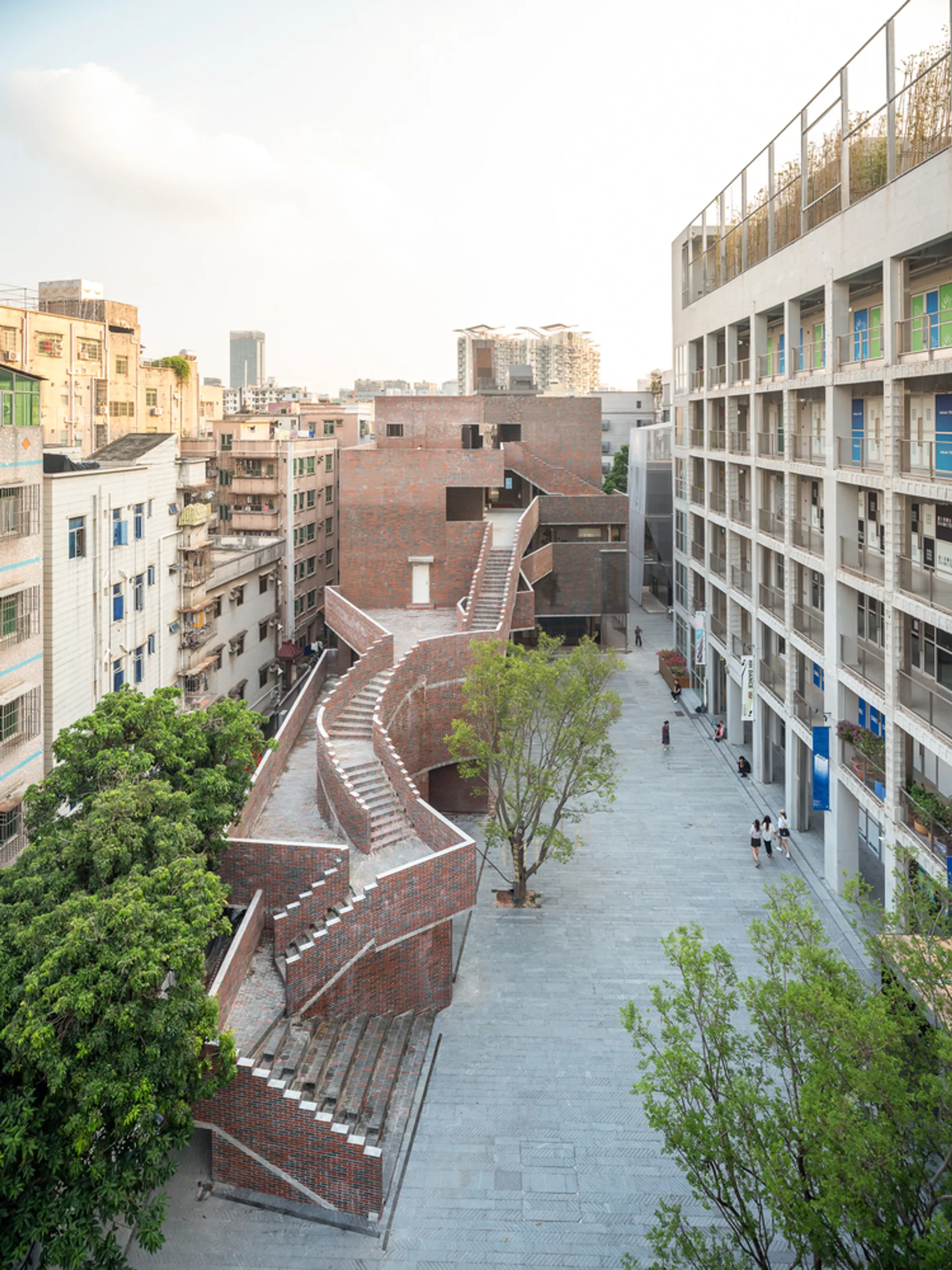
Nantou is one of those rare places in Shenzhen where history has not been bulldozed into parking lots. The ancient walled town, now swallowed by the megacity's urban sprawl, retains a tight grain of lanes and low buildings that feel almost accidental next to the glass towers a few blocks away. Into this charged context, Atelier FCJZ has inserted a neighborhood center that refuses to announce itself as a civic monument. Instead it borrows the materials, the scale, and even the spatial rhythm of the old town, turning a long, narrow site into a sequence of courtyards, ramps, and perforated walls that you discover only by walking through.
What makes the project genuinely interesting is its refusal to choose between preservation nostalgia and modernist insertion. The building is unmistakably new: its brick surfaces shift between red, gray, and ochre tones in deliberate patterns; its staircases wind upward with a sculptural confidence that owes nothing to vernacular precedent. Yet its footprint follows the logic of the site so closely that from the air it reads as just another piece of the patchwork. The result is a civic building that earns its place not by standing out, but by fitting in with intelligence.
Brick as Language
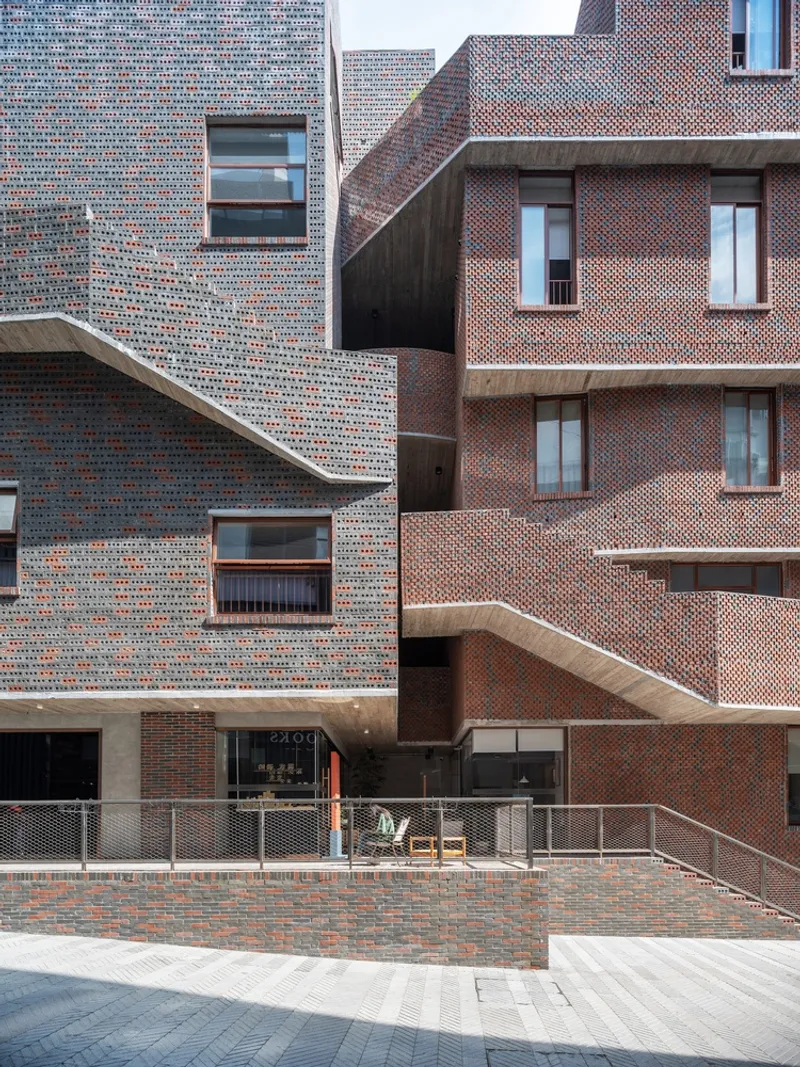
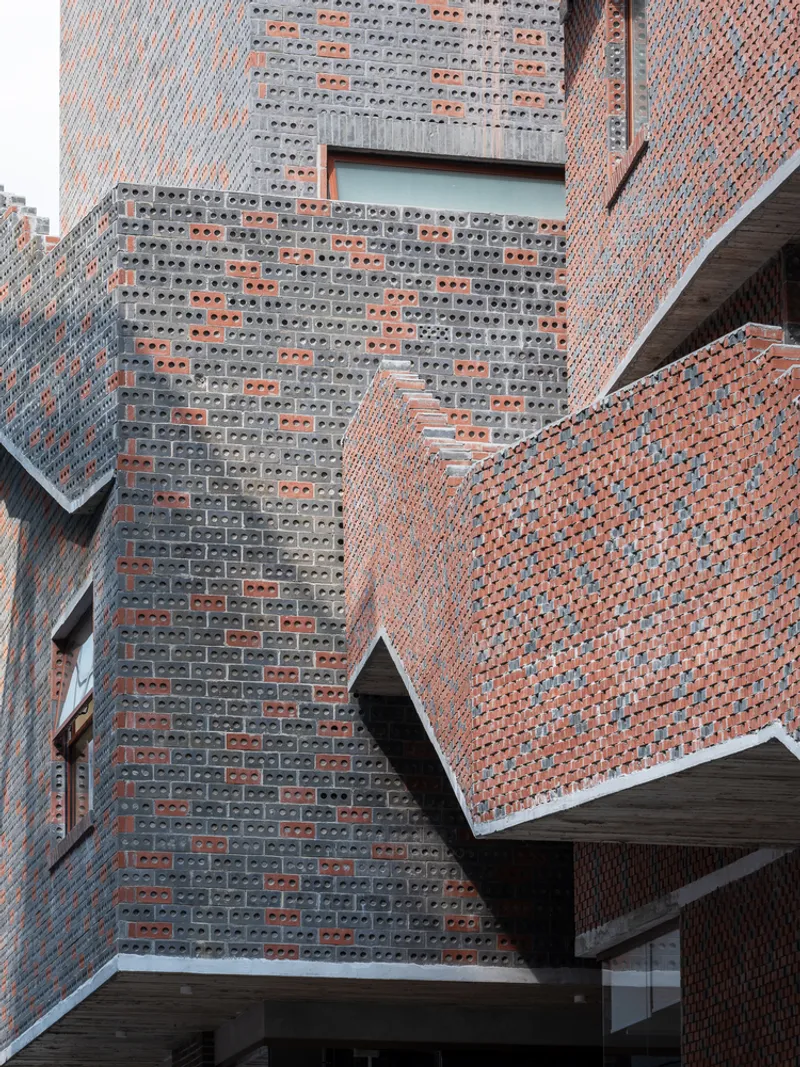
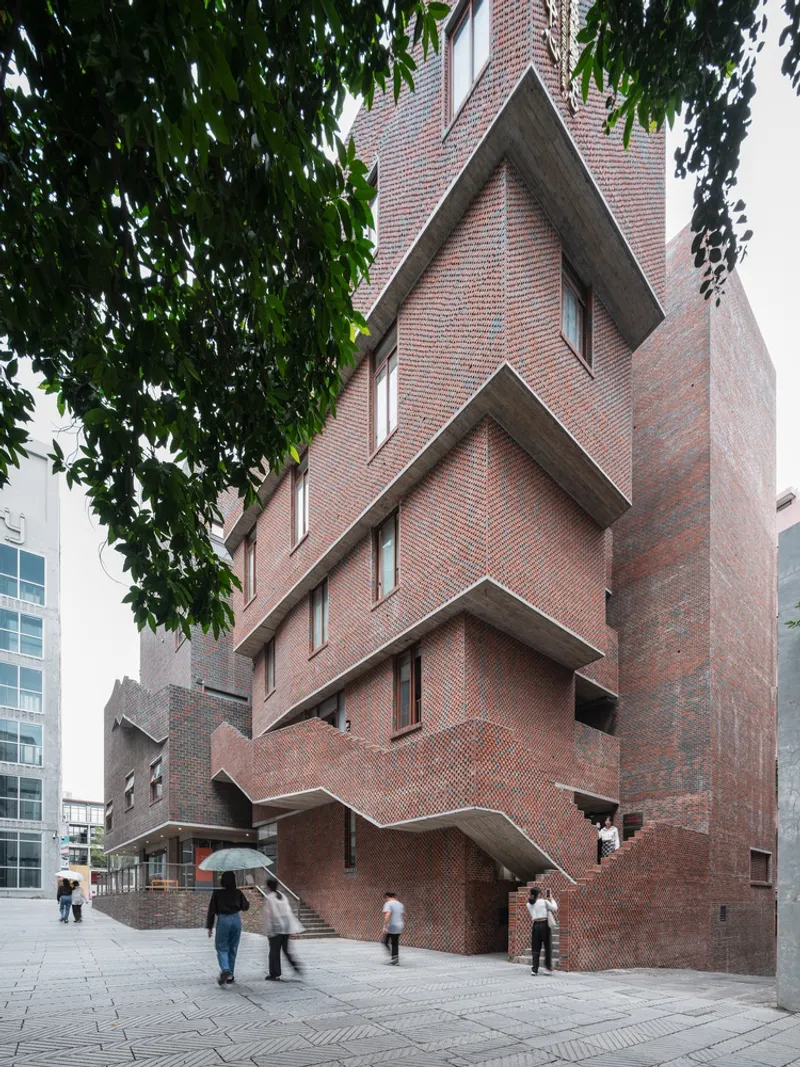
Atelier FCJZ deploys brick not as a nostalgic gesture but as a full compositional system. The facades mix at least three tonal ranges of masonry, from deep red to cool gray, and alternate between solid walls and perforated screens with the confidence of a textile designer switching weaves. At close range the junctions between perforated and solid surfaces create angular geometries that give each elevation its own rhythm. From a distance, the variegated surfaces dissolve the building's mass and make it read as an extension of the surrounding roofscape rather than an alien volume dropped from above.
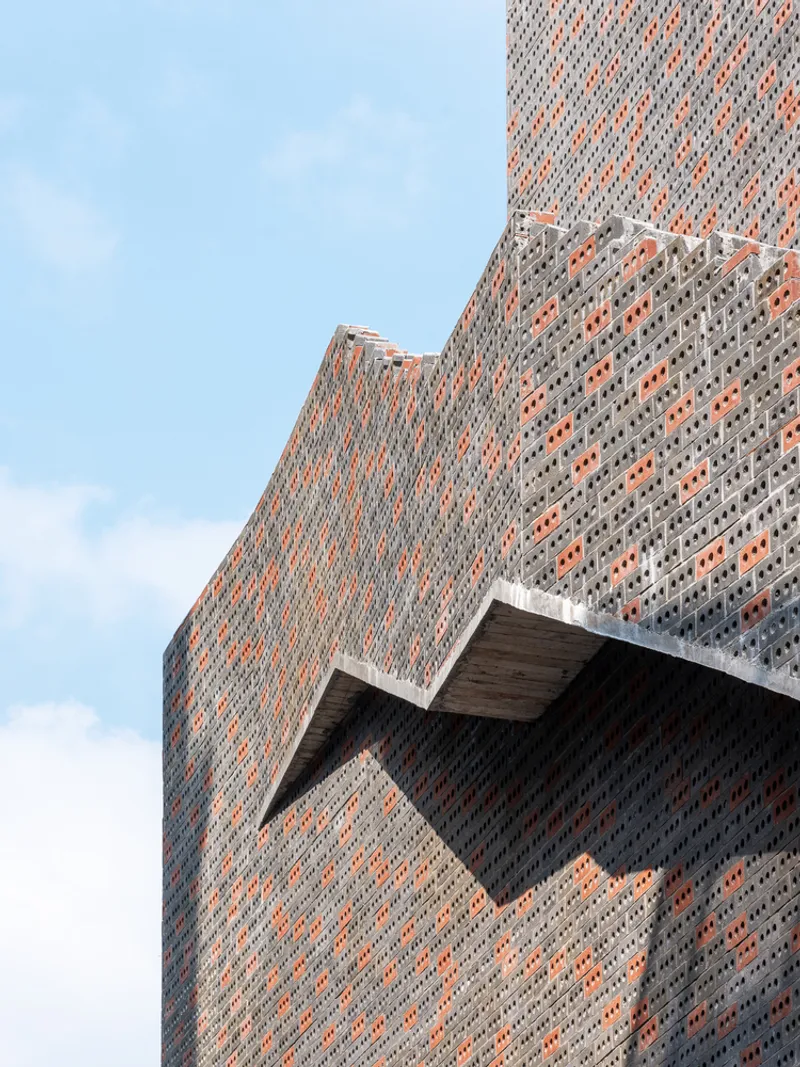
The projecting angled volumes visible along the upper levels push the brick language into three dimensions. These cantilevered forms cast deep shadows and frame views of adjacent trees and rooftops, turning every corner into a deliberate composition. It is a material strategy that rewards both the fast glance and the slow examination.
Courtyards and Circulation as Public Space
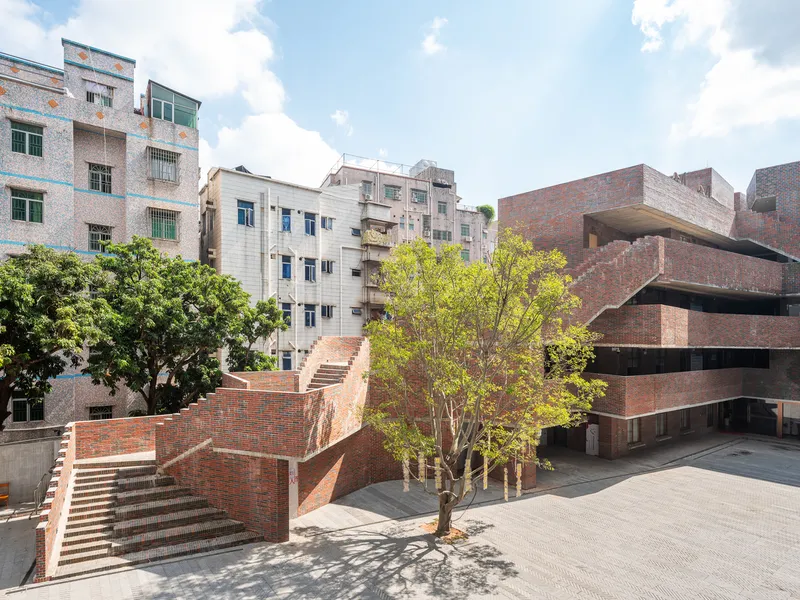
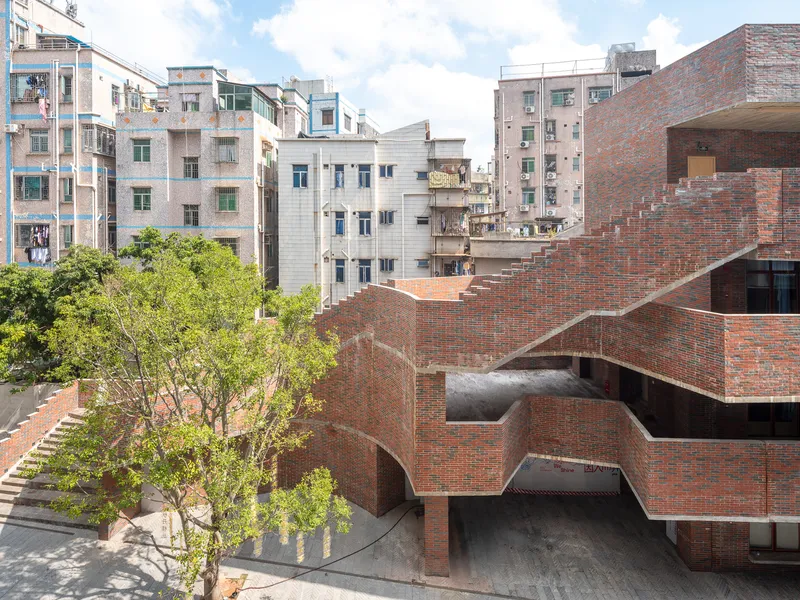
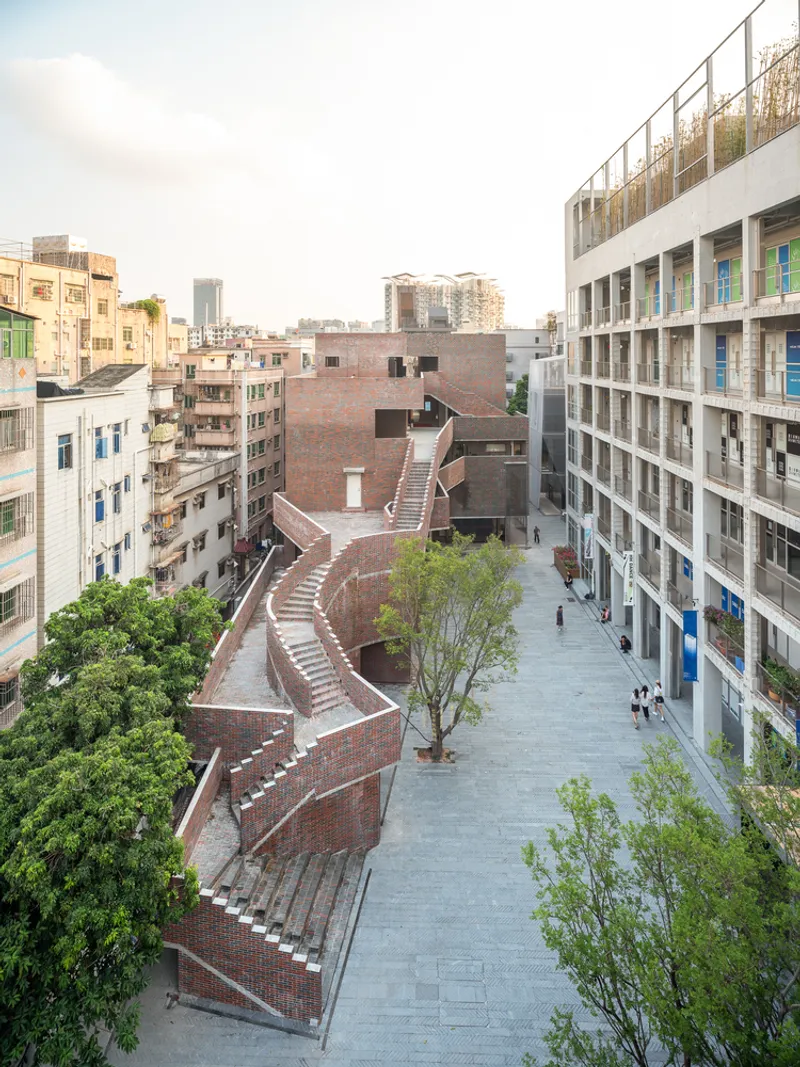
The building's plan is essentially a chain of courtyards connected by open-air ramps and staircases. Rather than placing circulation inside the building and reserving the ground for a lobby, Atelier FCJZ externalizes movement entirely. You ascend along winding brick stairs that wrap around trees, pass beneath arched passageways, and emerge onto rooftop terraces that survey the dense neighborhood below. The effect is closer to navigating an Italian hill town than entering a municipal facility.
At dusk the courtyards come alive. People gather on the cascading staircase, lean against parapets, or simply pass through on their way home. The building functions as a shortcut, a gathering spot, and a lookout simultaneously. This layering of uses within a single circulatory spine is the project's strongest architectural idea: the path is the program.
Navigating the Urban Grain
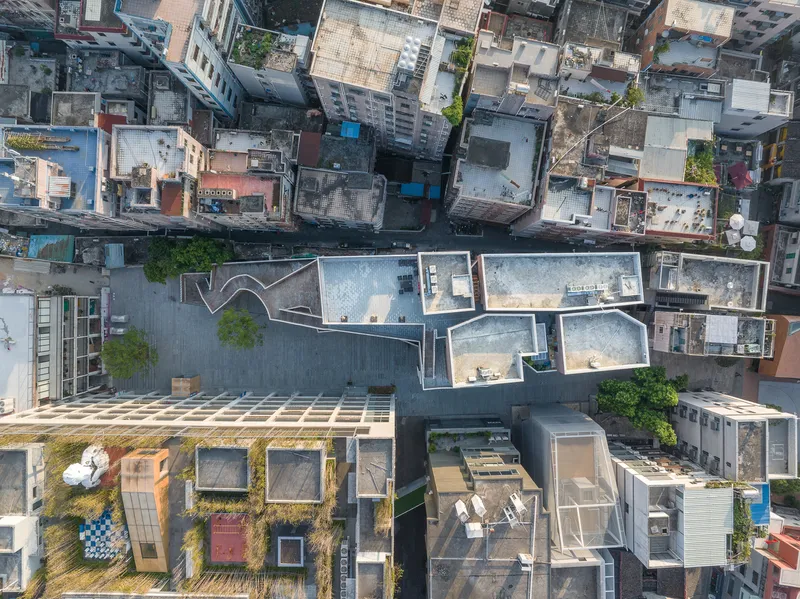
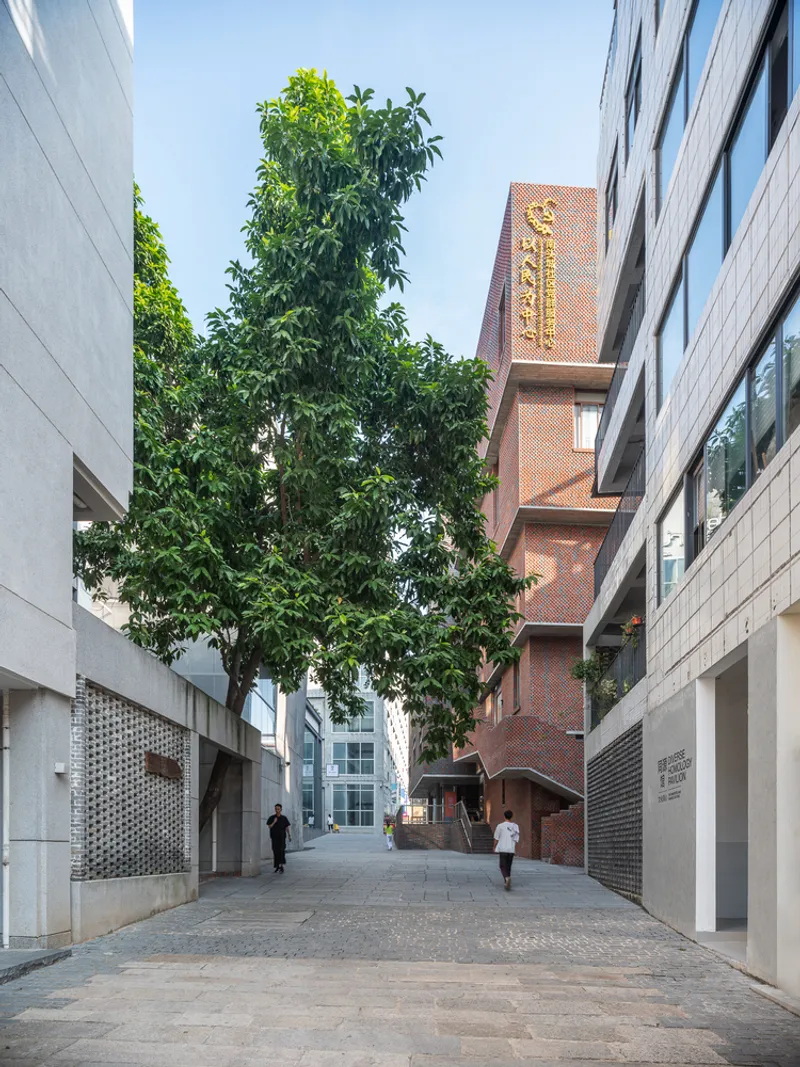
The aerial view is revealing. The building's elongated footprint threads between existing structures with surgical precision, maintaining the narrow lane widths and irregular setbacks of the old town. Tall trees survive along the pedestrian lanes flanking the center, their canopies brushing against brick walls. This is not a site that was cleared and rebuilt; it is a site that was negotiated, and the architecture shows the scars and benefits of that negotiation in every offset wall and angled plan line.
Walking at ground level between the center and its neighbors, you experience the kind of compressed, shaded passage that makes old Chinese towns pleasant even in subtropical heat. Atelier FCJZ clearly studied these existing conditions and calibrated the building's massing to preserve them rather than override them.
Interior Corridors and Material Detail
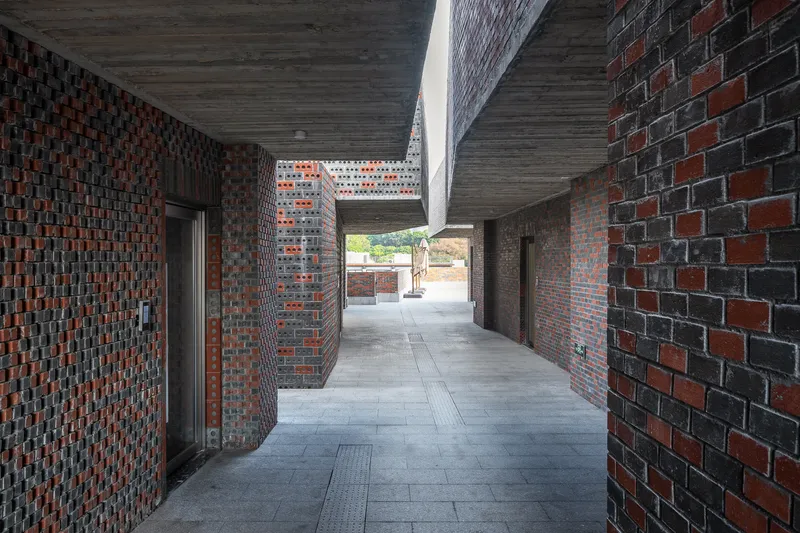
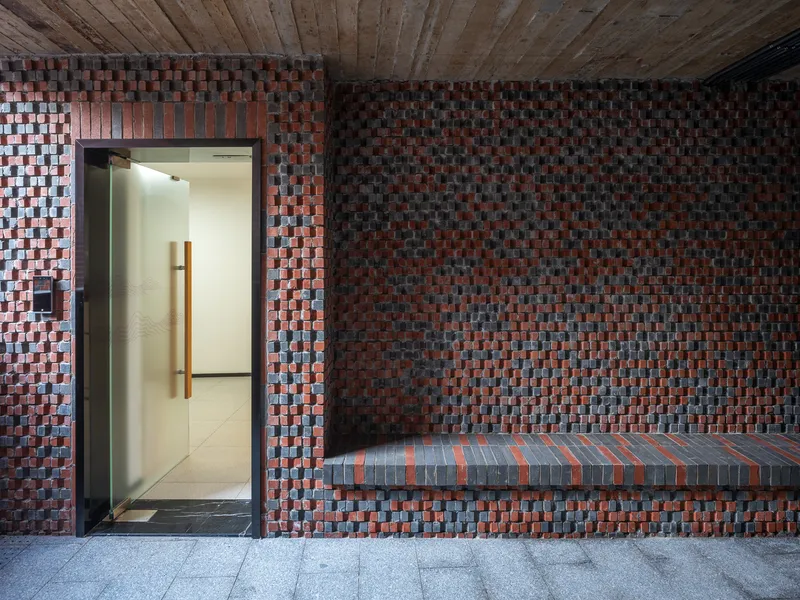
Inside, the palette stays disciplined: timber plank ceilings warm the covered passageways, while multicolored brick walls provide visual texture without applied finishes. Built-in benches along corridor walls invite pause, reinforcing the idea that circulation here is not merely functional but habitable. Light enters from courtyards at either end, so even the deepest interior moments feel connected to the sky.
Looking upward at the projecting volumes, the perforated brick screens filter sunlight into geometric patterns on the recessed soffits. These are the details that separate a thoughtful brick building from a merely competent one. Every surface has been considered not just for its appearance but for how it modulates light, air, and view.
Staircases as Sculptural Events
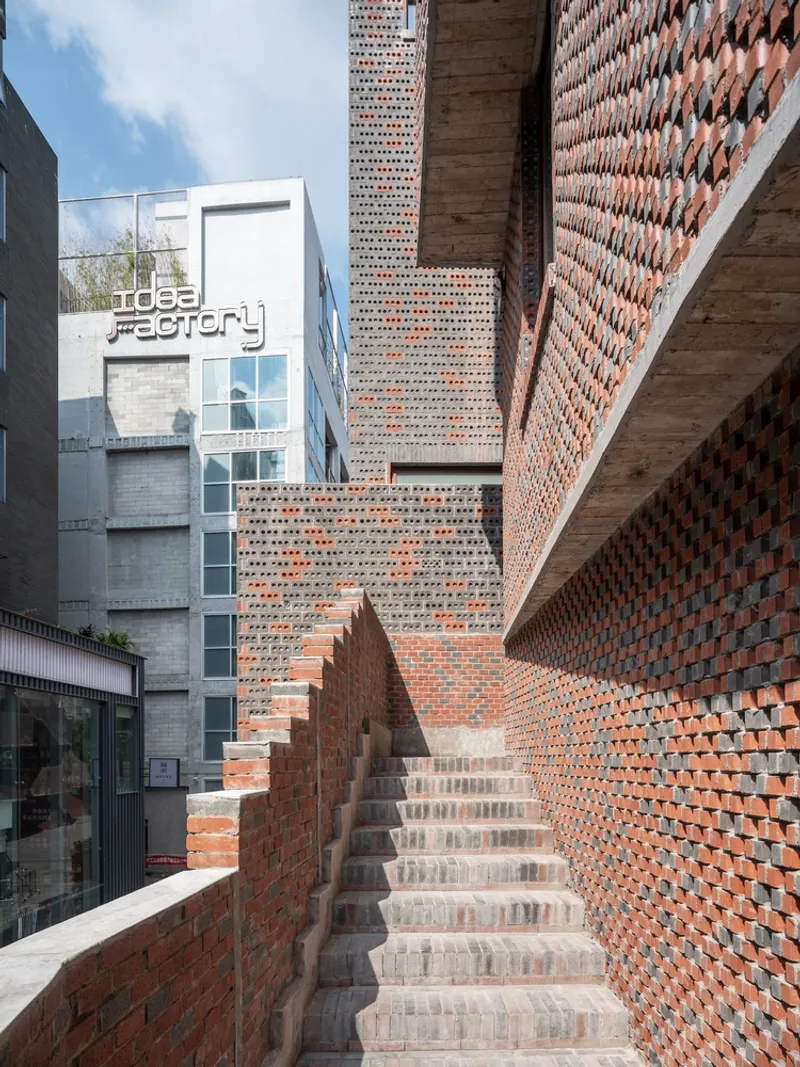
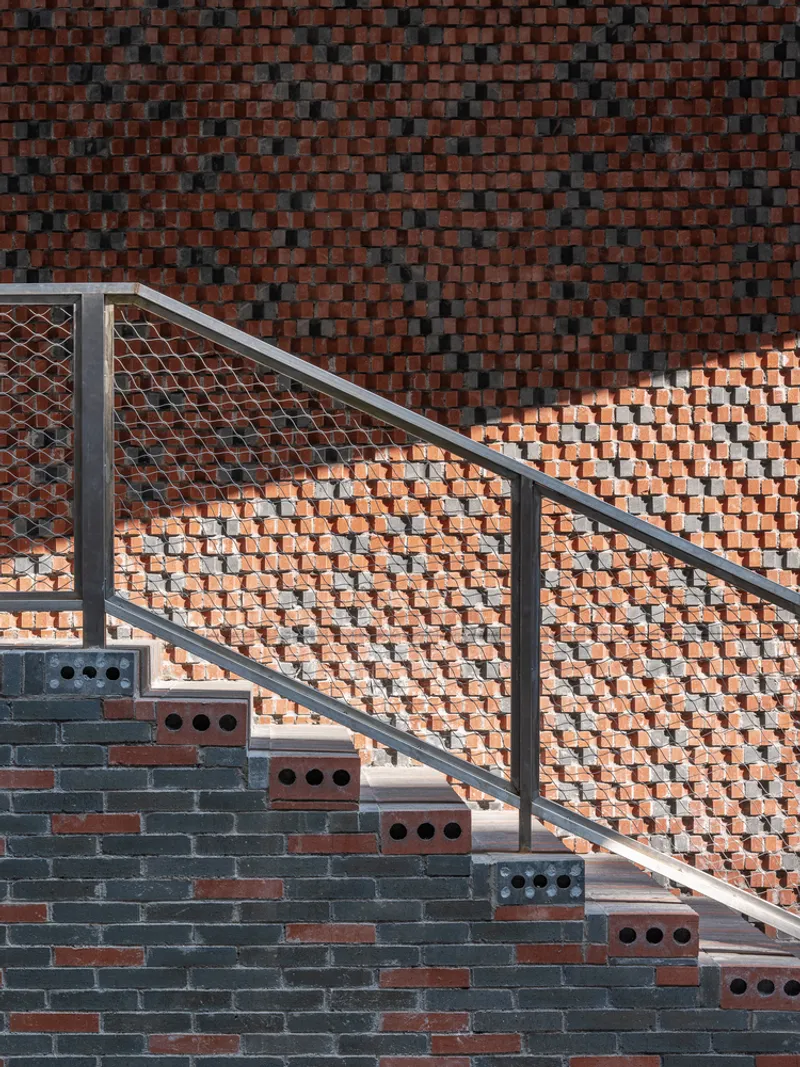
The exterior staircases deserve their own discussion. Ascending between patterned brick walls under open sky, they feel more like inhabitable sculptures than service elements. Metal railings are kept minimal, allowing the masonry to dominate. Afternoon sunlight rakes across the textured surfaces, turning each flight into a study in shadow and relief. These stairs are the connective tissue of the building, linking ground-level lanes to rooftop courtyards and giving the center its distinctive vertical rhythm.
Plans and Drawings
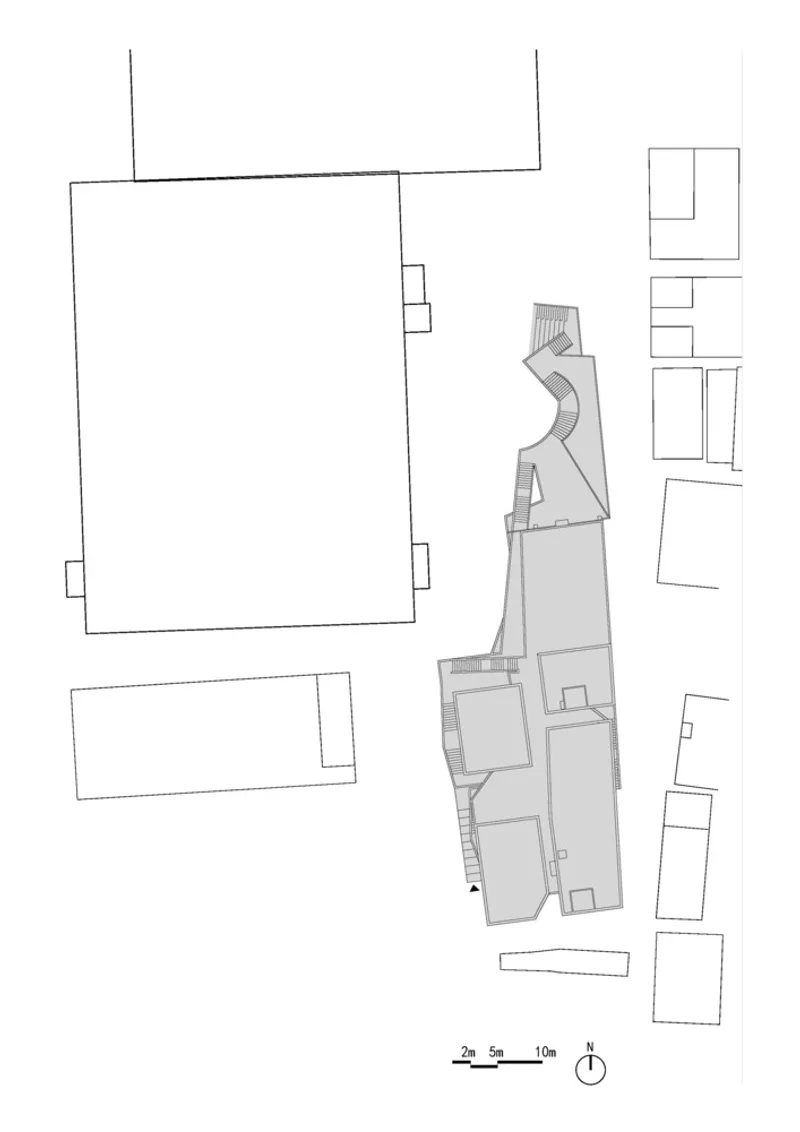
The site plan confirms what the aerial photograph suggests: the building is less a freestanding object than a thickened wall inserted between neighbors. Its elongated footprint follows the cadastral logic of the old town, with courtyards punched through at intervals to maintain permeability. The drawing makes clear how deliberately the building respects existing circulation routes, turning what could have been a barrier into a porous connector.
Why This Project Matters
Civic architecture in Chinese megacities tends toward one of two extremes: the spectacular landmark or the invisible developer box. Atelier FCJZ's Nantou Neighborhood Center charts a third path. It is clearly authored, rich in material invention, and spatially generous, yet it operates at the scale and tempo of the village it serves. The building proves that ambition and humility are not opposites; they can coexist in every brick course and every courtyard.
For architects working in dense, historically layered urban sites, the project offers a transferable lesson: read the grain, match the scale, externalize the life. When circulation becomes public space and facades become screens rather than barriers, even a modest community program can produce architecture of real consequence.
Nantou Neighborhood Center by Atelier FCJZ, Shenzhen, China. Photography by Fangfang Tian.
About the Studio
Share Your Own Work on uni.xyz
If projects like this are the kind of work you want to make, uni.xyz is a place to publish your own, find collaborators, and enter design competitions.



Popular Articles
Popular articles from the community


Riyadh For All: Intergenerational Urban Design for Active Aging in Rabat
Riyadh For All reimagines urban design in Rabat with intergenerational co-living, adaptive courtyards, and Moroccan cultural exchange today.

The Musturak Paradise: Senior Living Architecture for a Connected Future in Temara, Morocco
The Musturak Paradise reimagines senior living architecture in Temara via private homes, social spaces, culture, community, and shared care.

Conexión: Biophilic Design Reimagines High-Rise Living in Hong Kong
Conexión reimagines high-rise living in Hong Kong through biophilic design, green facades, shared spaces, daylight, water and nature within.

Co-life: Sustainable Architecture for Age-Friendly Community Living
Co-life reimagines sustainable architecture for seniors through courtyards, rammed earth, shared gardens, and spaces designed for belonging.

Similar Reads
You might also enjoy these articles


Hodi-Mandai Geram
Project Function: Preservation and revitalization of the Intangible heritage and socio-spatial identity of the Hodi by Housing, Cultural Memory Center, Sacred Grove, landscape, local tourism economy


Olio Towers: A Mid-Rise for Performers That Fuses Housing, Rehearsal, and Stage
Located blocks from Houston's Theater District, this modular tower stacks living units around a central performance atrium.

Oasis: Modular Green Housing Carved into Dhaka's Urban Fabric
A shortlisted Plugin Housing entry reclaims unauthorized settlements in Dhaka with stepped concrete volumes, green roofs, and ventilation-driven design.

Black Hole: A Floating Megastructure for the Post-Physical Era
Emiliano Mazzarotto envisions a spherical, self-scaling arena where e-sports, digital hotels, and holographic stadiums replace traditional public space.


Explore Community Center Competitions
Discover active competitions in this discipline



Challenge to reimagine the Iron Throne


Photograph architecture without architects


Illustrate the lost glory of Angkor Wat - Render Challenge


Design challenge to reuse E-waste
Comments (0)
Please login or sign up to add comments
No comments yet. Be the first to comment!