

Ujoohyun: A Neighbourhood Building with a Skylight
Chun Architects cut a vertical skylight void through a five-storey Seoul neighbourhood building, turning a routine brief into spatial architecture.


Seoul's residential neighbourhoods are full of small multi-storey buildings called "neighbourhood living facilities": five floors of mixed programme on a tiny lot, built to the maximum envelope allowed by code. Most of them are forgettable. Ujoohyun, designed by Chun Architects, is not. It is a five-storey building on a corner lot in a dense low-rise area that manages to be spatially generous, materially precise, and architecturally ambitious without exceeding its zoning.
The building contains commercial space on the lower floors, a residential unit on the upper floors, and a private study under the pitched roof at the top. The programme is ordinary. The architecture is not.
A Dark Brick Volume in a Red-Brick Neighbourhood
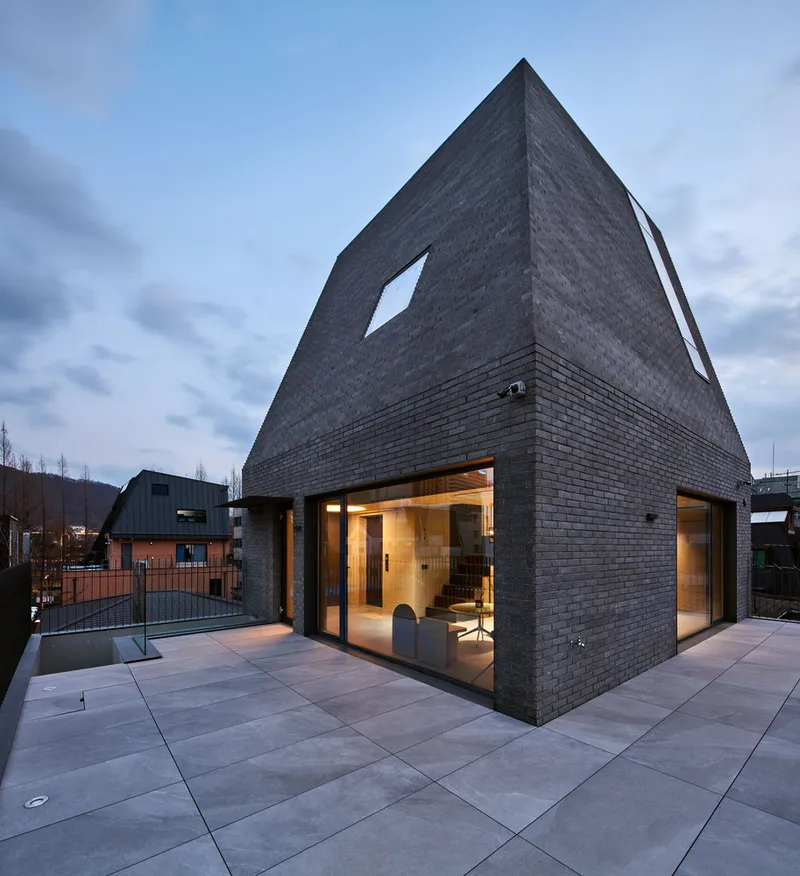

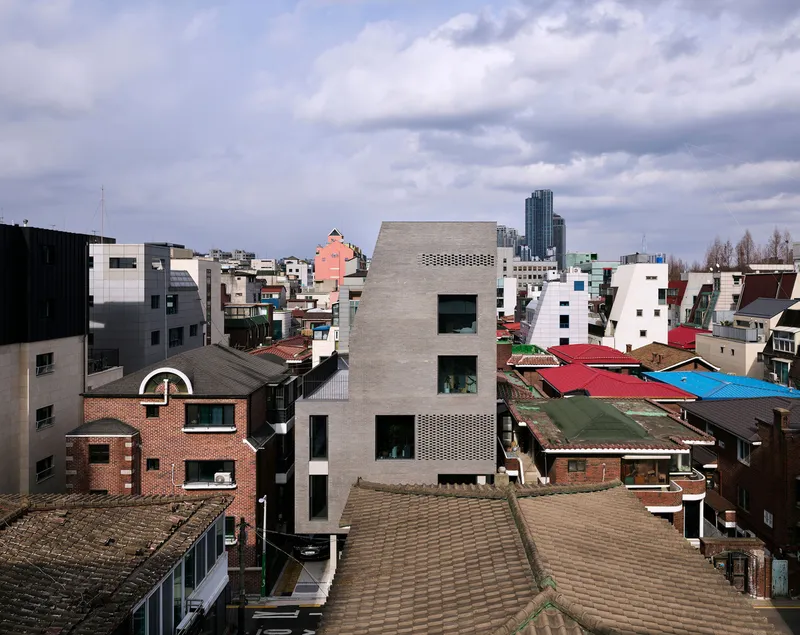
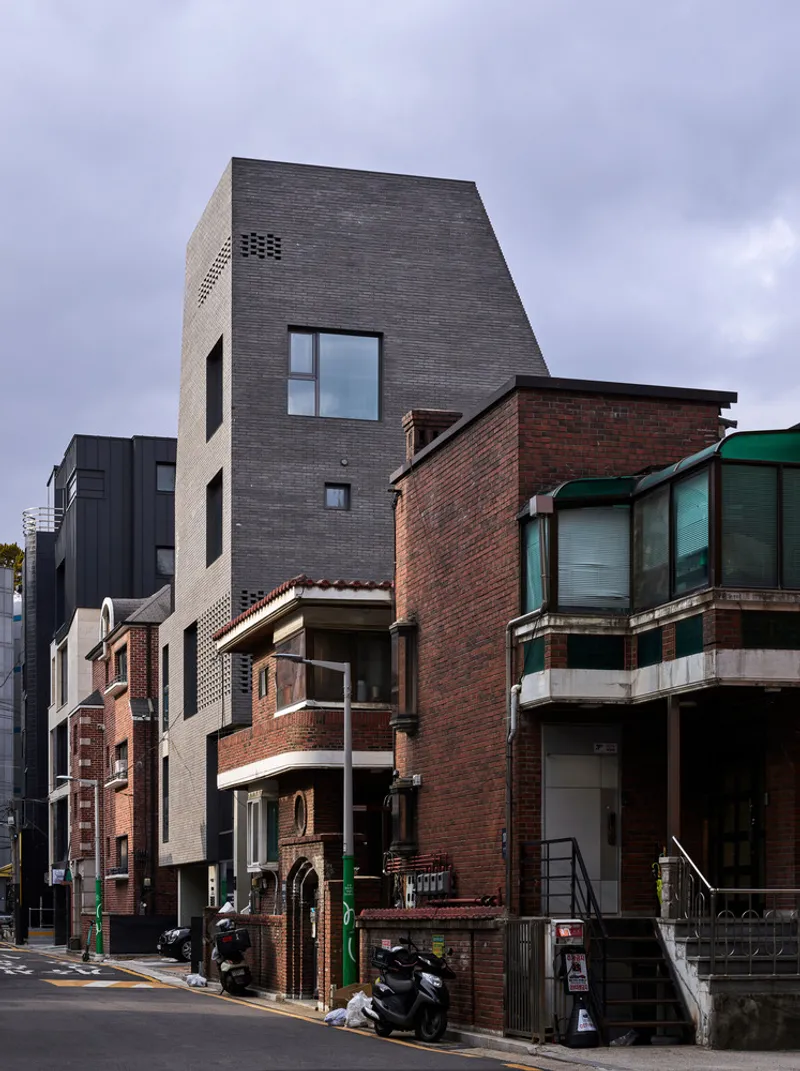
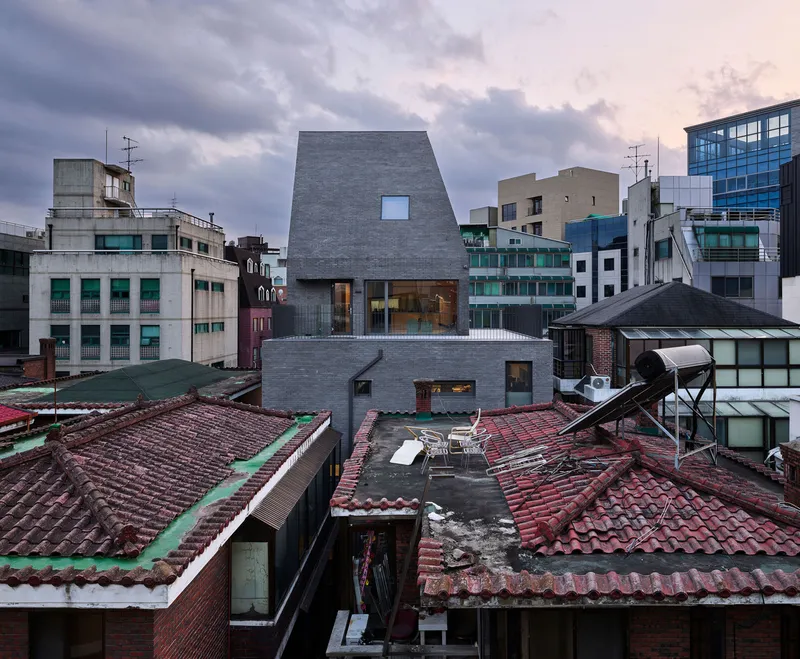
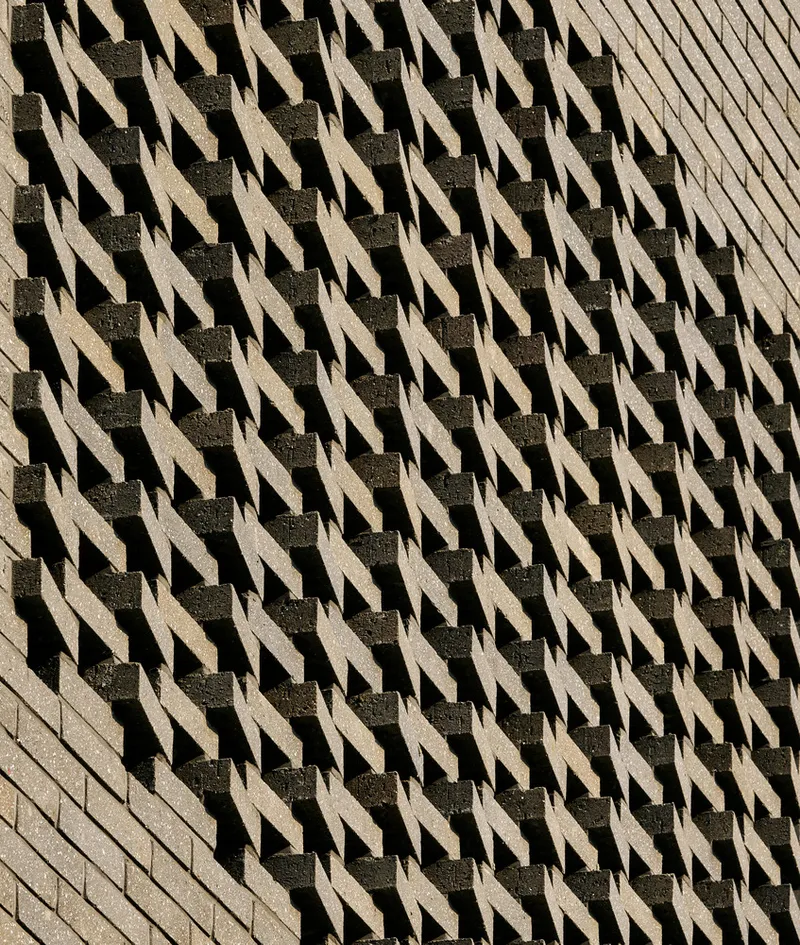
The building reads as two materials stacked: a pale concrete base containing the commercial floors, and a dark brick upper volume containing the residence. The dark brick is laid with alternating protruding headers, creating a subtle textured relief that catches light and shadow across the facade. The pitched top, clad in the same dark brick, gives the building a silhouette that is distinct from the flat-roofed apartment blocks around it.
From the rooftops, the building is immediately identifiable: a dark angular form among red terracotta and concrete. This is neighbourhood architecture that takes a position without shouting.
The Skylight Void: Light from the Top
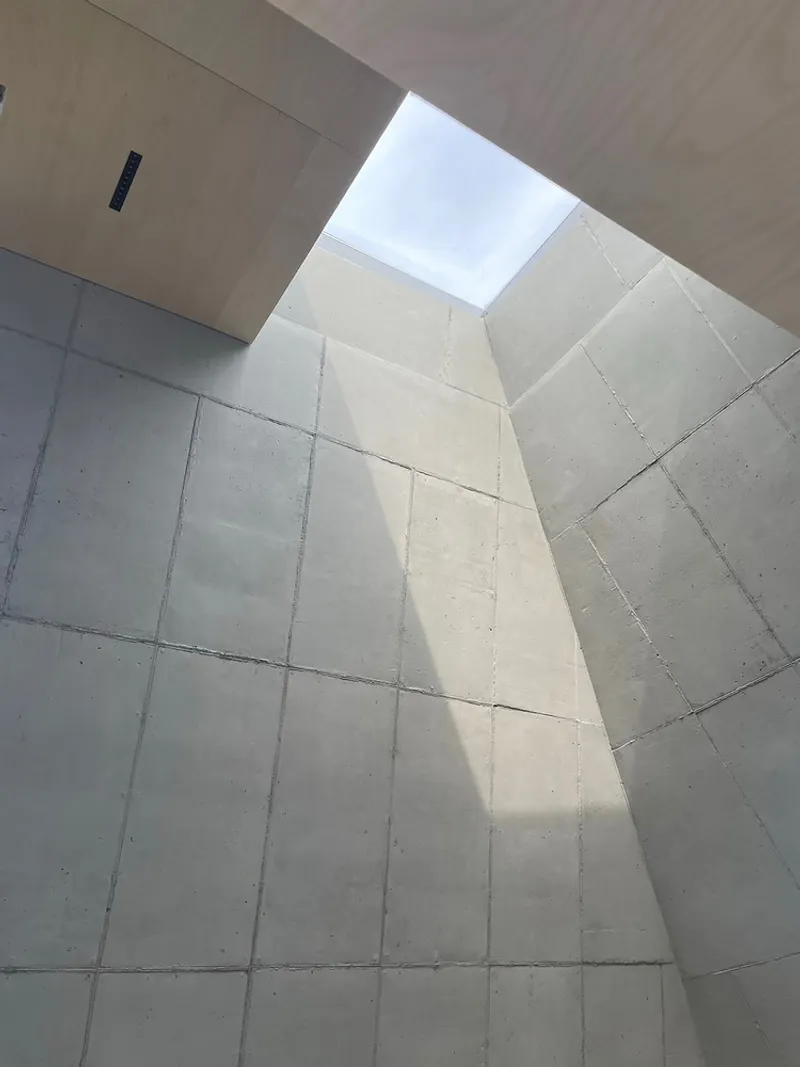
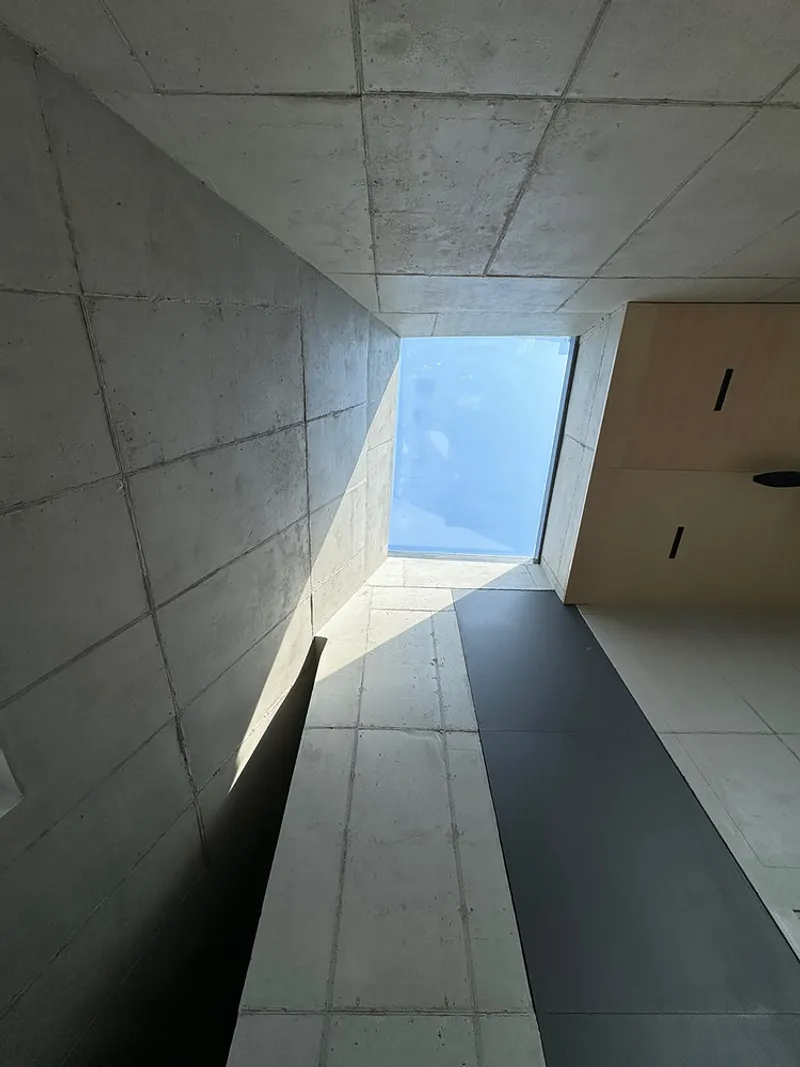
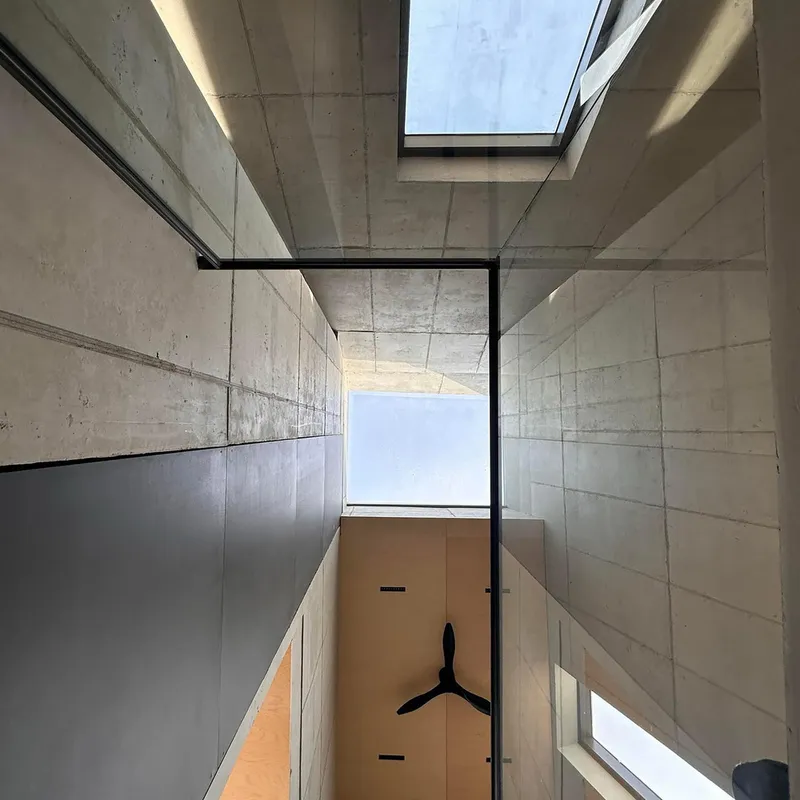
The defining spatial element is a vertical void that cuts through the centre of the building, rising from the upper floors to an angular skylight at the roof. The concrete walls of the void are left raw. Light washes down them, changing through the day. At the top, the skylight aligns with the pitched roof geometry, creating an angular funnel of concrete that frames the sky.
This void does three things. It brings natural light deep into the section. It creates a visual connection between the residential floors. And it gives the building an interior scale that contradicts its small footprint. You look up and see sky. In a five-storey building on a 50 square metre lot, that is the difference between living in a box and living in a space.
The Top Floor Study
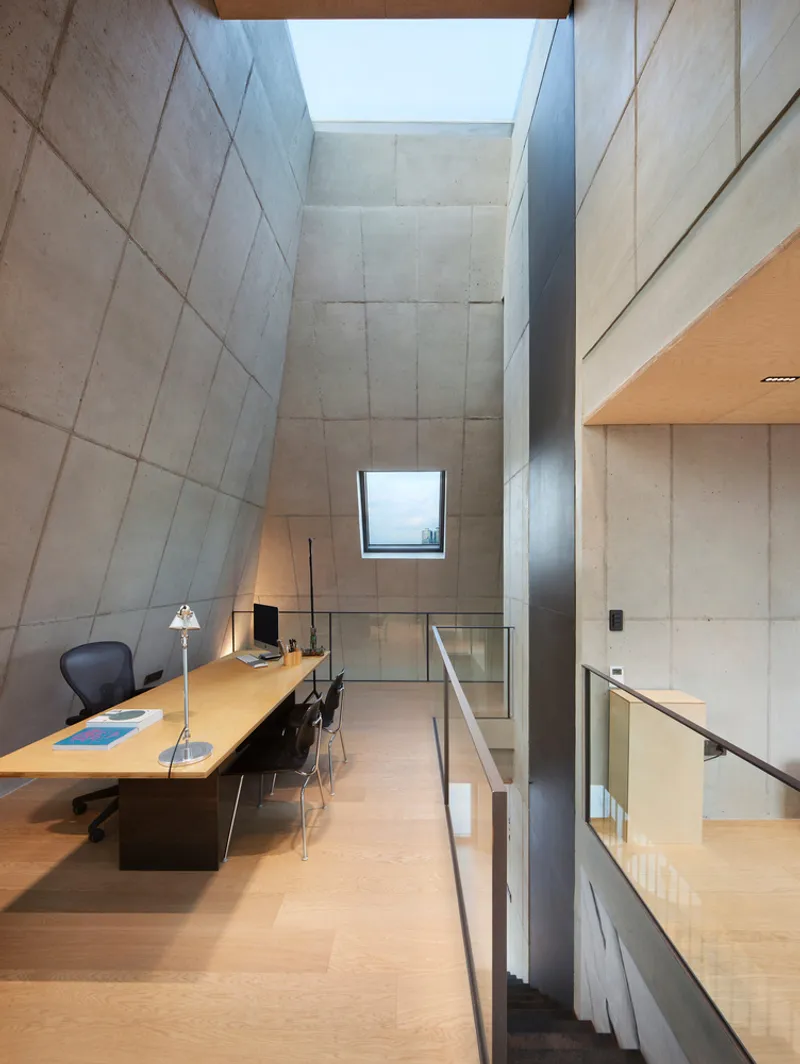
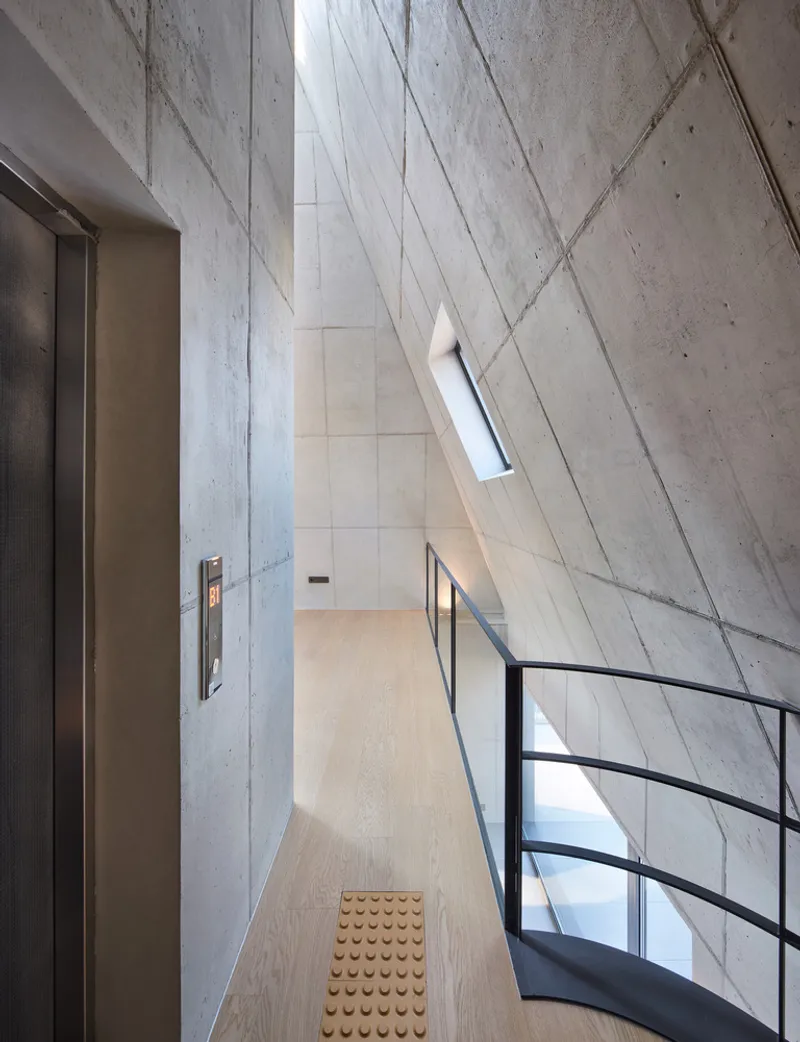
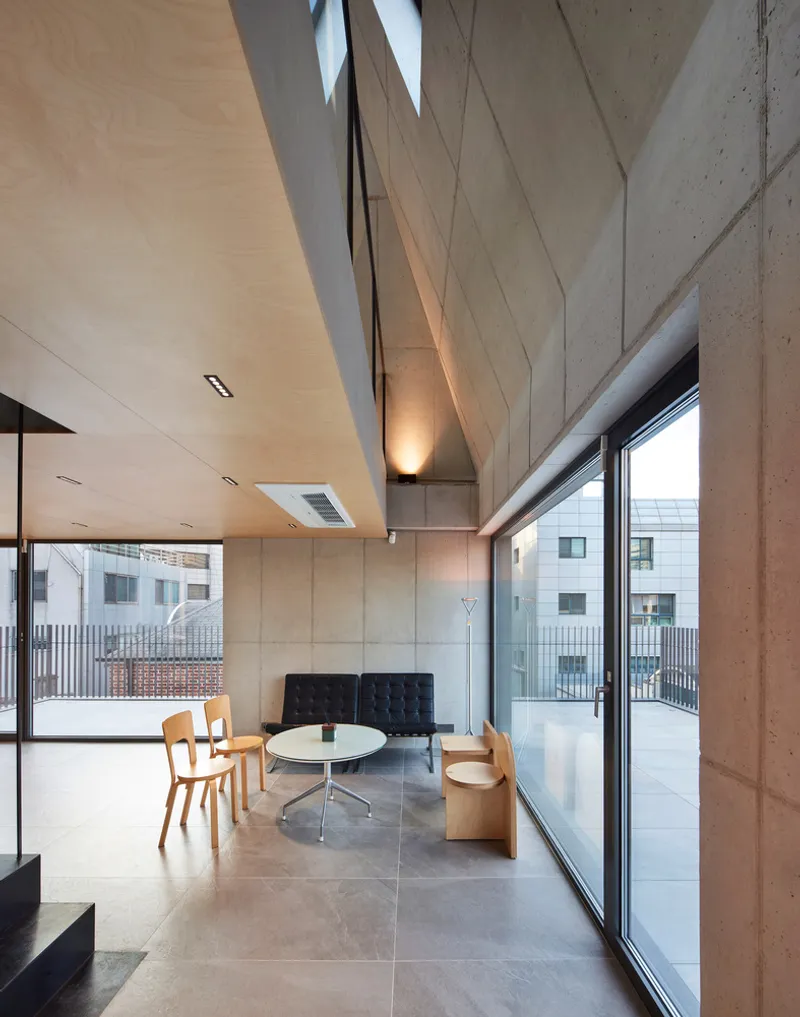
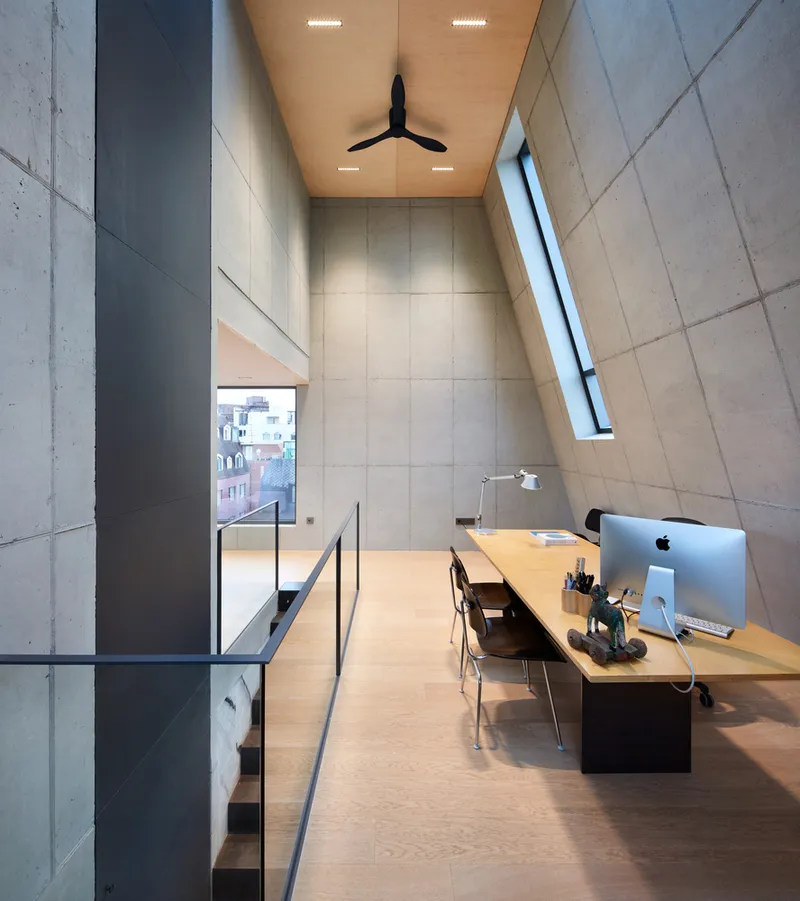
The top floor sits under the pitched roof within the dark brick volume. It is a private study: a long timber desk runs along one wall, with exposed concrete on three sides and a birch-panelled ceiling above. The angular skylight cuts into the roof directly overhead. This is the quietest room in the building, and the one with the most light.
The combination of raw concrete, warm birch, and direct sky produces a space that feels monastic. It is designed for concentration. If you are an architect who works from home, this is the room you would design for yourself.
The Residential Floors
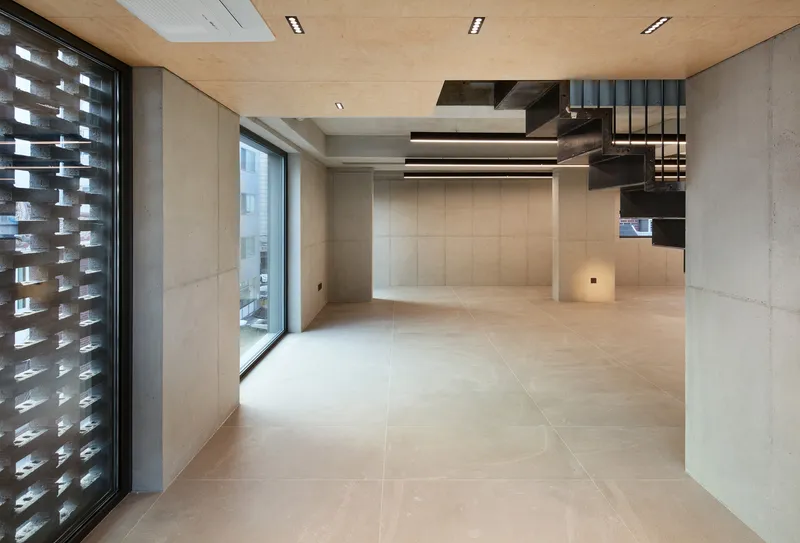
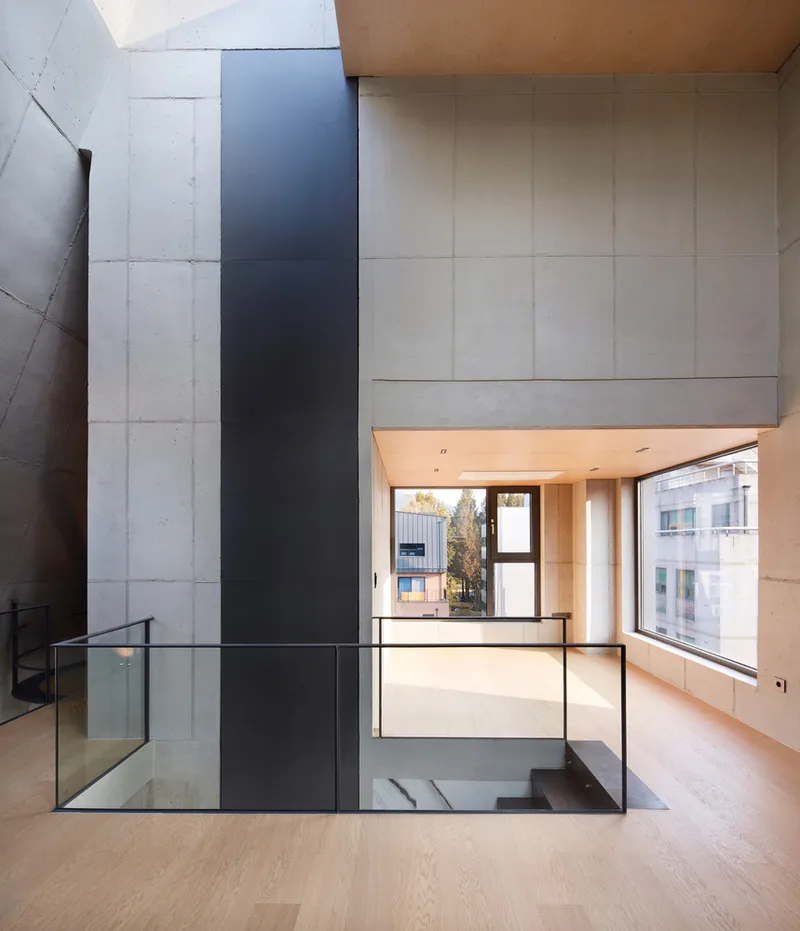
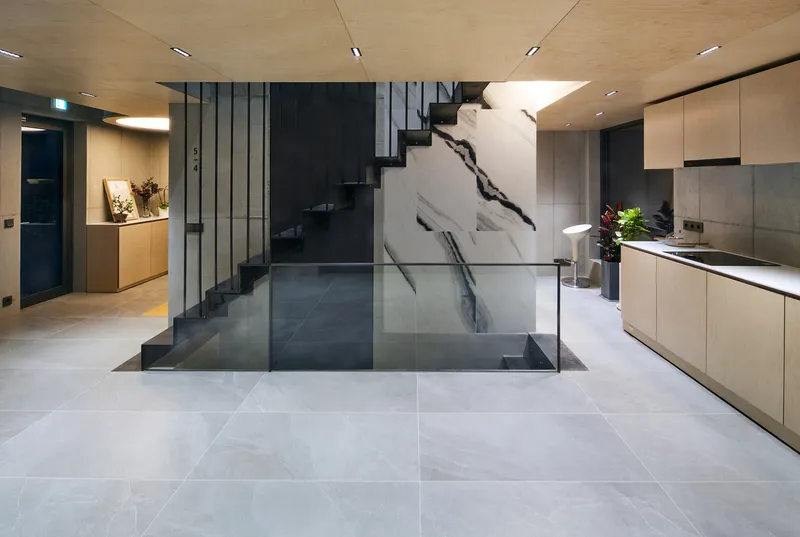
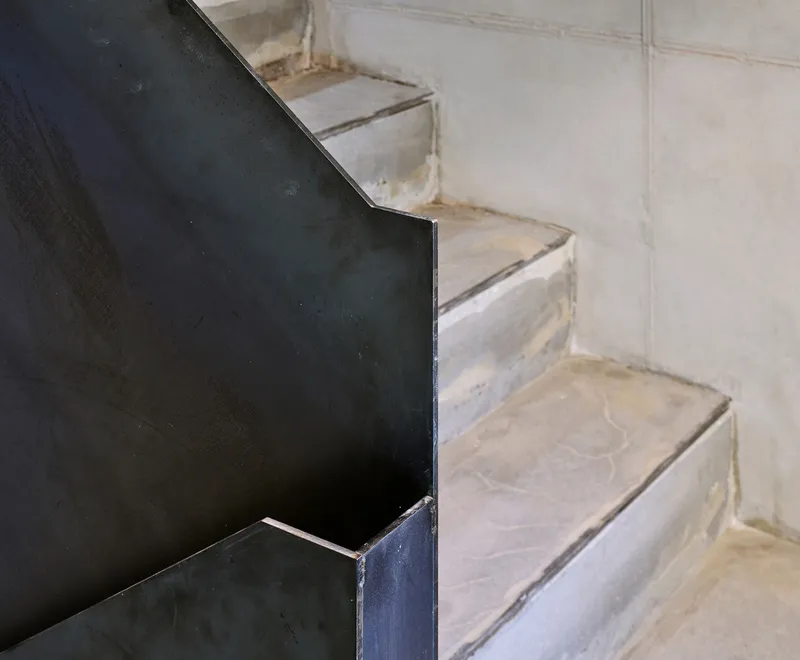
The living spaces are double-height in parts, with concrete walls and full-height windows that frame the neighbourhood. The kitchen features a black steel stair with a marble-veined stone wall behind it. The material palette is narrow and consistent: exposed concrete, birch panels, black steel, and dark stone. No plasterboard, no paint. Every surface is either structure or a deliberate finish.
The Commercial Floors
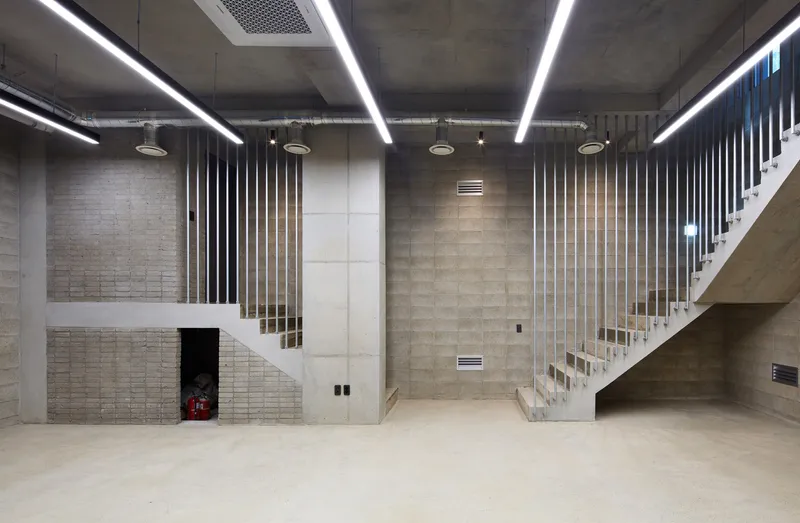
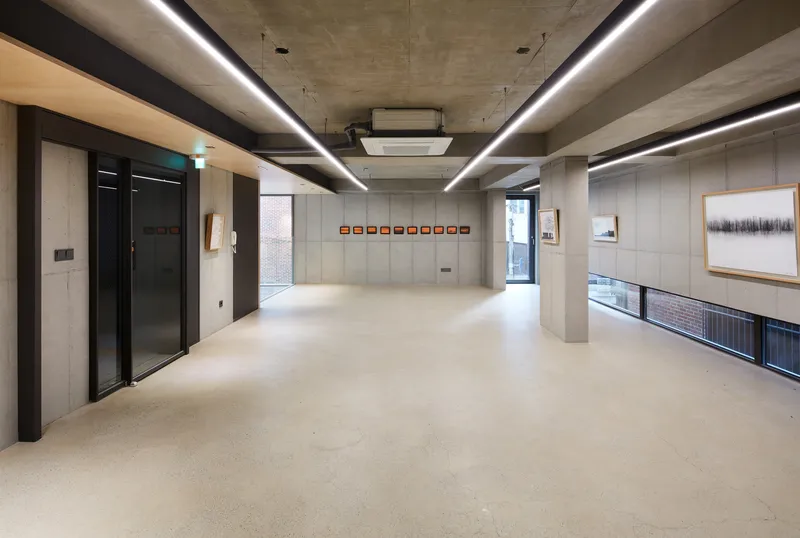
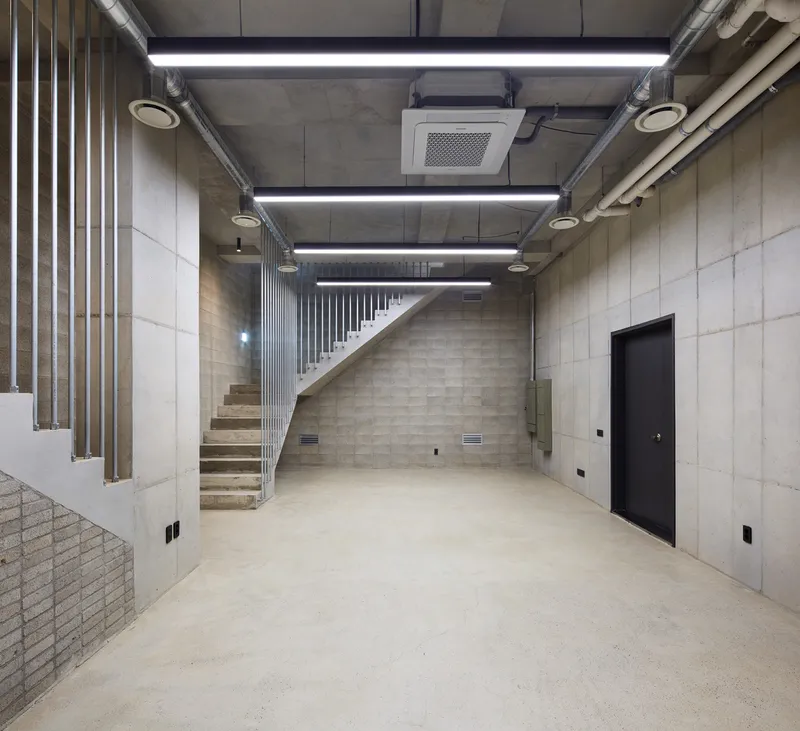
The lower floors are open-plan commercial spaces with exposed concrete ceilings, polished floors, and birch-panelled zones. One floor functions as a gallery with art hung on the concrete walls. The louvred window wall on the commercial floor provides privacy while admitting light. The basement has its own character: concrete block walls, metal railings, and a stair that reads as infrastructure.
Plans, Elevations, and Sections
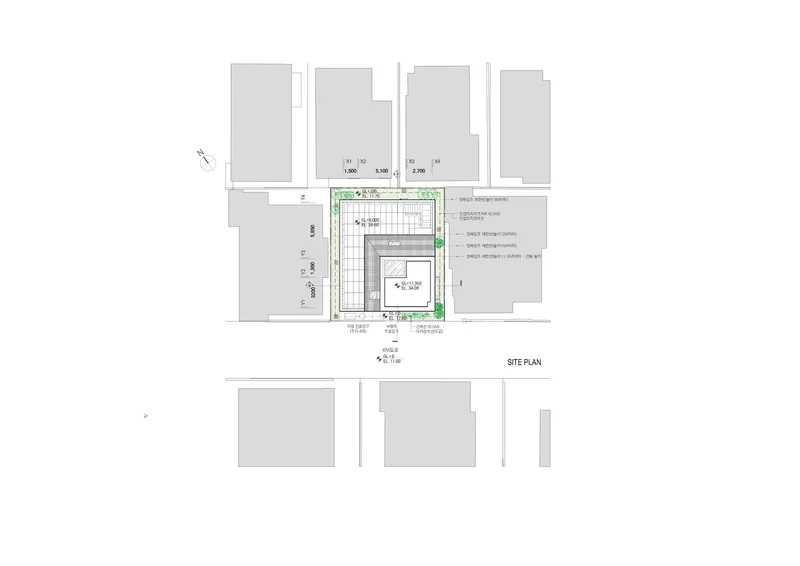

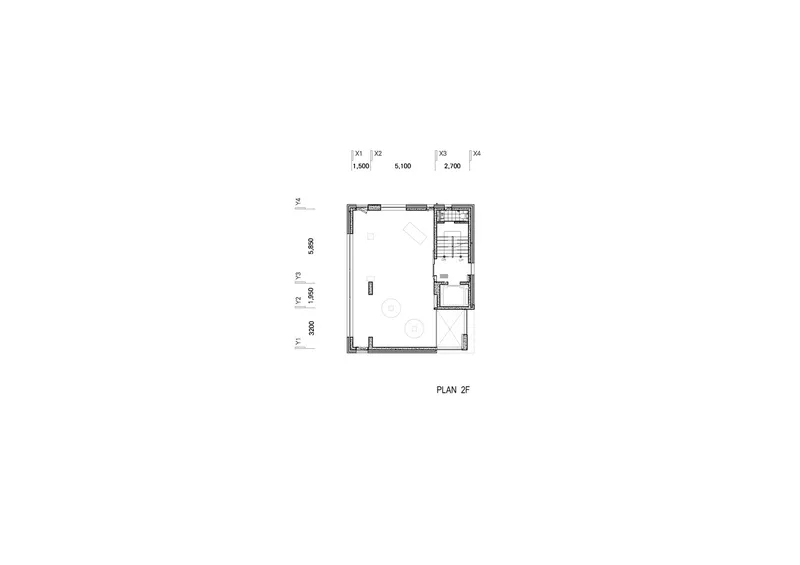
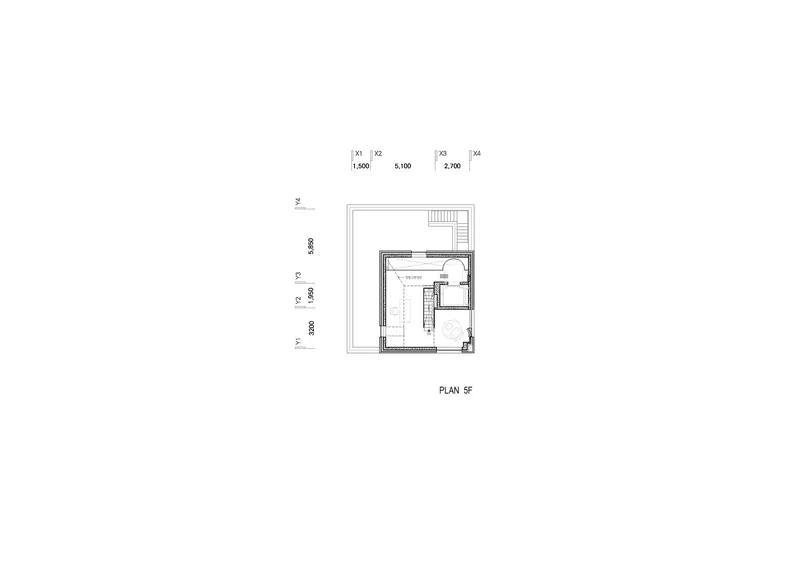
The plans show the compact footprint and how the stair core, skylight void, and open floors are organised within it. The fourth floor plan shows the rooftop terrace with planting. The fifth floor shows the attic study under the pitched roof. The sections reveal the full vertical sequence: basement, commercial, gallery, residence, terrace, study, skylight.

Why This Project Matters
Neighbourhood living facilities are the most common building type in Seoul. There are tens of thousands of them, and almost none are designed by architects. They are developer products, built to formula, maximising floor area and minimising cost. Ujoohyun proves that the same zoning, the same programme, and the same budget constraints can produce architecture. The skylight void costs a few square metres of floor area. It gives back a spatial quality that no amount of floor area can replace.
If you are designing small multi-storey mixed-use buildings in dense urban neighbourhoods, this project is worth studying for how a single vertical void transforms a routine brief into something memorable.
About the Studio
Share Your Own Work on uni.xyz
If you are working on small urban buildings, mixed-use architecture, or neighbourhood-scale design, uni.xyz is a place to publish your work and connect with a global design community.
Project credits: Ujoohyun Neighborhood Living Facility by Chun Architects. Seoul, South Korea. Photographs: Kim Yongkwan, Yseo Chun.


Popular Articles
Popular articles from the community


Jaramillo Van Sluys Arquitectura and Urbanismo Turn a Demolished Registry Lot in Quito into an Orchard Plaza
In Quito's Centro Histórico, a 2,800 m² plaza exposes the San Agustín convent wall and redraws its lost Augustinian orchard in volcanic stone.

GROUP A Strips a 1969 Rotterdam Harbor Headquarters to Its Frame and Wraps It in Timber Louvers
In Rotterdam's M4H harbor district, Ferro Offices reuses a 1969 frame, adds one timber storey and reaches BREEAM-NL Outstanding.

David Ortega Stacks a Two-Story Mexico City Penthouse Around a Steel Stair and a Pergola-Shaded Roof Terrace
In Colonia Roma, a 300 m² penthouse uses oak joinery, a planted steel stair and a slatted roof pergola to make a new-build apartment feel like a house.

U.GA Architects Wraps an Oval Rooftop Pool in Curved Board-Formed Concrete on Busan's Jeollidan-gil
In Busan's Jeonpo-dong, a 454 m² mixed-use block stacks a neighborhood facility, guest rooms and an oval rooftop pool inside spiraling concrete walls.

Similar Reads
You might also enjoy these articles


Hodi-Mandai Geram
Project Function: Preservation and revitalization of the Intangible heritage and socio-spatial identity of the Hodi by Housing, Cultural Memory Center, Sacred Grove, landscape, local tourism economy


Olio Towers: A Mid-Rise for Performers That Fuses Housing, Rehearsal, and Stage
Located blocks from Houston's Theater District, this modular tower stacks living units around a central performance atrium.

Oasis: Modular Green Housing Carved into Dhaka's Urban Fabric
A shortlisted Plugin Housing entry reclaims unauthorized settlements in Dhaka with stepped concrete volumes, green roofs, and ventilation-driven design.

Black Hole: A Floating Megastructure for the Post-Physical Era
Emiliano Mazzarotto envisions a spherical, self-scaling arena where e-sports, digital hotels, and holographic stadiums replace traditional public space.

Explore Architecture Competitions
Discover active competitions in this discipline

Challenge to reimagine the Iron Throne

Photograph architecture without architects

Illustrate the lost glory of Angkor Wat - Render Challenge

Design challenge to reuse E-waste
Comments (0)
Please login or sign up to add comments
No comments yet. Be the first to comment!