

Informal Design Turns a Huizhou Sales Center into a Five-Zone Community Hub
NOWSEE Store in Guangdong Province fuses retail, dining, art, and reading into a modular streetside destination for 700 square meters.


Property sales centers are typically disposable architecture. They serve their purpose during the marketing phase of a residential development, then sit vacant or get demolished. Informal Design saw a different trajectory for a building beside CR Land's Park View Mansion community in Huizhou, Guangdong Province. Rather than letting the structure idle, the Shenzhen-based studio converted it into NOWSEE Store, a 700-square-meter hybrid of retail, café, art exhibition, reading lounge, and business meeting space. The project was designed in under three months and completed by July 2023.
What makes the project worth paying attention to is not the program list but the method. Informal Design retained nearly everything they could from the original building: flat eaves, pebblewash facades, interior cement walls. Then they inserted five interconnected facade volumes that push outward toward the street, creating a sequence of show windows that pulls daylight deep into the plan and blurs the line between sidewalk and interior. The result is a streetside space that feels genuinely open to the neighborhood rather than gated behind the usual developer branding.
Five Volumes, One Open Route
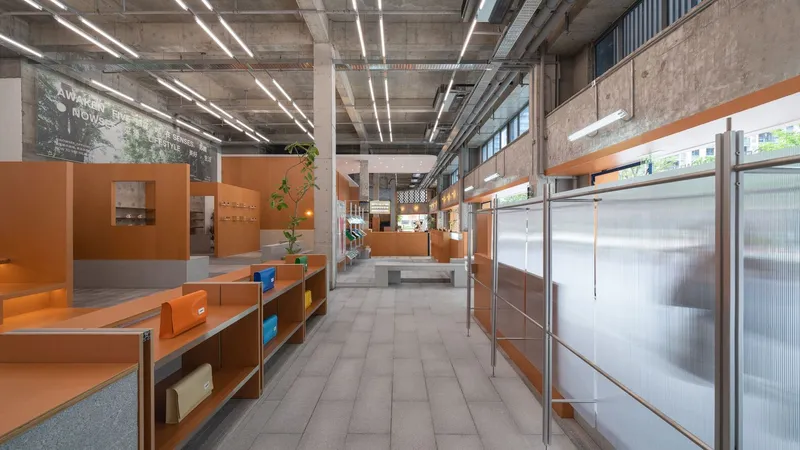
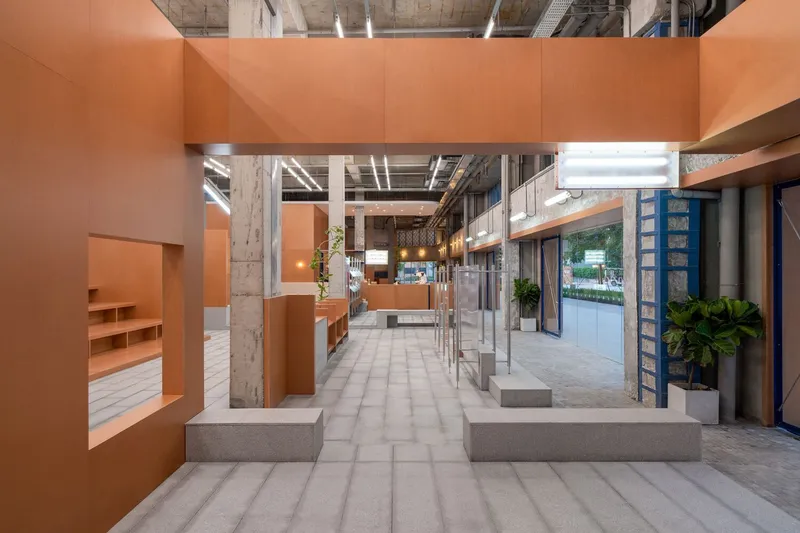
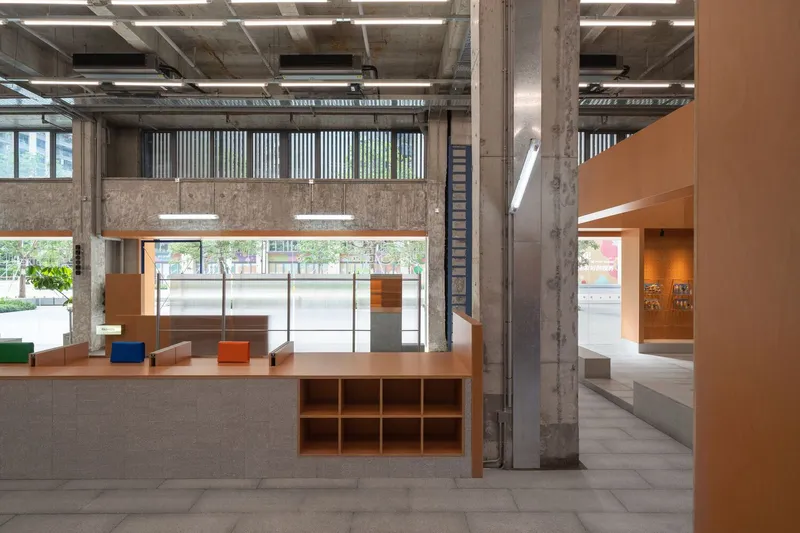
The five facade blocks are the structural conceit that holds the whole project together. Each one is clad in orange-painted steel and marine-grade plywood, and they protrude outward from the building's existing envelope to create individual show windows along the pedestrian street. Inside, these volumes subdivide the 700-square-meter plan into five zones without ever closing off sight lines. A street-style open circulation route threads through all of them, so visitors drift from one function to the next without encountering a dead end.
Floor-to-ceiling push-pull glazing replaces the original thick doors and windows, a move that does more than admit light. It turns the entire ground plane into a porous membrane. Gray granite and beige marble flooring runs continuously from inside to out, and the landscaping strategy, with gray pavements, warm road lamps, and window seats, extends inward from the pedestrian street. The architecture does not announce itself as a threshold; it simply continues the city.
The Bar as Anchor Point
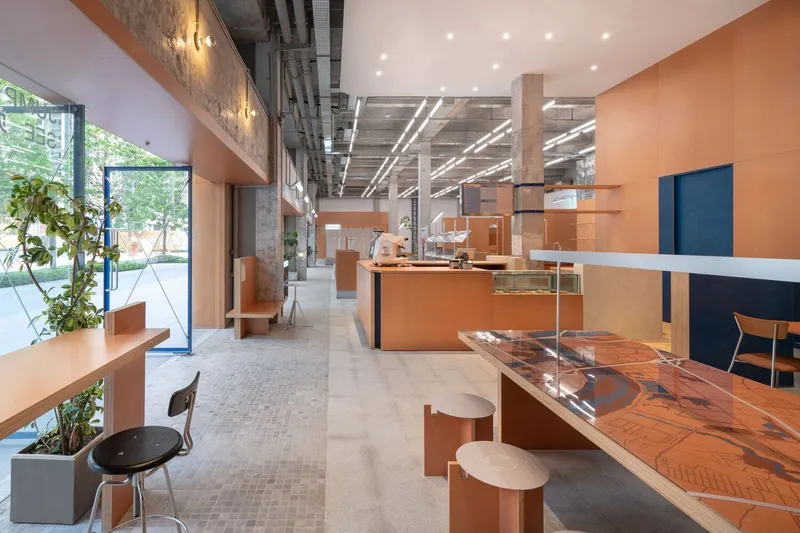
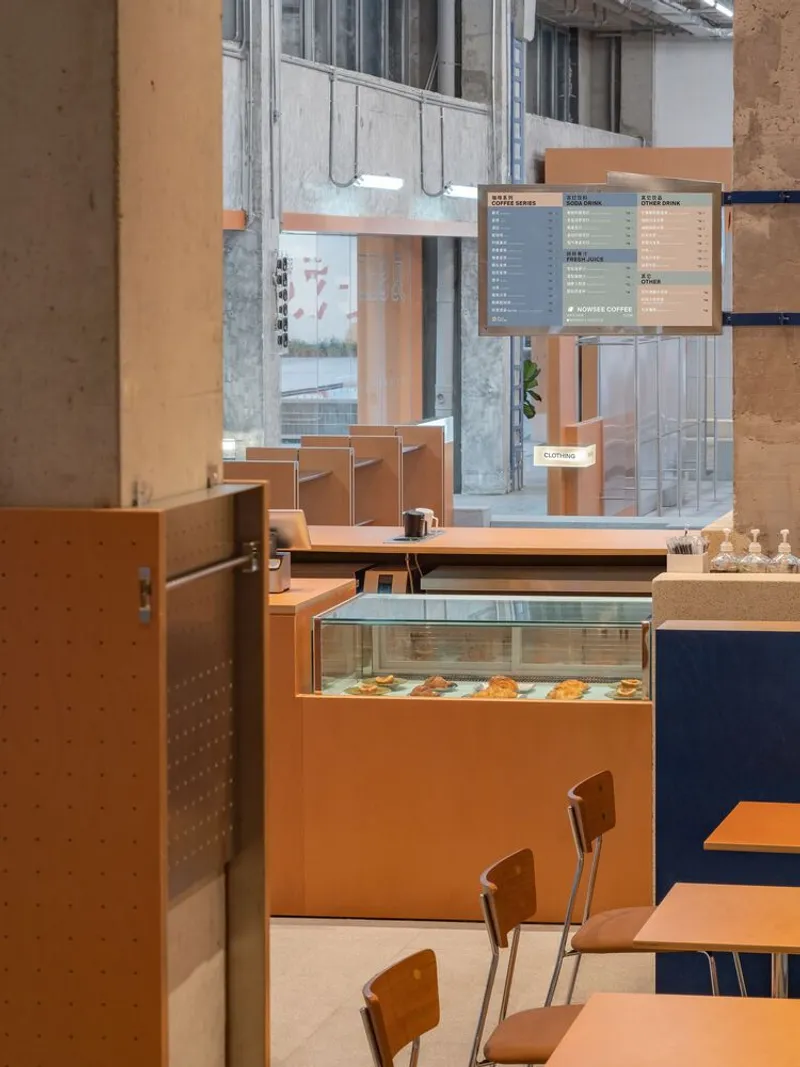
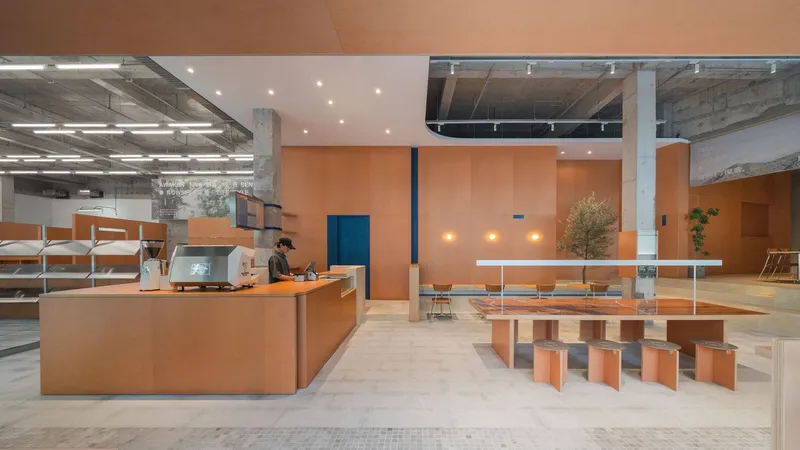
At the center of the plan sits a bar counter that operates as both café and orientation device. It is the spatial fulcrum around which the five zones rotate. The counter itself is finished in the project's signature orange with transparent acrylic shelving that exposes its stainless-steel substructure, screws and all. A glass pastry display case and hanging menu board keep the function legible, while the raw industrial detailing keeps it consistent with the rest of the interior.
This is a shrewd organizational move. In a space that juggles retail, dining, reading, exhibition, and negotiation, the bar gives visitors a single recognizable landmark. Whether you are picking up a coffee or waiting for a meeting, you orient yourself relative to the counter. It replaces the lobby desk or reception area that a conventional sales center would require.
Retail and Display as Transparent Infrastructure
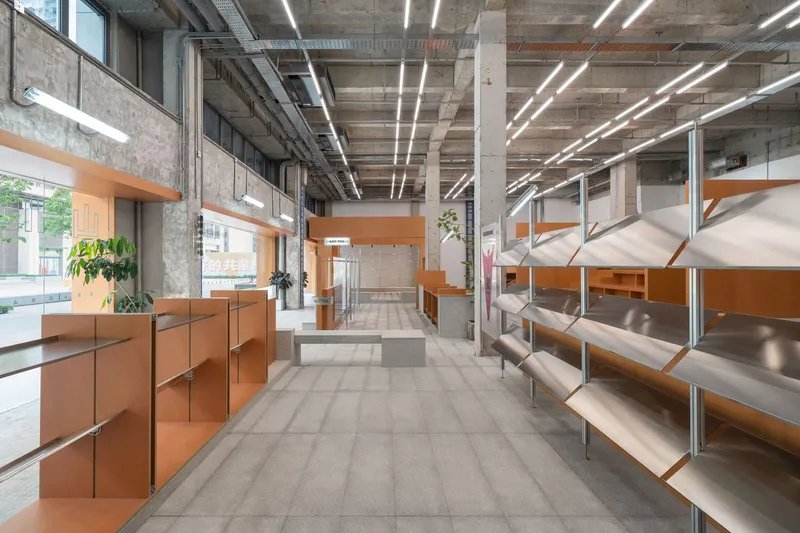
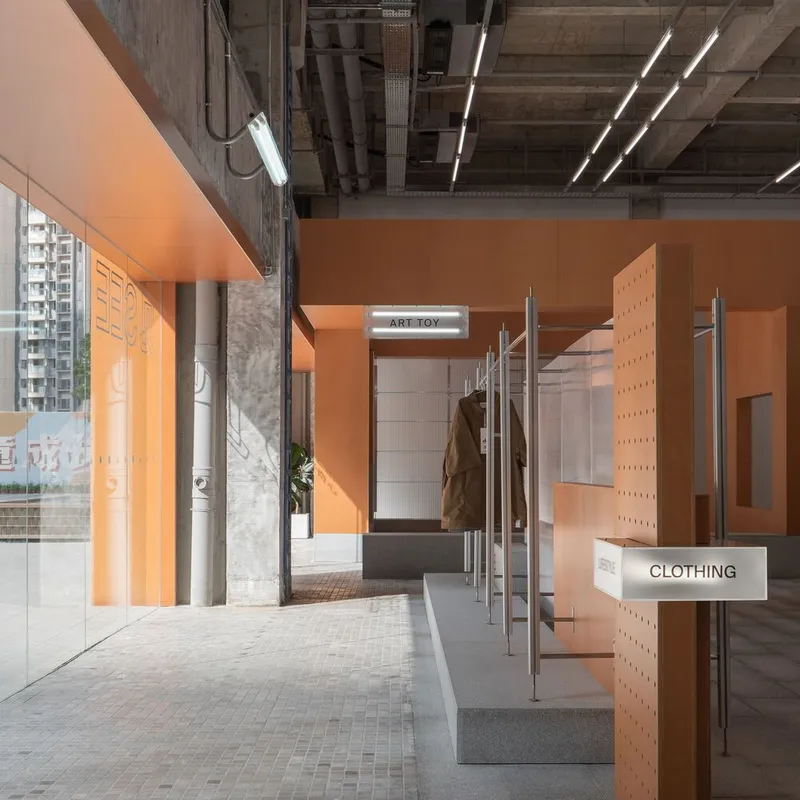
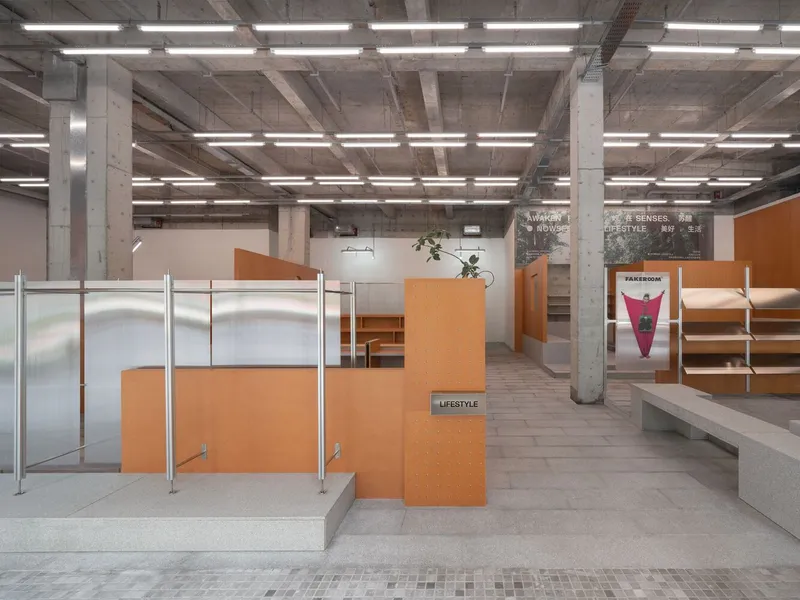
Informal Design treated the retail fixtures as architecture in miniature. Aluminum square-tube shelving, transparent and matte acrylic panels, and stainless-steel sandblasted plates are assembled into modular display units whose internal structure is deliberately visible. The design logic is borrowed from prefabrication: components can be swapped, angles adjusted, and entire configurations replaced without renovating the space itself. Seasonal retail shifts or new brand partnerships require only a fixture change, not a construction crew.
The exposed concrete ceiling above, left intact from the original building, reinforces the honest-materials ethos. Linear lighting tracks and mechanical ducts run openly overhead, and the orange partition walls read as inserted objects rather than permanent divisions. The effect is of a carefully curated warehouse where everything, from the clothing racks to the translucent partitions, is designed to be moved.
Stepped Reading and Casual Dining
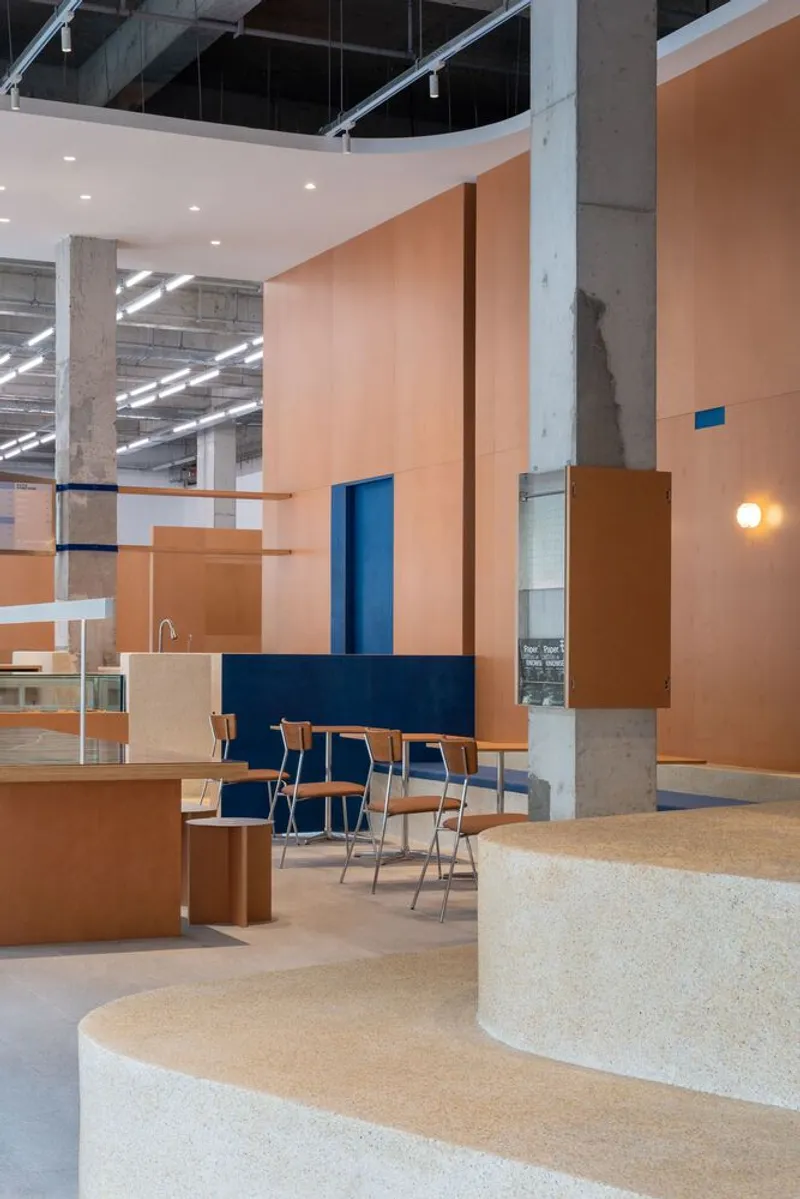
The stepped reading area occupies a terrazzo platform that rises in gentle tiers beside the concrete columns. Blue upholstered chairs and timber tables sit on these curved steps, creating an informal amphitheater that works equally well for reading, conversation, or small community events. The material shift from the granite and marble of the circulation zones to the warmer terrazzo signals a change of pace without a wall.
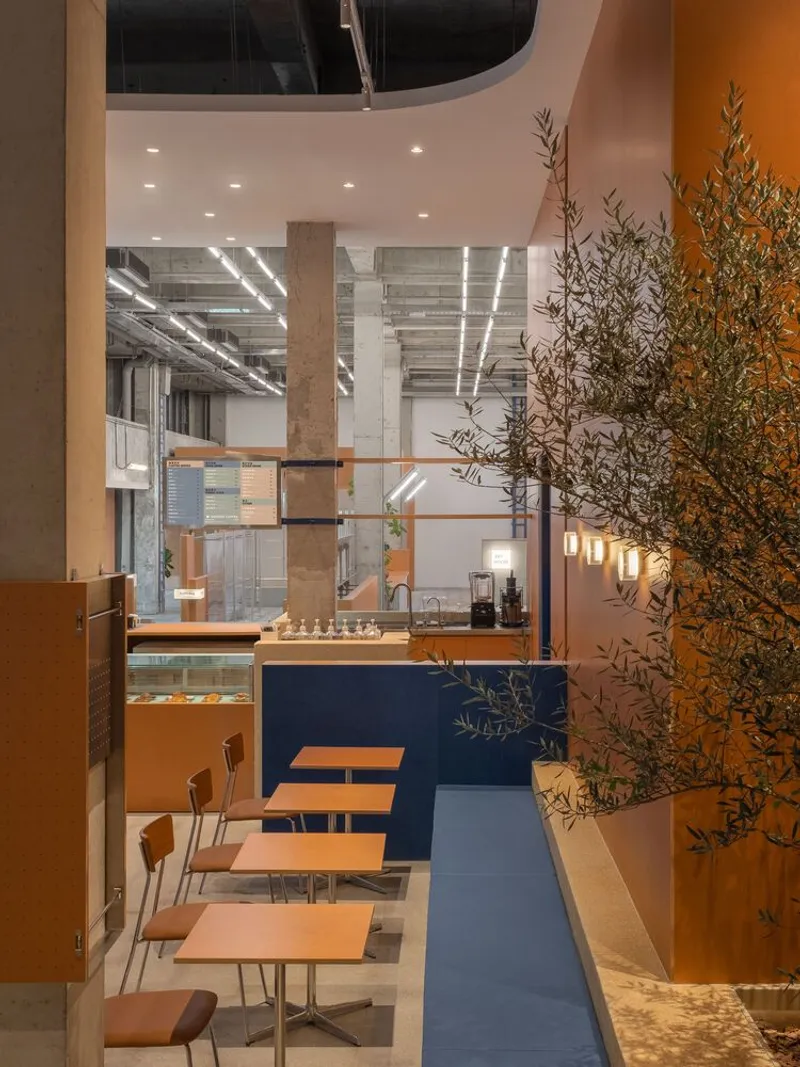
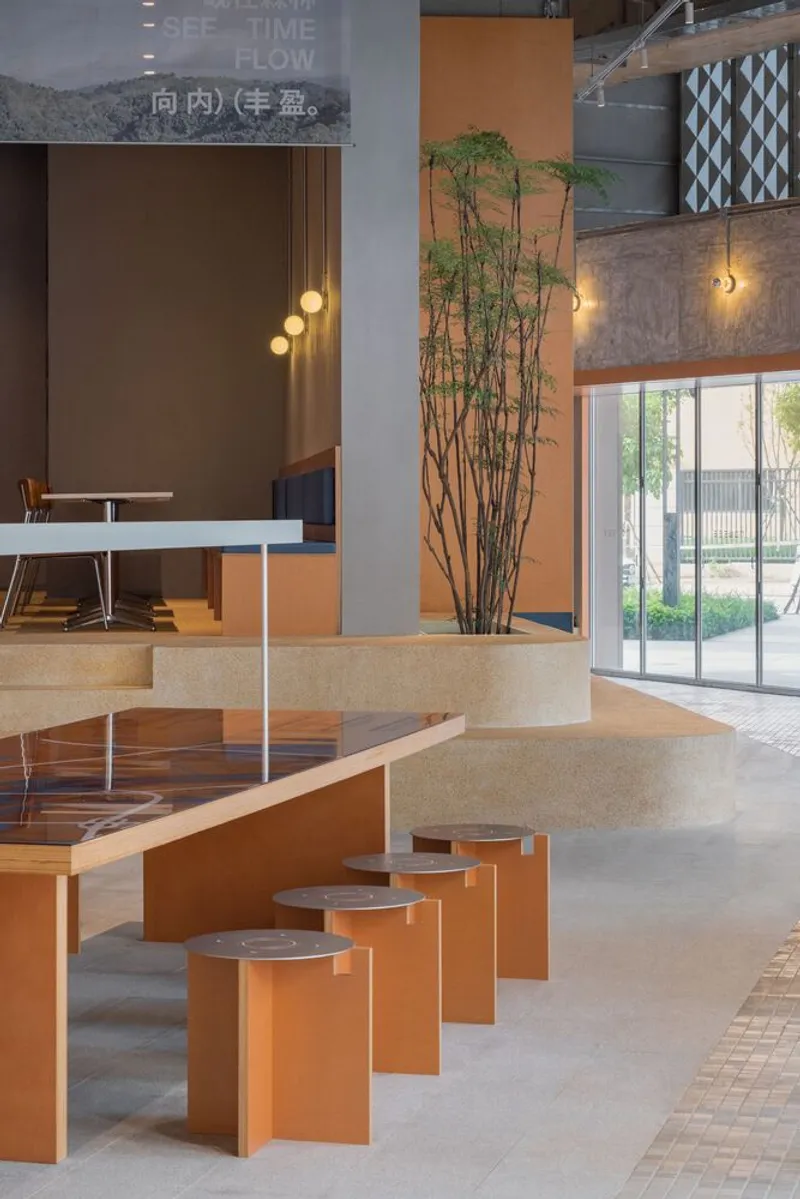
Nearby, the casual dining section pairs navy blue banquettes with orange tables and an olive tree, while a communal table with round stools sits beside a tall bamboo planter and pendant lights. The planting is not decorative filler. Interior trees and bamboo are positioned at structural columns and circulation nodes, softening the industrial palette and reinforcing the biophilic connection to the landscaped street outside.
Materiality and Adaptive Reuse
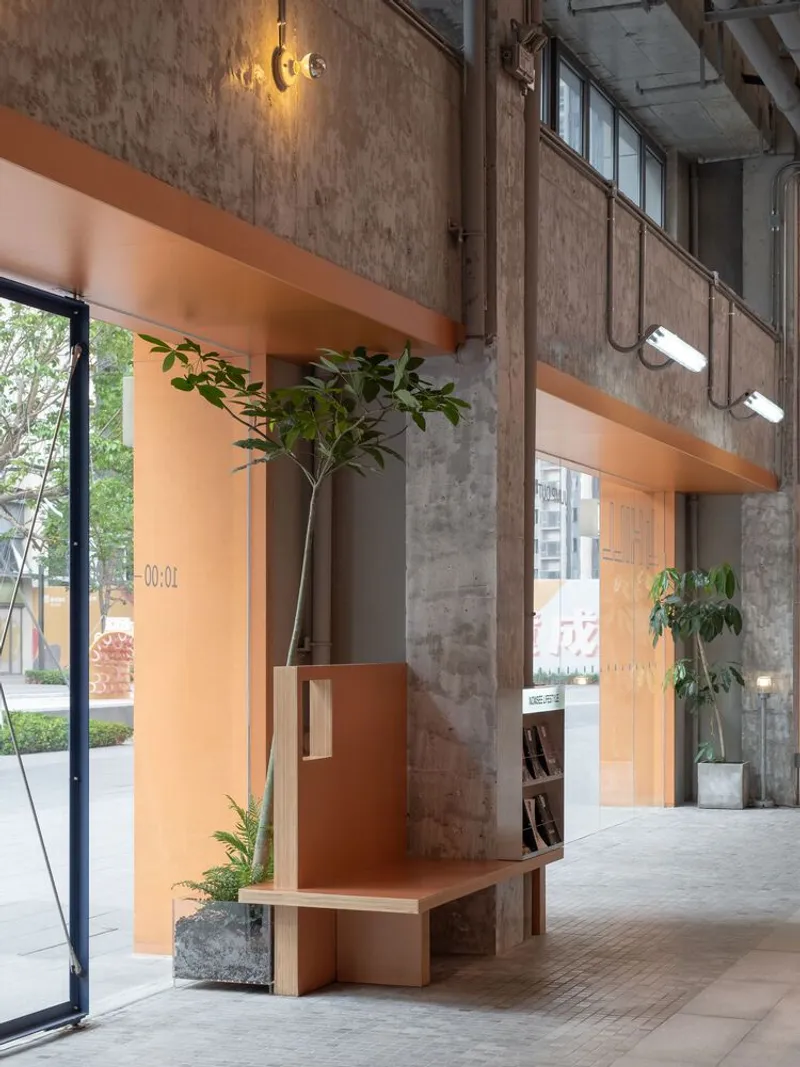
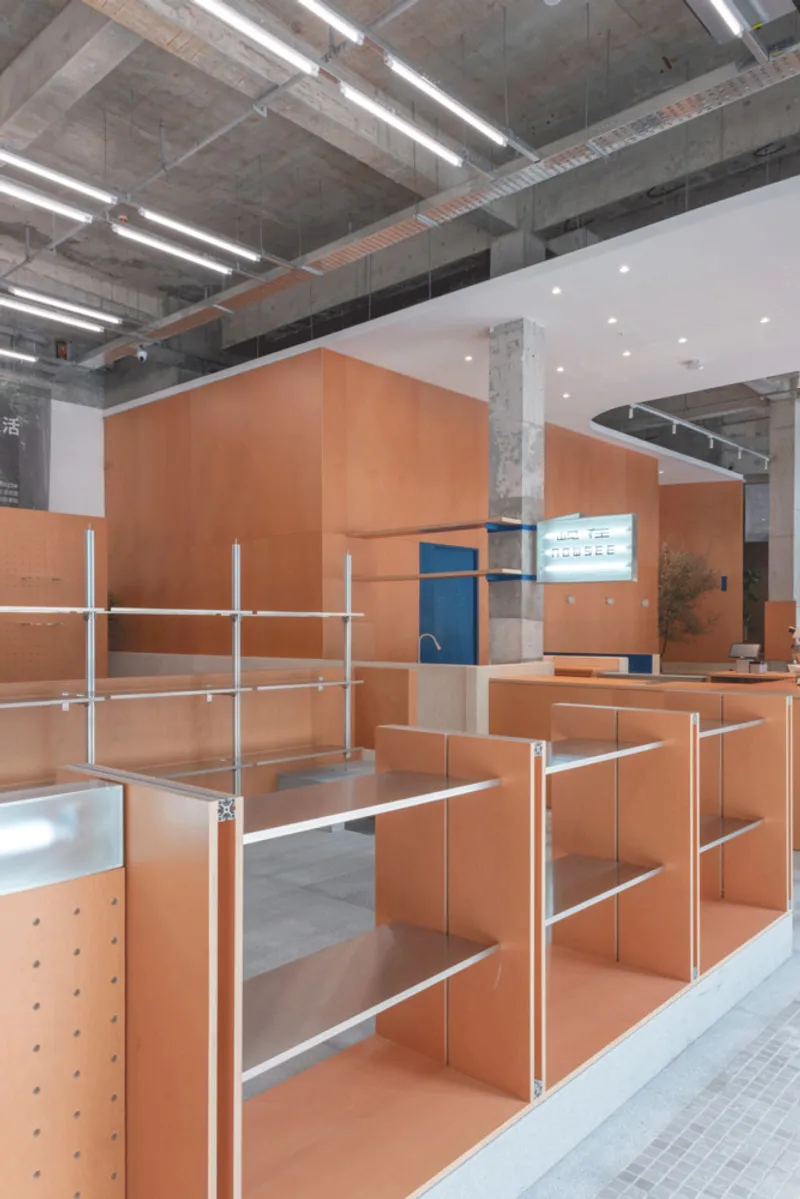
The sustainability argument here is practical, not performative. By retaining the original flat eaves, pebblewash, and cement walls, Informal Design minimized demolition waste and preserved the option for future reuse should the building's program change again. The new materials layered on top, marine-grade plywood in both original and dyed finishes, birch boards, sandblasted stainless steel, are all chosen for durability and disassembly. The modular plywood shelving units with white metal rails, for instance, bolt together rather than being glued or welded.
Orange benches wrap around concrete columns near the glazed entrance, planters integrated into their structure. The detail is minor but telling: rather than hiding the existing column, the furniture embraces it. Throughout the project, the new elements treat the old building as a host rather than an obstacle. The concrete columns become spatial anchors, the exposed ceiling becomes a unifying datum, and the pebblewash facade becomes a textural counterpoint to the smooth glazing and painted steel.
Why This Project Matters
Second-tier Chinese cities like Huizhou are full of sales centers that outlive their marketing cycle and become dead weight on new residential developments. NOWSEE Store offers a replicable model: keep the bones, insert modular volumes, and program the space for mixed community use rather than single-purpose retail. Informal Design managed the entire chain, from site selection and branding to architectural renovation, VI design, and supply-chain management, which means the strategy is designed to scale. CR Land now has a template it can deploy across developments.
More broadly, the project demonstrates that a strong spatial idea does not require a large budget or a long timeline. Three months of design, two months of construction, and a commitment to keeping what already exists produced a space that is more compelling than most purpose-built retail interiors. The lesson for developers and architects alike is simple: the most sustainable square meter is the one you do not demolish.
NOWSEE Store by Informal Design, Huizhou, Guangdong Province, China. 700 square meters. Completed 2023. Photography by Chao Zhang and Tong Xia.
About the Studio
Share Your Own Work on uni.xyz
If projects like this are the kind of work you want to make, uni.xyz is a place to publish your own, find collaborators, and enter design competitions.




Popular Articles
Popular articles from the community


Riyadh For All: Intergenerational Urban Design for Active Aging in Rabat
Riyadh For All reimagines urban design in Rabat with intergenerational co-living, adaptive courtyards, and Moroccan cultural exchange today.

Lunar Spiral: Space Architecture Shaped by the Mathematics of the Universe
Lunar Spiral reimagines space architecture through Fibonacci geometry, lunar regolith, levitating habitats, and self-sustaining Moon living.

Conexión: Biophilic Design Reimagines High-Rise Living in Hong Kong
Conexión reimagines high-rise living in Hong Kong through biophilic design, green facades, shared spaces, daylight, water and nature within.

The Earth Pod: 3D Printed Homes for Resilient Refugee Communities
The Earth Pod reimagines refugee housing through 3D printed homes made from clay, combining resilience, self-sufficiency, and rapid shelter.


Similar Reads
You might also enjoy these articles


Hodi-Mandai Geram
Project Function: Preservation and revitalization of the Intangible heritage and socio-spatial identity of the Hodi by Housing, Cultural Memory Center, Sacred Grove, landscape, local tourism economy


Olio Towers: A Mid-Rise for Performers That Fuses Housing, Rehearsal, and Stage
Located blocks from Houston's Theater District, this modular tower stacks living units around a central performance atrium.

Oasis: Modular Green Housing Carved into Dhaka's Urban Fabric
A shortlisted Plugin Housing entry reclaims unauthorized settlements in Dhaka with stepped concrete volumes, green roofs, and ventilation-driven design.

Black Hole: A Floating Megastructure for the Post-Physical Era
Emiliano Mazzarotto envisions a spherical, self-scaling arena where e-sports, digital hotels, and holographic stadiums replace traditional public space.

Explore Retail of Tomorrow Competitions
Discover active competitions in this discipline


Challenge to design luxury tourism on rails


Challenge to reimagine the Iron Throne


Photograph architecture without architects


VR headsets Storefront design competition
Comments (0)
Please login or sign up to add comments
No comments yet. Be the first to comment!