
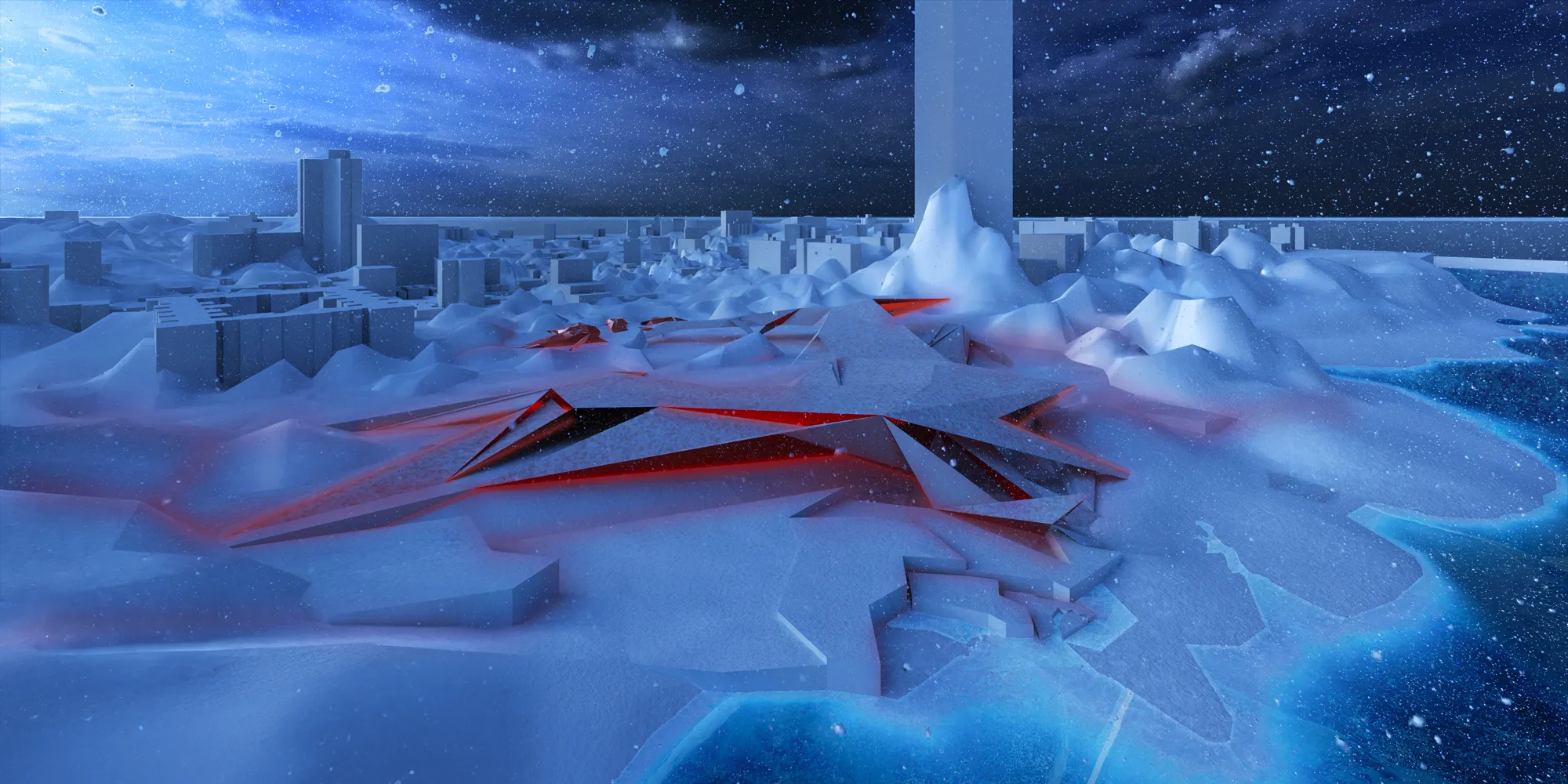
N.U.M.B: Nodal Urban Mechanism for Breathing
A new neighborhood system for a frozen city
Before New York froze, it drowned. Floodwaters breached the coastline, overwhelming defenses and filling the city’s infrastructure like a system absorbing its own collapse. But the real rupture came after. The sudden shift—flood to freeze—left the city suspended in stillness. No systems functioned. Transit shut down. Grids failed. Public space disappeared under layers of ice.
NUMB begins where reactivation becomes possible—not in the city center, but at the edge. The project takes root in Two Bridges, not by chance, but because of what this place represents. Historically a melting pot, Two Bridges was never defined by a singular identity. It was built from the movement of people, languages, and lifeways. Communities lived on top of one another, across from one another, in shared buildings, in alleys, in tight corridors filled with contradiction. Yet through it all, there was continuity. This density of interaction and co-dependence created resilience, long before resilience became a design term. In the aftermath of the freeze, that social memory matters. NUMB imagines this neighborhood as the first to reawaken—not through grand redevelopment, but through localized infrastructure embedded in the ground and in the relationships that survived above it.
NUMB proposes a nodal geothermal system designed not for stability, but for survival and adaptation. The first node ignites a cluster of housing, social spaces, and enclosed gardens raised above the frozen terrain. These are not luxury projects—they are survival mechanisms. They reintroduce publicness, gathering, and exchange in a city that has lost its basic circulatory function.
At the core of each node is a geothermal heat collector chamber, embedded underground, activated through borehole thermal exchange. The system is introduced specifically for this extreme future: generating heat when surface infrastructures fail, and nurturing enclosed microclimates where food can grow, humidity can be regulated, and life can stitch itself back together.
The awakening unfolds incrementally—through phases of survival growth. NUMB expands outward across Manhattan not with towers, but with distributed breathing nodes. Growth Phase I begins at Two Bridges—the ignition point. Growth Phase II stitches into Chinatown, Foley Square, and Wall Street—community, civic infrastructure, and economic systems reborn in survival form. Growth Phase III reaches toward Harlem, Morningside Heights, and Central Park, pulling in cultural, institutional, and ecological anchors. Additional phases expand the system’s tissue across smaller latent nodes, reactivating forgotten edges, alleys, rooftops, and reservoirs. NUMB’s logic is not linear—it branches, overlaps, and densifies, forming a living survival cartography.
Spatially, the project introduces a new urban form. Above the geothermal infrastructure, social spaces—elevated fifteen feet above the ice—create corridors of communal gathering, hydro gardens, and thermal commons. Housing modules cluster around these bridges of warmth, stitched together by circulation that prioritizes proximity and encounter. Walls are layered with experimental insulation—plant-based composites, thermal gels—enveloping life in adjustable layers of thermal protection and permeability. Structure, environment, and community are no longer separate—they are one interwoven system.
Architecture here resists spectacle. It rejects the skyline. It turns inward, downward, and outward at once—into layers of air, soil, and human density. Instead of iconic form, NUMB proposes functional monuments: of breath, warmth, and memory.
The neighborhood becomes an ecosystem—both spatially and socially—where architecture enables flexibility, and survival is a collective act. Residents are not passive recipients; they become stewards of their node. They understand the geothermal system, tend the hydro gardens, repurpose social spaces, and adapt the environment with shifting needs. The block transforms into a vessel for shared living, mutual resilience, and regenerative action.
NUMB's architecture enables a new civic rhythm—where housing folds into collective life, gardens grow under arctic shells, and space is continuously reconfigured by its users. Programs overlap and mutate: from sleeping to gathering, from growing to surviving, from surviving to thriving. Circulation is porous, promoting interaction over isolation. Conflict is inevitable, but conflict is part of life—and NUMB makes space for adaptation.
As NUMB expands, it forms a decentralized urban network, less hierarchical and more alive. The system is scalable, editable, and deeply tied to its occupants. No two nodes are identical; each evolves with its micro-ecology of breath, heat, and social memory. Over time, this network became the city’s new circulatory system: not monuments of steel and glass, but living monuments of care, proximity, and adaptation.
Two Bridges was chosen not because it was whole, but because it carried within it the DNA of survival: a history of informal coexistence, cultural layering, and resilient density. NUMB does not erase that—it amplifies it. It builds the future from the overlooked fragments of the past.
NUMB is not a return. It is a beginning.
A beginning that asks architecture to do more than shelter—to mediate, activate, and connect.



Popular Articles
Popular articles from the community


AL-JANNAH: Sustainable Architecture and Permaculture for Afghan Widows
AL-JANNAH uses sustainable architecture and permaculture to create resilient oasis of housing, learning, work and renewal for Afghan widows.

Hill & Cross Opera: Sculptural Opera House Architecture Shaped by Tallinn’s Landscape and Identity
Hill & Cross Opera reimagines opera house architecture in Tallinn through its sculptural hill, civic plaza, glass wave and a luminous cross.
EW PARK: Sustainable Architecture Reimagines the Future of Urban Parking
EW PARK reimagines city parking as a modular wooden tower combining automation, solar energy, electric mobility, and adaptable urban design.

Co-Life: Senior Housing Design That Reconnects Older Adults With the City
Co-Life reimagines senior housing design through healing gardens, shared streets, workshops, and a sustainable community across generations.

Similar Reads
You might also enjoy these articles

Day and Night Park: A Time-Based Urban Newsstand in Beijing
A temporary urban newsstand in Beijing blending travel, light, and reading through poetic colors, compact form, and community-focused design.

Modernist Patio Renovation in El Masnou, Barcelona by Oliver Segura Arquitectura + Cebrià Arquitectura
Modernist patio renovation blending tradition and innovation with a movable pool, leveled floors, and Catalan materials in El Masnou.

Alto Residencial Coop: Cooperative Housing Development in Santiago de Compostela by Carbajo Barrios Arquitectos
A linear cooperative housing complex blending white volumes and perforated metal façades, enhancing community living, natural light, privacy, and urban integration.
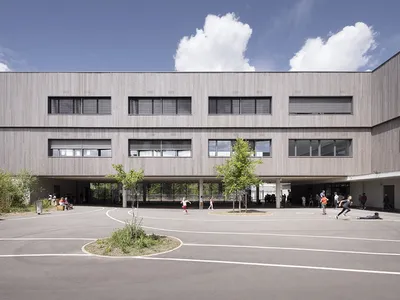
Vil Genis School by BPA ARCHITECTURE – Massy, France
Vil Genis School in Massy, France, features sustainable design, south-facing classrooms, community integration, accessible spaces, and modern educational architecture.



Comments (0)
Please login or sign up to add comments
No comments yet. Be the first to comment!