
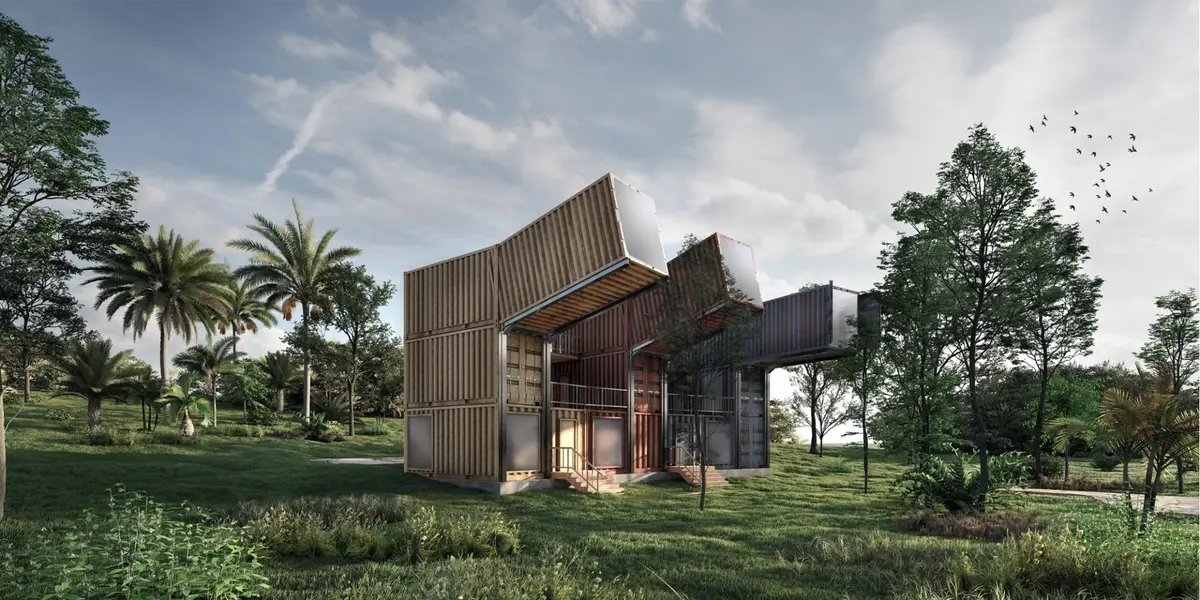
Protecting avian biodiversity: Bird observatories to help spread awareness & save rare bird species.
Results for ‘Fly’ - Landscape design competition out now


Known as evolutionary cousins of dinosaurs, birds have evolved from theropods (meat-eating dinosaurs) and the oldest bird fossils are about 150 million years old.
The scientific study only started in the 17th century with Aristotle's books on bird habitats and migration patterns. Since then, records of different birds in the form of written manuscripts and drawings have enriched our knowledge of biodiversity. As scientific studies, wonderment, and awareness of these species increased, they became an inspiration for human flight.
Birds beautifully co-exist with nature and also share a cultural relationship with humans. They are one of the most crucial members of our ecosystem. By providing food for scavengers and decomposers they help maintain sustainable population levels of their prey and predators.
Thereby, indirectly balancing nature’s relationship with the human world.
Although in recent years, there is increased pressure on birds and their role due to rapid urbanization.
While avian diversity in India has been limited to the study and conservation in protected ecosystems. There is a varied bird diversity outside these areas that remains neglected.
Further coastal areas are under serious threats of land reclamation and pollution. It has led to the destruction of natural habitats, as they are under serious threats due to sand dredging, coastal land reclamation, and pollution.
The coastline of Alibaug, Raigad comprises 30% of resident birds and 70% of migratory species. With the current state of development in and around Alibaug, the stress to residents and migratory birds is inevitable.
How can we reduce this human intervention and still maintain our balance with these species?
Rare species of birds are found on the coastline of Alibaug. In an extraordinary instance, the species of Woodchat Shrike which barely reaches Baluchistan was found in the region. Species like Oyster-catcher, Plovers, and Ruddy turnstone can also be spotted.
With the provision of Ro-Ro water services and ferries, Alibaug has become a weekly recreational spot among the inhabitants of Mumbai city. Demands for beach views and other recreation have led to rapid infrastructural encroachment into natural habitats. Since the coastline is not protected by officials, it is necessary to create awareness about its rich biodiversity. There is a need to document and conserve it.
What if this need is integrated into the tourism of the region? Can a balance be created between these species and us?
Brief: The challenge was to design a sustainable observatory with a visitor's center with spaces for awareness and information that would balance and maintain the region’s landscape.
Some of the Best competition projects are as follows:
Winning Project: The Shrike
By: Lei Lin
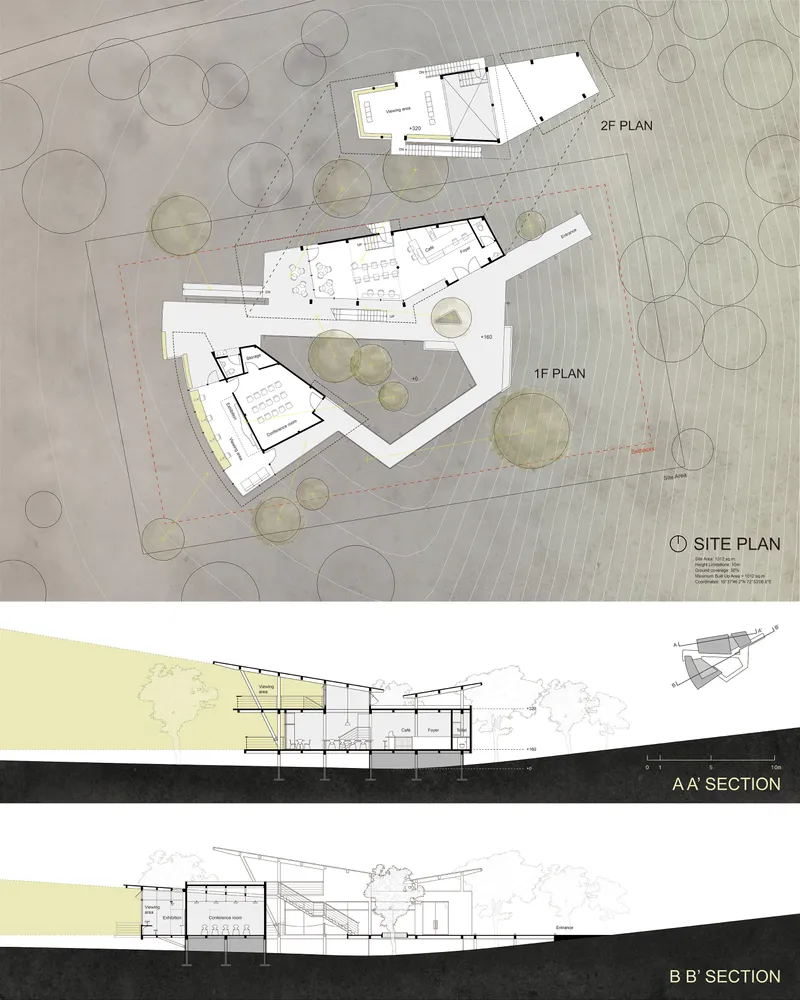
Fig: 1 Site Plan and Section Plan
Description: A bird observatory site planning in which users may experience a boundary-less connection with the natural beauty of the coastal environment. Shrike is a bird obeservatery set amongs the diverse coastline of maharashtra, India. It is a construct that reaches into the wild habitat around, whilst maintaining a safe and inclusive experience for all visitors…
-----------------------
People’s Choice: Nests
By: An Dra, Anca R. Teodora & Nicolae Baciu

Fig: 2 Site Plan and Section Plan
Description: Realizing a mean to let the coexistence between man and the natural environment happen. Our concept starts from the idea of looking at the world through different eyes. We tried to create a scenario that would allow watching birds from oversized nests that fit the human form.
-------------------------
Editor’s Choice: FLY HIGH
By: Anna Kosmala
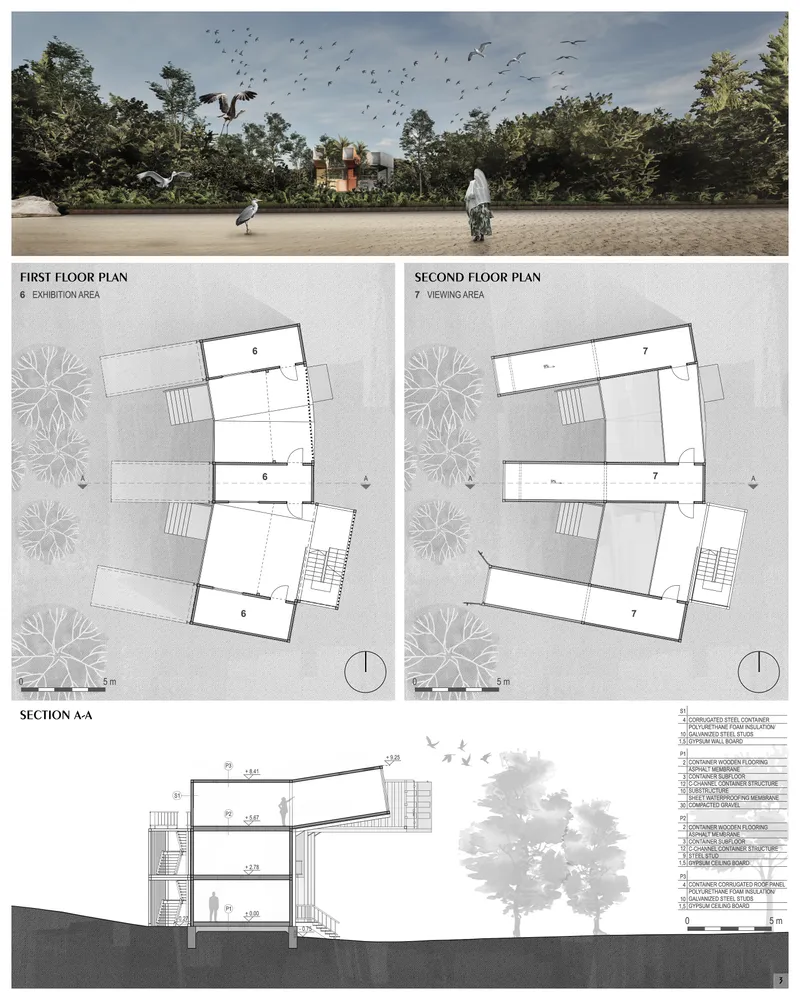
Fig: 3 Floor Plan, Section Plan and site image
Description: Creating a relationship between birds and humans. The concept of the project was to design an observatory that would draw attention to the source of various threats to the birds in Alibaug in India. The idea was aimed at reducing resource consumption and imitating of the carbon footprint.
------------------------
Editor’s Choice: FLY - Bird Observatory
By: Ritu Deshmukh
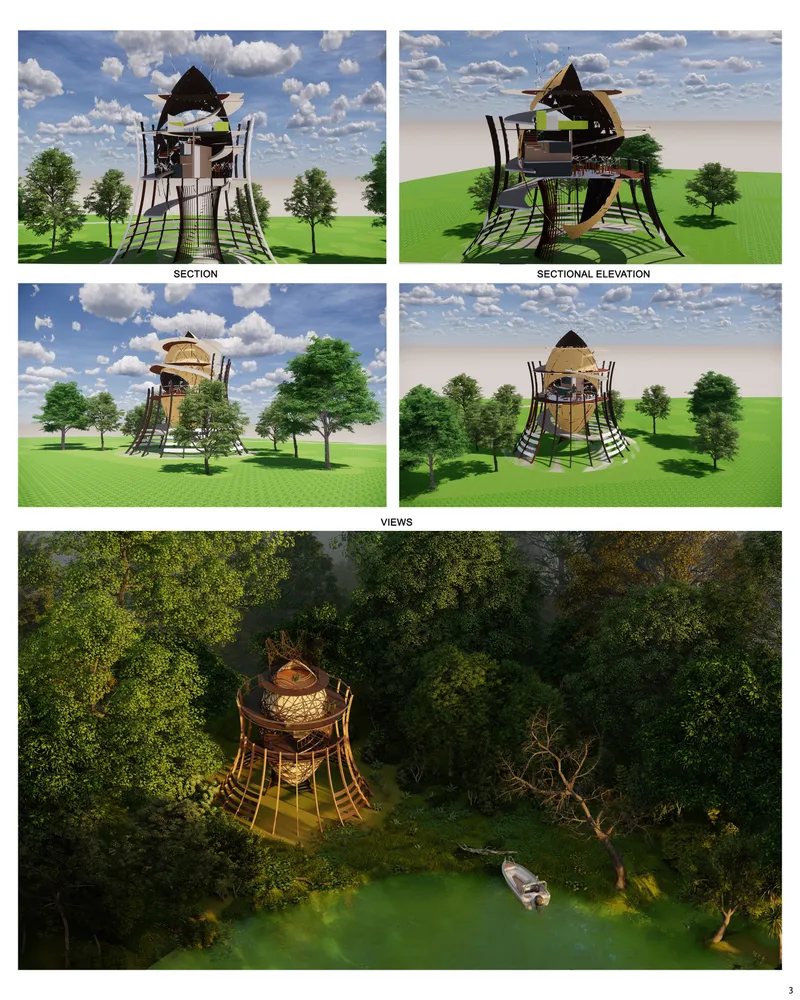
Fig: 4 Section, Sectional Elevation and site view
Description: The design of the sustainable observatory and visitor center would help to spread awareness about the bird species. The concept of the structure is derived from a weaver bird’s nest that is flawlessly suspended between the earth and sky in midst of lush trees and a calm coastline.

Follow us on social media: Facebook | Instagram | LinkedIn | Twitter | Youtube
References (3)


Popular Articles
Popular articles from the community


Wave 'Coral': Four Perforated Canopies Bring Human Scale to a Monumental Plaza
A wavy lattice shell repeated four times around an obelisk, turning a vast paved square into pockets of shade, planting and places to sit.


Minqa Atelier Steps a 53 m² Teak Refuge Down a Forested Slope in Ecuador's Chocó
In Pedro Vicente Maldonado, Ecuador, stepped teak platforms on river-stone gabions let a small forest house follow the hillside instead of flattening it.

Engagement Through Sculpture: Concrete Shells That Turn a Paris Square Into a Climbable Lookout
A winning Sculpt[r] 2020 entry drapes timber stairs over sloping concrete shells, offering Parisians a climb, a view and shade beneath.

S-AR Builds a Five-Square-Meter Concrete Chapel in a Mexican Garden from Thin Walls and Old Bricks
In Santiago, Nuevo León, a tunnel of 8 cm concrete walls tilts down to a steel cross, floored with crushed brick from the chapel it replaced.

Similar Reads
You might also enjoy these articles

Vietnam S: Rhymes of the River Built From Upturned Boat Hulls and a Shared Rooftop
Timber-ribbed, hull-shaped pavilions gather around a water courtyard, turning a street market into an authentic, dynamic place to chill out.

The Floating Spirit: A Fish Market of Stacked Rings Where Shops Grow With Their Sellers
A fish market for sellers whose adaptable structure lets each shop evolve with its needs, wrapped in curving tiers, roof terraces and a walkable bridge.
Engagement Through Sculpture: Concrete Shells That Turn a Paris Square Into a Climbable Lookout
A winning Sculpt[r] 2020 entry drapes timber stairs over sloping concrete shells, offering Parisians a climb, a view and shade beneath.
Wave 'Coral': Four Perforated Canopies Bring Human Scale to a Monumental Plaza
A wavy lattice shell repeated four times around an obelisk, turning a vast paved square into pockets of shade, planting and places to sit.


Comments (0)
Please login or sign up to add comments
No comments yet. Be the first to comment!