
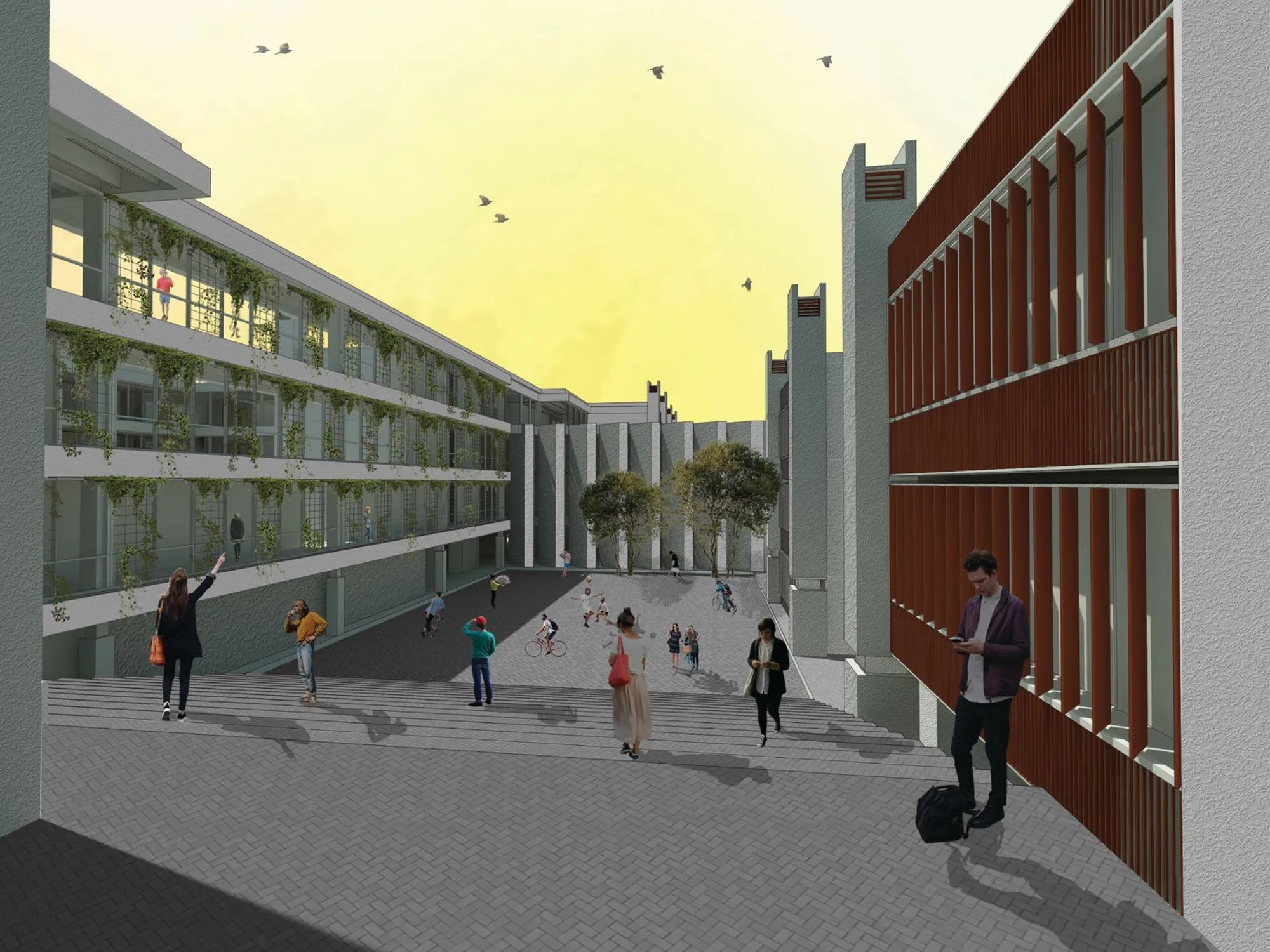
Regional Continuities of a Diaspora People: Cultural Architecture for Sindhi Identity in Gandhidham
A cultural architecture proposal in Gandhidham that reclaims memory, identity, and urban continuity for the Sindhi Hindu diaspora after Partition.


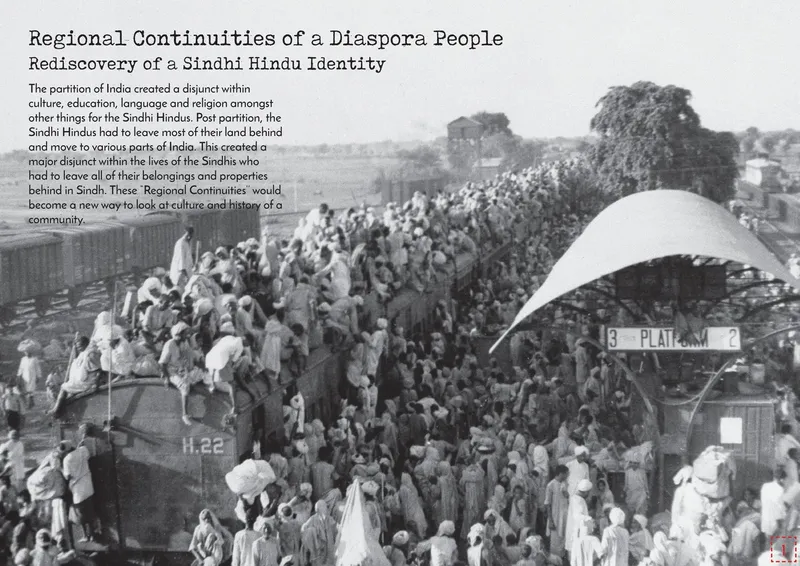
The Partition of India in 1947 triggered one of the largest human migrations in modern history. Among the displaced were the Sindhi Hindus, a community forced to leave their ancestral land of Sindh and resettle across newly formed India. This rupture did not merely involve geographic displacement; it fractured language, rituals, education systems, and collective memory. Regional Continuities of a Diaspora People is a cultural architecture proposal that seeks to re-establish this broken continuum through a carefully constructed urban and architectural intervention in Gandhidham, Kutch.
Gandhidham itself is not incidental to this narrative. Conceived as a planned city by the Sindhu Resettlement Corporation, it emerged from a desert landscape as a deliberate act of rehabilitation for the Sindhi community. The city embodies resilience, collective effort, and cultural reconstruction. Within this context, the proposed Cultural University acts as a contemporary genius loci: a place where memory, education, and urban life converge: allowing Sindhi identity to be rediscovered, reinterpreted, and transmitted across generations.
Reading History Through Cultural Architecture
The project "Regional Continuities of a Diaspora People" frames the historical evolution of Sindhi culture through three conceptual phases: The Roundabout, The Retraction, and The Refuge. These phases form the intellectual foundation of the architectural strategy.
The Roundabout refers to Sindh as a land shaped by centuries of dynasties, trade routes, invasions, and cultural exchange: from the Indus Valley Civilization to Islamic, Mughal, and colonial influences. This layered history produced a hybrid culture rooted in adaptability. Architecturally, this idea translates into spatial plurality, overlapping programs, and a non-hierarchical urban fabric.
The Retraction marks the moment of Partition, a sudden contraction of geography and identity. The mass migration of Sindhi Hindus resulted in cultural compression, loss of homeland, and dispersal across Indian cities. This phase informs the project’s emphasis on thresholds, corridors, and moments of pause, representing rupture and transition.
The Refuge signifies resettlement. Gandhidham becomes the spatial and symbolic refuge where displaced communities reorganized their social, economic, and cultural lives. The architecture responds by creating spaces of gathering, exchange, and public engagement, transforming memory into an active, lived condition.
Gandhidham as an Urban Framework
Located in Kutch, Gandhidham is structured by strong infrastructural axes, proximity to Kandla Port, and a landscape shaped by water bodies such as Shinai Lake. The city’s land ownership patterns, divided between the Sindhu Resettlement Corporation and the Kandla Port Trust, inform site selection and program distribution.
The proposal strategically inserts the Cultural University within the existing urban fabric, rather than isolating it as an inward-looking campus. This approach aligns with contemporary cultural architecture practices that dissolve boundaries between city and institution. Academic spaces, public plazas, archives, and cultural facilities are interwoven with city axes, allowing daily urban life to pass through the campus.
Green corridors are introduced along major movement spines, connecting open spaces, academic buildings, and public amenities. These corridors serve ecological, climatic, and social functions, creating shaded pedestrian routes while reinforcing visual and spatial continuity across the site.
Programmatic Structure: Architecture as Cultural Infrastructure
The Cultural University is conceived as a town-level institution rather than an insular academic enclave. Its programmatic distribution reflects this ambition.
Educational facilities include faculties of Architecture, Language, Arts, Music, Fabric, and Applied Social Sciences. These programs anchor the intellectual core of the campus while directly engaging with Sindhi heritage, folklore, and contemporary cultural production.
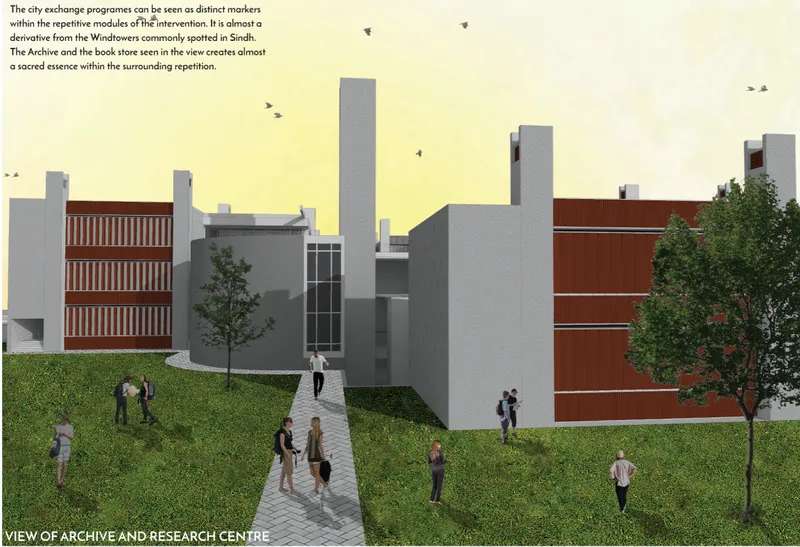
Institutional and administrative functions: such as archives, museums, research centers, and cultural collaboration spaces, are positioned as public interfaces. These spaces invite citizens, scholars, and visitors to participate in the ongoing reconstruction of cultural memory.
Amenities, housing, and recreational landscapes complete the ecosystem, ensuring that the campus remains active beyond academic hours. The integration of bookstores, cinema halls, music halls, and public plazas reinforces the role of architecture as a civic catalyst.
Climate-Responsive Cultural Architecture
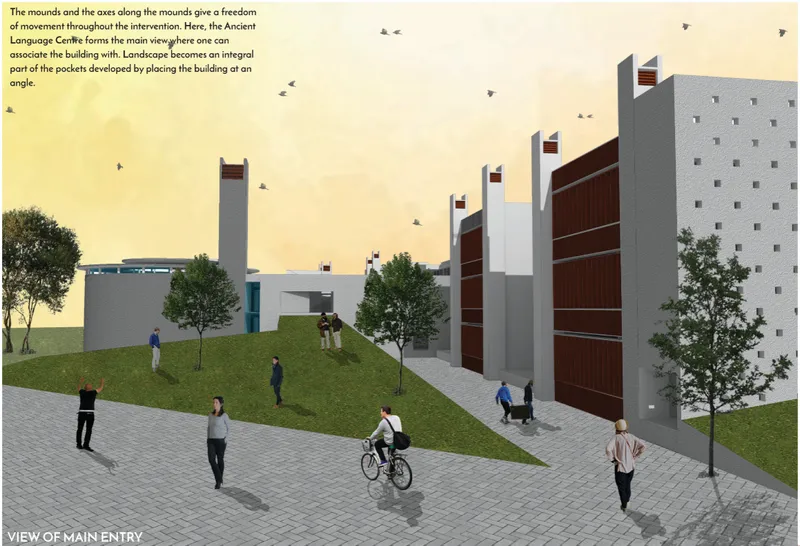
Responding to the hot and arid climate of Kutch, the architectural language prioritizes passive cooling and microclimatic control. Buildings are recessed from plot edges to create shaded green buffers. Double façades are introduced along south-west and north-east orientations to reduce heat gain.
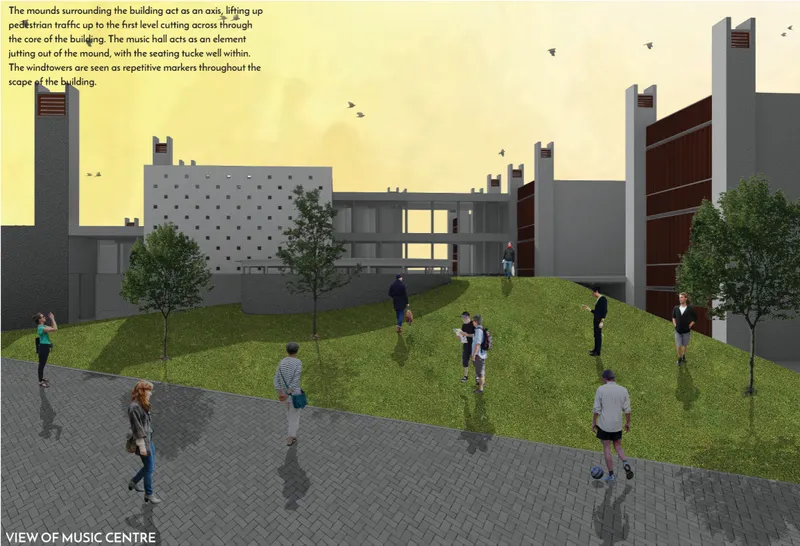
Soil excavated from basement construction is reused to form landscaped mounds and earth berms, shading built volumes and reducing thermal exposure. These landforms also act as urban gestures, visually softening the built mass while referencing the region’s topography.
Circulation corridors cut through buildings, allowing wind movement and creating shaded public spaces. This climatic strategy reinforces the idea of cultural architecture as an environmental mediator, rooted in regional conditions rather than imported form.
Axes, Connectivity, and Urban Continuity
The architectural layout is governed by a system of orthogonal axes aligned with the city grid. While building blocks initially follow street façades, they are rotated and offset to create visual corridors, public courts, and green pockets.
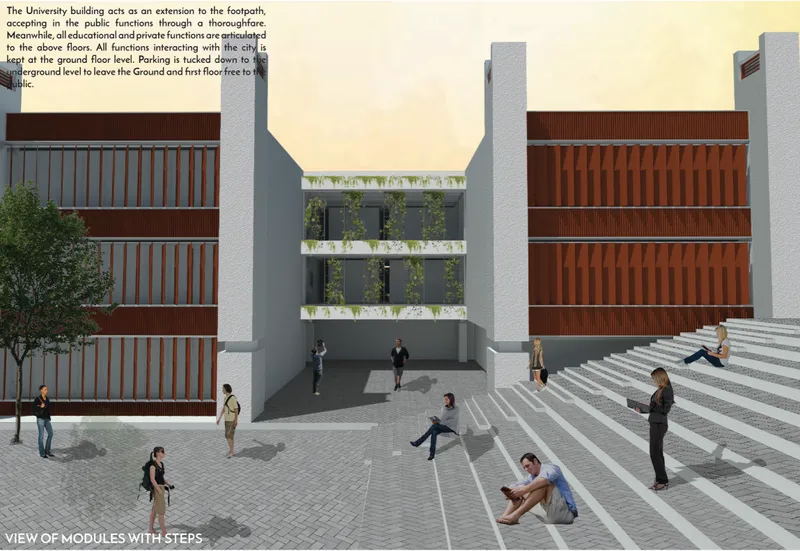
Vehicular access is limited to the main arterial road, while pedestrian and cycling networks dominate internal circulation. Parking is largely shifted to basement levels, freeing ground planes for public use and landscape continuity.
This layered connectivity strategy ensures that the university operates as an extension of Gandhidham’s urban life: absorbing movement, facilitating interaction, and reinforcing cultural continuity through everyday use.
Cultural Architecture as Collective Memory
At its core, Regional Continuities of a Diaspora People positions cultural architecture as an instrument of remembrance and regeneration. Rather than monumentalizing the past, the project embeds memory within daily urban routines: learning, gathering, performing, and walking through shared spaces.
The Cultural University becomes a living archive, where history is not frozen but continually rewritten through education, art, and civic engagement. For the Sindhi community and the people of Kutch, it offers a spatial framework to negotiate identity, belonging, and continuity in a post-Partition landscape.
This project by Pranay Khanchandani demonstrates how architecture, when grounded in regional narratives and urban responsibility, can transform displacement into resilience and memory into meaningful space.



Popular Articles
Popular articles from the community


The Musturak Paradise: Senior Living Architecture for a Connected Future in Temara, Morocco
The Musturak Paradise reimagines senior living architecture in Temara via private homes, social spaces, culture, community, and shared care.

Riyadh For All: Intergenerational Urban Design for Active Aging in Rabat
Riyadh For All reimagines urban design in Rabat with intergenerational co-living, adaptive courtyards, and Moroccan cultural exchange today.

The Earth Pod: 3D Printed Homes for Resilient Refugee Communities
The Earth Pod reimagines refugee housing through 3D printed homes made from clay, combining resilience, self-sufficiency, and rapid shelter.

Co-Life: Senior Housing Design That Reconnects Older Adults With the City
Co-Life reimagines senior housing design through healing gardens, shared streets, workshops, and a sustainable community across generations.

Similar Reads
You might also enjoy these articles

Maya Harvest: A Cacao Resort Village Rooted in Mayan Tradition and Local Craft
Situated within a Tabasco cacao plantation, this shortlisted resort proposal merges vernacular materials with hands-on cultural immersion.
Harmonia: A River-Shaped Community That Grows Over Decades in Boa Vista
Curved pathways and modular grid structures along the Branco River create a phased settlement designed to evolve from 2030 to 2050.
The Architecture of Bathing: A Mughal Hammam Reimagined Across the Yamuna
Charlotte May's honorable mention entry for The Black Taj reinterprets Agra's bathing rituals through red sandstone, water, and framed views of the Taj Mah
Om-1: A Wall-Hung System That Moves Your Workspace Off the Desk
Modular plywood boards, magnetic pegs, and utility elements migrate clutter from the horizontal surface to the vertical plane.

Comments (0)
Please login or sign up to add comments
No comments yet. Be the first to comment!