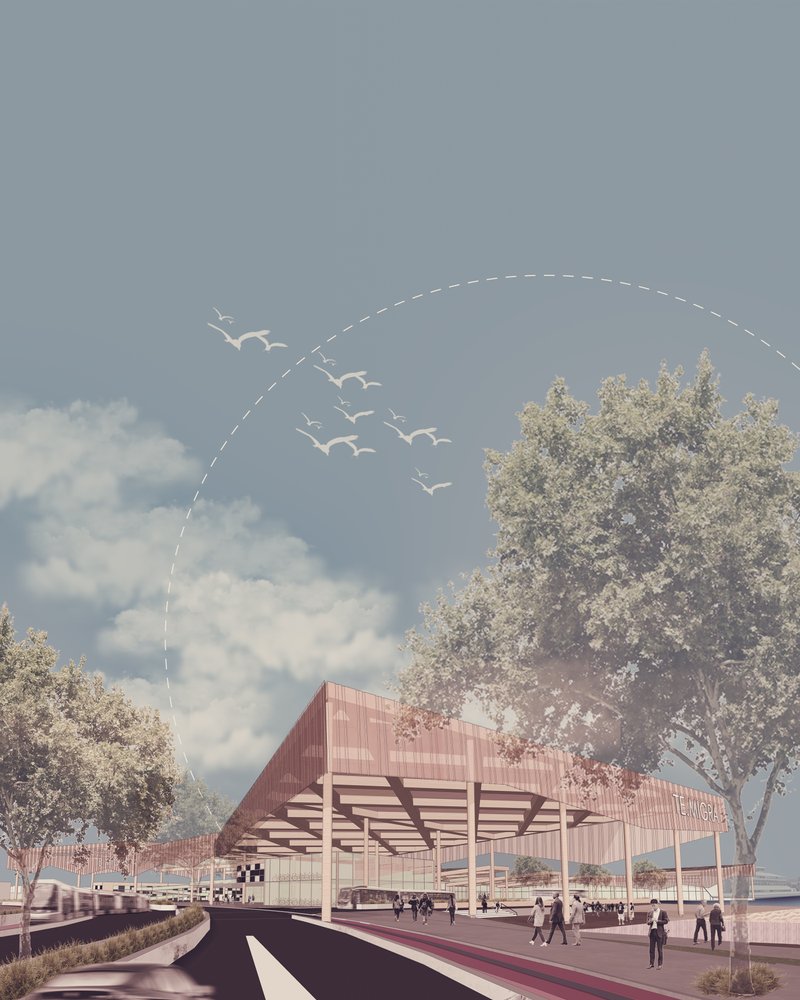
REINFORCING CENTRALITIES
The Case of the Intermunicipal Multimodal Terminal in the Gradim


INTRODUCTION
This project is the result of the Final Graduation Work inserted in the field of architecture, urbanism, urban mobility and economy. The proposal is focused on the implementation of the Inter-municipal Multimodal Terminal in Gradim (TE.MIGRA) as a result of the general urban mobility project capable of connecting the existing regional centralities and creating other economic poles from the Transportation Oriented Development (TOD) methodology, which plans urban mobility as the main factor to make the city more compact and accessible aiming to achieve the 3C city standard: Compact, Connected and Coordinates for people. The proposal is inserted in the city of São Gonçalo in the State of Rio de Janeiro in Brazil being one of the 20 most populated cities in the country. This choice was from the continuous experience in the city and perception of its emerging needs.
In order to understand the context, the project is developed in several scales solving the emerging issues of the territory while respecting its diverse contexts and dynamics within the city. These scales are divided into: metropolitan, municipal, territorial, area of influence and immediate surroundings.
URBAN CONTEXT
In the 20th century, the process of spontaneous industrialization began in São Gonçalo characterized by investments financed by the private sector. Under this scenario, the city was called "Manchester Fluminense" becoming the owner of the largest industrial pole of the State reaching national prominence. Later on, the city's participation in the industrial sector was reduced and in 1970, the city's industrial park was definitively deactivated as a result of the population densification process based on the disorderly occupation of large lots at the time and the Government's disinterest. In this context, there was a reduction in the services offered in the city due to the lack of investments and government actions characterizing the city with a strong residential character, which is defined by dormitory city.
Just as São Gonçalo hosted countless industries, the Gradim neighborhood worked in the industrial sector with fishing industries and shipyards, which make up the urban voids located mainly on the beachfront. The choice of the neighborhood was based on the following factors: the ground on the shore because it is the location with the largest below water level, facilitating travel for water transportation and reducing financial investments for maintenance and dredging; the strategic location near the structural roads of São Gonçalo and the main existing centers; the rescue of the memory of one of the main passenger ports that existed in the city; the creation of another centrality near the shore, which generates the appropriation by residents and the implementation of new uses for the industrial voids.
URBAN MOBILITY
In this historical panorama, urban mobility was thought from the old demands of displacement and not as a factor of accelerating the socioeconomic development of the city at the time. Therefore, it does not meet the current demands resulting in major traffic jams, long wait for public transportation, insecurity and discomfort in travel throughout the city.
Currently, in the spatial structure of São Gonçalo, the strengthening of the economy and establishment of centers, which are defined by the brazilian researcher Santos (1988) as a result of the concentration of activities, services and transportation is influenced by urban accessibility, since the centers are located in the most accessible neighborhoods and the existing sub-centers are located along the main travel routes.
However, São Gonçalo does not have the Mobility Plan, called PlanMob, which aims to expand access to services offered throughout the municipality in an integrated manner and is mandatory for all cities with over 500,000 inhabitants in Brazil. In this sense, it was observed the need for the realization of the plan and for interventions that will be inserted in PlanMob in the future through the reorganization of the road network of São Gonçalo and the insertion of passenger terminals connected to each other in order to transform the city into a democratic network in access and polycentric, that is, a spatial structure that has countless economically independent nodes and integrated through the TOD methodology.
PROPOSAL
For this reason, one of the developments of the general mobility proposal is the Intermunicipal Multimodal Terminal in the Gradim with capacity to serve about 70,000 passengers per day and approximately 40 million trips per year. The destinations are divided into 80% intermunicipal and 20% municipal and has 6 modals, being them: ferryboats, Articulated VLP, Articulated BRT, standard bus, bicycles, cars and on foot.
It is understood that the equipment is relevant and of great impact and therefore it is perceived that there is a need to move specific actions to the surroundings in order to help in the complementation of use and appropriation of the place following general guidelines and the three main concepts of the project: the urban context, which influences in the elaboration of interventions from the experiences and experiences of the city and its immediate surroundings; the visual permeability proposing that the project be visually permeable making the terminal integrated to the context where it is located and recovering the appropriation of the place through the vision; the polyvalence, under the logic that the public equipment is an extension of the city in its dynamics, complex flows and directed to the people.
The sustainability measures were applied based on the local climatic conditions, influencing from the implantation to the materials used in the project.
- The implantation was positioned in the North, which is the predominant sense of natural ventilation with the transport bays in the same direction in order to avoid noise in the Fishermen's Colony;
- Installation of transparent panels on the facades and roof maximizing natural lighting;
- The height of the structure maximizing cross ventilation;
- The metallic structure covered with wood in order to bring to mind the fishing experience of the past in the territory at the same time has a great useful life;
- Respect to existing vegetation;
- Implantation of native vegetations.
MATERIALITY AND STRUCTURE
The objective was to choose materials that would remember the local history at the same time as they would overcome large spans and have a long life span near the maritime areas in order to bring a comfortable ambience to the passengers. For this reason, the mesh with diagonal beams on the roof was worked with wood as it was the most conventional for this type of roof.
The mesh and beams have the same dimension equivalent to 1 meter high by 1.25 meters wide and are supported directly by 74 circular pillars with 60cm diameter and up to 30 meters of distance between them. Since wood is a material originally light there are 16 corner pillars that support the mezzanine and the vertical circulations. In this sense, the main materials chosen are wood and the metallic structure covered with this material.
Two other issues considered were thermal comfort and the maximum use of natural lighting. In view of this, the GEOCLAD zinc perforated panels were defined, which allow flexibility and malleability for any architectural form. These panels make up the project in the roof and as cladding for the facades.
Regarding the frame plans, they were positioned in strategic places to protect pedestrians in the transport displacement areas, directing only one exit and entrance to the bays, helping to restrict the embarkation and disembarkation places of the ferryboats. The frame plans are divided by standardized metal frames for the building of 3.5 meters x 4.5 meters of distance between them being supported by pillars located in the facades of the building.
The design process for defining the structure, roof and frames - adding the stores and the mezzanine - was strongly influenced by the thought of independent and separate plans and disciplines at the same time connected and integral parts of a whole.