
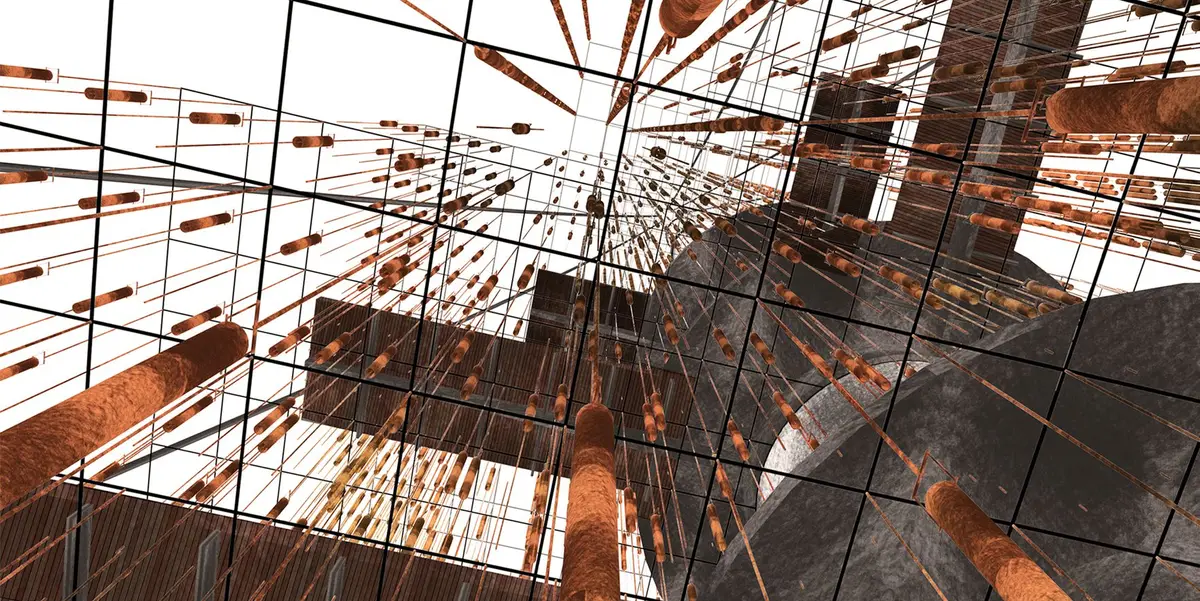
Resonating Memories: A Funerary Tower Where Chimes Hold Ashes and Sound Replaces Stone
A vertical memorial fuses crematorium, market, and wind-activated copper chimes into an architecture of collective mourning and urban life.


What if a cemetery could ring? Not with bells tolling for the departed, but with thousands of copper chimes, each one holding the ashes of a loved one, each one activated by wind or by the deliberate touch of a visitor's hand. "Resonating Memories" proposes exactly that: a vertical funerary tower where death is not sealed in stone but suspended in sound, where the act of remembrance is audible, shifting with the weather, decaying with time, and woven into the daily life of a city.
Designed by Shan Yu and Bryan Ahn, the project was shortlisted in the Circle of Life competition. Sited along an urban waterfront, the tower stacks a crematorium, a public market, a congregation platform, and two tiers of chime chambers into a single pyramidal structure. It is a direct challenge to the isolation of conventional cemeteries, proposing instead a memorial space where the living and the dead coexist in resonance.
A Pyramid on the Waterfront
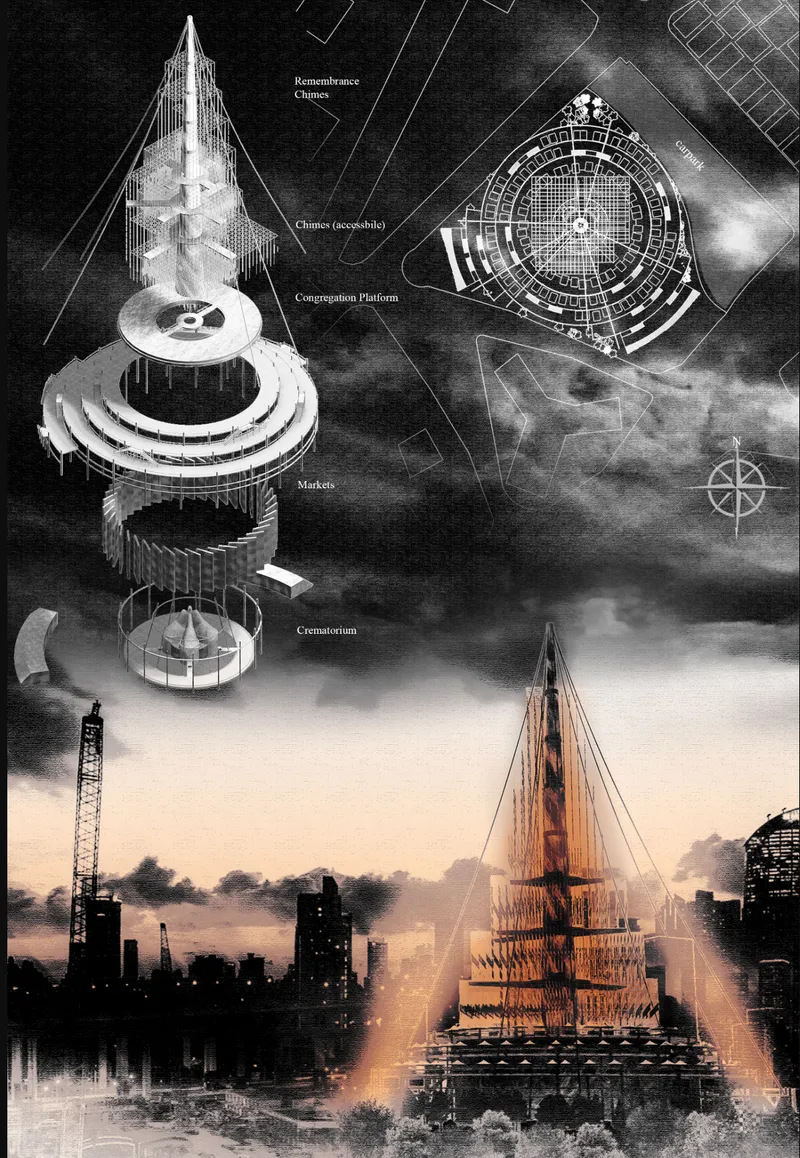

The composite rendering and sectional drawing together reveal the tower's logic: a tapered pyramidal form rising from the waterfront, its silhouette unmistakable against the dusk skyline. Exploded axonometric views break the structure into its constituent layers, showing how each programmatic zone occupies a distinct horizontal band. The section exposes a cable structure suspending fields of chimes within the upper volume, while tiered platforms step inward as the tower narrows. Verticality is not merely formal here; it addresses the real urban scarcity of burial grounds by compressing a full memorial program into a single footprint.
The decision to place the crematorium at the base and the most inaccessible chimes at the top establishes a spatial narrative of ascent. Mourners begin at the ground with the ritual of cremation and move upward through progressively more ethereal zones. The tower functions simultaneously as a visual and auditory landmark within the cityscape, its copper chimes shimmering and sounding in ways that change with time and weather.
Market Below, Memory Above


One of the project's most provocative moves is the insertion of a vibrant public market directly above the crematorium. The market level, shown with food vendors under canopies and pedestrians walking beneath elevated timber platforms, is deliberately informal. Locals shop, vendors interact, and death is subtly integrated into the rhythm of daily activity. It breaks the conventional barrier between the sacred and the mundane, insisting that mourning need not be segregated from the pulse of urban life.
Above the market, the interior platform view reveals the chime zone in its full spatial drama. Visitors move through a field of hanging copper elements with the city visible at sunset beyond. Each chime holds ashes; each one can be touched or left to the wind. The sound is not incidental but constitutive, turning the act of remembrance into something audible and shared. At the upper levels, the chimes become physically inaccessible but remain visually and sonically present, evoking a sense of transcendence and the gradual release of grief.
Stone, Fabric, and the Weight of Ritual

At ground level, the cremation chamber anchors the entire composition. The interior view looks upward at a central stone element framed by white fabric curtains, establishing a threshold between the profane exterior and the solemnity of the ritual within. The sculptural stone presence and gentle, diffused lighting guide mourners through the ceremony without overwhelming them. It is a space of compression and focus, the gravitational counterpoint to the airy, ringing volumes above.
The material palette carries symbolic weight throughout the tower. Copper is chosen specifically for its impermanence: it tarnishes, greens, and transforms over decades, mirroring the shifting nature of memory itself. The white fabric at the base suggests purity and transition. The timber platforms of the market carry the warmth of everyday life. Together, these materials construct an argument that a memorial building can be honest about decay rather than pretending to permanence.
Why This Project Matters
"Resonating Memories" takes a clear position: that mourning in contemporary cities should be collective, embodied, and sensory rather than hidden behind walls and hedgerows. By stacking cremation, commerce, congregation, and remembrance into a single vertical structure, Yu and Ahn propose an architecture that refuses to separate death from life. The market is not a cynical addition; it is the mechanism that ensures the tower remains inhabited, that grief is never performed in isolation, and that the dead remain part of the city's daily rhythm.
The copper chimes are the project's most memorable invention. They solve a practical problem (where to store ashes in a dense city), create a sensory experience (sound as memorial), and carry a potent metaphor (impermanence as beauty). In a competition field that could easily default to somber minimalism, this entry earns attention by insisting that remembrance can be loud, public, and alive.
View the Full Project
About the Designers
Enter a Design Competition on uni.xyz
uni.xyz runs architecture and design competitions year-round that reward proposals with spatial conviction and real site intelligence.
Project credits: Resonating Memories by Shan Yu, Bryan Ahn Circle of Life (uni.xyz).


Popular Articles
Popular articles from the community


Aquadapt: An Underwater Habitat That Rewrites Its Rooms by the Hour
Curved modules ring the seabed while one shell shifts from breakfast room to cinema, farm and football pitch as residents' needs change.


ETEH Reworks the Shared Spaces of São Domingos School in Brazil Around Timber, Color and Hanging Plants
At São Domingos School in Brazil, 436 m² of hall, refectory and library are recast with timber joinery, a yellow and blue code and trailing greenery.

FCC Arquitectura Expands a Portuguese Granite House with a Board-Marked Concrete Wing
In Portugal, JV House pairs a cleaned-up whitewashed and granite dwelling with a timber-shuttered concrete extension, courtyards and a garden pool.

Opera on the Sea: Driftwood Logic Shapes a Timber Opera House on Estonia's Coast
Trevor Orgill's opera house translates the entangled drift of floating timber into a civic building where wood, water, and music converge.

Similar Reads
You might also enjoy these articles

Vereda Arquitetos Renovates a 40-Square-Meter Apartment Inside Niemeyer's Copan Building
A compact unit in São Paulo's most iconic residential tower gets a material overhaul that pairs exposed concrete with bold blue Formica.

Shakur's House: Exposed Brick as an Interior Organiser in a 168 m² Mashhad Residence
Brick moves indoors in this Mashhad residence, where masonry walls, glass partitions and teal planes sequence a compact home without closing it off.

Day and Night Park: A Time-Based Urban Newsstand in Beijing
A temporary urban newsstand in Beijing blending travel, light, and reading through poetic colors, compact form, and community-focused design.

Modernist Patio Renovation in El Masnou, Barcelona by Oliver Segura Arquitectura + Cebrià Arquitectura
Modernist patio renovation blending tradition and innovation with a movable pool, leveled floors, and Catalan materials in El Masnou.

Comments (0)
Please login or sign up to add comments
No comments yet. Be the first to comment!