

Revitalizing History: The Providur’s Palace Cultural Complex in Zadar
Providur’s Palace in Zadar merges historic heritage with contemporary design, creating a multifunctional cultural hub for art, music, and education.


The Providur’s Palace, a centerpiece of Zadar’s historic urban fabric, represents a masterful blend of centuries-old heritage and contemporary design. As part of the newly unified Two Palaces complex, the project connects the recently renovated Providur’s Palace with the historically significant Rector’s Palace, forming a vibrant cultural hub for the city. Spanning 10,000 square meters, this transformation delivers a multifunctional space integrating art galleries, concert halls, educational facilities, and a branch of the Zadar City Library, solidifying its role as a central institution for arts, culture, and civic engagement.
Preserving History, Embracing Modernity
The architectural team, led by Iva Letilović and Igor Pedišić, approached the project with sensitivity to the palaces’ rich historical layers. Over the decades, Providur’s Palace had accommodated numerous civic associations, cultural clubs, and city institutions, resulting in a fragmented interior layout. The building’s interiors had become labyrinthine, with interwoven horizontal and vertical pathways that were largely incompatible with modern museum and cultural functions.
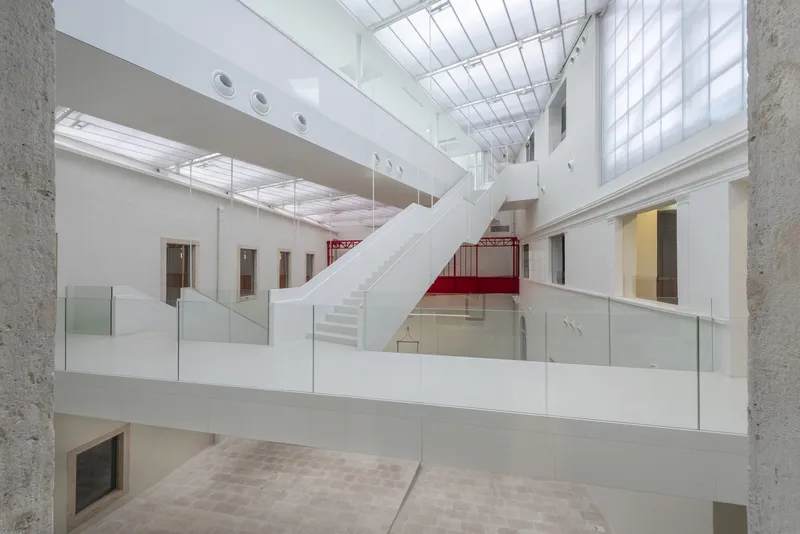
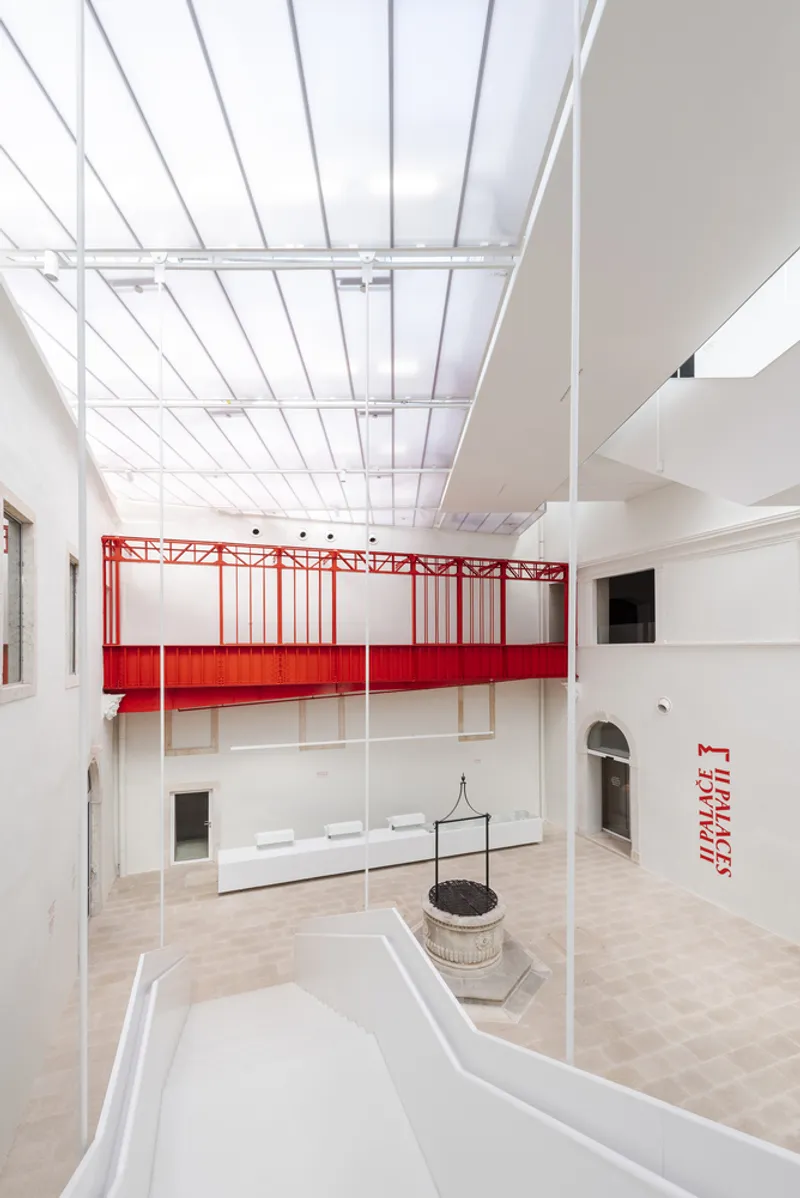
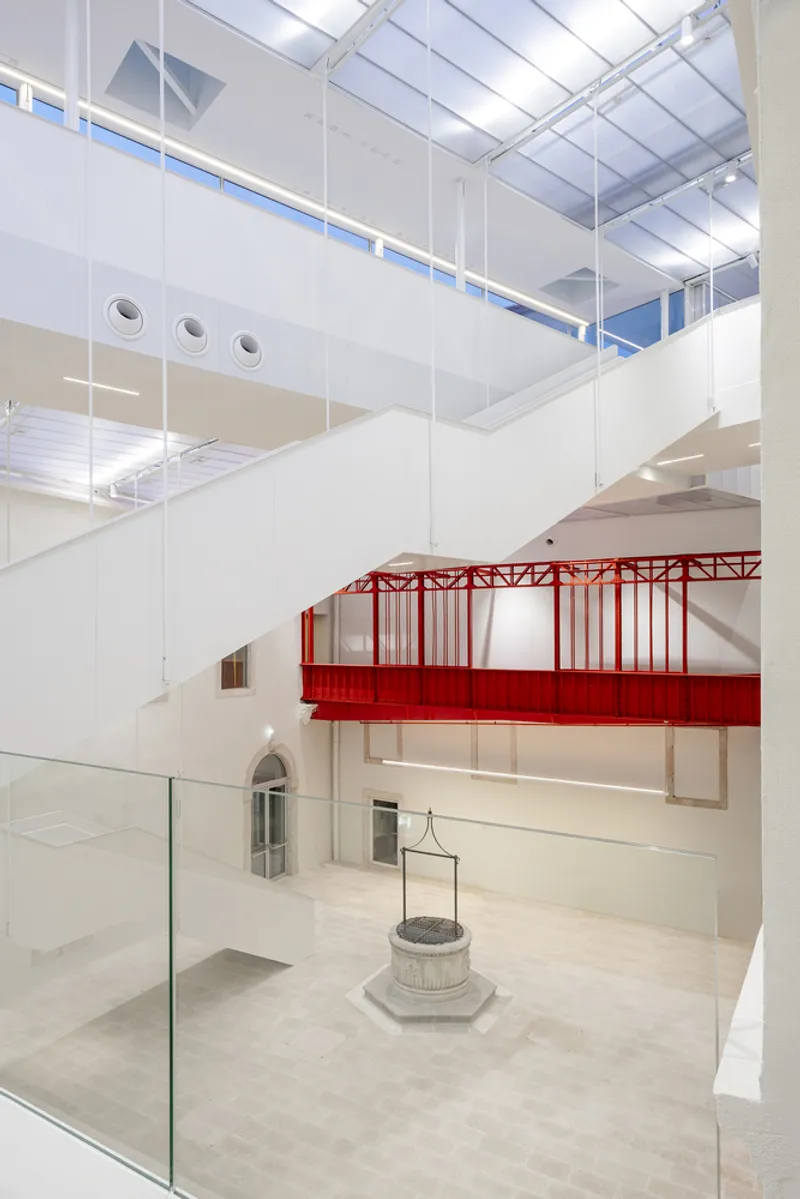
The architects faced the challenge of maintaining the integrity of this historical fabric while adapting it to contemporary usage. Rather than erase the traces of past transformations, the design preserves the palaces’ historical narrative. Existing spatial structures, including stone floors, old well covers, and remnants of 19th-century steel frameworks, were carefully conserved and integrated into the renovation.

Architectural Highlights
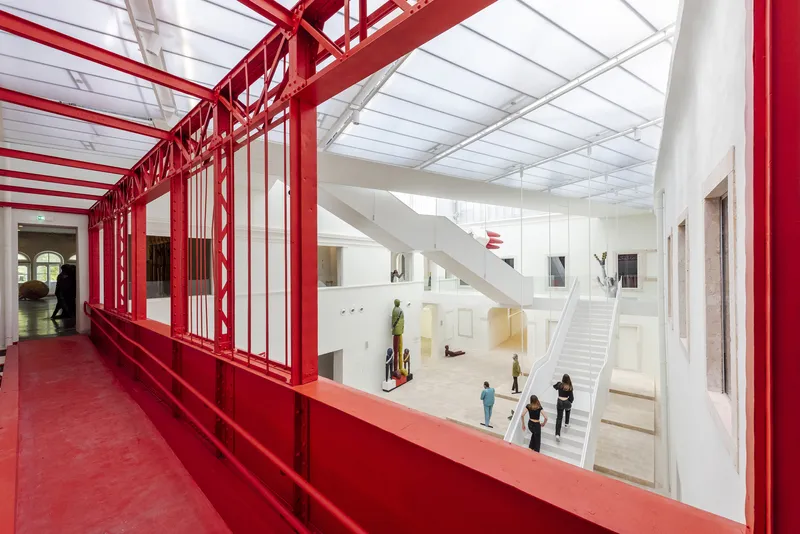
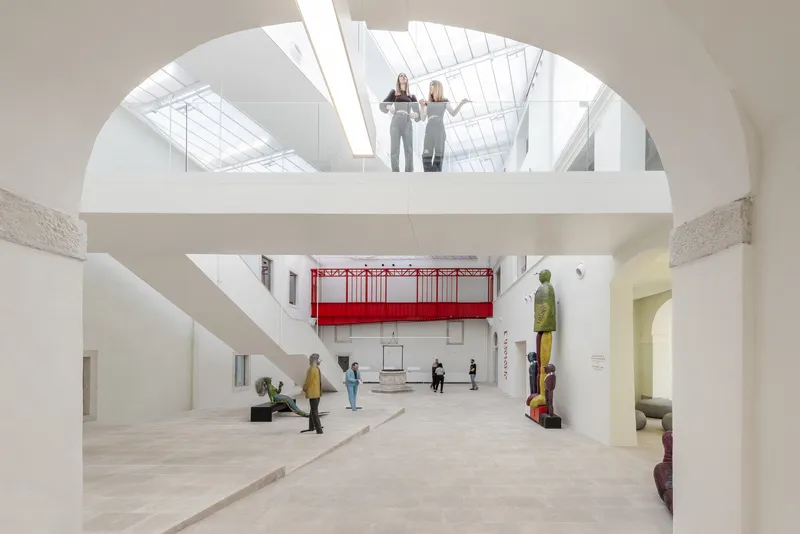
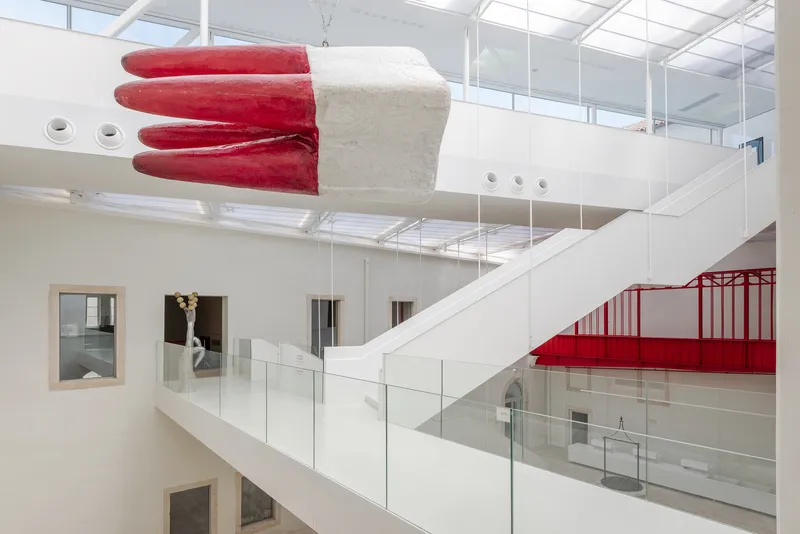
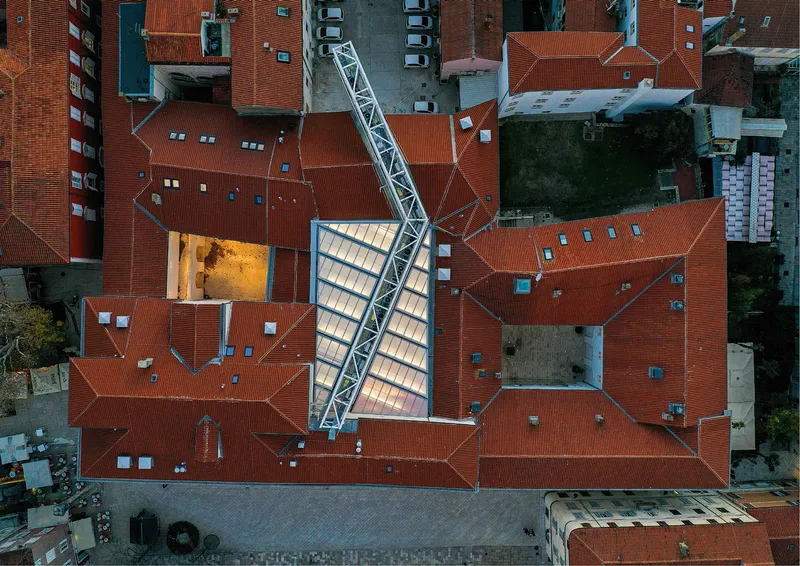
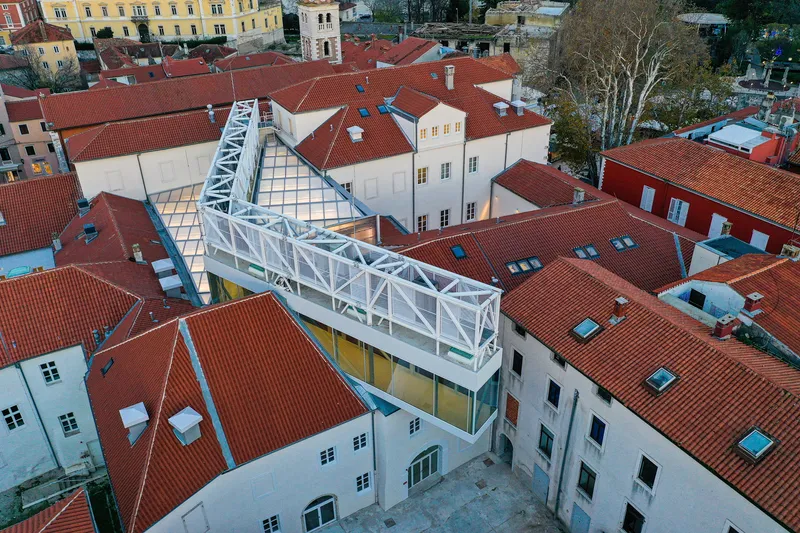
A key feature of the project is the transformation of the former open atrium into a covered, multilevel passage connecting the two palaces. The atrium serves as the central circulation core, guiding visitors through exhibition spaces, concert halls, and library areas. Dominated by white surfaces and illuminated by natural light filtering through a translucent polycarbonate roof, the atrium creates a visually compelling dialogue between historic elements and modern interventions.
Distinctive steel staircases, suspended like architectural sculptures, extend through the atrium, complementing both the vertical and horizontal movement of the complex. Two bridges connect the palaces: a newly constructed bridge and a renovated historic balcony, the latter painted bright red to serve as a visual signature within the otherwise monochromatic space. This bold accent not only adds artistic character but also facilitates accessibility, including ramps for visitors with disabilities.
Integration of Technology and Infrastructure
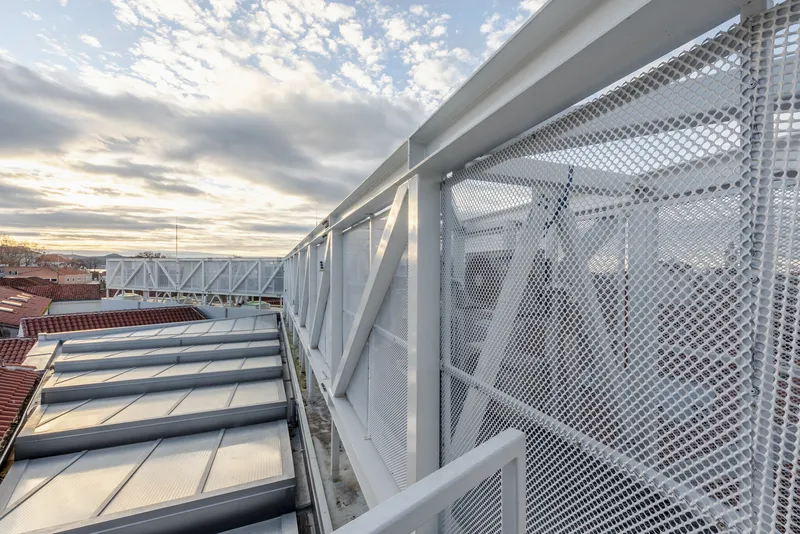
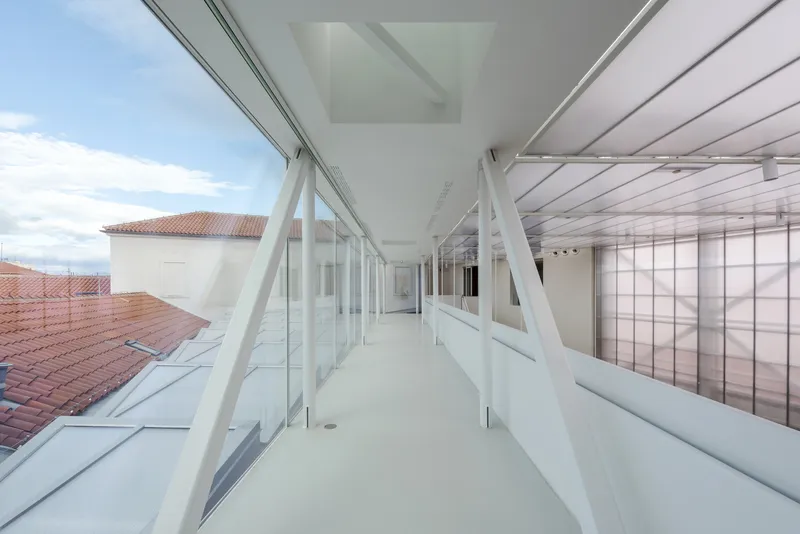
The renovation integrates a discreet technological infrastructure to support the diverse functions of the Two Palaces complex. A steel grid on the roof conceals ventilation channels, air-conditioning units, and structural supports while also providing the framework for the glass corridor and atrium roof. This “hidden machine” allows the historic palaces to function efficiently without compromising their architectural authenticity, ensuring that both modern needs and conservation principles are met simultaneously.
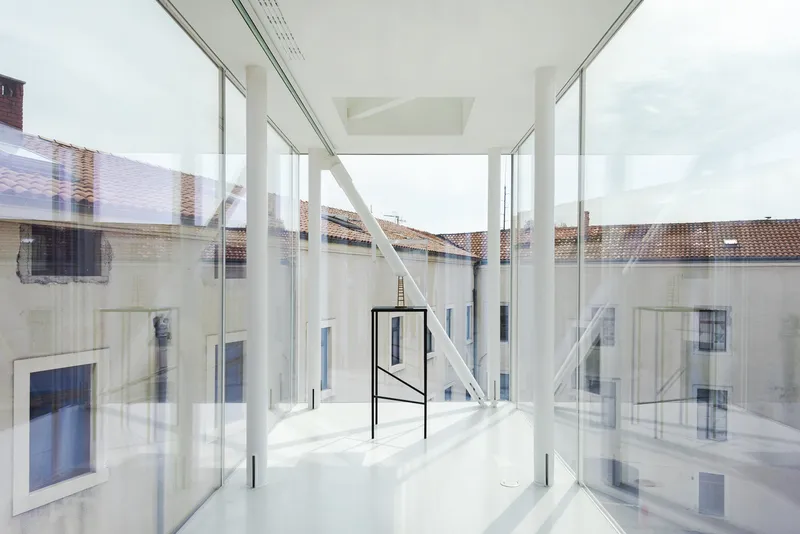
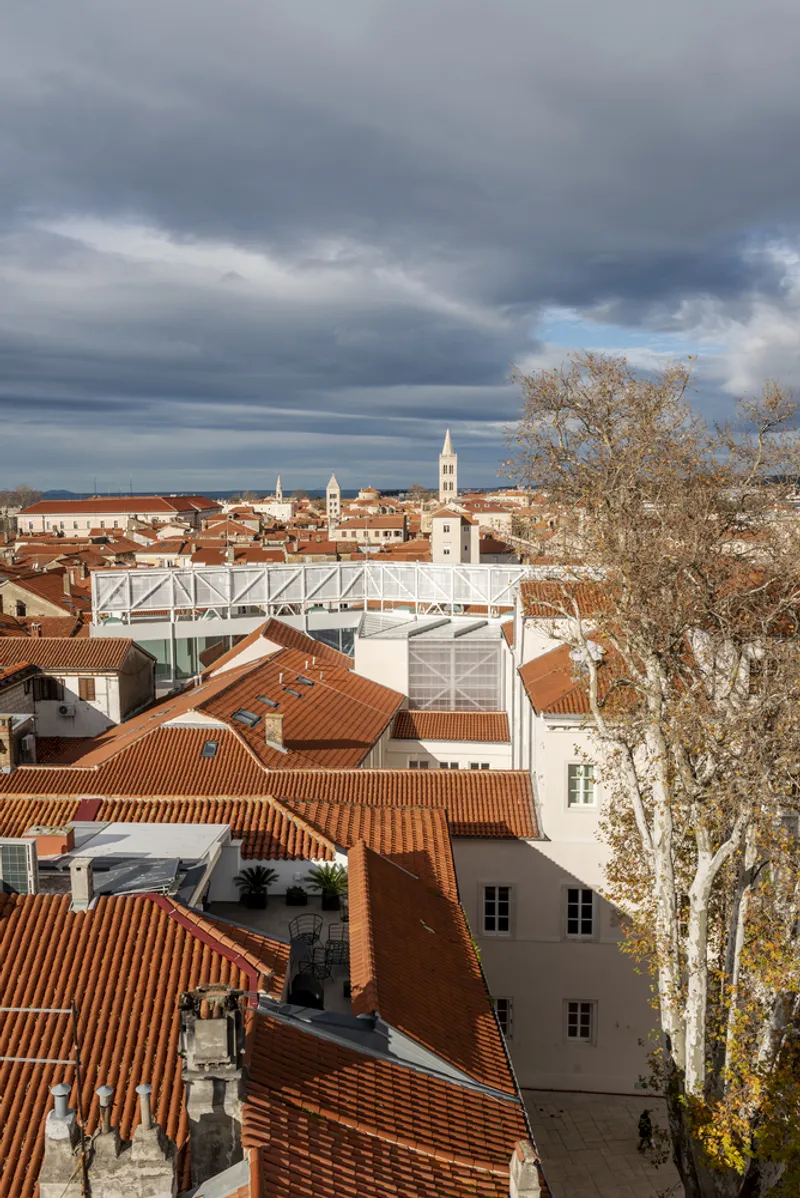
Visitors can ascend to the highest levels of the glass corridor, where the city of Zadar unfolds as part of the exhibition. From these elevated vantage points, the interplay of red rooftops, historic stone facades, and the blue Dalmatian sky enhances the cultural experience, merging the cityscape with the museum-like interior.
Cultural and Social Significance
The Providur’s Palace now serves as a cultural living room for Zadar, a space where citizens and visitors converge to engage with art, music, literature, and learning. The renovation underscores a contemporary philosophy: historic buildings can host modern functions without losing their identity. By carefully balancing preservation and innovation, the architects created an adaptive framework for future cultural programming, establishing a model for integrating contemporary architecture within historic urban contexts.
Vision and Legacy
The Two Palaces project exemplifies the potential of adaptive reuse in heritage architecture. By respecting the layers of history, conserving significant structural elements, and introducing functional modernity, the project demonstrates a new paradigm for renovating protected urban spaces. This approach fosters collaboration between architects, conservationists, contractors, and civic institutions, illustrating that careful planning and creative vision can revitalize historic centers while preserving their cultural identity.
The Providur’s Palace stands as a testament to thoughtful architectural intervention, merging Zadar’s rich historical past with contemporary urban life. It not only revitalizes a prominent historic landmark but also redefines how cultural spaces can engage communities, blending functionality, aesthetics, and heritage.
All photographs are works of
Filp Brala


Popular Articles
Popular articles from the community


David Macias Steps a Doorless Stone and Plaster House Down a Tropical Colombian Hillside
In the humid hills of Colombia, Threshold House replaces the front door with an open void and terraces its 850 m² down the slope instead of fighting it.

Cube Design Draws an Ecological Corridor Between Two Shenzhen Hills with the Nankai Building
Beside Shenzhen's container docks, the Nankai Building pairs stacked balconies with a climbing green screen to connect two hillsides across its height.

Jaramillo Van Sluys Arquitectura and Urbanismo Turn a Demolished Registry Lot in Quito into an Orchard Plaza
In Quito's Centro Histórico, a 2,800 m² plaza exposes the San Agustín convent wall and redraws its lost Augustinian orchard in volcanic stone.

U.GA Architects Wraps an Oval Rooftop Pool in Curved Board-Formed Concrete on Busan's Jeollidan-gil
In Busan's Jeonpo-dong, a 454 m² mixed-use block stacks a neighborhood facility, guest rooms and an oval rooftop pool inside spiraling concrete walls.

Similar Reads
You might also enjoy these articles

Gil Mello Arquitetura Tilts a Single Roof Toward the Waterfalls on a Plateau Above Aiuruoca, Brazil
In Aiuruoca, Minas Gerais, a 200 m² house of local labor and reclaimed poles pairs a low valley veranda with a tall mountain one.
U.GA Architects Wraps an Oval Rooftop Pool in Curved Board-Formed Concrete on Busan's Jeollidan-gil
In Busan's Jeonpo-dong, a 454 m² mixed-use block stacks a neighborhood facility, guest rooms and an oval rooftop pool inside spiraling concrete walls.

Felipe Hess Arquitetos Turns a Blind Stone Wall to the Street and Opens a Brazilian House onto a Courtyard and Canal
A canal-front house in Brazil hides behind painted stone and planting, then opens to an olive-tree courtyard, a reed-ceilinged porch and a curving pool.
David Macias Steps a Doorless Stone and Plaster House Down a Tropical Colombian Hillside
In the humid hills of Colombia, Threshold House replaces the front door with an open void and terraces its 850 m² down the slope instead of fighting it.

Explore Architecture Competitions
Discover active competitions in this discipline

Challenge to reimagine the Iron Throne

Photograph architecture without architects

Illustrate the lost glory of Angkor Wat - Render Challenge

Design challenge to reuse E-waste
Comments (0)
Please login or sign up to add comments
No comments yet. Be the first to comment!