

KKOL Studio Reimagines the Renaissance Ideal City as a Seoul Corporate Café
Inside a KN Global office building, three carefully zoned areas merge classical spatial hierarchy with warm timber minimalism.


A café inside a corporate office building doesn't usually carry much conceptual weight. It's a break room with better coffee. But KKOL Studio took a different position with RiverRidge Cafe, located on the ground floor of the KN Global building in Seoul, South Korea. The space serves a dual purpose: it is both a specialty coffee café and a break room for company executives. Rather than defaulting to the standard open-plan lounge, the designers structured the interior around the Renaissance notion of the "ideal city," borrowing its hierarchical spatial logic and translating it into three distinct zones.
What makes the project genuinely compelling is the seriousness with which that conceit is pursued. The three zones, labeled Sacred, Public, and Private, are not just marketing language layered onto a floor plan. They correspond to real programmatic differences: solo study seating, communal café tables, group meeting areas for eight or more, and even a rostrum for seminars. The interior reads as a single coherent composition, held together by a limited palette of timber, concrete, and white surfaces, yet each zone has its own atmosphere and scale. Classical ideas about order and proportion coexist with a restrained contemporary materiality, and neither dominates.
A Ground Floor That Glows


Seen from the street at dusk, RiverRidge Cafe reads as a lantern at the base of an otherwise opaque office tower. The floor-to-ceiling glazed facade dissolves the boundary between sidewalk and dining area, with pendant lights and warm interior surfaces pulling passersby into the composition. Bare winter trees in the foreground give the night views a graphic quality, almost stage-like.
The entrance canopy, a suspended grey plane punched with recessed square lights, signals the threshold without overstating it. It's a quiet gesture that sets the tone for the interior: controlled, precise, but never cold.
Timber as Structural Gesture


The most visually striking element in the café is a large angled timber beam that cuts diagonally across the gallery-like main space. It functions as both a structural anchor and a spatial organizer, creating a sense of directed movement through the room. Light oak tables and stools sit beneath it, scaled to reinforce the intimacy of individual and paired seating.
The beam's rust-warm tone contrasts deliberately with the surrounding white walls and concrete floor, pulling the eye upward and then along its trajectory. Recessed square wall sconces are embedded at its edges, casting a soft glow that articulates the joint between timber and plaster. It's an element that carries real presence without being decorative. The detail is restrained enough that the beam reads as architecture, not furniture.
Zoning Through Material and Level Change


The three-zone strategy is legible in section, not just plan. Broad concrete steps lead up to a raised platform anchored by a black cubic volume framed in glass, establishing the Private zone as physically and visually distinct from the Public seating below. The change in level is generous, more like a landscape terrace than a standard split-level, which gives the upper area genuine autonomy.
Meanwhile, the Sacred zone occupies quieter corners where the angled timber wall meets white panels, creating a sense of enclosure without partition walls. The rust-colored surface and the oak bench beneath it form a self-contained nook. KKOL Studio treats zoning as an atmospheric condition rather than a line on a plan, using material shifts and topographic moves to differentiate use without hard boundaries.
Light and Detail at Close Range


The café's detailing rewards close inspection. Frosted glass wall sconces produce a diffuse, even light that flattens shadows and gives the white walls a soft luminosity. Where sunlight enters, it casts precise shadow lines across the concrete floor, creating a graphic counterpoint to the warm artificial lighting. These two light qualities, natural and artificial, are allowed to coexist without one negating the other.
Curved timber wall elements wrap around individual seating stations, providing a sense of shelter that is more psychological than acoustic. The surfaces are smooth but not glossy, absorbing light rather than reflecting it, which keeps the overall tone calm even during busy hours.
Considered Details: Power, Sound, Hardware


A café that doubles as a work environment for executives needs infrastructure that stays invisible. Recessed power outlets are integrated into the timber table edges, flush enough that they read as joinery rather than technology. A mug rests on one of these surfaces as if to demonstrate that the proportions work at the scale of daily use, not just in photographs.
Wall-mounted speakers and cylindrical light fixtures above the timber stair treads are treated with the same discretion. Even the door hardware, a circular black metal plate with a smaller inset disc on dark timber paneling, is designed as a miniature composition. These details accumulate into a coherent sensibility: nothing is incidental, but nothing is shouting for attention either.
Vertical Circulation and Lighting Rhythm


The stairwell connecting the café level to upper floors features five rectangular wall sconces arranged in an ascending sequence along a white wall. It is a simple move, almost diagrammatic, but it transforms what could be a purely functional passage into a moment of spatial rhythm. The sconces graduate in height with the stair treads, creating a parallax effect as you climb.
The suspended entrance canopy echoes this controlled repetition, with its own grid of recessed square lights. Together, these elements establish a visual language that carries through the entire project: geometry as ornament, repetition as rhythm, restraint as luxury.
Plans and Drawings


The floor plan confirms the tripartite zoning strategy: a bar area anchors one end, a central hall organized around the staircase provides the Public zone, and dining seating clusters extend toward the glazed facade. The section drawings reveal how the angled timber beam and the curved staircase interact volumetrically, occupying different registers of the same space. Textured wall panels and hanging pendant lights are positioned to reinforce the sectional reading, layering depth into what is ultimately a single-story interior.
What the drawings make especially clear is how much spatial variety KKOL Studio extracted from a relatively straightforward rectangular footprint. The level changes, angled planes, and material shifts generate the sense of moving through multiple rooms without the use of partition walls. The plan is open, but the experience is sequential.
Why This Project Matters
Corporate cafés are rarely asked to do much intellectual work. They exist to provide caffeine and a momentary change of scenery, and most are designed accordingly. RiverRidge Cafe takes that brief and elevates it by importing a genuine conceptual framework, the Renaissance ideal city, and using it to structure a program that is more varied than it first appears. The result is a space that accommodates solo study, casual socializing, formal meetings, and public presentations within a single room, all without sacrificing coherence or calm.
KKOL Studio's achievement here is one of proportion and restraint. The material palette is narrow, the color range muted, the details precise but never precious. The angled timber beam is bold enough to organize the entire space without becoming a spectacle. In a design culture that often conflates complexity with value, this project makes a quiet case for the opposite: that a clear idea, rigorously executed in a limited palette, can produce an interior that feels both rich and effortless.
RiverRidge Cafe Interior Design by KKOL Studio, Seoul, South Korea. Photography by Donggyu Kim.
About the Studio
Share Your Own Work on uni.xyz
If projects like this are the kind of work you want to make, uni.xyz is a place to publish your own, find collaborators, and enter design competitions.


Popular Articles
Popular articles from the community

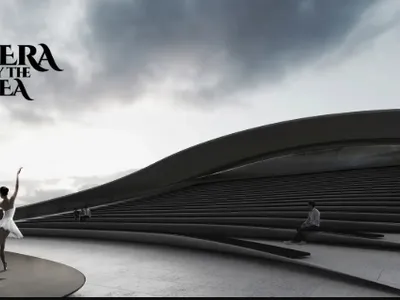
Opera by the Sea Estonia: Three Shells Dissolving Architecture into Tallinn's Coastline
A winning opera house proposal replaces monumental form with interconnected shells that blur the boundary between building, park and Baltic Sea.
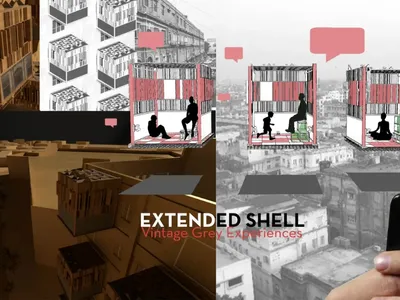
Extended Shell: Retrofitting Kolkata's Balconies as Living Urban Thresholds
A modular retrofit system recovers the social and environmental intelligence of Kolkata's historic verandas for contemporary Park Street residents.
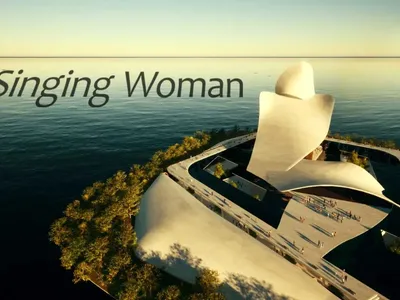
Singing Woman: An Opera House That Performs Before the Curtain Rises
Ovidiu Cristian Pavel's conceptual opera house translates Estonia's choral identity into a sculpted waterfront landmark facing the Baltic Sea.
Cloaked Colonization: A Mobile Underwater Habitat That Moves Like a Fish
Micah Abaya's shortlisted EHC Pacific entry reimagines ocean settlement as a dispersed network of self-sustaining architectural organisms.

Similar Reads
You might also enjoy these articles


Hodi-Mandai Geram
Project Function: Preservation and revitalization of the Intangible heritage and socio-spatial identity of the Hodi by Housing, Cultural Memory Center, Sacred Grove, landscape, local tourism economy


Olio Towers: A Mid-Rise for Performers That Fuses Housing, Rehearsal, and Stage
Located blocks from Houston's Theater District, this modular tower stacks living units around a central performance atrium.

Oasis: Modular Green Housing Carved into Dhaka's Urban Fabric
A shortlisted Plugin Housing entry reclaims unauthorized settlements in Dhaka with stepped concrete volumes, green roofs, and ventilation-driven design.

Black Hole: A Floating Megastructure for the Post-Physical Era
Emiliano Mazzarotto envisions a spherical, self-scaling arena where e-sports, digital hotels, and holographic stadiums replace traditional public space.

Explore Cafe and Restaurant Design Competitions
Discover active competitions in this discipline

Challenge to reimagine the Iron Throne

Photograph architecture without architects

Illustrate the lost glory of Angkor Wat - Render Challenge

Design challenge to reuse E-waste
Comments (0)
Please login or sign up to add comments
No comments yet. Be the first to comment!