

Rural Library in Kochargaon: A Community-Centered Educational Haven by pk_iNCEPTiON
Rural Library by pk_iNCEPTiON in Kochargaon fosters inclusive learning with multifunctional study rooms, central courtyard, sustainable design, and community engagement.


Nestled in the heart of Kochargaon Village, India, the Rural Library by pk_iNCEPTiON stands as a beacon of learning and community engagement. Completed in 2024, this 108 m² educational facility was designed to address the village’s critical shortage of reading and study spaces, improving literacy rates and nurturing a culture of knowledge.
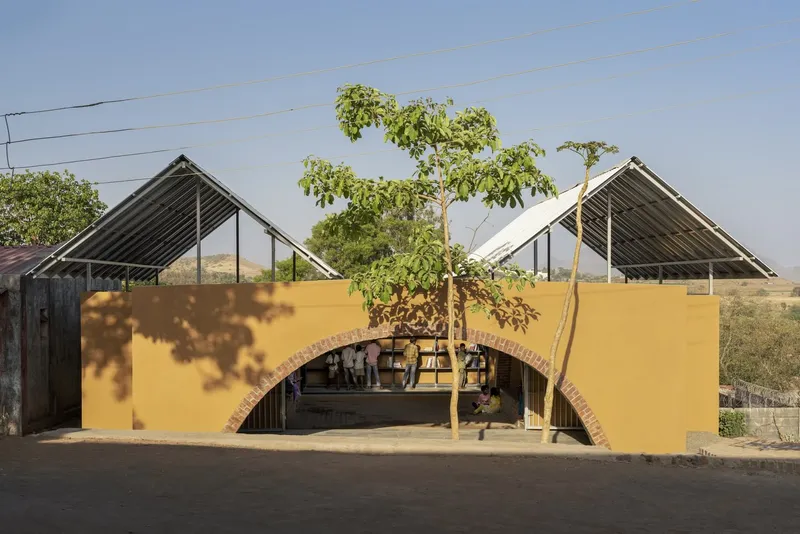
The project site is the plinth of a collapsed Aanganwadi, located near the village’s main temple complex. This strategic position connects the library visually and spatially to the existing temple pavilion, traditionally a hub for public gatherings and religious events. By situating the library slightly below road level, the design creates a subtle yet engaging transition from the bustling street and temple spaces into a serene learning environment.


Design Vision and Community Impact
Originally envisioned as two separate study rooms, one for males and another for females, the concept quickly expanded after consultations with the NGO Round Table and multiple site visits. The architects recognized a broader community need: a space that promotes lifelong learning for all ages. This led to a multifunctional design that integrates study rooms, reading areas, a central book stacking space, and a multipurpose courtyard for diverse educational activities.
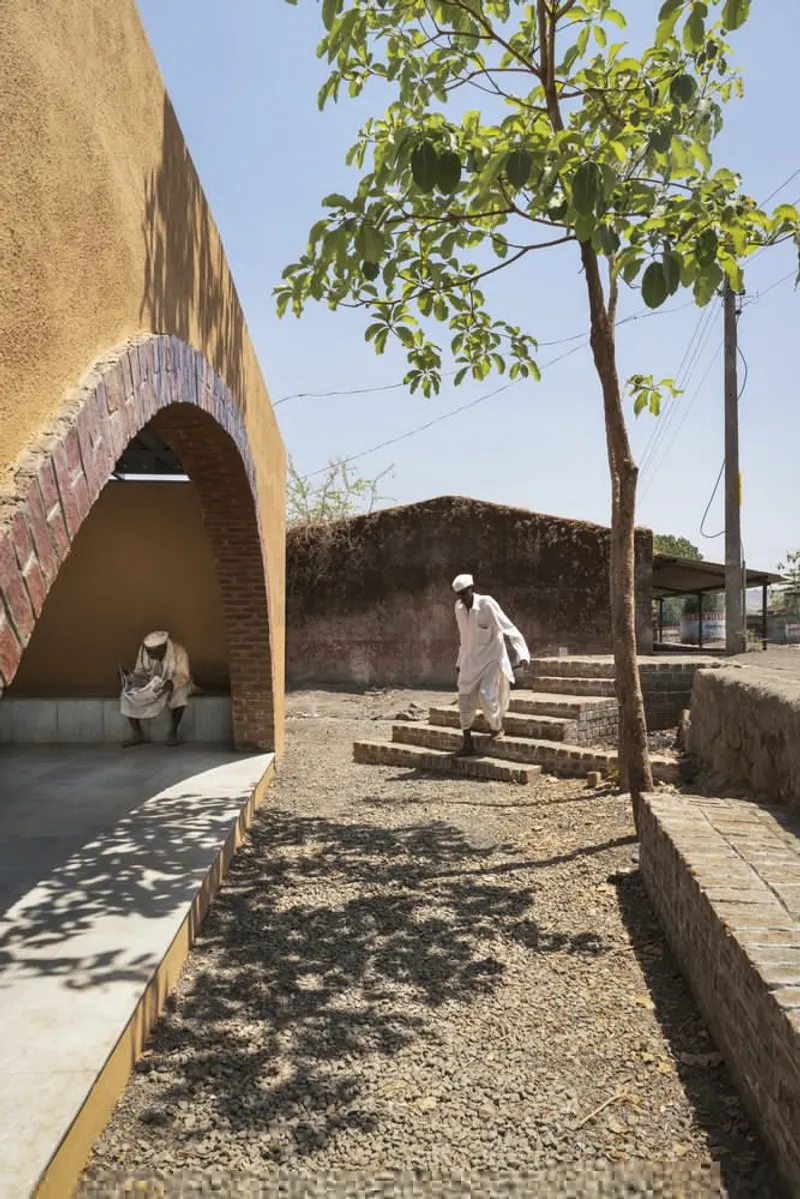
The library’s layout revolves around a central courtyard, fostering visual and physical connections between all functional zones. A semi-covered front pavilion serves as the welcoming entrance, guiding visitors from the road via a series of steps that double as informal gathering areas. The first pavilion features a large load-bearing arch and verandah, ideal for reading newspapers and magazines, and inviting the elderly to engage comfortably.


Architecture and Spatial Organization
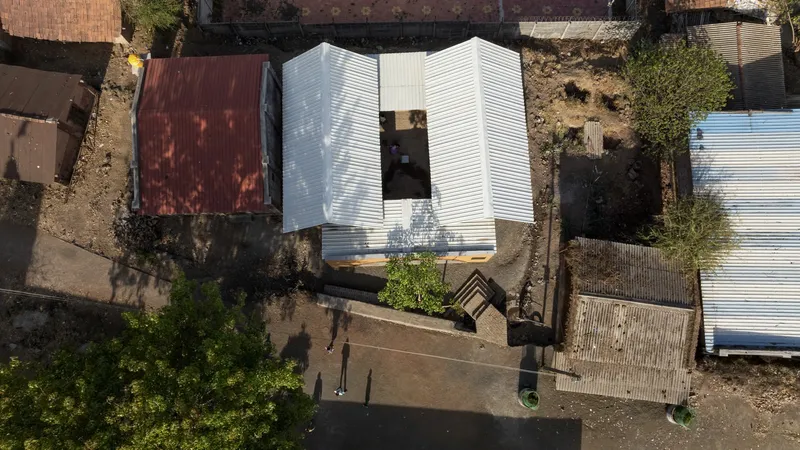
The core structure comprises three primary covered spaces: two study rooms and a book stacking area, all arranged concentrically around the central courtyard. A fourth pavilion at the front creates a semi-covered entrance and arrival space.
- Study Rooms: Oriented perpendicular to the temple complex, these rooms ensure a quiet, focused environment shielded from street noise. Large openings face the central courtyard, allowing flexible use for classes or group activities.
- Book Stacking Area: Strategically positioned to attract attention from both the temple pavilion and the street, this area features colorful bookshelves visible to passersby. Two large sliding shutters serve a dual purpose—revealing the collection or transforming into writable blackboards for outdoor lessons and workshops.
- Central Courtyard: This flexible outdoor space doubles as a playground, workshop area, or night school for village women, fostering an interactive, participatory learning ecosystem.

Sustainable and Low-Maintenance Design
The library’s design emphasizes cost-effective, multifunctional construction using locally available materials. Load-bearing walls with expansive arched openings maximize structural efficiency while enhancing aesthetics.
- Roofing: High-pitched roofs made from corrugated metal sheets promote natural ventilation, expel hot air, and offer views of the sky and surrounding trees.
- Flooring: Locally sourced stone ensures durability and low maintenance.
- Lighting & Ventilation: Carefully designed openings optimize daylight and cross-ventilation, creating a comfortable environment for study and leisure.


All photographs are works of Pranit Bora




Popular Articles
Popular articles from the community


The Ocean Hive: Sustainable Architecture for a Self-Sufficient Civilization at Sea
The Ocean Hive imagines sustainable architecture at sea, where modular habitats, algae, wave power and ocean waste sustain a growing colony.

The Earth Pod: 3D Printed Homes for Resilient Refugee Communities
The Earth Pod reimagines refugee housing through 3D printed homes made from clay, combining resilience, self-sufficiency, and rapid shelter.

The Musturak Paradise: Senior Living Architecture for a Connected Future in Temara, Morocco
The Musturak Paradise reimagines senior living architecture in Temara via private homes, social spaces, culture, community, and shared care.

Co-life: Sustainable Architecture for Age-Friendly Community Living
Co-life reimagines sustainable architecture for seniors through courtyards, rammed earth, shared gardens, and spaces designed for belonging.

Similar Reads
You might also enjoy these articles


Hodi-Mandai Geram
Project Function: Preservation and revitalization of the Intangible heritage and socio-spatial identity of the Hodi by Housing, Cultural Memory Center, Sacred Grove, landscape, local tourism economy


Olio Towers: A Mid-Rise for Performers That Fuses Housing, Rehearsal, and Stage
Located blocks from Houston's Theater District, this modular tower stacks living units around a central performance atrium.

Oasis: Modular Green Housing Carved into Dhaka's Urban Fabric
A shortlisted Plugin Housing entry reclaims unauthorized settlements in Dhaka with stepped concrete volumes, green roofs, and ventilation-driven design.

Black Hole: A Floating Megastructure for the Post-Physical Era
Emiliano Mazzarotto envisions a spherical, self-scaling arena where e-sports, digital hotels, and holographic stadiums replace traditional public space.
Explore Educational Building Competitions
Discover active competitions in this discipline



Challenge to design public laboratory


Challenge to reimagine the Iron Throne


Photograph architecture without architects


Illustrate the lost glory of Angkor Wat - Render Challenge
Comments (0)
Please login or sign up to add comments
No comments yet. Be the first to comment!