

Salma Tower: A Vertical Forest Redefining Sustainable Office Architecture in São Paulo
Salma Tower integrates vertical forests, open ground floors, and biophilic design, redefining sustainable corporate architecture along São Paulo’s Faria Lima corridor.


Salma Tower, designed by aflalo/gasperini arquitetos, stands as a new benchmark for sustainable corporate architecture along Avenida Faria Lima, one of the most dynamic business corridors in São Paulo. Completed in 2024, the 36,616 m² office tower reimagines the relationship between workplace, city, and nature through a bold bioarchitectural approach that integrates dense vertical forests into the heart of a high-rise building.
Occupying half a city block, the site benefits from three urban access points: Rua Professor Atílio Inocenti, Avenida Horácio Lafer, and Avenida Faria Lima, allowing the building to operate as a true urban connector rather than an isolated corporate object. This strategic positioning reinforces the tower’s civic presence and enhances permeability at both pedestrian and metropolitan scales.

Open Ground Floor and Urban Integration
At street level, Salma Tower departs from conventional corporate typologies. The ground floor is conceived as a completely open and barrier-free public space, without walls or railings. Active façades host shops and restaurants, encouraging daily interaction between office users, pedestrians, and the surrounding neighborhood. This openness transforms the base of the building into an extension of the city, reinforcing urban vitality and social engagement.
The single tower rises 16 floors, each with approximately 850 m² of flexible office space. Generous floor-to-floor heights of 4.68 meters allow for enhanced natural ventilation, daylight penetration, and spatial comfort, supporting contemporary and adaptable workplace layouts.

Vertical Forests and Bioarchitecture in the Workplace
The most distinctive architectural feature of Salma Tower is its continuous system of vertical forests. Each floor incorporates 110 m² of double-height planted spaces arranged in a spiral around the building’s central core, which houses elevators and staircases. In total, the project integrates 1,760 m² of vertical woodland, creating an immersive natural environment within a dense financial district.
These green spaces function as more than visual elements. Acting as thermal insulators and acoustic buffers, the forests help regulate indoor temperatures, reduce noise pollution, and generate a pleasant microclimate throughout the tower. The result is a healthier and more stimulating working environment that redefines everyday office life by placing nature at its core.

Terraces Law and Hanging Gardens
The architectural strategy is supported by São Paulo’s Terraces Law, which allows 5% of the site area to be dedicated to hanging gardens. These elevated landscapes were carefully designed to promote physical and psychological well-being, offering users the rare experience of walking barefoot through a dense forest in the middle of a high-rise building. The planted terraces extend the existing vegetation of neighboring plots, reinforcing ecological continuity within the urban fabric.
The landscaping design was developed through a close collaboration between Soma Arquitetos and Cardim Arquitetura, resulting in a meticulously curated natural system that balances biodiversity, maintenance efficiency, and sensory experience.

Collaborative Design and Full-Scale Experimentation
A defining aspect of the project was the collaborative relationship between the architects and the client, Grupo G4M, investor and owner of the development. Sharing a common vision centered on sustainability and innovation, the client actively participated in the design process. This included the construction of a 1:1 scale mockup of the vertical forest, enabling a full sensory evaluation of spatial proportions, vegetation density, and environmental comfort before final execution.
This user-oriented and experimental approach allowed the design to evolve organically, leading to unprecedented solutions that align architectural performance with human experience.


LEED Platinum and Sustainable Excellence
Salma Tower’s commitment to sustainability has been formally recognized by the Green Building Council. The project achieved an exceptional score of 85 points, earning LEED Platinum certification, well above the required minimum. This achievement confirms the effectiveness of its bioarchitectural principles, from energy efficiency and environmental comfort to urban integration and landscape design.
More than an office building, Salma Tower represents a paradigm shift in corporate architecture. By harmonizing constructed space and nature, it offers a forward-looking model for sustainable, human-centered workplaces in dense metropolitan environments.


All photographs are works of
Pedro Mascaro


Popular Articles
Popular articles from the community

Faces of the Soviet Avant-Garde: Turning Moscow's Street Names into an Open-Air Museum
A network of sculptural installations across a Moscow residential district transforms forgotten architect names into spatial encounters with cultural memor

Cloaked Colonization: A Mobile Underwater Habitat That Moves Like a Fish
Micah Abaya's shortlisted EHC Pacific entry reimagines ocean settlement as a dispersed network of self-sustaining architectural organisms.
The Amber Palace Opera: A Geological Fiction Surfaces on Tallinn's Baltic Waterfront
Pierre Brillard reimagines a Baltic legend as a public landscape, opera house, and waterfront promenade rooted in Tallinn's coastal identity.
Manzana Morphosis: Stretching Barcelona's Grid into a Living Landscape for 2050
A radical reworking of the Eixample manzana turns density into a tool for generous public space, vertical ecology, and environmental performance.

Similar Reads
You might also enjoy these articles

FAMM Arquitectura Organizes Ten Villas Around Courtyards and Jungle in Nosara, Costa Rica
El Molino pairs two elongated volumes with deep overhangs and timber louvers to build a compact coastal community five minutes from the beach.
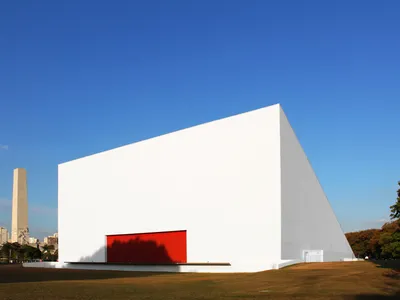
Oscar Niemeyer's Ibirapuera Park Pavilions Define São Paulo's Cultural Identity in Concrete and Curve
A constellation of modernist volumes set within São Paulo's most important urban park, conceived for the city's 400th anniversary in 1954.
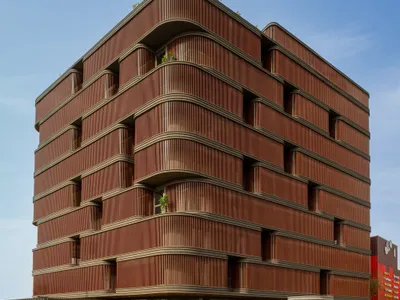
Sanjay Puri Architects Wraps a Jaipur Office Tower in Capsule-Shaped Green Buffers
A nine-level climate-responsive workplace near Jaipur Airport uses stacked planter terraces and aluminium screens to fight 40°C heat.
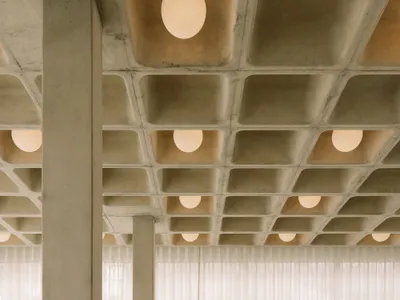
RHO Converts a Berlin Spree-Side Industrial Courtyard into Enkime's 1,000 m² Agency Headquarters
A social media agency's new home in Charlottenburg trades glossy branding for concrete waffle ceilings, glazed tile, and sheer curtains.

Explore Office Building Competitions
Discover active competitions in this discipline

Challenge to reimagine the Iron Throne

Photograph architecture without architects

Illustrate the lost glory of Angkor Wat - Render Challenge

Design challenge to reuse E-waste
Comments (0)
Please login or sign up to add comments
No comments yet. Be the first to comment!