

Foster + Partners Wraps a World-Class Broadcast Hub in Glass and Water at PGA TOUR Studios
A 165,000-square-foot media production facility in Ponte Vedra Beach, Florida, balances high-tech studio demands with passive cooling and rainwater systems


Broadcasting facilities are energy hogs by nature. Banks of LED walls, control rooms running around the clock, thousands of simultaneous video feeds: the program practically demands a building that guzzles power and ignores its surroundings. At Ponte Vedra Beach, Florida, Foster + Partners took on that contradiction directly with the PGA TOUR Studios, a 165,000-square-foot, three-level media production complex that sits beside TPC Sawgrass and the PGA TOUR's existing headquarters. The building houses eight production rooms, eight audio control rooms, and seven LED-outfitted studios, along with the largest golf footage library on earth. And yet its defining architectural gesture is not technological spectacle but a horizontal glass pavilion hovering over water, anchored by slender white columns and a generous overhanging roof.
What makes the project genuinely interesting is the tension between what happens inside and what the building projects outward. Internally, the program is dense and demanding: control rooms that can handle 144 live camera inputs, format-agnostic hardware built for a media landscape that changes every few years, corridors designed to flex as needs grow. Externally, the architecture reads as restrained, almost serene: a long, low datum line of white metal, concrete, and glass reflected in four artificial ponds that double as a stormwater management system. That duality, a production engine disguised as a lakeside pavilion, is the real design achievement.
A Floating Datum Over Water


The building's most striking quality is its relationship with water. Four artificial ponds surround the structure, collecting rainfall and channeling it through engineered soil into an underground irrigation system that requires no additional energy. The effect at dusk is remarkable: the three-story glass facade, horizontal louvers, and broad cantilevered roof double themselves in reflection, stretching the building's apparent scale while dissolving its mass. It is a landscape strategy and an architectural strategy operating as one.
The ponds are not ornamental. They handle up to the 98th percentile of rain events and ensure zero runoff impact on neighboring ecosystems. Outdoor irrigation water is supplied entirely by the harvested rainfall. The decision to make this infrastructure the building's visual centerpiece, rather than hiding it behind a parking lot, elevates what could be a mundane civil engineering task into the primary spatial experience.
Colonnades and the Canopy


Generous colonnades line the south and east elevations, creating shaded intermediate zones between the glass envelope and the Florida sun. The white cylindrical columns are deliberately oversized in visual weight relative to the roof they support, lending the building an almost civic gravity. This is not a sleek corporate campus pavilion trying to disappear. It announces itself as a public-facing institution.
The overhanging roof is the primary passive cooling device. In a subtropical climate where solar heat gain can dominate energy budgets, the deep canopy shades the curtain wall below and reduces reliance on mechanical cooling. Combined with daylighting strategies that illuminate 68% of regularly occupied spaces with natural light while controlling glare, the envelope works hard so the HVAC system does not have to. The result is a 13% reduction in energy consumption against baseline, a meaningful number for a facility running this much production equipment.
The Outdoor Room


Beneath the colonnade on the south side, a covered terrace with café seating brings production staff outside, framed by palm trees and ornamental grasses. The space reads as an extension of the interior rather than an afterthought bolted onto the facade. A landscaped pathway connects the studios directly to PGA TOUR's existing headquarters across a vast shared lake, reinforcing a campus logic that ties the two buildings together without requiring a car trip.
Biophilic design runs through the project at every scale: natural materials inside, extensive views to landscape from circulation spaces, and a deliberate blurring of the indoor-outdoor threshold. For a building whose primary rooms, the studios and control rooms, are necessarily sealed, dark, and artificially lit, these outdoor moments become critical pressure valves for the people who work there.
Production at the Core


Step inside the studios and the architectural language shifts entirely. Curved ceiling-mounted lighting rings, wraparound LED projection screens, and dense arrays of monitors replace the white columns and glass walls. The broadcast studio shown here demonstrates the facility's capacity to create fully immersive environments for on-camera presentation, with coastal imagery wrapping around the talent position. Seven LED-equipped studios and eight production control rooms give PGA TOUR the ability to produce multiple live broadcasts simultaneously.
The control rooms are designed around adaptability. Format-agnostic hardware and software mean the facility can absorb emerging broadcast technologies without major renovations. That kind of future-proofing is expensive up front but prevents the architectural obsolescence that plagues purpose-built media facilities within a decade. Scalability and flexibility were treated not as interior fit-out decisions but as core architectural requirements from the start.
Circulation and Interior Detail

A switchback staircase with integrated LED strip lighting along curved metal handrails connects the three levels. The top-down view reveals a careful attention to detail in the circulation spaces, which in a facility with 18 main corridors could easily become anonymous. The stair is both wayfinding device and design object, drawing occupants through the building vertically while offering a moment of spatial relief between the sealed production environments.
Construction waste was held to roughly 12 pounds per square foot, and low-toxicity, low-impact materials were specified throughout. The building's embodied carbon intensity landed at 42 kg CO2e per square foot, a figure that speaks to disciplined material selection across a large-format commercial project. LEED certification was achieved, with the facility performing well across energy, water, and indoor environmental quality categories.
Plans and Drawings


The site plan reveals the building's relationship to its parking and landscape context, with the rectangular footprint oriented to maximize the south and east glass facades toward the water. Floor plans across all three levels show spaces organized around a central courtyard or void, a move that brings daylight deep into the plan and provides orientation within what could otherwise be a disorienting matrix of dark studios and corridors. The perimeter circulation strategy keeps the sealed production rooms at the core while lining the edges with naturally lit workspace.
Elevations confirm the building's emphatically horizontal character: the roof line and colonnade base create a consistent datum on all four sides, while rooftop plantings soften the profile from a distance. The longitudinal section cuts through the structural grid to reveal how the multi-story interior spaces interlock, with studios stacked and corridors threaded between them. The wall section detail is particularly revealing, showing the acoustic assembly layers, insulation, and metal deck that make a broadcast-grade enclosure possible behind the clean glass facade.
Why This Project Matters
Media production facilities rarely enter the architectural conversation. They tend to be black boxes wrapped in tilt-up concrete, optimized for technical performance and indifferent to context. PGA TOUR Studios demonstrates that a building housing some of the most energy-intensive programming in sports broadcasting can also perform as a piece of landscape architecture, managing stormwater, reducing heat gain through passive means, and creating genuinely pleasant outdoor spaces for the people who spend long days inside windowless control rooms.
Foster + Partners' contribution here is not a signature form or a heroic structural gesture. It is a disciplined, systems-level integration of program, climate, and site. The building's value lies in the argument it makes: that high-performance technical facilities and environmental responsibility are not competing priorities but complementary ones, and that the architectural resolution of that tension can produce something worth looking at across the water.
PGA TOUR Studios by Foster + Partners. Ponte Vedra Beach, Florida. 165,000 square feet. Completed 2024. Photographs by Nigel Young.
About the Studio
Share Your Own Work on uni.xyz
If projects like this are the kind of work you want to make, uni.xyz is a place to publish your own, find collaborators, and enter design competitions.


Popular Articles
Popular articles from the community

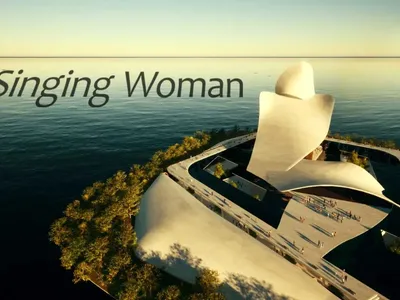
Singing Woman: An Opera House That Performs Before the Curtain Rises
Ovidiu Cristian Pavel's conceptual opera house translates Estonia's choral identity into a sculpted waterfront landmark facing the Baltic Sea.
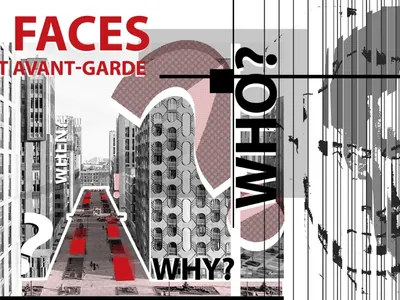
Faces of the Soviet Avant-Garde: Turning Moscow's Street Names into an Open-Air Museum
A network of sculptural installations across a Moscow residential district transforms forgotten architect names into spatial encounters with cultural memor
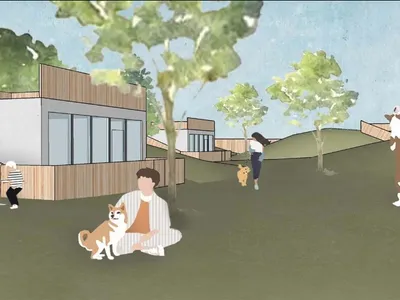
Temporary Home for Dogs: A Reversed Zoo Rethinks Animal Shelter Architecture
In Bucharest, a sinuous corridor and freed landscape flip the logic of containment, designing a shelter that works to make itself unnecessary.
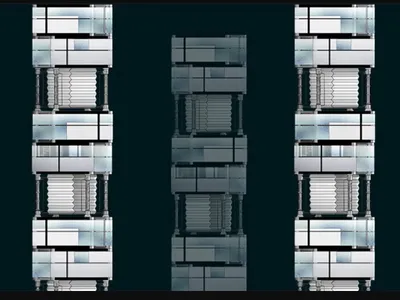
Tsunami Convergenics: Turning Catastrophic Ocean Forces into Underwater Housing Infrastructure
A speculative underwater settlement off the coast of Onagawa, Japan, treats tsunamis and typhoons as energy sources rather than threats.

Similar Reads
You might also enjoy these articles

Hodi-Mandai Geram
Project Function: Preservation and revitalization of the Intangible heritage and socio-spatial identity of the Hodi by Housing, Cultural Memory Center, Sacred Grove, landscape, local tourism economy

Olio Towers: A Mid-Rise for Performers That Fuses Housing, Rehearsal, and Stage
Located blocks from Houston's Theater District, this modular tower stacks living units around a central performance atrium.
Oasis: Modular Green Housing Carved into Dhaka's Urban Fabric
A shortlisted Plugin Housing entry reclaims unauthorized settlements in Dhaka with stepped concrete volumes, green roofs, and ventilation-driven design.

Black Hole: A Floating Megastructure for the Post-Physical Era
Emiliano Mazzarotto envisions a spherical, self-scaling arena where e-sports, digital hotels, and holographic stadiums replace traditional public space.

Explore Architecture Competitions
Discover active competitions in this discipline

Challenge to reimagine the Iron Throne

Photograph architecture without architects

Illustrate the lost glory of Angkor Wat - Render Challenge

Design challenge to reuse E-waste
Comments (0)
Please login or sign up to add comments
No comments yet. Be the first to comment!