

Technopark: Timber Volumes That Put Culture on the Ground Floor and Learning Above
Aigyl Gilmutdinova's Technopark layers public exhibition floors beneath studios and labs, tied together by courtyards, timber and harvested rainwater.


Most technoparks are built like business parks: gated, scheduled, and empty after the last lab closes. The Technopark works from a different idea. It treats innovation as a public activity, putting robotics labs and libraries in the same building as film screenings, performance areas and self-organised discussion clubs. The bet is that a building with overlapping uses stays active at more hours of the day, and that a child who comes for an exhibition might go home curious about a workshop upstairs.
The project was developed by Aigyl Gilmutdinova and published on her uni.xyz profile. It is set in a context the designer describes as rich in natural surroundings and public potential. The brief is broad: a cultural institution, an educational centre and a civic gathering space in one integrated complex. The response is a cluster of interconnected blocks built from breathing materials and organised around courtyards, with sustainability strategies running from the facade to the paving.
Fragmented Massing That Still Reads as One Ensemble
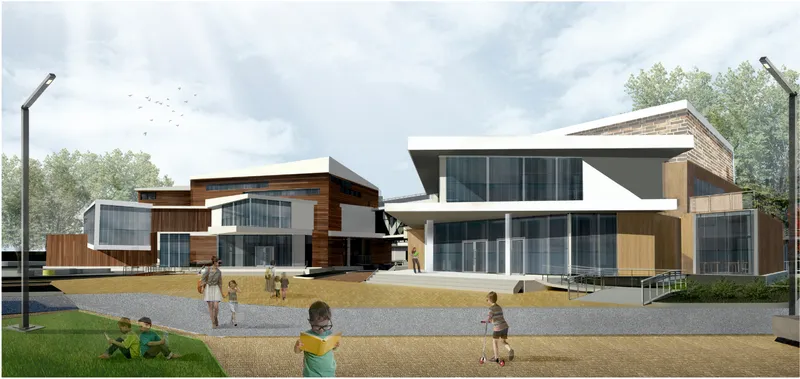
The opening rendering sets the tone: two timber-clad volumes under crisp white roof planes, their ground floors fully glazed and open to a lawn where children play. Breaking the programme into separate blocks keeps the scale domestic rather than institutional, and the shared vocabulary of wood and white framing holds the pieces together. The project's own logic is visible here. Each block answers a specific functional need, yet they stay visually and physically connected, so the complex reads as a single campus instead of a collection of pavilions.
The glazed ground floor is the key move. By placing exhibition zones, performance spaces and shared amenities at street level, Gilmutdinova lets the public see into the building before they decide to enter. Transparency works here as an invitation rather than a style, and it carries the project's central claim that a technopark should be as approachable as a park.
A Vertical Atrium Where Learning Meets Public Life
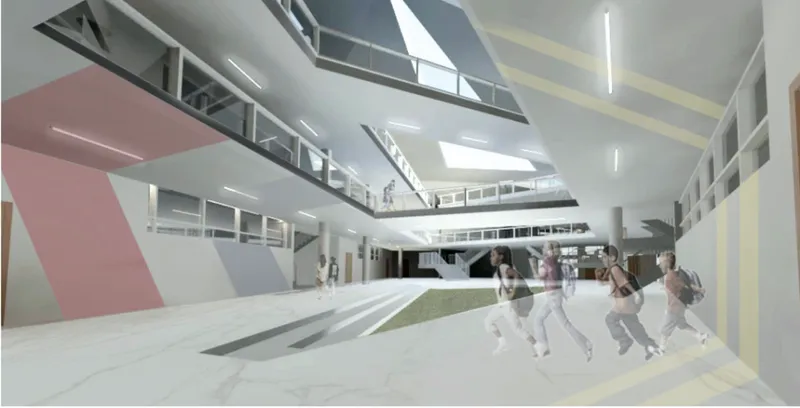
Inside, the programme stacks vertically. The atrium rendering shows a multi-level void lit by skylights, with pink and grey wall panels lining the upper floors and students running across a marble floor below. This is where the vertical distribution becomes something people can feel: classrooms, workshops, libraries and studios sit on the upper levels, while the public ground floor stays open and loud. The void links the two, so anyone on the lower level can see the activity above.
That visual link matters for a building that wants learning and culture to overlap. A robotics lab seen from an exhibition floor stops being a closed room and becomes part of the show. The soft palette also keeps the interior from feeling like a corporate lobby, which suits a space meant for informal meetings and self-organised community activity as much as formal instruction.
Courtyards, Bridges and a Landscape That Breathes
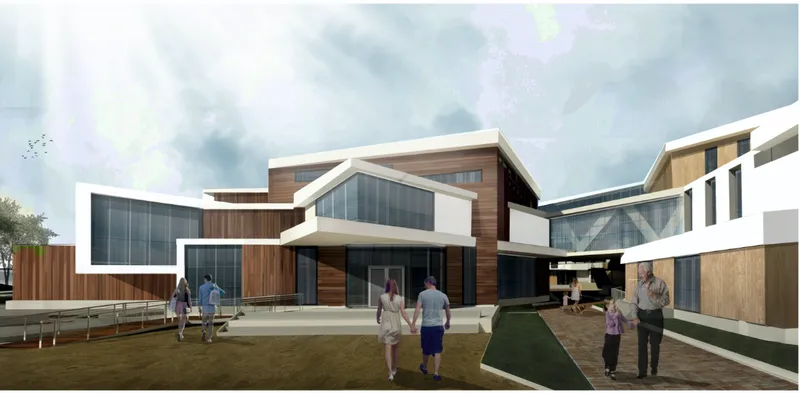
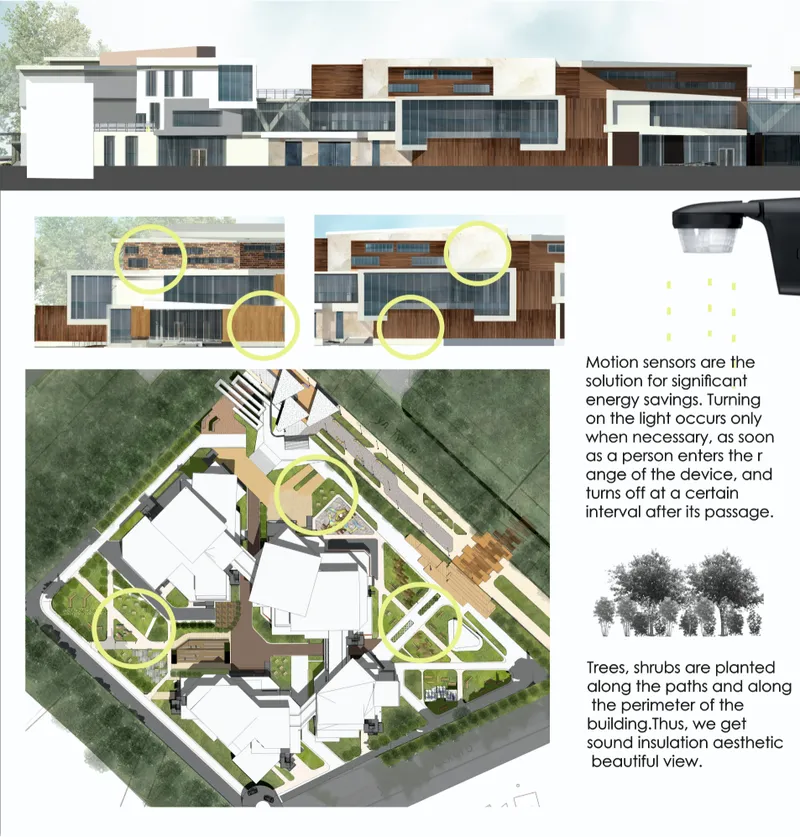
The entrance facade combines timber cladding, white frames and a glazed bridge between volumes. The bridge does practical work: it keeps the blocks connected at upper levels so that circulation stays continuous even where the massing breaks apart. The presentation board makes the site strategy clear. Its aerial plan circles planted courtyards set among tree-lined paths, and the street elevation and facade crops show the material rhythm at closer range. Courtyards, routes and transitional spaces set up a sequence of changing viewpoints that rewards wandering through the complex.
The material and environmental choices fit this approach. Wood, plaster and facing brick are chosen as breathing materials that support healthier interiors and reduce reliance on artificial climate control, while double glazing limits heat loss through the large openings. Outside, ecological paving lets grass grow through its openings, absorbing water and cutting surface runoff without breaking the visual continuity of the grounds. Rainwater collection and recycling systems filter and store water for reuse, reducing demand for potable supply. Taken together, these measures make the landscape part of the building's environmental performance rather than decoration around it.
Why This Project Matters
The Technopark questions an assumption that still shapes many innovation districts: that research and education need separation from the public to function. Gilmutdinova's scheme argues the opposite. By placing performance, film and exhibition at ground level and labs and studios above, with a shared atrium and courtyards between them, it builds a vertical section in which curiosity can travel upward. That organisational idea is the project's strongest contribution, and other designers could apply it to libraries, schools and civic centres.
Its sustainability agenda is modest in tone but coherent in practice. Breathing materials, permeable paving and rainwater reuse are not new on their own, yet here they support the same goal as the programme: a building that is open, porous and easy to occupy. The next step would be to show how the flexible spaces adapt over time and how the courtyards perform across seasons. As a framework for public architecture that treats learning as a civic act, the Technopark is a convincing proposal.
View the Full Project
About the Designers
Designer: Aigyl Gilmutdinova
Enter a Design Competition on uni.xyz
uni.xyz runs architecture and design competitions year-round that reward proposals with spatial conviction and real site intelligence.
Project credits: Technopark by Aigyl Gilmutdinova.


Popular Articles
Popular articles from the community


U.GA Architects Wraps an Oval Rooftop Pool in Curved Board-Formed Concrete on Busan's Jeollidan-gil
In Busan's Jeonpo-dong, a 454 m² mixed-use block stacks a neighborhood facility, guest rooms and an oval rooftop pool inside spiraling concrete walls.

David Ortega Stacks a Two-Story Mexico City Penthouse Around a Steel Stair and a Pergola-Shaded Roof Terrace
In Colonia Roma, a 300 m² penthouse uses oak joinery, a planted steel stair and a slatted roof pergola to make a new-build apartment feel like a house.

Jaramillo Van Sluys Arquitectura and Urbanismo Turn a Demolished Registry Lot in Quito into an Orchard Plaza
In Quito's Centro Histórico, a 2,800 m² plaza exposes the San Agustín convent wall and redraws its lost Augustinian orchard in volcanic stone.

LT2A and OPEN Architectes Thread a Brick and Glass High School Through a Wooded Belgian Campus
In Braine-l'Alleud, a 3,000 m² wing for Collège Cardinal Mercier pairs pale brick with a glazed colonnade, deferring to a small chapel and a dense wood.

Similar Reads
You might also enjoy these articles

Maya Harvest: A Cacao Resort Village Rooted in Mayan Tradition and Local Craft
Situated within a Tabasco cacao plantation, this shortlisted resort proposal merges vernacular materials with hands-on cultural immersion.
Harmonia: A River-Shaped Community That Grows Over Decades in Boa Vista
Curved pathways and modular grid structures along the Branco River create a phased settlement designed to evolve from 2030 to 2050.

The Architecture of Bathing: A Mughal Hammam Reimagined Across the Yamuna
Charlotte May's honorable mention entry for The Black Taj reinterprets Agra's bathing rituals through red sandstone, water, and framed views of the Taj Mah
Om-1: A Wall-Hung System That Moves Your Workspace Off the Desk
Modular plywood boards, magnetic pegs, and utility elements migrate clutter from the horizontal surface to the vertical plane.

Explore Public Architecture Competitions
Discover active competitions in this discipline

Challenge to design a portable theatre

Challenge to design a portable music platform

Challenge to design public laboratory

Challenge to design an open learning module for the elderly
Comments (0)
Please login or sign up to add comments
No comments yet. Be the first to comment!