

emBRACEMENT: Turning Agra's Pollution into Architecture That Breathes
A porous arabesque monument across the Yamuna from the Taj Mahal filters air and water while redefining love as ecological stewardship.


What if the next great monument on the Yamuna River was not built to commemorate love for one person, but to protect an entire city? Across the water from the Taj Mahal, a porous arabesque shell rises as a filtering body: absorbing polluted air, purifying water, and giving back to a landscape stretched thin by environmental neglect. The building is not white marble. It does not compete with Shah Jahan's masterpiece. Instead, it completes a conversation left unfinished for centuries, extending the myth of the Black Taj into a working bioclimatic ecosystem.
Designed by Yusuke, Gen Saito, Mai, and Yuki, "emBRACEMENT" received an Honorable Mention in The Black Taj competition. The team reframes Shah Jahan's devotion to Mumtaz Mahal as something broader: a narrative of protection directed at Agra's people, its river, and its fragile ecology. Sited on the opposite bank of the Yamuna, the project positions itself as a reflective counterpart to the Taj, one that absorbs and gives back rather than simply enduring.
An Arabesque Canopy as Structural Forest

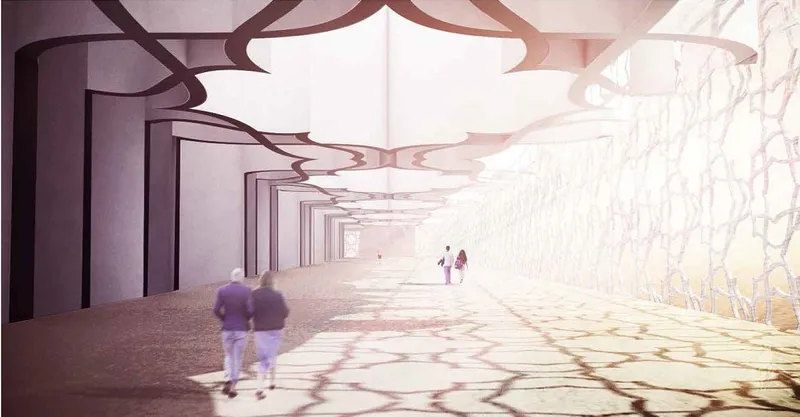
The interior reads like an ethereal forest. Vertical columns branch upward into curved ceiling ribs, forming an arabesque canopy that filters sunlight into geometric patterns drawn from Islamic tradition. The effect is not decorative overlay; it is the structure itself. Branching ribs carry loads while carving sacred voids overhead, letting light shift through the day in ways that recall the dappled illumination of a dense tree canopy. In the gallery spaces, a white staircase threads through this lattice, and visitors are scaled against the soaring structural rhythm to quietly powerful effect.
A long corridor reveals how the repetition of dark columns and organic ceiling patterning casts deep, intricate shadows onto terrazzo floors. The spatial sequence is deliberate: narrow corridors expand into luminous halls, creating what the designers call "sequences of embrace." Solid balances void, private dissolves into public, and environmental data becomes spatial rhythm. Each passage captures the shifting tones of Agra's sky.
Filtering Flow: Air and Water as Design Material
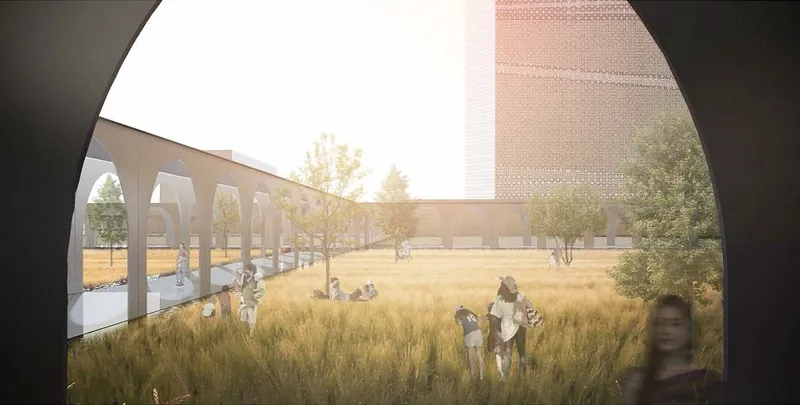
At the core of the project sits a "Filtering Flow System" that integrates air and water purification directly into the architectural framework. Absorption and photocatalyst filters embedded within the porous shell transform polluted air into purified flow through a combination of natural and mechanical exchanges. Below grade, underground heat exchange networks moderate interior temperatures and assist in water recycling. An air-conditioning garden, visible through arched openings, purifies air while sustaining micro-ecosystems above. The view through the colonnade onto grassy courtyards and a perforated brick tower shows how landscape and engineering merge into a single living infrastructure.
Columns, Marble, and the Weight of Intimacy

One of the most compelling interior moments occurs in a passage where rhythmic dark columns stand beside a textured marble wall under dappled light. The branching ceiling structure overhead is clearly load-bearing, yet it reads as organic, almost vegetal. The space feels both intimate and monumental. There is a tactile quality here: rough marble surfaces catch light in ways that smooth Mughal precedents never allowed. Where the Taj Mahal expressed permanence through flawless symmetry, emBRACEMENT embodies impermanence and transformation. Its surfaces change with the hour. Its porous skins breathe.
A Glowing Shell Reflected on the Yamuna
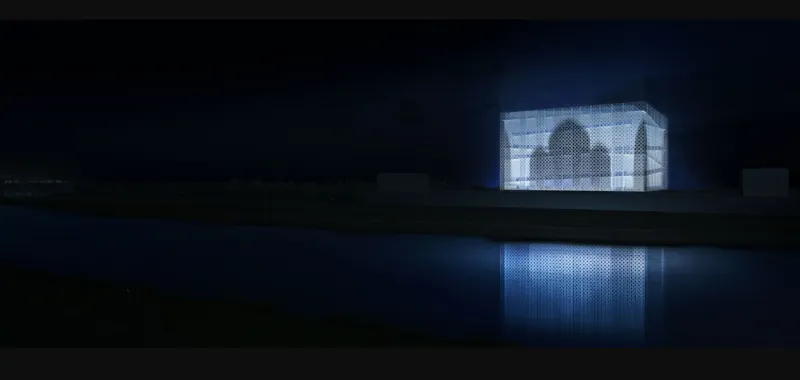
At night, the perforated facade transforms into a lantern beside still water. The illuminated skin glows against a dark sky, its reflection doubled on the river's surface, creating a quiet mirror dialogue with the Taj Mahal upstream. The image confirms that the building's porous shell is not merely a filtering mechanism but a calibrated luminous surface, turning environmental performance into visual presence. It is this dual reading, infrastructure as icon, that gives the project its conceptual weight.
Civic Life Inside a Monument
The programme resists monumental emptiness. A library, museum, entrepreneurship offices, and natural conditioning gardens are woven through the structure, connecting the living city to its historical soul. Green corridors and cultural nodes extend across the Yamuna, bridging the gap between heritage precinct and everyday urban life. The design insists that a symbolic building must also be a used building, rooting ecological awareness in civic routine rather than visitor spectacle.
Why This Project Matters
emBRACEMENT treats heritage not as something to preserve under glass but as an active conversation between past and future. By positioning a bioclimatic filtering system inside an arabesque shell on the banks of one of India's most culturally charged rivers, the team proposes that mythology can become mechanism and legacy can become a living system. The project converts Shah Jahan's personal devotion into planetary care, a reframing that feels both poetically generous and technically grounded.
What makes this Honorable Mention entry compelling is its refusal to separate symbol from system. The porous facade purifies air and glows at night. The underground networks cool interiors and recycle water. The arabesque canopy carries structural loads and shapes devotional light. In every detail, the environmental and the cultural are fused into one gesture. For Agra, a city often defined by what it already has, emBRACEMENT proposes something it desperately needs: architecture that heals the ground it stands on.
View the Full Project
About the Designers
Designers: Yusuke, Gen Saito, Mai, Yuki
Enter a Design Competition on uni.xyz
uni.xyz runs architecture and design competitions year-round that reward proposals with spatial conviction and real site intelligence.
Project credits: The Black Taj - DRKD47 by Yusuke, Gen Saito, Mai, Yuki The Black Taj (uni.xyz).


Popular Articles
Popular articles from the community


U.GA Architects Wraps an Oval Rooftop Pool in Curved Board-Formed Concrete on Busan's Jeollidan-gil
In Busan's Jeonpo-dong, a 454 m² mixed-use block stacks a neighborhood facility, guest rooms and an oval rooftop pool inside spiraling concrete walls.

Jaramillo Van Sluys Arquitectura and Urbanismo Turn a Demolished Registry Lot in Quito into an Orchard Plaza
In Quito's Centro Histórico, a 2,800 m² plaza exposes the San Agustín convent wall and redraws its lost Augustinian orchard in volcanic stone.

David Macias Steps a Doorless Stone and Plaster House Down a Tropical Colombian Hillside
In the humid hills of Colombia, Threshold House replaces the front door with an open void and terraces its 850 m² down the slope instead of fighting it.

LT2A and OPEN Architectes Thread a Brick and Glass High School Through a Wooded Belgian Campus
In Braine-l'Alleud, a 3,000 m² wing for Collège Cardinal Mercier pairs pale brick with a glazed colonnade, deferring to a small chapel and a dense wood.

Similar Reads
You might also enjoy these articles


Aquadapt: An Underwater Habitat That Rewrites Its Rooms by the Hour
Curved modules ring the seabed while one shell shifts from breakfast room to cinema, farm and football pitch as residents' needs change.

Play: Fragments of Their World: Remembered Architecture Rebuilt as a Modular Playground for Refugee Camps
Tom Gardner abstracts domes, arches and towers from the homelands of displaced families into a kit of child-scaled play parts for camp settlements.
REBIRTH: A Circular Settlement Where Afghan Widows and Their Children Rebuild Life Together
A shortlisted Resile entry turns the circle into a protective ring of timber and brick, gathering homes, classrooms and gardens around a shared landscape.
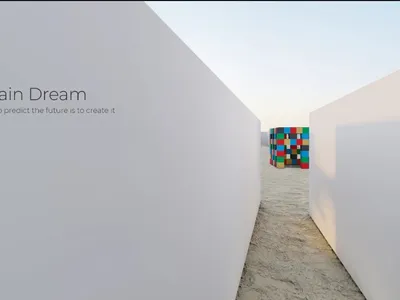
The Main Dream: A Recycled Plastic Kit That Lets Refugee Children Build Their Own Playground
Thirty-centimetre interlocking cubes that connect on three axes turn play into construction, letting children author the spaces they occupy.

Explore The Black Taj Competitions
Discover active competitions in this discipline

Challenge to reimagine the Iron Throne

Photograph architecture without architects

Illustrate the lost glory of Angkor Wat - Render Challenge

Bring back Drive In's
Comments (0)
Please login or sign up to add comments
No comments yet. Be the first to comment!