

Aslam Sham Architects Wraps a Kerala Home in Diagonal Brick and a Cantilevered Yellow Box
On a compact plot in Calicut's Thiruvannur, a five-bedroom house fuses patterned brickwork with bold metal geometry to rethink suburban living.


Kerala's suburban fabric rarely asks for attention. Row after row of gated compounds settle into a rhythm of concrete, tile, and the occasional flourish of colour. The Yellow Box, completed in 2024 by Aslam Sham Architects, refuses that anonymity. Occupying a modest 10-cent (roughly 4,355 sq. ft.) plot in Thiruvannur, Calicut, the five-bedroom residence announces itself through a three-dimensional brick veil laid on the diagonal and a cantilevered yellow metal volume that juts into the street view like a piece of industrial origami.
What makes this house worth studying is not just its graphic punch but the logic behind the spectacle. The brick screen is not decorative wallpaper: it filters light, moderates privacy, and channels ventilation across a plan that has almost no interior partition walls in its common areas. The yellow box is not cosmetic either: it houses the staircase, the vertical spine that connects the home's public and private zones. Every material choice here carries structural and environmental weight, and the tension between the handmade quality of the brickwork and the precision of the metal finish gives the project its real character.
A Facade That Breathes
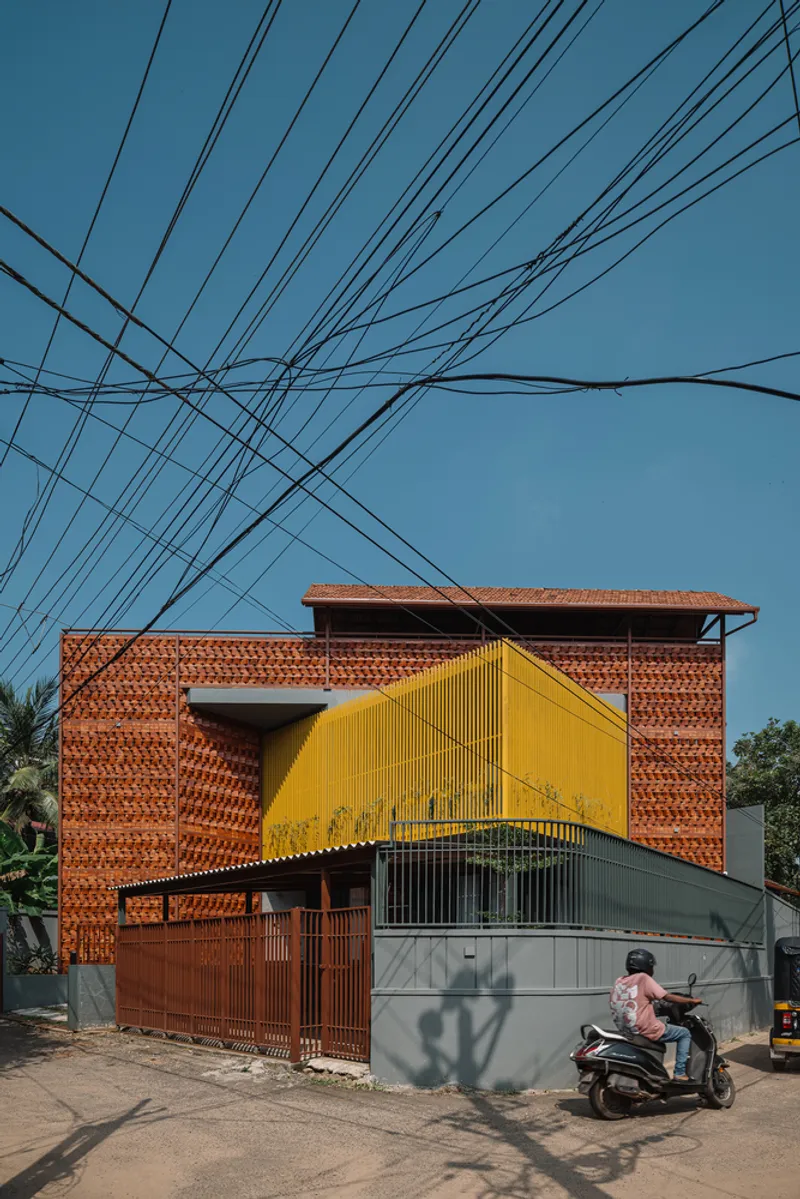

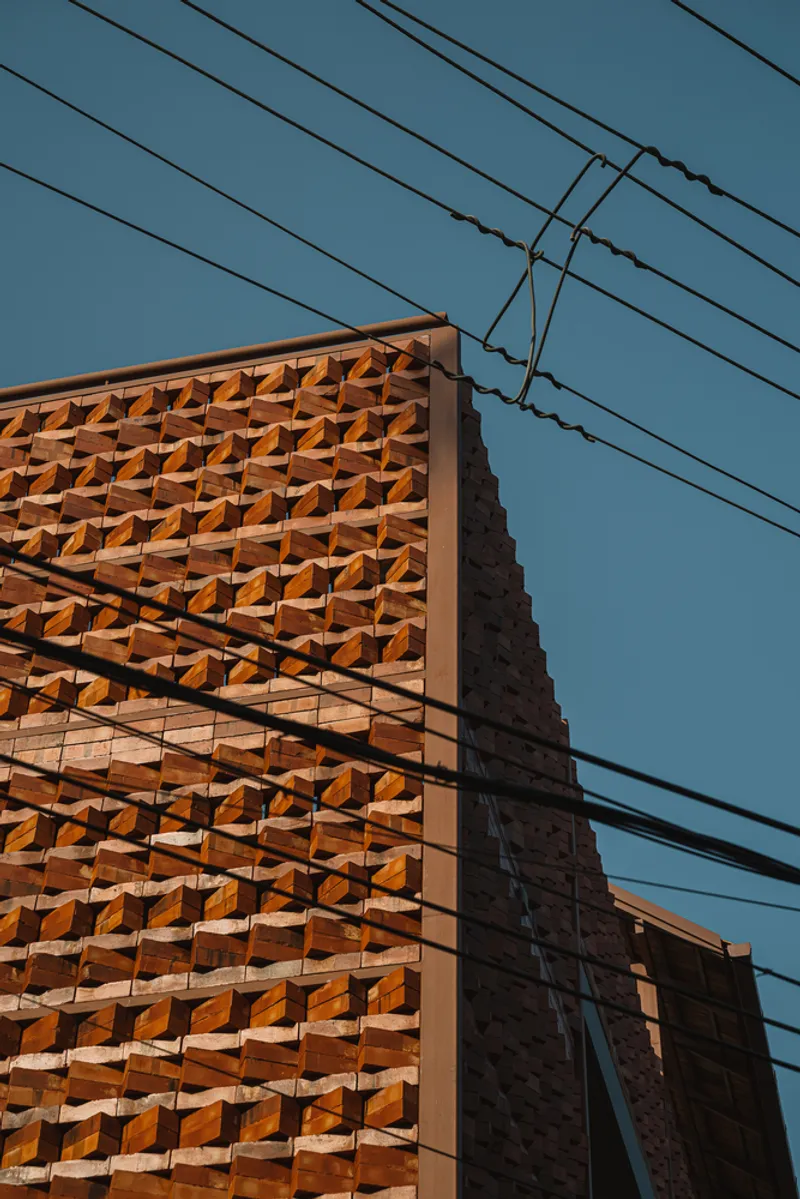
The street elevation reads as two competing systems: a massive, gabled brick wall patterned in a basketweave-like diagonal grid, and the sharp yellow louvered screen that punctuates it. The brick is not flush. Individual units are recessed and projected in a three-dimensional interlocking pattern that catches Kerala's equatorial sun at every angle, producing a shadow map that shifts hour by hour. At midday the wall looks almost flat; by late afternoon it becomes deeply sculptural.
This porosity is deliberate. The brick veil shields the house from direct street exposure while remaining permeable to air and diffused daylight. In a south-east-facing home in a tropical climate, that dual function is essential. The architects avoid the cliché of a jaali screen by scaling the pattern to the entire gable wall, turning what could be a decorative accent into the building's primary environmental strategy.
The Yellow Intervention
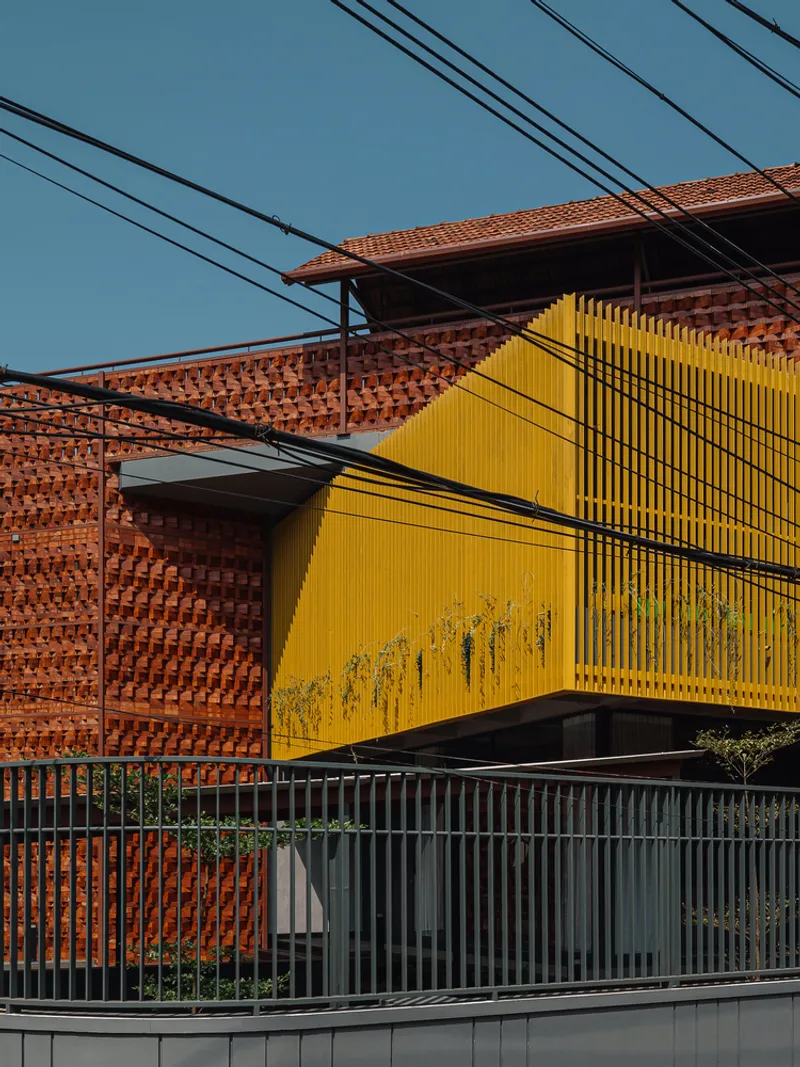
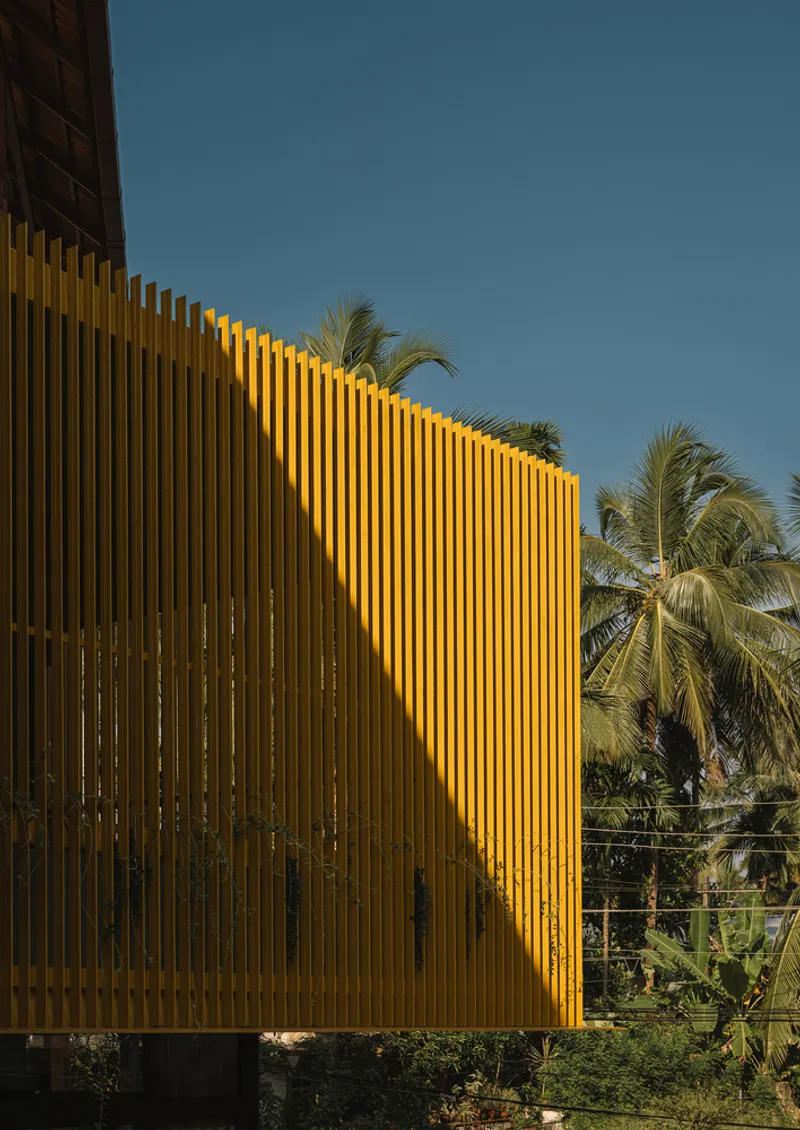

Where the brick is warm and rough, the yellow metal volume is slick and industrial. Vertical slats form a louvered screen that wraps the projecting box, letting it glow from within at night while reading as a solid colour block during the day. The contrast is not subtle, and that is precisely the point. Aslam Sham Architects treat the metal box as an insertion, a modern object dropped into the traditional brick envelope.
The colour choice itself is noteworthy. Yellow is uncommon in Kerala's residential palette, where whites, greys, and terracotta dominate. Here it signals a willingness to be seen, pulling the house out of its suburban context and turning the facade into something closer to public art. Flanked by palm trees and crossed by overhead power lines, the composition has an appealing rawness: this is not a sanitised render but a building that inhabits its messy, real neighbourhood.
Open Plan on a Tight Footprint

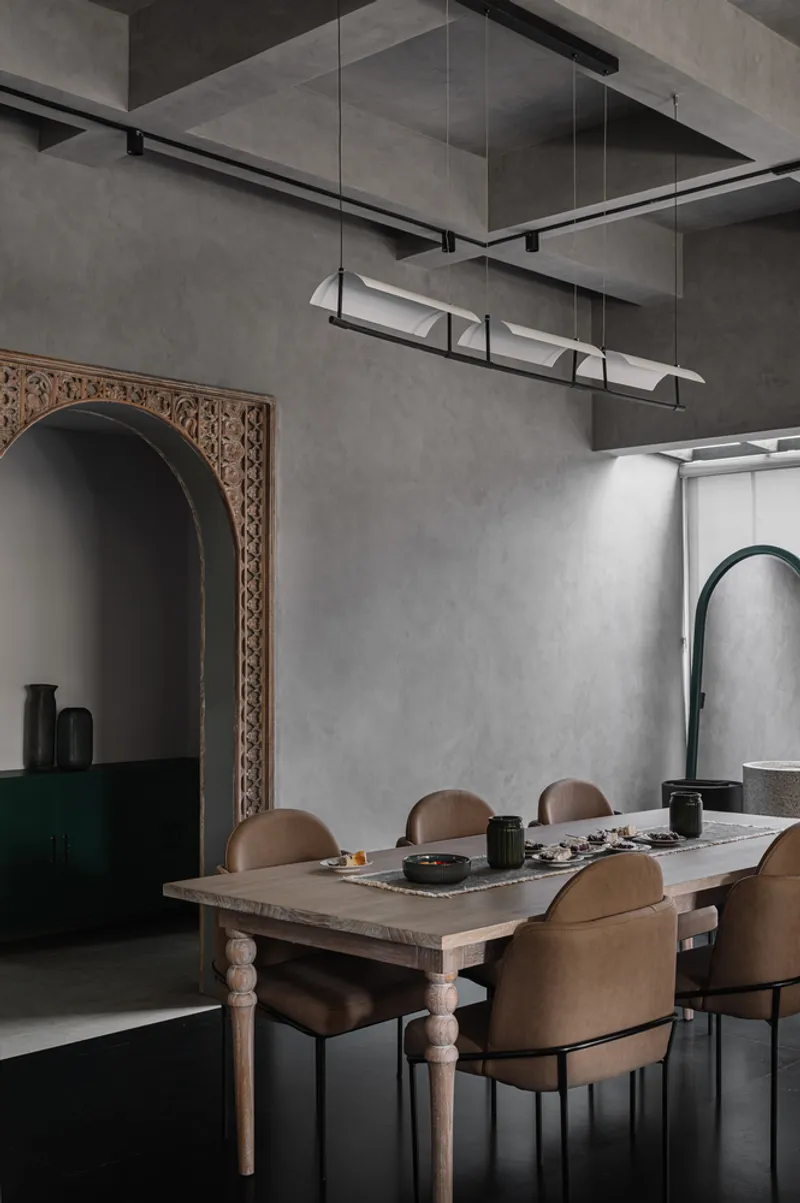
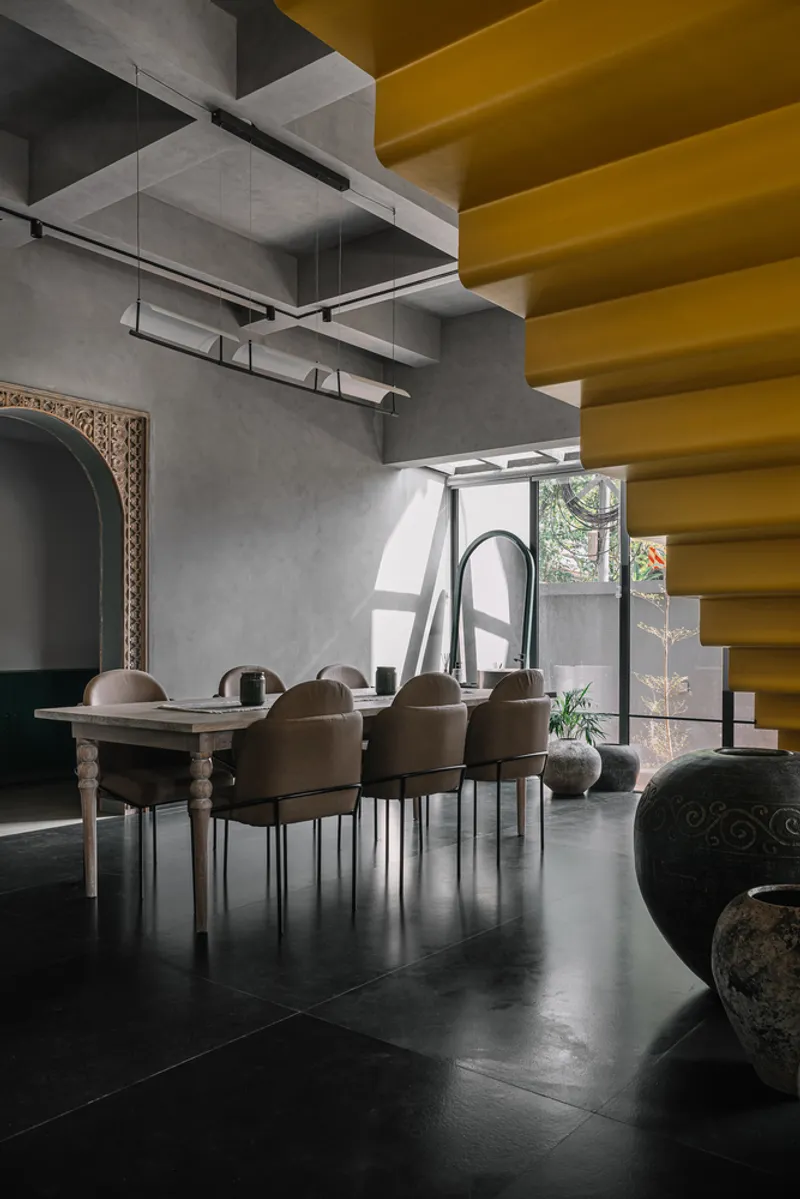
Inside, the 4,100 sq. ft. built-up area feels considerably larger than its numbers suggest. The architects stripped back interior walls in the common zones, letting living, dining, and circulation merge into a single continuous experience. Arched doorways frame sightlines from one area to the next, giving depth to a plan that could otherwise feel flat. A carved alcove beside the dining table introduces ornamental texture without consuming floor space.
Natural light is handled with care. The dining area sits beneath yellow-painted ceiling beams and receives generous daylight through a glazed doorway that opens to the rear. The colour yellow migrates from the exterior metal box into the interior palette, tying the two realms together. Linear pendant fixtures run low over the dining table, creating an intimate zone within the larger open volume. The effect is a house that feels both spacious and grounded, communal without being cavernous.
The Staircase as Centrepiece
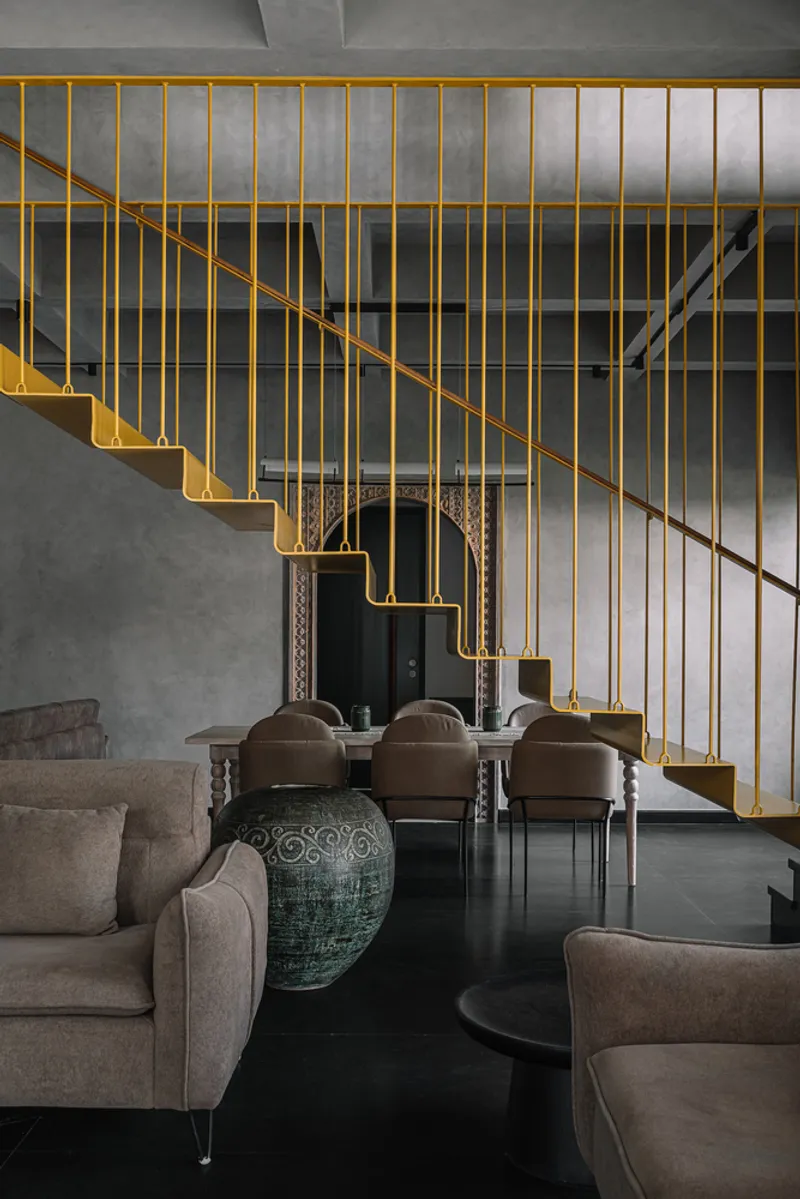

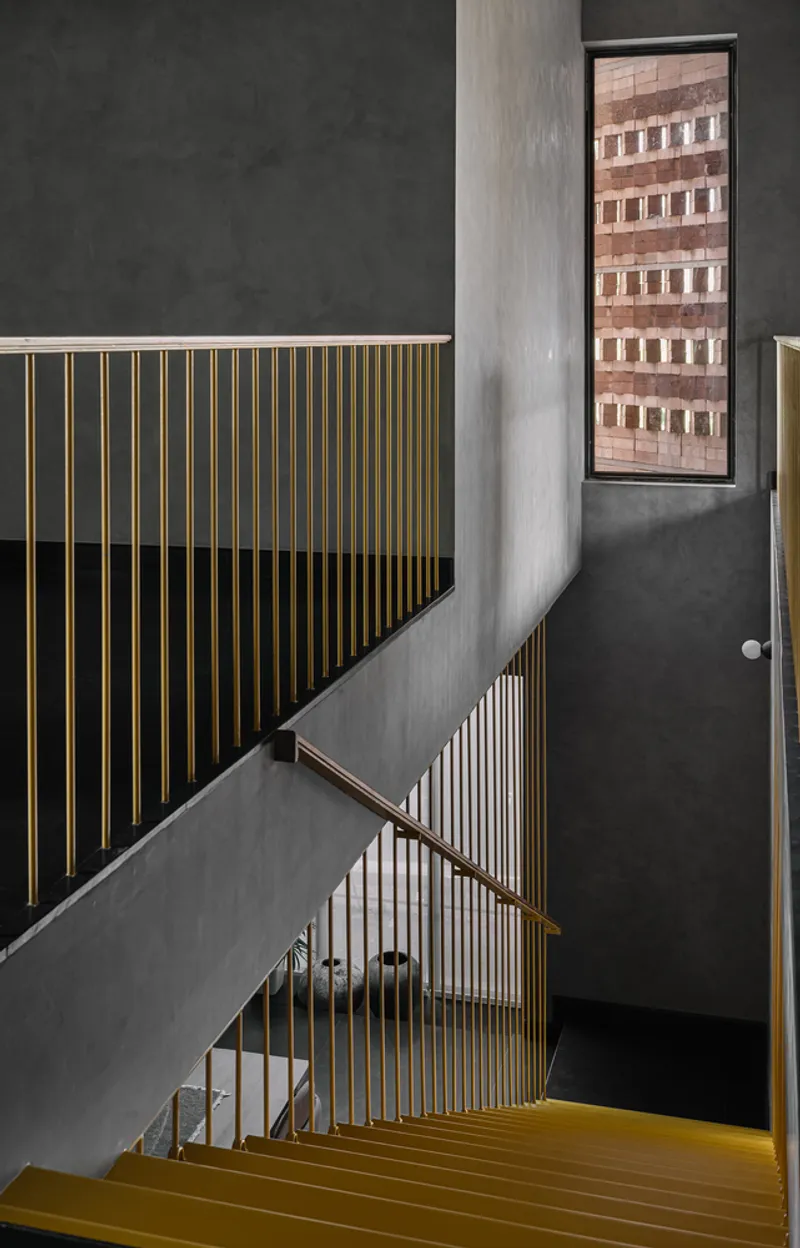
If the brick veil is the building's face, the staircase is its backbone. A cantilevered brass structure rises through the double-height living space, its treads floating against a backdrop of decorative tiled walls and arched windows. Vertical rod balustrades keep the visual weight low, allowing light to pass through the stairwell from narrow windows that frame views of the brick exterior beyond.
Seen from above, the stair reveals its construction honestly: each brass tread is anchored into the concrete wall and left exposed, with no soffit or cladding to disguise the engineering. The architects clearly want this element to be read as furniture rather than infrastructure, a warm metallic object that draws the eye upward and connects the social ground floor to the private bedrooms above.
Craft Meets Industrial Finish

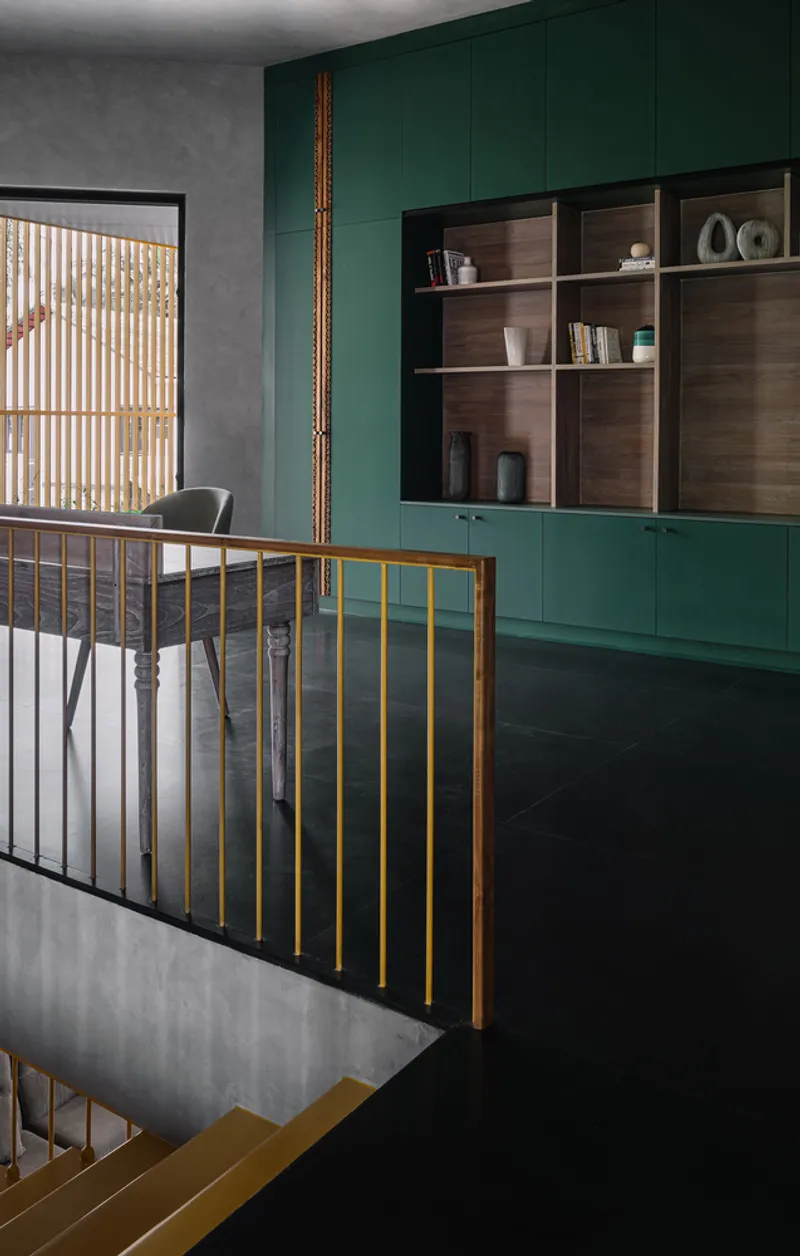

Throughout the interiors, the architects maintain a deliberate friction between handcrafted and machine-made surfaces. The brass staircase sits beside fabric screen walls and carved timber columns. An arched mirror reflects the stair against green lacquered cabinetry. Upstairs, a brass railing wraps the landing and gives way to green panelled storage walls that recall mid-century Kerala woodwork.
This layering of registers prevents the house from tipping into either pure minimalism or nostalgic pastiche. The carved decorative elements could belong to a traditional Malabar interior; the brass and green panelling feel contemporary. By letting these vocabularies coexist without resolving their differences, the design stays visually active. Every corner offers a new material conversation.
Private Rooms, Personal Texture

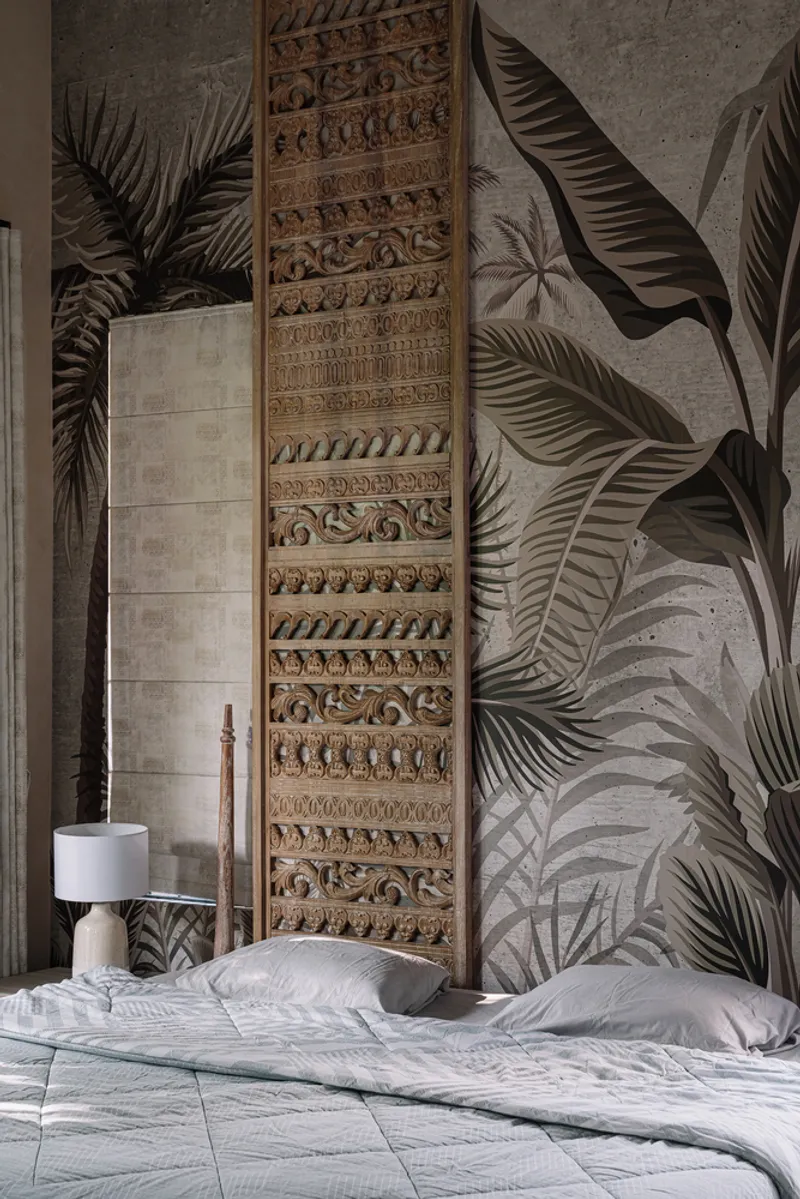
The five bedrooms are positioned to retain seclusion without disconnecting from the house's overall spatial narrative. One bedroom features a carved timber headboard panel mounted against a mural of tropical palm leaves, a bold gesture that gives the room its own identity while echoing the organic themes visible from the street. Daylight enters through controlled openings, preserving intimacy.
Looking down the brass stair run from the upper level, concrete walls and vertical metal rods frame slices of natural light from adjacent windows. The transition from public to private is gradual rather than abrupt, mediated by the staircase itself. You move from open living space, through the sculptural stairwell, into increasingly enclosed sleeping quarters. The sequence feels choreographed without being rigid.
Plans and Drawings
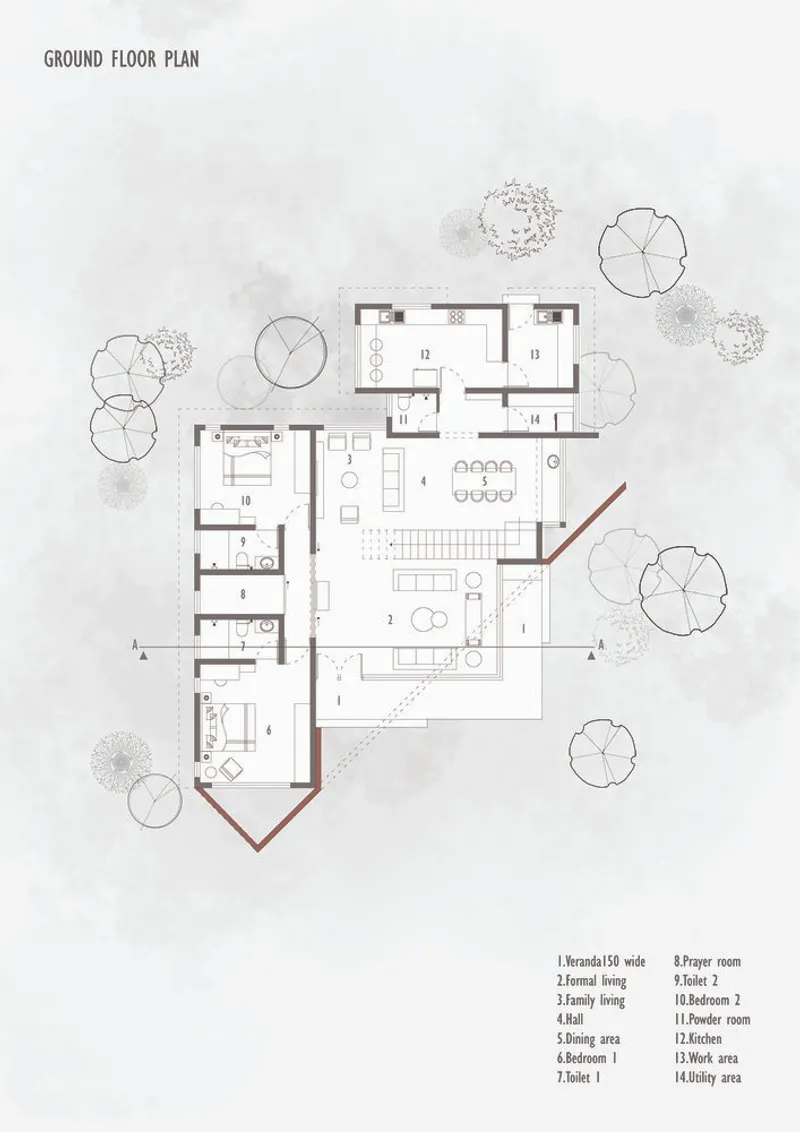
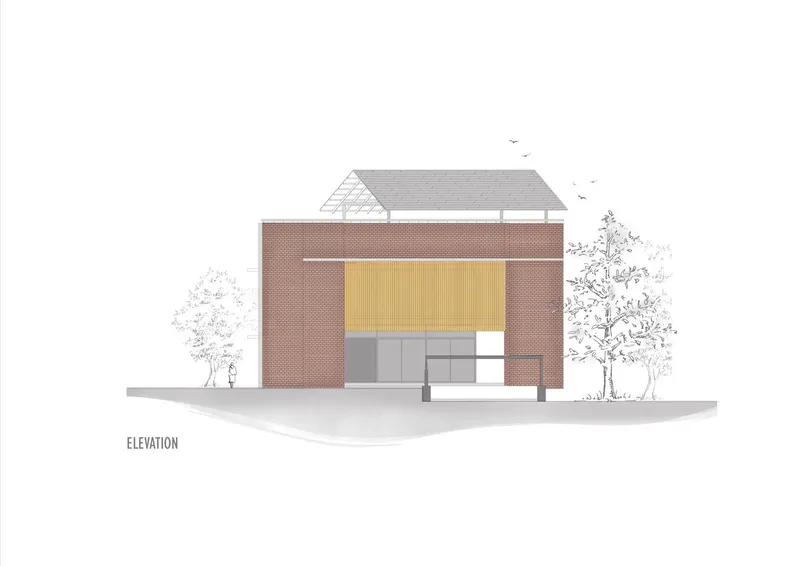

The ground floor plan reveals an angular layout with central living spaces surrounded by tree canopies, confirming how much the architects relied on landscape to soften the building's hard geometry. The elevation drawing shows the full interplay between the brick gable, the timber upper window panel, and the roofline. In section, the double-height stair void becomes legible as the hinge between the two storeys, with the brick veil standing as a freestanding plane in front of the enclosed volume. These drawings clarify what the photographs only hint at: the building is not one mass but a layered assembly of independent elements held in careful tension.
Why This Project Matters
The Yellow Box matters because it demonstrates that constraint can be generative. A 10-cent plot, a five-bedroom brief, a suburban street in Calicut: none of these ingredients suggest architectural ambition. Yet Aslam Sham Architects extracted a residence that operates on multiple levels simultaneously, as climate screen, as spatial instrument, as street sculpture. The diagonal brick pattern is not ornament applied after the fact; it is the building's primary environmental and privacy strategy, integral to the plan from the first sketch.
At a moment when much of Kerala's residential architecture oscillates between imported modernism and literal vernacular revival, this house carves out a middle path that feels genuinely local and genuinely new. The brass staircase, the carved timber, the terracotta brick, the yellow metal: none of these materials are exotic, but their combination here produces something that belongs to its place without repeating it. That is a harder trick than it looks, and it is what makes the project worth watching as the studio's trajectory develops.
The Yellow Box, designed by Aslam Sham Architects, Thiruvannur, Calicut, India. Plot area: 4,355 sq. ft. Built-up area: 4,100 sq. ft. Completed 2024. Photography by Ishi Sitwala.
About the Studio
Share Your Own Work on uni.xyz
If projects like this are the kind of work you want to make, uni.xyz is a place to publish your own, find collaborators, and enter design competitions.


Popular Articles
Popular articles from the community


David Ortega Stacks a Two-Story Mexico City Penthouse Around a Steel Stair and a Pergola-Shaded Roof Terrace
In Colonia Roma, a 300 m² penthouse uses oak joinery, a planted steel stair and a slatted roof pergola to make a new-build apartment feel like a house.

Cube Design Draws an Ecological Corridor Between Two Shenzhen Hills with the Nankai Building
Beside Shenzhen's container docks, the Nankai Building pairs stacked balconies with a climbing green screen to connect two hillsides across its height.

GROUP A Strips a 1969 Rotterdam Harbor Headquarters to Its Frame and Wraps It in Timber Louvers
In Rotterdam's M4H harbor district, Ferro Offices reuses a 1969 frame, adds one timber storey and reaches BREEAM-NL Outstanding.

U.GA Architects Wraps an Oval Rooftop Pool in Curved Board-Formed Concrete on Busan's Jeollidan-gil
In Busan's Jeonpo-dong, a 454 m² mixed-use block stacks a neighborhood facility, guest rooms and an oval rooftop pool inside spiraling concrete walls.

Similar Reads
You might also enjoy these articles


Hodi-Mandai Geram
Project Function: Preservation and revitalization of the Intangible heritage and socio-spatial identity of the Hodi by Housing, Cultural Memory Center, Sacred Grove, landscape, local tourism economy


Olio Towers: A Mid-Rise for Performers That Fuses Housing, Rehearsal, and Stage
Located blocks from Houston's Theater District, this modular tower stacks living units around a central performance atrium.

Oasis: Modular Green Housing Carved into Dhaka's Urban Fabric
A shortlisted Plugin Housing entry reclaims unauthorized settlements in Dhaka with stepped concrete volumes, green roofs, and ventilation-driven design.

Black Hole: A Floating Megastructure for the Post-Physical Era
Emiliano Mazzarotto envisions a spherical, self-scaling arena where e-sports, digital hotels, and holographic stadiums replace traditional public space.

Explore Exposed Brick Competitions
Discover active competitions in this discipline

Challenge to reimagine the Iron Throne

Photograph architecture without architects

Illustrate the lost glory of Angkor Wat - Render Challenge

Design challenge to reuse E-waste
Comments (0)
Please login or sign up to add comments
No comments yet. Be the first to comment!