
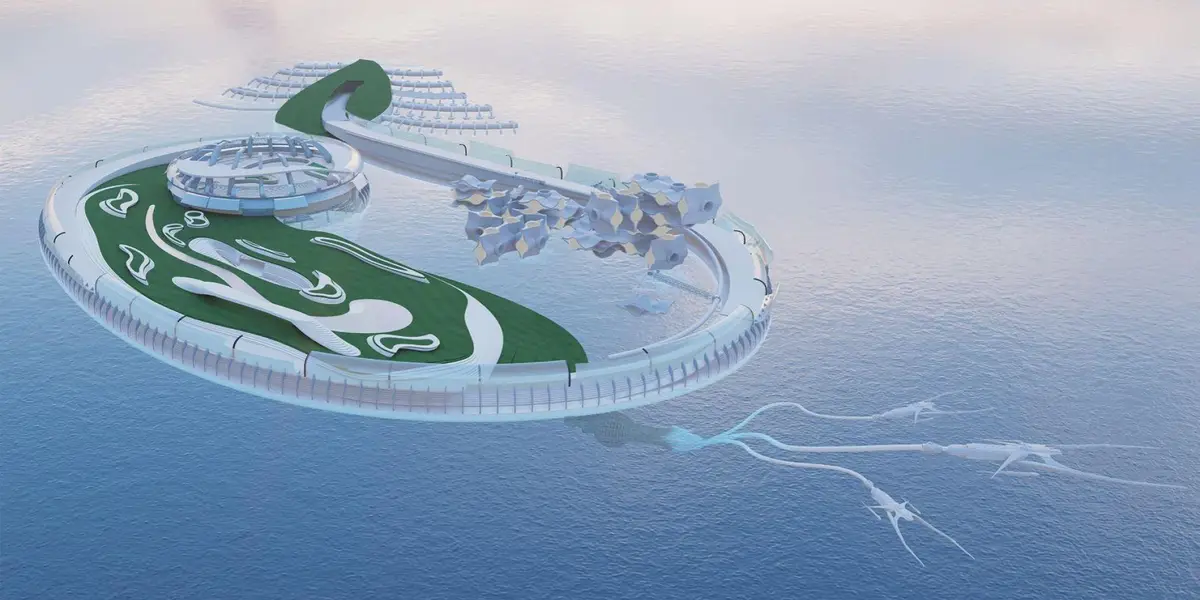
Designing for a future crisis: Architects envision floating habitats for survival in a world submerged in water.
Result for 'Atlantis' - Extreme Architecture Design challenge competition, out now.


The Climate crisis is one of the issues faced by the human race at the forefront, requiring our immediate attention. But due to its vast generalization around the world, the level of urgency for action is constantly underestimated.
Now, with everything said and done, we are left with the repercussions of our actions. Sea level rise is one of the most significant consequences, and its wrath can cause destruction that might be too difficult for even humans to overcome in time.
The global sea level is estimated to rise 30 centimeters by 2050. Chronic floods will affect 300 million coastal communities by then, and the home of 200 million people will be permanently underwater by the end of the century. These staggering statistics are pushing us to take action.
But as we are on the path of adopting sustainable ways of living, the efforts we take towards global flooding may be in vain. Some experts say that our efforts are not at par with the pace of sea-level rise, and we might not be able to combat it in time.
How can we ensure our survival in this scenario?
Although we were preparing for this eventuality to occur in the next thousand years, if the situation of submerging comes up sooner, it could potentially lead to the obliteration of our species. The image of the world, if we were to survive this eventuality, will be extremely different from what it is now. Consider, if humans as a species still exist and haven’t evolved gills to survive underwater, we need to come up with habitats that can give us a chance to not only survive but thrive. We will have to embrace the idea of a water world habitat, as less or no land may be available for respite.
Besides the mental preparation, the physical input to be put in, is immense, even with advanced technology to back us up. The habitat must be resilient to not just the old, but the new disasters that might come up in the water world. What kind of infrastructure would we need to adapt to the water world? What are the pitfalls that would come with being afloat? Can we overcome the issues with an efficient system?
What would our lifestyle be like in this new world?
Can preparing for such harsh conditions, highlight the need to protect our current resources, in the process?
Technology today makes it possible to create floating habitats for hundreds of people to survive well, for a limited time. But as humans will evolve with this circumstance, habitats can be made to survive humans, even permanently.
Brief: Challenge was to design a floating habitat for humans for a distant future where the world is imagined to be completely submerged in water.
The future water world will have limited resources so optimization of every element will be key to creating these habitats. The layout is critical as it will be shaped by the new way of living of people. The water habitat must be self-sustainable in the event that all land resources are flooded. It must be able to withstand unexpected adversities.
The aim was to design a safe, functional, and convenient floating habitat, to protect life, in a water world crisis.
Creative designs and inventive solutions can be futuristic but be seen from a scientific viewpoint. Strategies employed must be sustainable, for even when we are surrounded by water and facing calamities so that we do not repeat the same mistakes that we made on land.
Some of the Best competition projects are as follows:
Winning Project: The Wave
By: Tyler Kazimierczuk, BobiJo Lingle
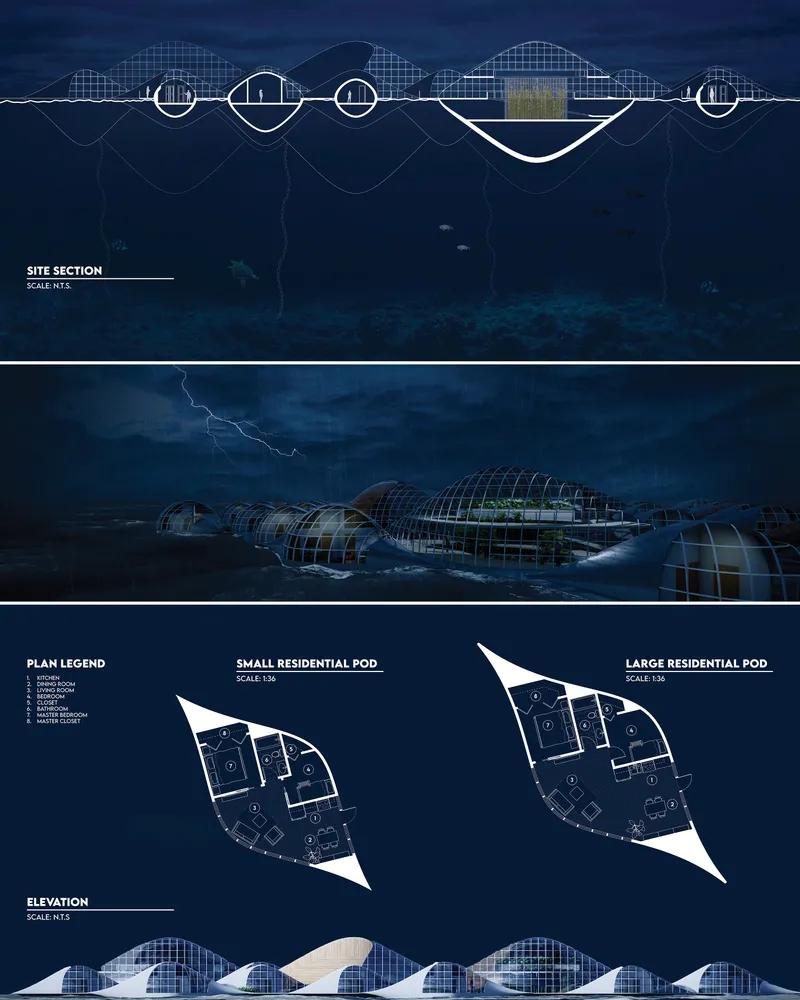
Fig: 1 Section and Site Plan
Description: The Wave is a project that addresses the climate crisis by providing a home to a community off the coast of modern day San Francisco. With sea water levels rising at alarming rates, this proposal offers a unique solution to this problem through influences of the natural environment and its benefits.
---------------------
People’s Choice: ATLANDIS
By: Michael Massu
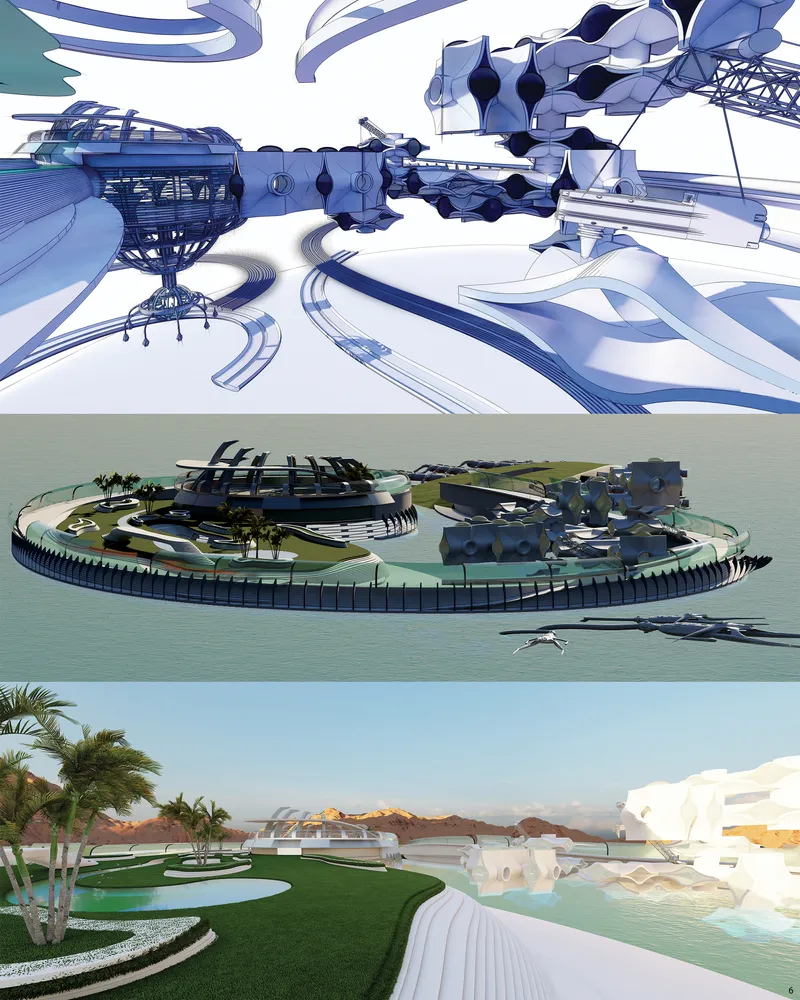
Fig: 2 Renders
Description: A powerful civilization once existed above the surface of the ocean. Later, floods of extraordinary violence swallowed all types of sophisticated construction and advanced technology. The story redacts back in 2100 when a night of misfortune all things above the surface of the ocean sank into the depth of the sea, starting a completely new era for us.
---------------------
Editor’s Choice: CORAL CITY
By: Jacob Smith
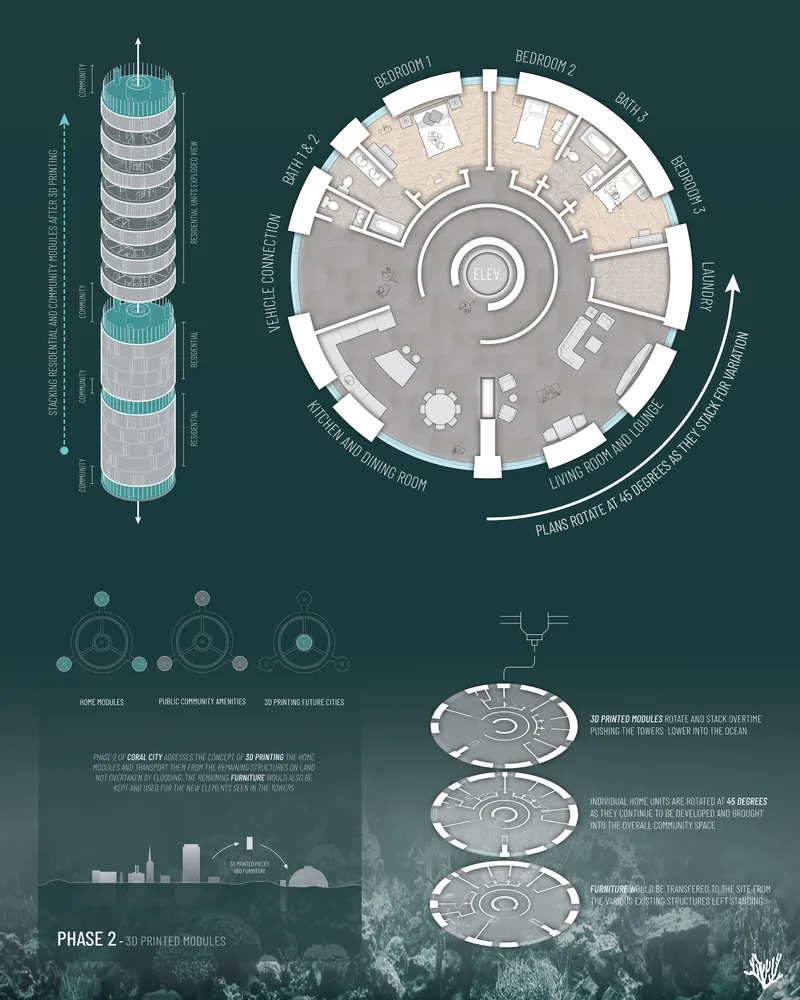
Fig: 3 3D Printed Module
Description: Coral City allows for a direct connection to the existing wildlife in the San Francisco Bay. Coral is a major element in the natural ecosystem in our oceans across the globe, giving the project a strong base to be expanded out into many cities and countries. Coral's natural growth overtime allows for its strength to grow as the years progress.

Follow us on social media: Facebook | Instagram | LinkedIn | Twitter | Youtube
References (3)


Popular Articles
Popular articles from the community


FCC Arquitectura Expands a Portuguese Granite House with a Board-Marked Concrete Wing
In Portugal, JV House pairs a cleaned-up whitewashed and granite dwelling with a timber-shuttered concrete extension, courtyards and a garden pool.

LT2A and OPEN Architectes Thread a Brick and Glass High School Through a Wooded Belgian Campus
In Braine-l'Alleud, a 3,000 m² wing for Collège Cardinal Mercier pairs pale brick with a glazed colonnade, deferring to a small chapel and a dense wood.


Singing Woman: An Opera House That Performs Before the Curtain Rises
Ovidiu Cristian Pavel's conceptual opera house translates Estonia's choral identity into a sculpted waterfront landmark facing the Baltic Sea.

Cube Design Draws an Ecological Corridor Between Two Shenzhen Hills with the Nankai Building
Beside Shenzhen's container docks, the Nankai Building pairs stacked balconies with a climbing green screen to connect two hillsides across its height.

Similar Reads
You might also enjoy these articles

Aquadapt: An Underwater Habitat That Rewrites Its Rooms by the Hour
Curved modules ring the seabed while one shell shifts from breakfast room to cinema, farm and football pitch as residents' needs change.

Play: Fragments of Their World: Remembered Architecture Rebuilt as a Modular Playground for Refugee Camps
Tom Gardner abstracts domes, arches and towers from the homelands of displaced families into a kit of child-scaled play parts for camp settlements.
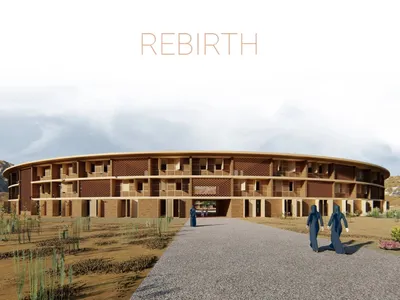
REBIRTH: A Circular Settlement Where Afghan Widows and Their Children Rebuild Life Together
A shortlisted Resile entry turns the circle into a protective ring of timber and brick, gathering homes, classrooms and gardens around a shared landscape.
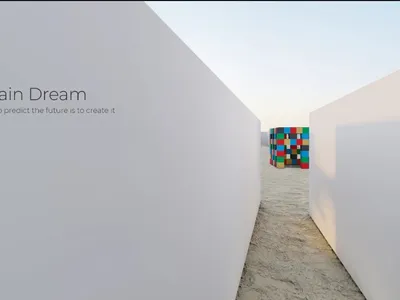
The Main Dream: A Recycled Plastic Kit That Lets Refugee Children Build Their Own Playground
Thirty-centimetre interlocking cubes that connect on three axes turn play into construction, letting children author the spaces they occupy.


Comments (0)
Please login or sign up to add comments
No comments yet. Be the first to comment!