

Jimenez Arquitectos and FB+ Estudio Build a Chapel from Salvaged Tiles in Ecuador's Andean Highlands
Perched atop a cemetery hill in Taquil, this 25 m² open chapel transforms abandoned roof tiles into a sacred landmark through collective labor.


Rural-to-urban migration leaves behind more than empty houses. In the Andean parish of Taquil, near Loja, Ecuador, it left behind thousands of clay roof tiles, peeled from structures no one returned to maintain. Jimenez Arquitectos and FB+ Estudio saw in that surplus not waste but a vocabulary. Their Tile Chapel, completed in 2020, is a 25 m² open-air place of worship built almost entirely from recycled terracotta tiles, stone, earth, and wood, erected through minga, the communal labor tradition that still binds this deeply Catholic community together.
What makes the project genuinely interesting is its refusal to treat "sustainable" and "spiritual" as separate ambitions. The chapel sits at the highest point of the Taquil cemetery, where residents gather annually to honor the dead. Its walls follow a tractrix curve that simultaneously dissipates the fierce hilltop winds and funnels sightlines outward toward the mountain landscape. Every structural decision, from the tile-over-tile wall system to the zenithal opening at the crown, serves liturgy, climate, and economy at once. The result is less a building than a proof of concept: that architecture for the poorest communities can still be inventive, site-specific, and moving.
Salvaged Tiles as Structural Logic
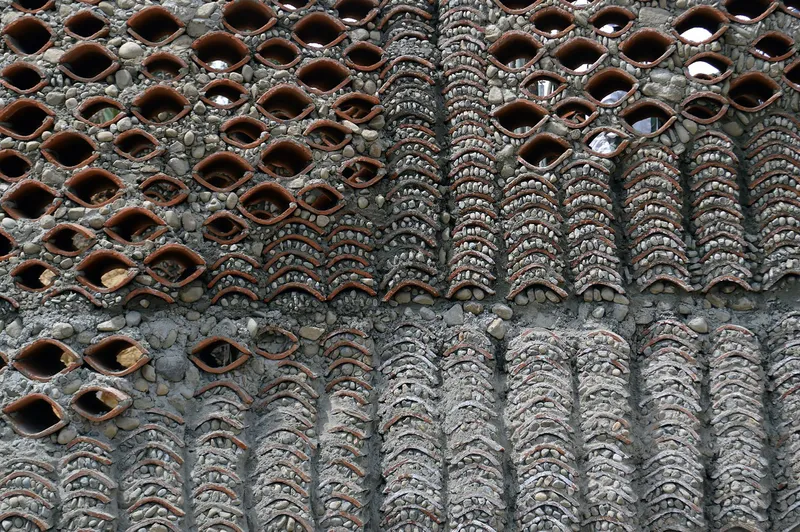
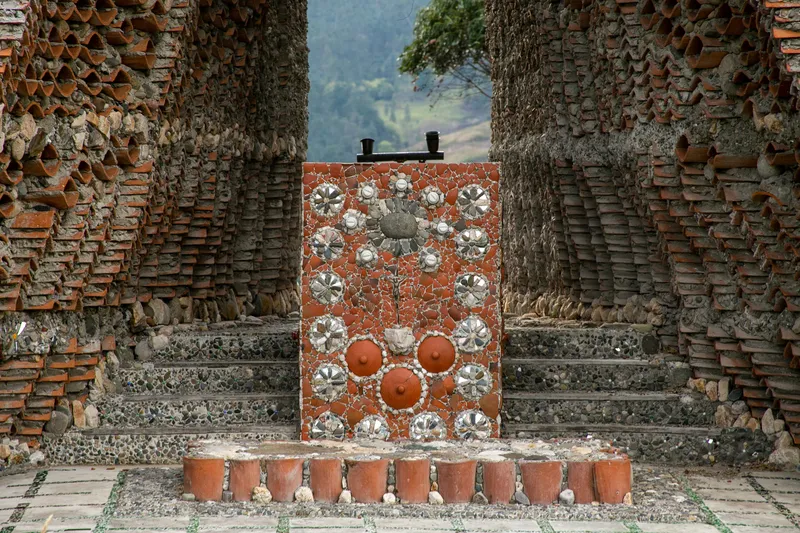
The chapel's construction material is also its ornament. Terracotta tiles salvaged from abandoned homes across Taquil are stacked, overlapped, and interlocked to form self-supporting curved walls. Look closely and you see the craft: stones are pressed into the joints between tiles, each one placed by a different pair of community hands. The technique is deliberately low-tech, requiring no specialized formwork or imported fasteners, yet the patterning that emerges is dense and rhythmic, almost textile in quality.
Recycled-material mosaics cover the altar and floor, extending the logic of reuse into the chapel's sacred furnishings. The architects chose tiles not for nostalgia but for pragmatic reasons: they are the most abundant, durable, and weather-resistant material available in rural Loja. Using them here gives new cultural meaning to objects that were otherwise decaying on rooftops nobody would repair.
Tractrix Curves and Wind
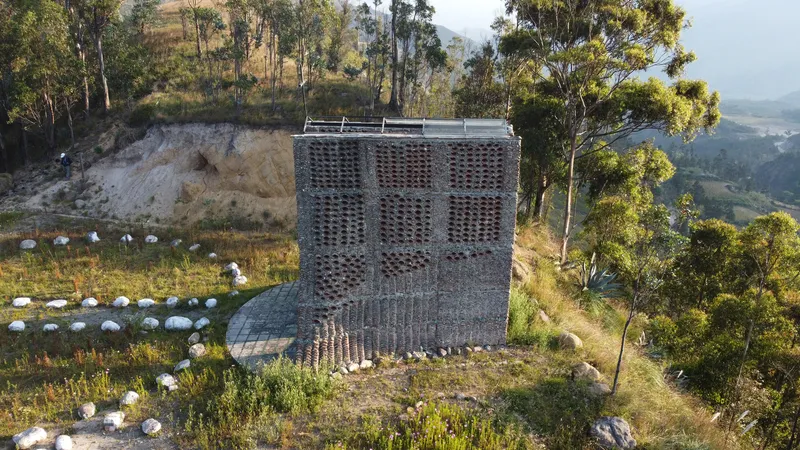
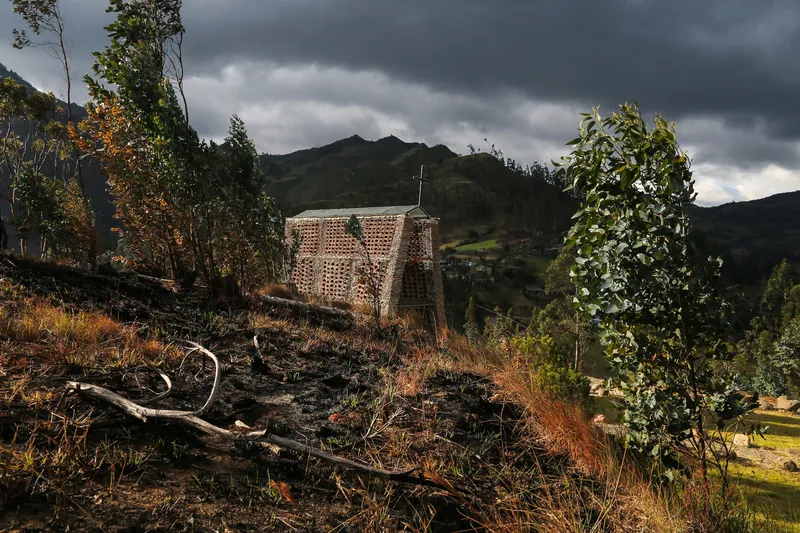
Taquil's cemetery sits on an exposed hilltop battered by Andean winds. A conventional rectilinear chapel would act as a sail; the architects' response was to shape the walls along a tractrix curve, a geometry that lets air slide around the structure rather than slam into it. The lower third of each wall is a continuous tile skin. The upper two-thirds are perforated by narrow wind-channeling tubes, small cylindrical openings that allow breezes to pass through the mass gently rather than pressurize the interior.
The perforations do double duty. They modulate light, casting shifting dot patterns across the interior, and they frame distant views of the surrounding mountains in dozens of small apertures. Standing inside, you are simultaneously sheltered and connected to the landscape, which is exactly the spatial condition an open-air ceremony demands.
Light from Above
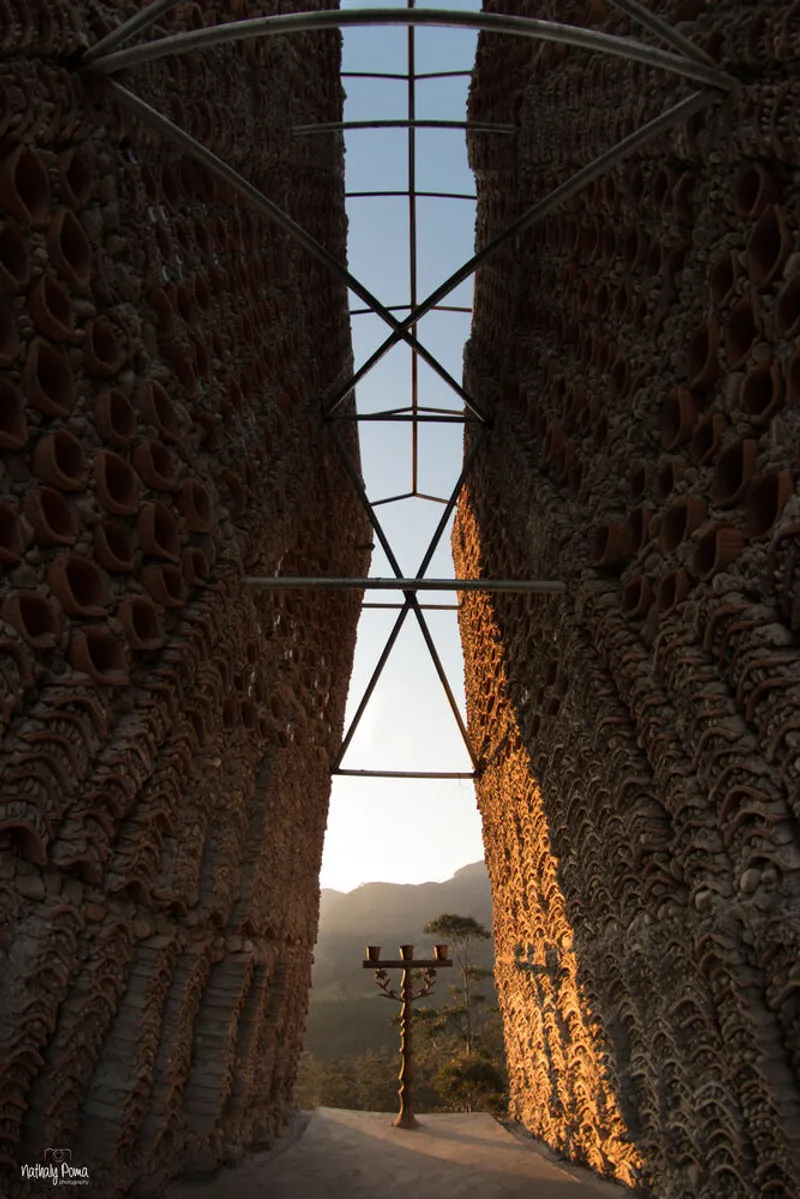
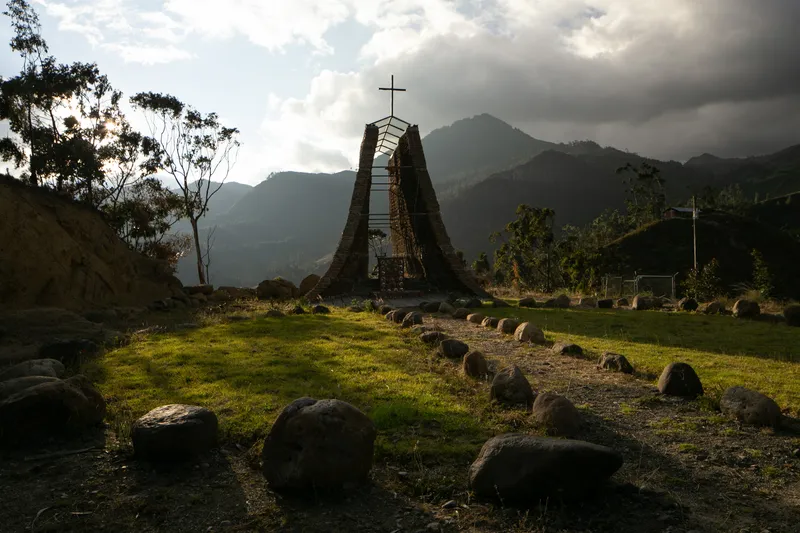
At the chapel's crown, the converging tile walls open to the sky. This zenithal aperture floods the interior with direct overhead light, an age-old technique for marking sacred space. Steel bracing elements span the opening, their thin cross-sections visible against the sky, providing structural rigidity without blocking the luminous effect. The interplay of rough terracotta texture, the deep channel of the walls, and the bright oculus above produces an atmosphere that feels both ancient and engineered.
From the exterior, the chapel reads as a steep triangular form topped with a cross, a clear silhouette against stormy Andean skies. That formal simplicity is important. The chapel needs to be legible across the cemetery from a distance, a landmark that orients the annual mass without competing with the landscape's own drama.
Site and Landscape
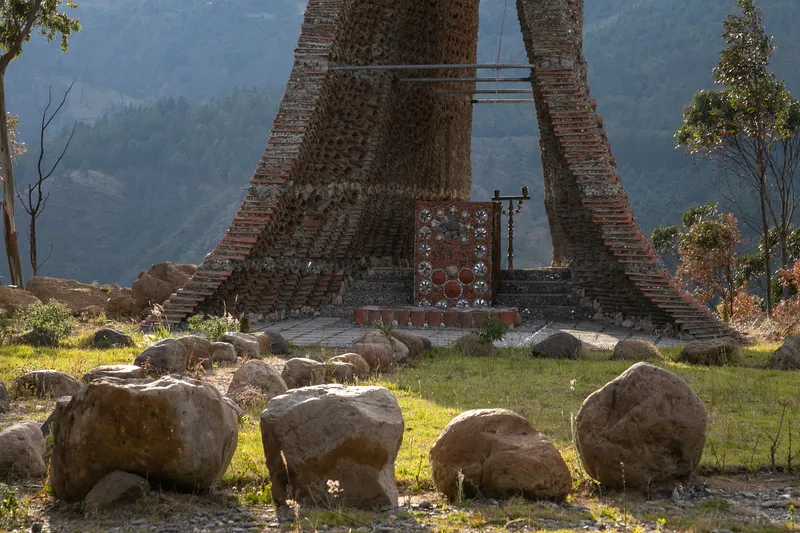
The base of the chapel is anchored by scattered boulders and a rough stone ground plane that merges with the cemetery terrain. There is no paved plaza, no formal threshold. Worshippers simply gather on the grass among headstones, and the chapel rises from that ground as if it were another geological feature. The architects resisted the temptation to over-design the approach; the result is a structure that belongs to its hillside rather than being imposed on it.
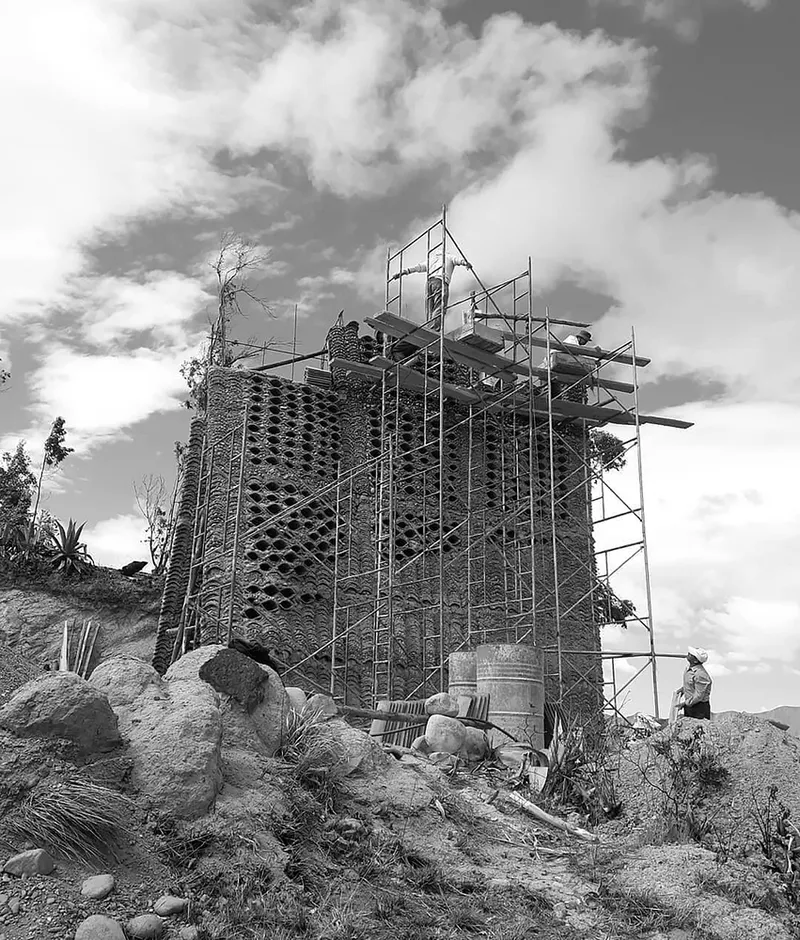
Construction photographs show scaffolding wrapping the tower in its final stages, with billowing clouds behind. Eucalyptus trees frame the site. The chapel is small enough that the landscape always dominates, which is the point: the architecture is a focusing device, not a monument.
Plans and Drawings
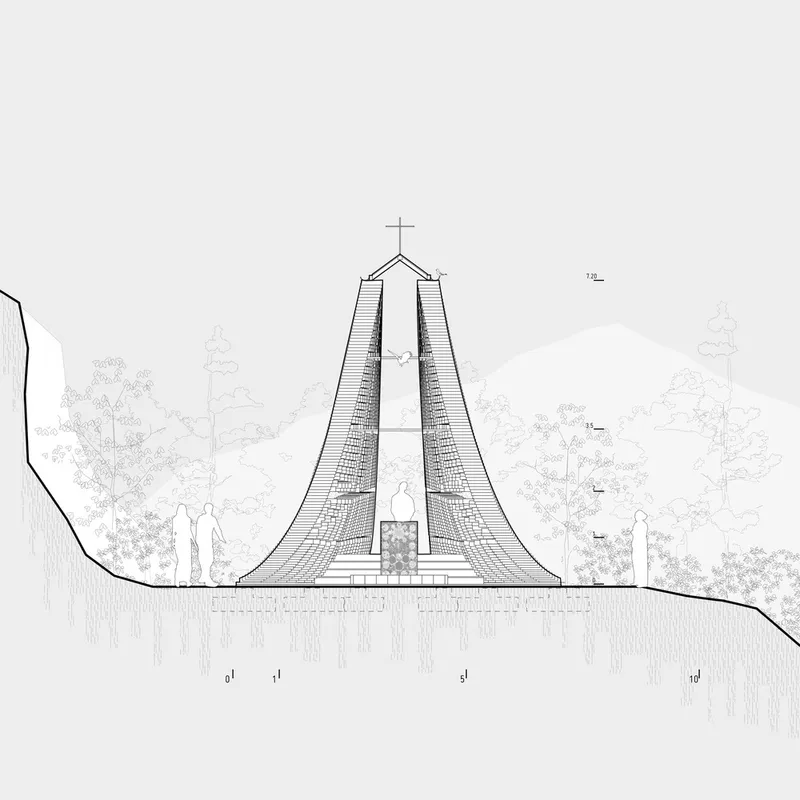
The elevation drawing reveals the chapel's steep pyramidal profile and its proportional relationship to the sloping terrain. Human figures at the base give a clear sense of its modest scale: this is a structure you can touch the walls of from almost any point inside. Trees are drawn at a comparable height, reinforcing how the architecture defers to its surroundings. The cross at the peak is the only element that breaks the roofline, a deliberate gesture toward the sky that the rest of the form already reaches for.
Why This Project Matters
The Tile Chapel is a counter-argument to the idea that constrained budgets produce constrained architecture. With 25 square meters, no imported materials, and a labor force composed entirely of local residents working through minga, Jimenez Arquitectos and FB+ Estudio delivered a building that performs structurally, climatically, and symbolically at a level that many well-funded projects never reach. The tractrix curve is not a decorative flourish; it solves a wind problem. The tile-over-tile system is not a craft exercise; it is the cheapest way to build a durable wall from materials already on site.
More broadly, the project offers a replicable model for rural communities across Latin America facing the same conditions: depopulation, abandoned building stock, strong communal traditions, and the need for public gathering spaces. The chapel has already become a local tourism draw, feeding economic energy back into Taquil. That outcome was not accidental; it was designed for. Architecture that takes community seriously, not as a branding exercise but as a construction method and a program, tends to produce buildings that communities actually care about long after the architects leave.
Tile Chapel by Jimenez Arquitectos and FB+ Estudio. Taquil, Loja, Ecuador. 25 m². Completed 2020.
About the Studio
Share Your Own Work on uni.xyz
If projects like this are the kind of work you want to make, uni.xyz is a place to publish your own, find collaborators, and enter design competitions.


Popular Articles
Popular articles from the community


The Amber Palace Opera: A Geological Fiction Surfaces on Tallinn's Baltic Waterfront
Pierre Brillard reimagines a Baltic legend as a public landscape, opera house, and waterfront promenade rooted in Tallinn's coastal identity.

Opera on the Sea: Driftwood Logic Shapes a Timber Opera House on Estonia's Coast
Trevor Orgill's opera house translates the entangled drift of floating timber into a civic building where wood, water, and music converge.

Opera by the Sea Estonia: Three Shells Dissolving Architecture into Tallinn's Coastline
A winning opera house proposal replaces monumental form with interconnected shells that blur the boundary between building, park and Baltic Sea.
Faces of the Soviet Avant-Garde: Turning Moscow's Street Names into an Open-Air Museum
A network of sculptural installations across a Moscow residential district transforms forgotten architect names into spatial encounters with cultural memor

Similar Reads
You might also enjoy these articles


Hodi-Mandai Geram
Project Function: Preservation and revitalization of the Intangible heritage and socio-spatial identity of the Hodi by Housing, Cultural Memory Center, Sacred Grove, landscape, local tourism economy


Olio Towers: A Mid-Rise for Performers That Fuses Housing, Rehearsal, and Stage
Located blocks from Houston's Theater District, this modular tower stacks living units around a central performance atrium.

Oasis: Modular Green Housing Carved into Dhaka's Urban Fabric
A shortlisted Plugin Housing entry reclaims unauthorized settlements in Dhaka with stepped concrete volumes, green roofs, and ventilation-driven design.

Black Hole: A Floating Megastructure for the Post-Physical Era
Emiliano Mazzarotto envisions a spherical, self-scaling arena where e-sports, digital hotels, and holographic stadiums replace traditional public space.

Explore Clay Tile Competitions
Discover active competitions in this discipline

Challenge to reimagine the Iron Throne

Photograph architecture without architects

Illustrate the lost glory of Angkor Wat - Render Challenge

Bring back Drive In's
Comments (0)
Please login or sign up to add comments
No comments yet. Be the first to comment!