
TINTIM ATRAE
Earth Made Housing Competition

Nowadays, architects face a huge challenge to design buildings with a low carbon footprint. We want to design in such a way as to use as little energy as possible, the materials used did not harm the environment, and people lived better than before. We ask ourselves how to strive to achieve low emissivity and build ecological buildings that meet the requirements of a modern inhabitant. The answer may be to take a step back and use the wisdom of our ancestors. One of the first signs of man's architectural creativity was building a shelter from the most accessible building material on Earth - itself. In the face of technological development, this ecological solution began to be abandoned, and the greater possibilities of other materials caused it to be displaced from common use. As numerous examples show, the possibilities of the earth are not very limited, and the problem that may affect it is the production of final products - most often dried bricks - from this raw material, which are usually made by hand. So I started looking for an answer to the burning question: is there another way to use earth in the process of building a house that will meet modern standards, that will shorten the time of erecting such a building, with the least impact on the environment? And I think I found that answer.
3D printing has been a rapidly developing technology in the field of construction in recent years. Using it allows you to drastically shorten the investment process. Printing small objects can take from one to several days. In the face of high economic and demographic growth both in Africa and in Ghana itself, this becomes a huge asset, allowing the construction of a habitat for many families in a definitely short time. Although the production of a 3D printer generates a carbon footprint, its use reduces the production of pollutants to the energy used, which, however, can be used from renewable energy sources. The filament is obtained at the construction site, it is a mixture of local soil and clay. The place where the raw material is obtained can be used in the further stages as a building foundation or a retention tank for rainwater collected in the rainy months. This leads to even lower emissions and the use of water in a closed loop. Currently, the technology of printing buildings from the earth is at a very early stage, but new possibilities are also opening up in shaping architecture. The structure of the wall can be freely formed, which is an advantage especially in a warm climate, such as in Bolgatanga , where it can be designed with a ventilation layer inside. This prevents overheating of the building without additional technical installations, thanks to which we strive for zero emissions even more .
3D printing has been a rapidly developing technology in the field of construction in recent years. Using it allows you to drastically shorten the investment process. Printing small objects can take from one to several days. In the face of high economic and demographic growth both in Africa and in Ghana itself, this becomes a huge asset, allowing the construction of a habitat for many families in a definitely short time. Although the production of a 3D printer generates a carbon footprint, its use reduces the production of pollutants to the energy used, which, however, can be used from renewable energy sources. The filament is obtained at the construction site, it is a mixture of local soil and clay. The place where the raw material is obtained can be used in the further stages as a building foundation or a retention tank for rainwater collected in the rainy months. This leads to even lower emissions and the use of water in a closed loop. Currently, the technology of printing buildings from the earth is at a very early stage, but new possibilities are also opening up in shaping architecture. The structure of the wall can be freely formed, which is an advantage especially in a warm climate, such as in Bolgatanga , where it can be designed with a ventilation layer inside. This prevents overheating of the building without additional technical installations, thanks to which we strive for zero emissions even more .
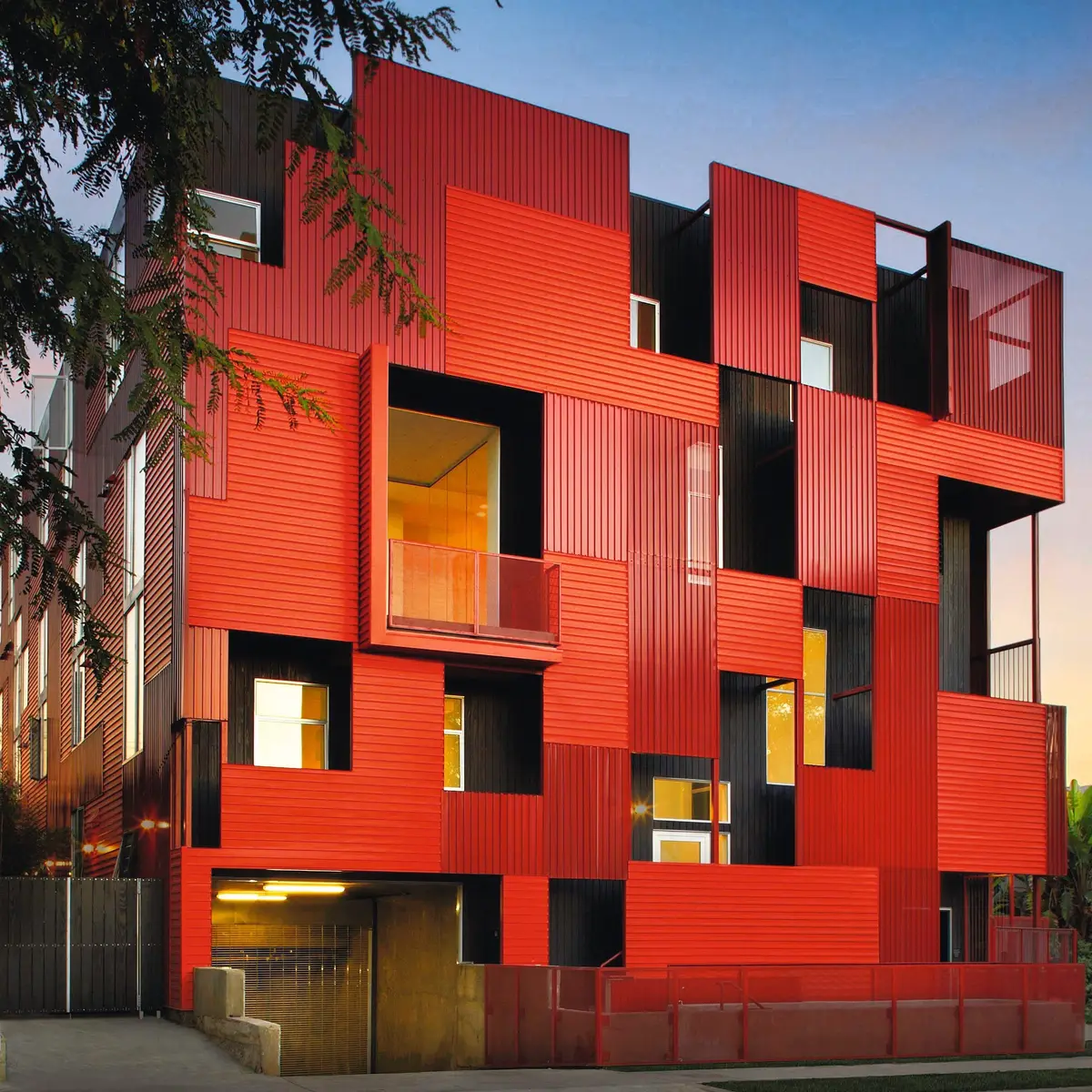
Looking for an escape from the hot climate and excessive sunlight, solutions were used to reduce the temperature inside the building. The residential building has been "wrapped" in a second layer of walls that let only part of the sun's rays through the windows, which creates a lower temperature between the walls. These spaces have been adapted to terraces or balconies belonging to the residents. In order to reduce the consumption of building material, insolation analyzes were carried out to design curtain walls only in places that require them. The patterns on the facades are taken from local craftsmanship - Kente clothes . The structure of the walls allows for better ventilation and discharge of heated air through internal ducts above the last ceiling, where it is exhausted thanks to the roof being raised on the trusses. The direction of the roof slope has been selected in accordance with the prevailing wind direction, which allows for even better ventilation.


Popular Articles
Popular articles from the community


David Macias Steps a Doorless Stone and Plaster House Down a Tropical Colombian Hillside
In the humid hills of Colombia, Threshold House replaces the front door with an open void and terraces its 850 m² down the slope instead of fighting it.

Cube Design Draws an Ecological Corridor Between Two Shenzhen Hills with the Nankai Building
Beside Shenzhen's container docks, the Nankai Building pairs stacked balconies with a climbing green screen to connect two hillsides across its height.

Juan García Correa, John González and Claudia Rueda Sink a Circular Amphitheater into a Manizales Engineering Building
On the La Nubia campus in Manizales, Colombia, the S1 Building folds labs and offices into a hillside of ramped lawns that double as a campus route.

Jaramillo Van Sluys Arquitectura and Urbanismo Turn a Demolished Registry Lot in Quito into an Orchard Plaza
In Quito's Centro Histórico, a 2,800 m² plaza exposes the San Agustín convent wall and redraws its lost Augustinian orchard in volcanic stone.

Similar Reads
You might also enjoy these articles


Vereda Arquitetos Renovates a 40-Square-Meter Apartment Inside Niemeyer's Copan Building
A compact unit in São Paulo's most iconic residential tower gets a material overhaul that pairs exposed concrete with bold blue Formica.

Shakur's House: Exposed Brick as an Interior Organiser in a 168 m² Mashhad Residence
Brick moves indoors in this Mashhad residence, where masonry walls, glass partitions and teal planes sequence a compact home without closing it off.

Day and Night Park: A Time-Based Urban Newsstand in Beijing
A temporary urban newsstand in Beijing blending travel, light, and reading through poetic colors, compact form, and community-focused design.

Modernist Patio Renovation in El Masnou, Barcelona by Oliver Segura Arquitectura + Cebrià Arquitectura
Modernist patio renovation blending tradition and innovation with a movable pool, leveled floors, and Catalan materials in El Masnou.

Explore Earth Architecture Competitions
Discover active competitions in this discipline


Essay writing competition - Architecture in video games

Challenge to design mud housing for contemporary communities
Comments (0)
Please login or sign up to add comments
No comments yet. Be the first to comment!