

TAB Wraps a Geoffrey Bawa-Inspired Family Home in Ribbed Metal Cylinders in Kochi
TropiBox Kochi House channels tropical modernism through curved volumes, cross ventilation, and courtyards in Kerala's dense urban fabric.


From the street, TropiBox Kochi House looks almost defensive: stacked cylindrical towers clad in ribbed metal, their horizontal corrugations catching late Kerala light behind a screen of banana palms and low garden walls. Nothing about the exterior telegraphs what lies inside. That tension between a closed, introverted facade and a radically open interior is the central proposition of the house, and it is what makes this 3,500 square foot residence by TAB (Tropical Architecture Bureau) worth studying closely.
Located in Kakkanad, a rapidly densifying district of Kochi, the project started from a personal brief. The client wanted to recover the atmospheric quality of a modest childhood home while carving out distinct territories for each family member. TAB's response draws explicitly from the legacy of Sri Lankan architect Geoffrey Bawa, translating his principles of tropical modernism into a site-specific strategy built around courtyards, passive ventilation corridors, and an L-shaped plan that splits public life on the ground floor from private quarters on a mezzanine above. The result is a house that breathes in every direction even as it presents a fortress face to the neighborhood.
The Closed Fist: Street Presence and Facade Strategy
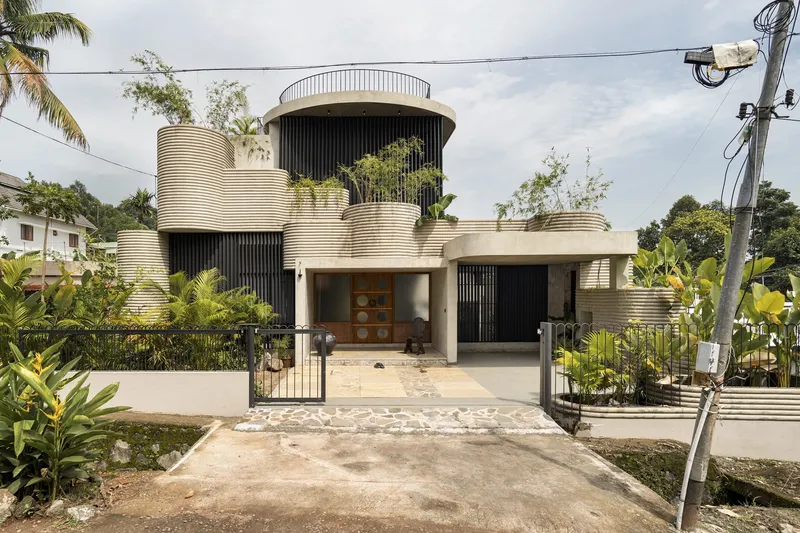
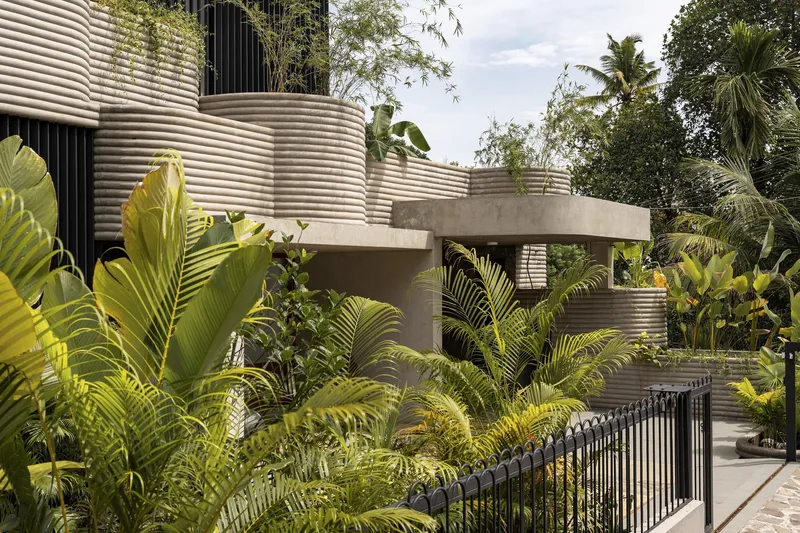
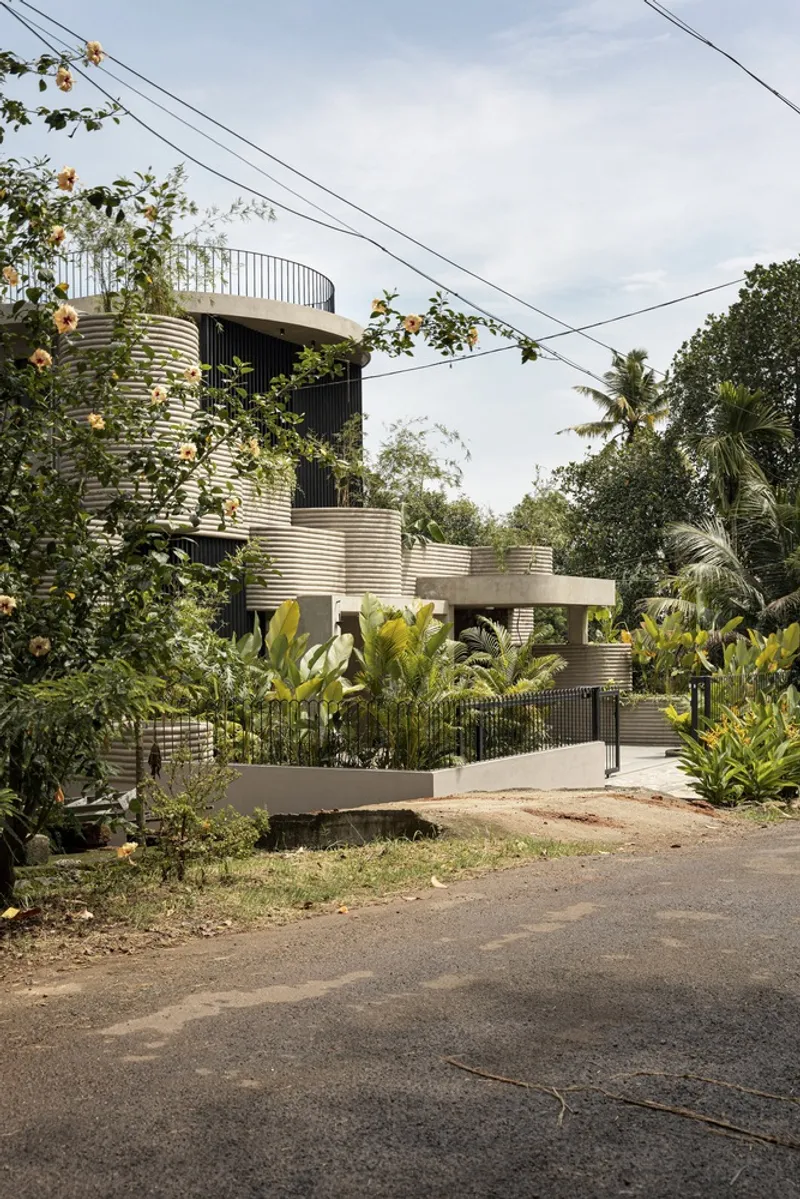
The two primary concrete facades are wrapped in horizontally ribbed metal cladding that gives the house its name and its character. The cylindrical volumes, stacked and offset, read as autonomous towers rather than a single domestic block. Planted terraces erupt at the seams, softening the industrial texture with cascading greenery. It is a deliberate inversion of the typical Kerala residence, which tends to signal hospitality with open verandahs. Here, privacy comes first. The corrugated skin deflects noise, heat, and the gaze of neighboring buildings in equal measure.
Concrete canopies project over entry points, creating deep shadows that further recede the house from the street. TAB treats the perimeter planting not as ornament but as infrastructure: front and back yards function as thermal buffers, the tropical foliage absorbing solar radiation before it reaches the metal skin. The effect is that the house sits several degrees cooler inside than a typical urban lot would allow.
The Open Core: Courtyard and Double-Height Atrium
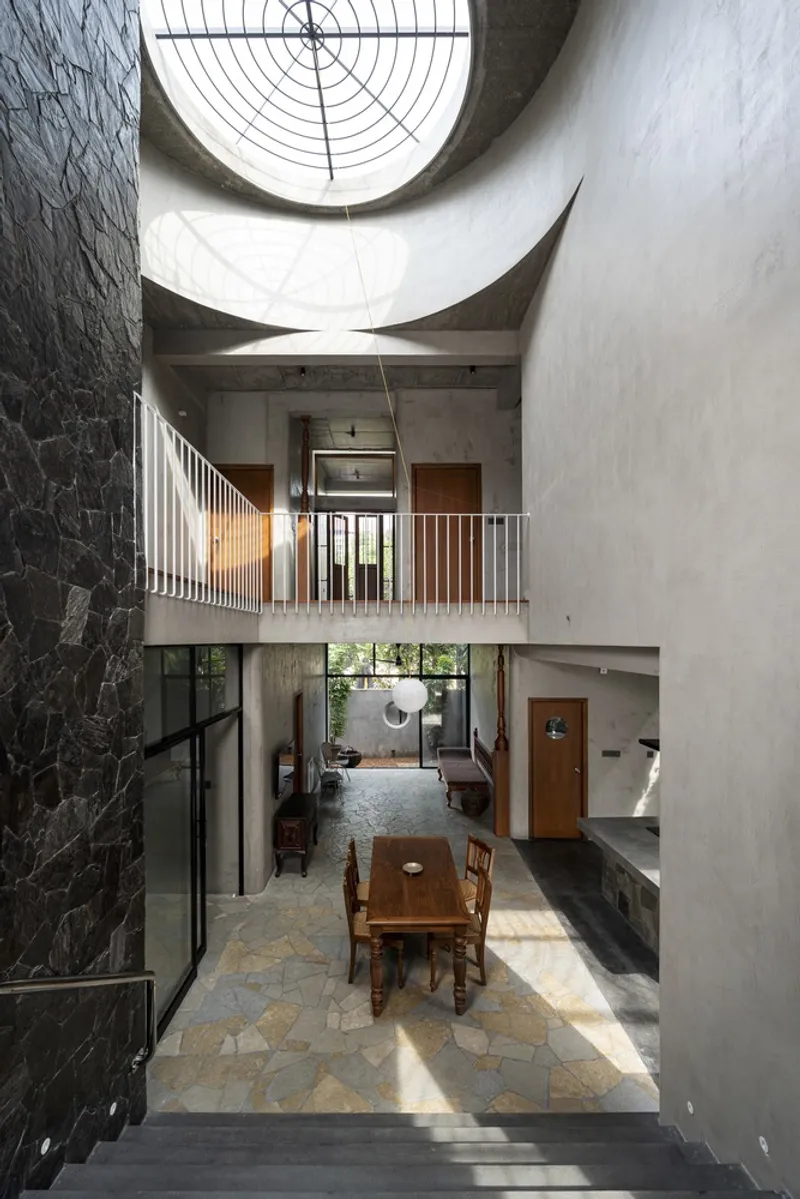
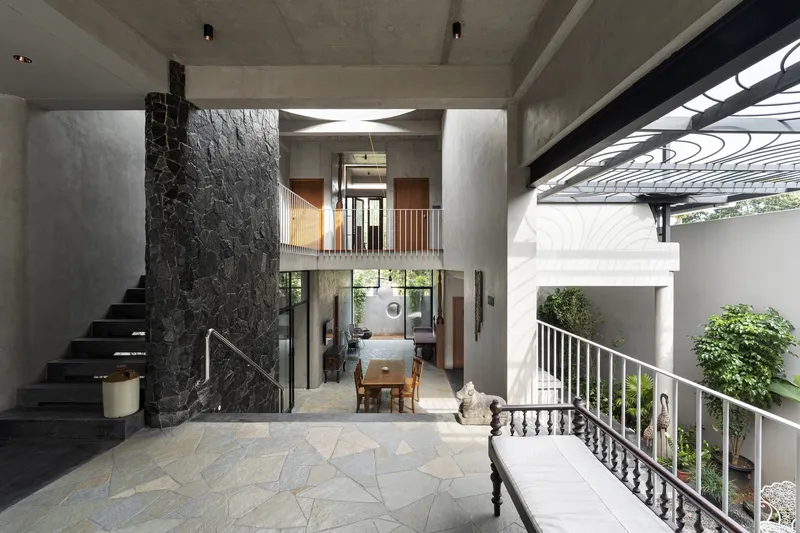
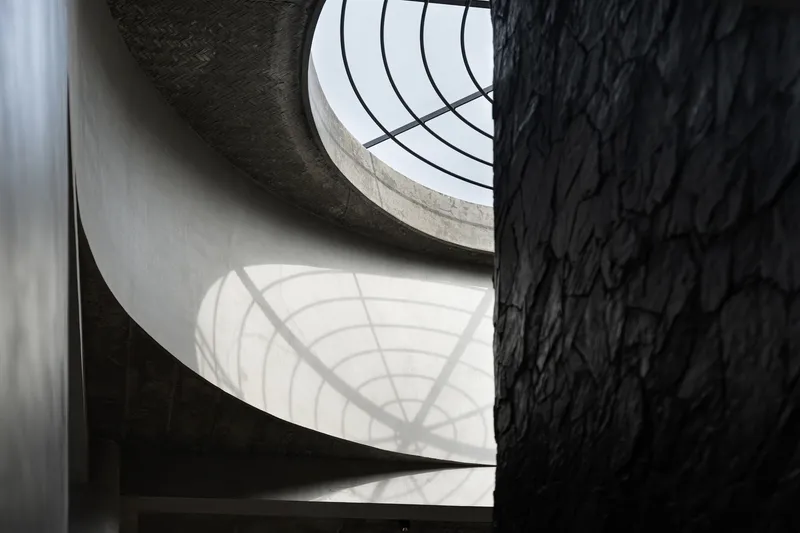
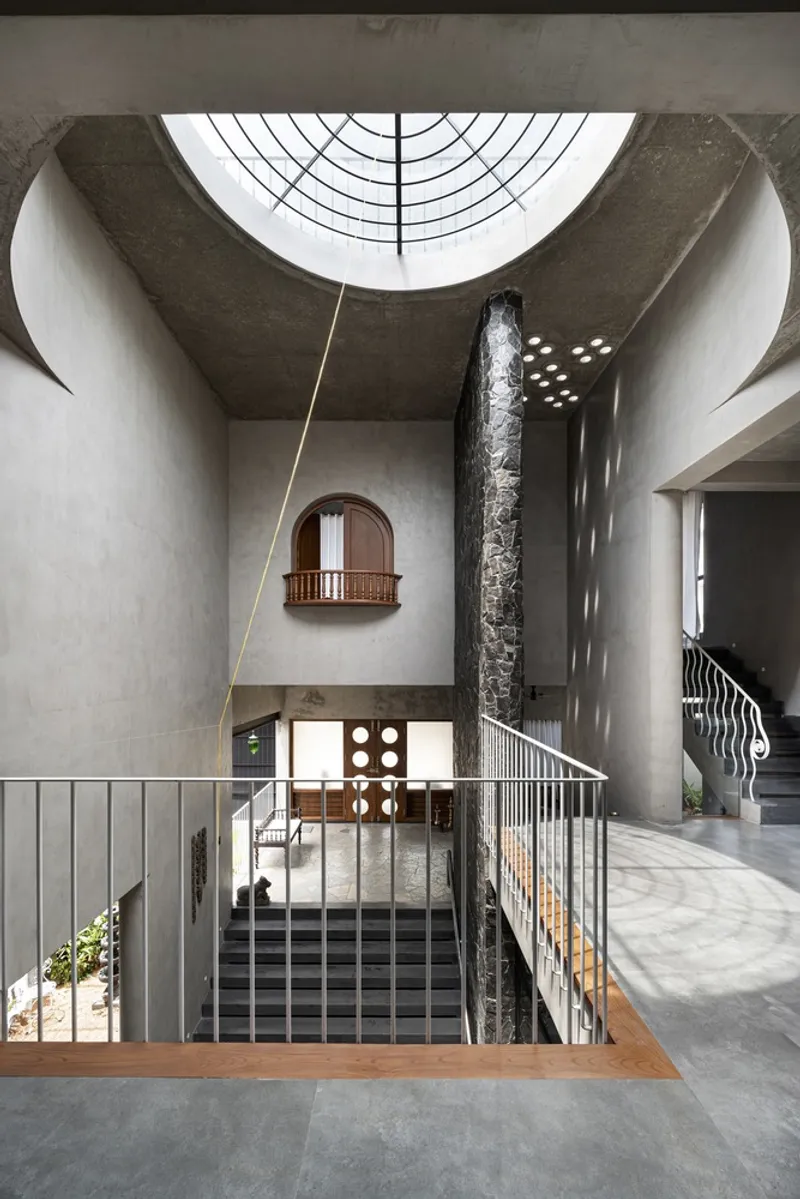
Step past the threshold and the introversion vanishes. A multi-level atrium opens vertically through the center of the house, anchored by a dark stone feature wall that runs from floor to roof. A circular skylight crowns the void, sending a disc of afternoon sun sliding down the black stone surface as the day progresses. A concrete bridge floats across the space at mezzanine level, connecting the two bedroom wings while framing views downward to the courtyard and upward to the sky.
The spiral staircase beside the rough-cut stone wall is the vertical spine of the house. Natural light filters through the skylight above and bounces off the textured stone, producing a gradient of illumination that changes by the hour. TAB oriented this central void along a north-south axis so that prevailing breezes pass through uninterrupted, a move that makes the atrium function as a thermal chimney, pulling warm air upward and drawing cooler air in from the ground-floor openings.
Kitchen as Social Engine
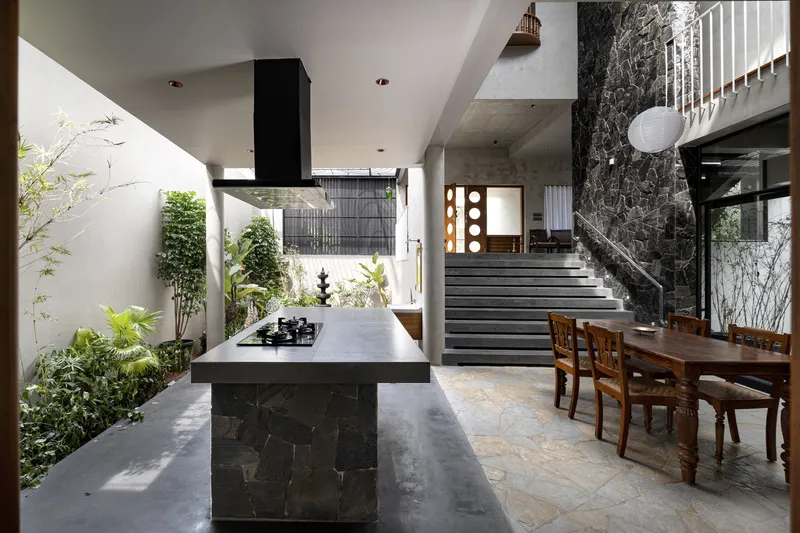
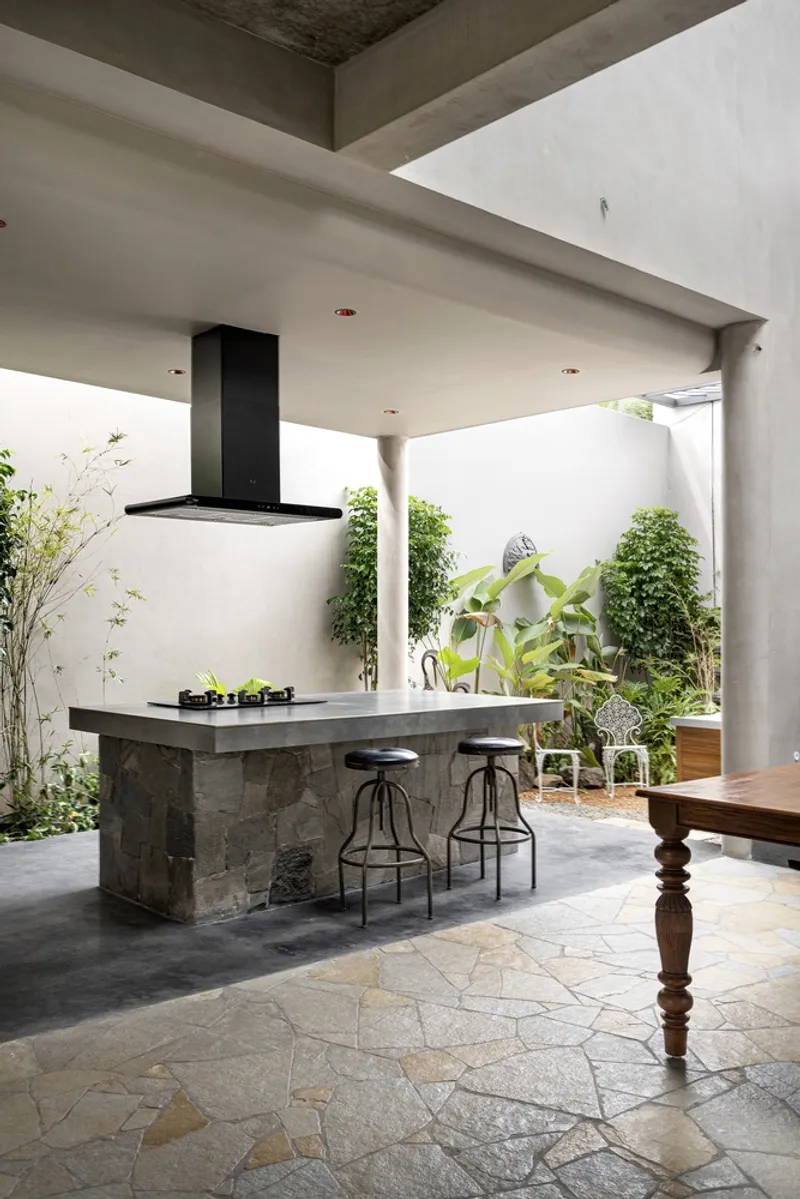
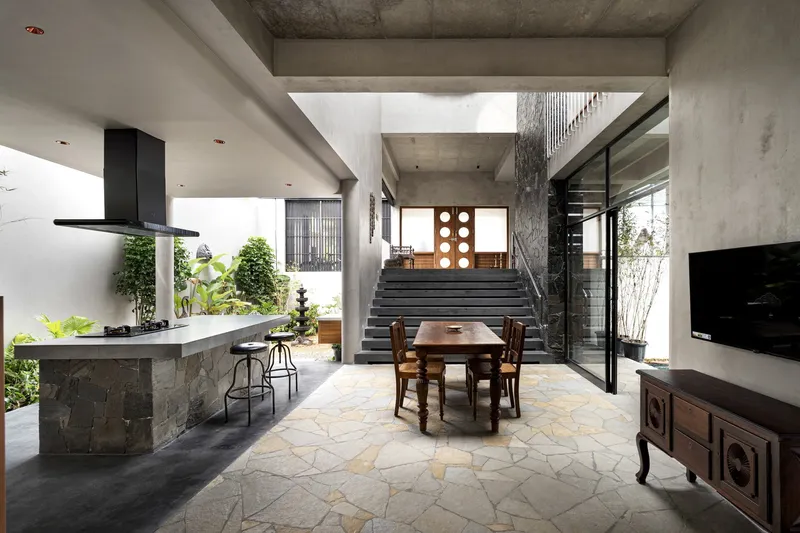
TAB positions the kitchen as the social core of the house, and the execution backs up the claim. A stone-clad, steel-topped island sits at the intersection of circulation paths, visible from the entry hall, the dining table, and the planted courtyard beyond. The black range hood drops from exposed ceiling beams like a piece of industrial sculpture, framing the view through to climbing vines on the courtyard wall. It is the kind of layout where cooking becomes a communal act rather than a domestic chore.
The dining area is set at the center of the plan beneath a double-height skylight, so that meals happen in the brightest, most connected room in the house. Concrete stairs rise directly beside the table, reinforcing the sense that every level of the home converges here. The material palette of dark marble, exposed concrete, and warm wood gives the kitchen sequence a tonal coherence that avoids the common trap of tropical interiors feeling busy or cluttered.
Thresholds Between Inside and Out
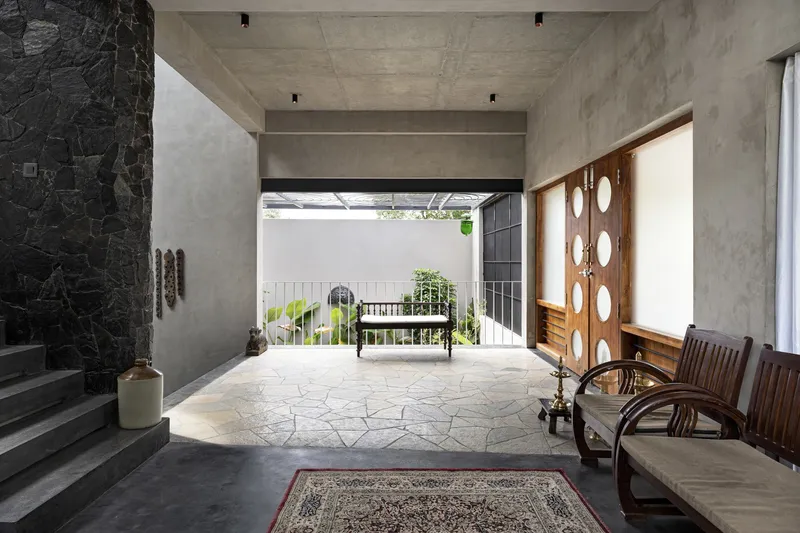
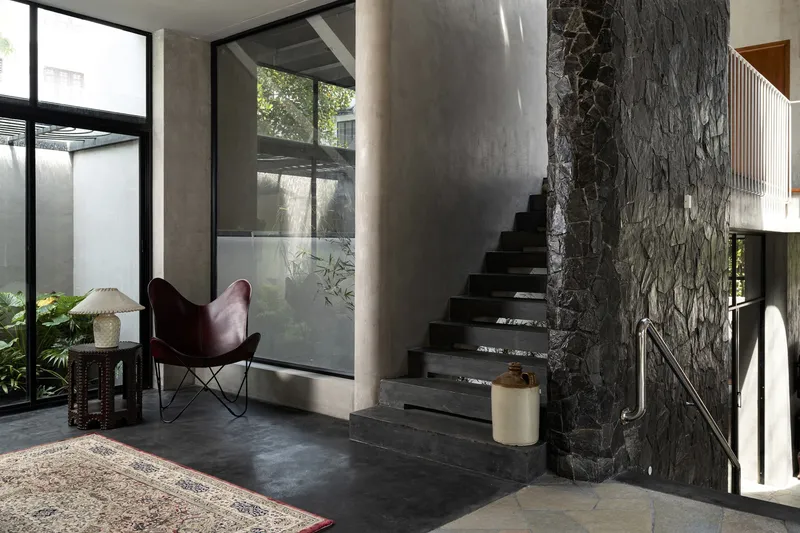
The ground-floor entry hall sets the tone for how the house manages thresholds. Stone-paved floors extend from the interior directly into the courtyard, dissolving the boundary between covered and uncovered space. A leather butterfly chair sits in the foyer beside a textured stone wall and a glazed courtyard opening, the kind of casually precise arrangement that only works when the climate strategy is confident enough to leave walls out entirely.
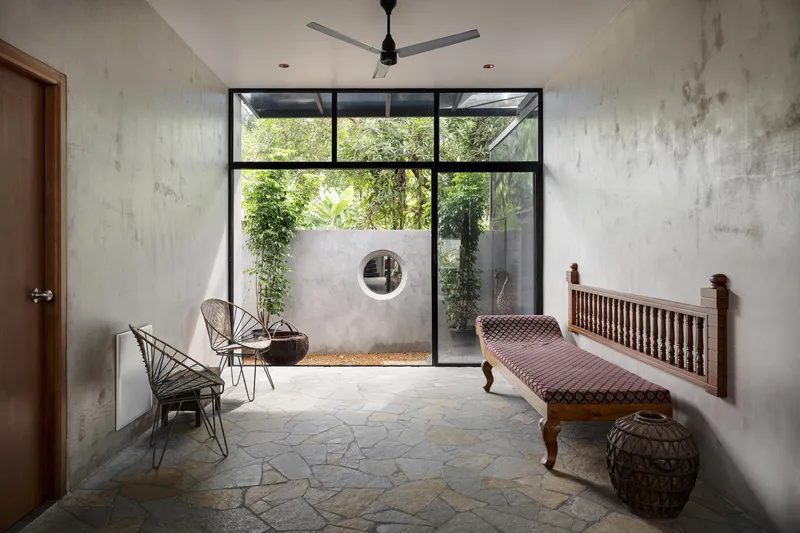
In one of the interior rooms, steel-framed windows look onto a walled courtyard punctuated by a circular aperture, a detail that recalls Bawa's fascination with controlled garden views. The aperture frames a single slice of sky and planting, turning the courtyard wall into a lens. These moments of deliberate framing distinguish TropiBox from looser open-plan tropical houses where everything is visible at once. TAB rations the views, which makes each one register more powerfully.
The Private Register: Bedrooms and Mezzanine
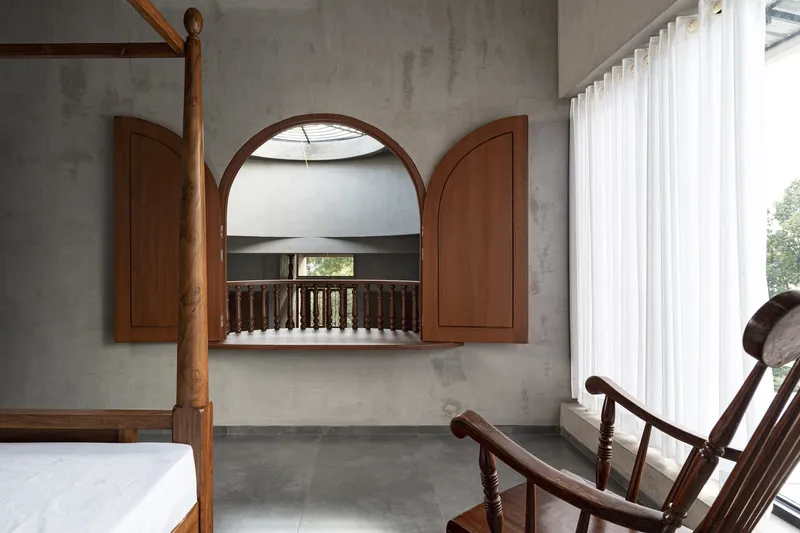
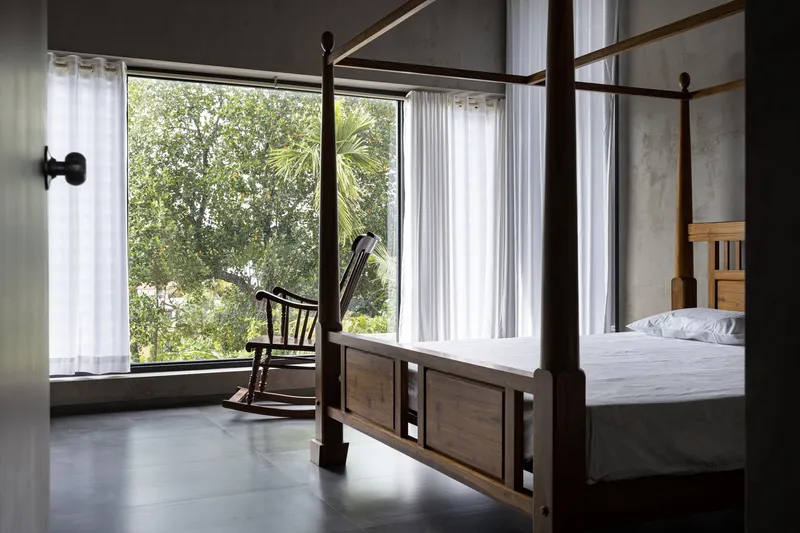
Upstairs, the mood shifts. The mezzanine bedrooms are oriented to maximize northern exposure and minimize the punishing southern sun, a straightforward climate move that also provides the best views over the garden canopy below. One bedroom features an arched timber window that opens directly onto the atrium, turning the double-height void into a visual extension of the sleeping space. The four-poster bed in the adjacent room sits beside a full-height window draped in white curtains, the garden canopy filling the frame like a living painting.
The upper level also includes a meditation area and a balcony that overlooks the courtyard. The curved skylight above the stair landing and the perforated metal railing allow light and air to pass freely between floors, reinforcing the vertical continuity that TAB engineered into the section. There are no closed planes from east to west on this level, a strategy that allows uninterrupted wind flow across the entire upper floor.
Materiality: Stone, Concrete, and Curved Plaster
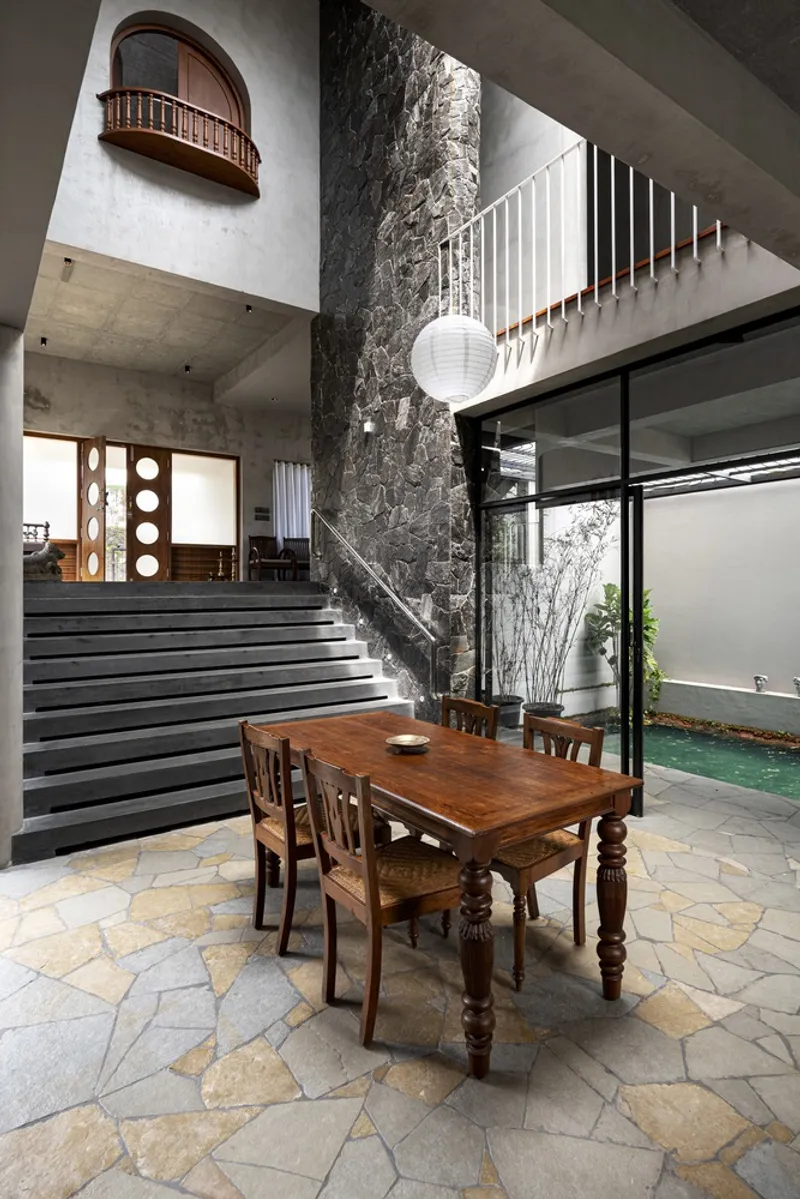
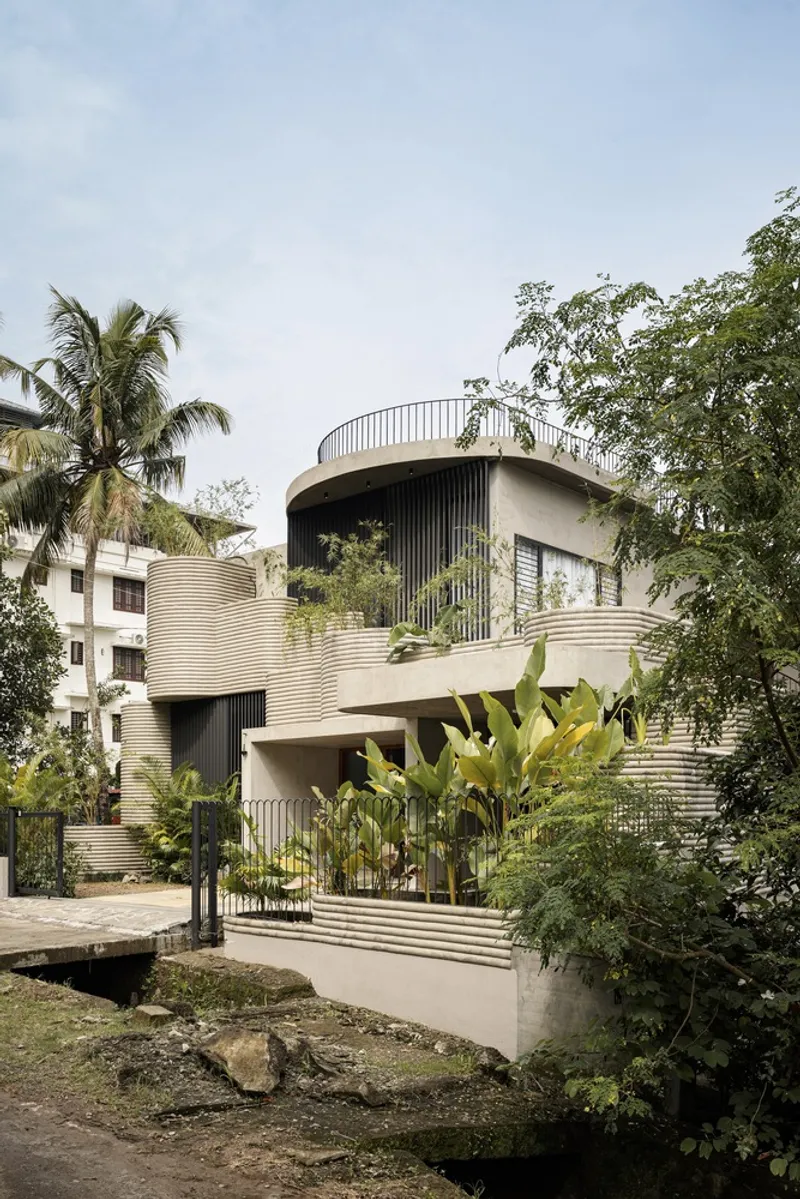
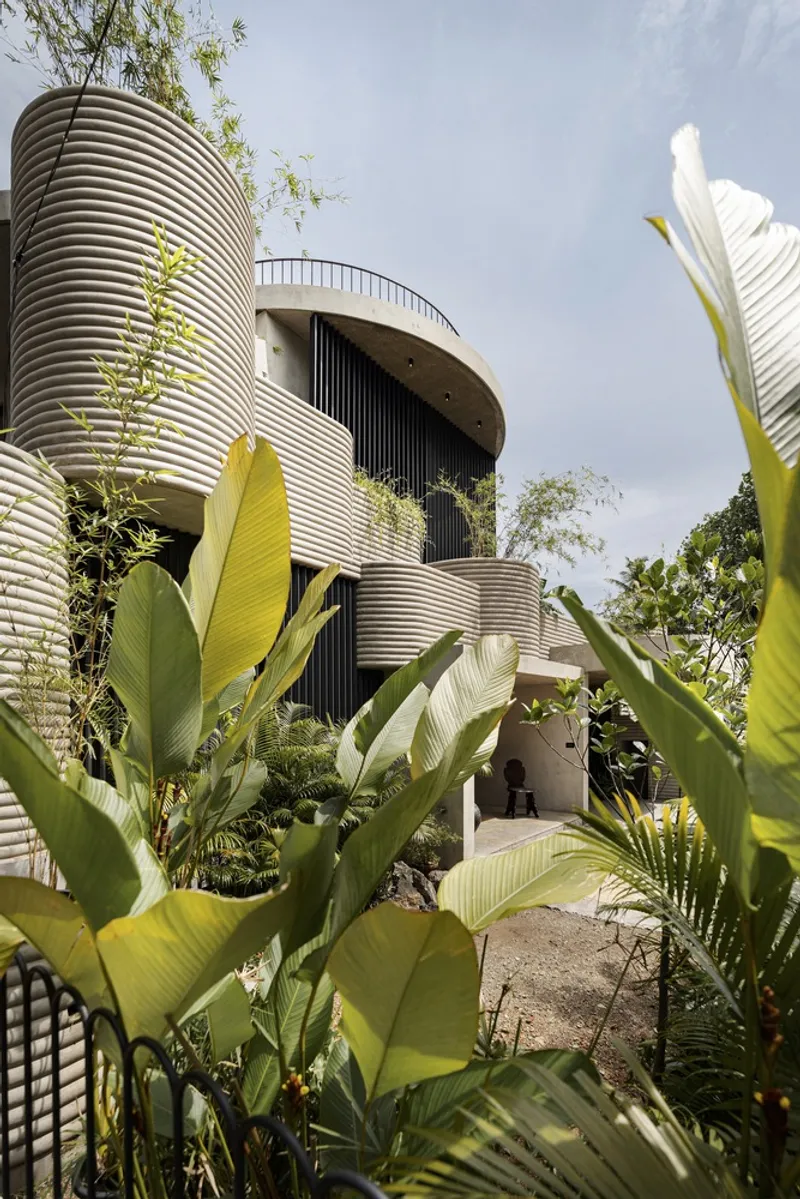
The material logic of TropiBox is disciplined but not austere. Locally sourced natural stone appears in irregular floor paving, staircase treads, and the kitchen island, its rough texture contrasting with the smooth cement plaster that forms the house's signature curved walls. Exposed concrete dominates the ceilings and structural elements, left unfinished to register the marks of formwork. Black metal joinery and window frames cut sharp lines against the softer plastered surfaces, a deliberate tension that keeps the interiors from feeling too homogeneous.
Wood appears throughout in doors, built-in furniture, and detailing, adding warmth to spaces that might otherwise tip toward brutalism. The marble-clad column in the double-height space is a single bold accent, its veined surface drawing the eye vertically and anchoring the otherwise open volume. TAB's material choices lean heavily on regional sourcing, which reduces transportation emissions while producing a palette that feels native to Kochi rather than imported from a design catalogue.
Plans and Drawings
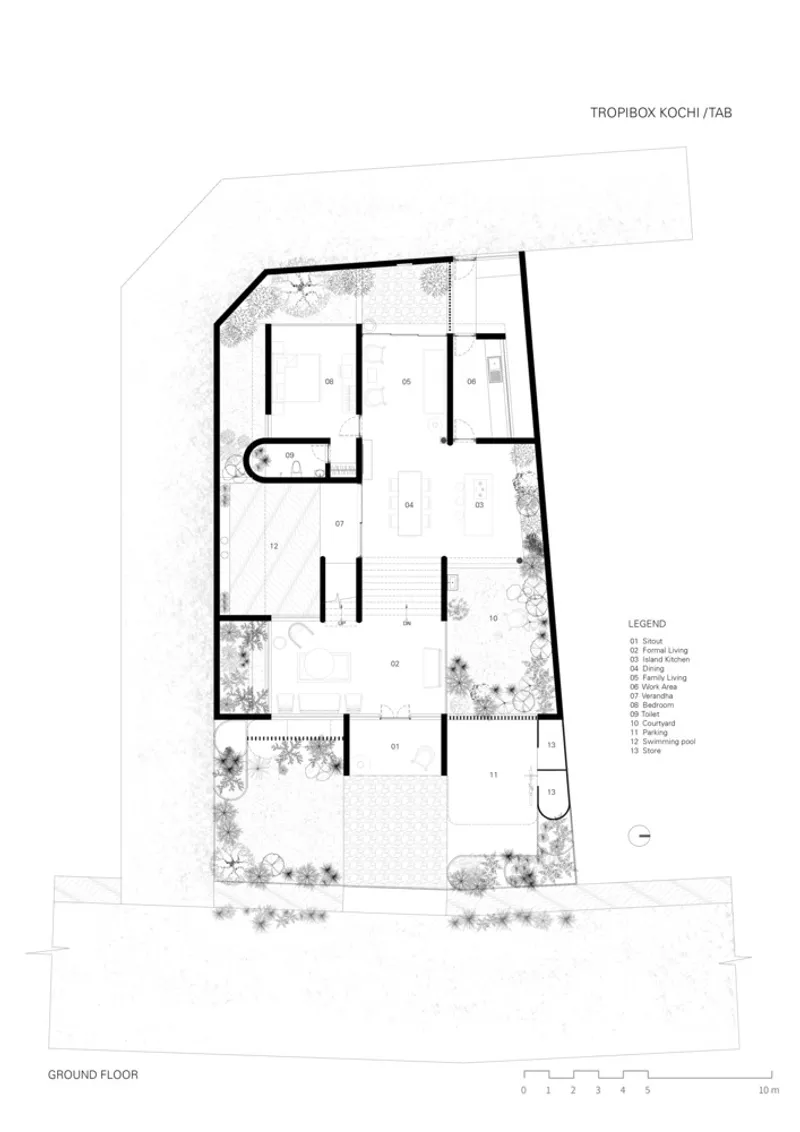
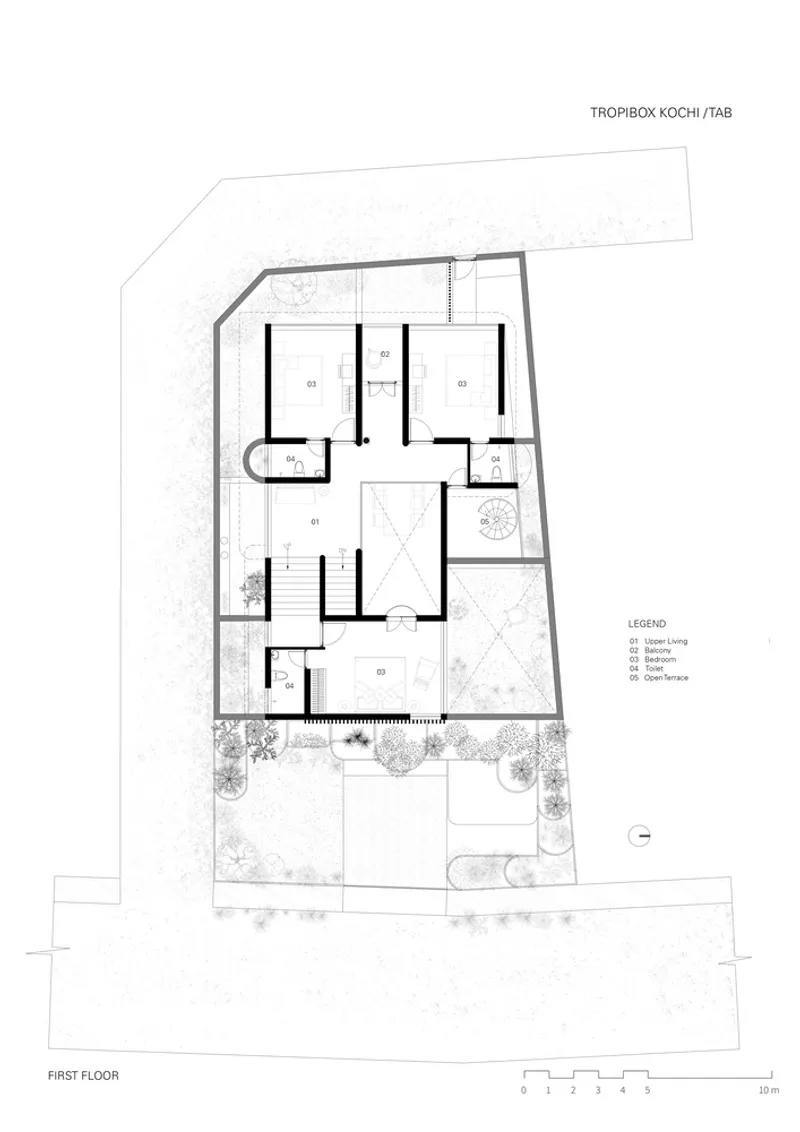
The ground floor plan confirms the L-shaped organization, with rooms arranged around a central courtyard ringed by planted beds along the perimeter walls. The kitchen and dining area occupy the hinge of the L, directly adjacent to the courtyard and the pool terrace beyond. On the first floor, bedrooms and bathrooms are organized around a void that looks down into the courtyard, preserving the visual and thermal connection between levels. The drawings make legible what the photographs suggest: that the entire house is structured as a series of nested enclosures, each one slightly more open than the last, moving from the fortified street facade inward toward the sky-lit core.
Why This Project Matters
Tropical modernism has become a crowded category, especially in South and Southeast Asia, where every firm with a courtyard plan and a louvered screen claims the lineage. What TAB achieves with TropiBox Kochi House is a version of the genre that feels genuinely worked through rather than simply referenced. The Geoffrey Bawa influence is present but digested: the controlled garden views, the blurred thresholds, the vertical section that functions as a climate machine. None of these ideas are new, but the way they are assembled here, inside stacked cylindrical volumes on a tight urban lot, produces something that has its own identity.
The project also demonstrates that passive design strategies can coexist with a strong formal proposition. The ribbed metal cylinders are not a concession to environmental performance; they are the aesthetic argument of the house. The cross ventilation corridors, the thermal buffer gardens, the oriented mezzanine, all of these are woven into the spatial experience rather than bolted on as afterthoughts. For a 3,500 square foot family home in a dense neighborhood, that integration of ambition and pragmatism is exactly the kind of architecture that makes Kochi a city worth watching.
TropiBox Kochi House by TAB (Tropical Architecture Bureau). Located in Kakkanad, Kochi, Kerala, India. 3,500 sq ft. Photography by Turtle Arts Photography.
About the Studio
Share Your Own Work on uni.xyz
If projects like this are the kind of work you want to make, uni.xyz is a place to publish your own, find collaborators, and enter design competitions.


Popular Articles
Popular articles from the community


Opera on the Sea: Driftwood Logic Shapes a Timber Opera House on Estonia's Coast
Trevor Orgill's opera house translates the entangled drift of floating timber into a civic building where wood, water, and music converge.
Faces of the Soviet Avant-Garde: Turning Moscow's Street Names into an Open-Air Museum
A network of sculptural installations across a Moscow residential district transforms forgotten architect names into spatial encounters with cultural memor

Singing Woman: An Opera House That Performs Before the Curtain Rises
Ovidiu Cristian Pavel's conceptual opera house translates Estonia's choral identity into a sculpted waterfront landmark facing the Baltic Sea.
Cloaked Colonization: A Mobile Underwater Habitat That Moves Like a Fish
Micah Abaya's shortlisted EHC Pacific entry reimagines ocean settlement as a dispersed network of self-sustaining architectural organisms.

Similar Reads
You might also enjoy these articles


Hodi-Mandai Geram
Project Function: Preservation and revitalization of the Intangible heritage and socio-spatial identity of the Hodi by Housing, Cultural Memory Center, Sacred Grove, landscape, local tourism economy


Olio Towers: A Mid-Rise for Performers That Fuses Housing, Rehearsal, and Stage
Located blocks from Houston's Theater District, this modular tower stacks living units around a central performance atrium.

Oasis: Modular Green Housing Carved into Dhaka's Urban Fabric
A shortlisted Plugin Housing entry reclaims unauthorized settlements in Dhaka with stepped concrete volumes, green roofs, and ventilation-driven design.

Black Hole: A Floating Megastructure for the Post-Physical Era
Emiliano Mazzarotto envisions a spherical, self-scaling arena where e-sports, digital hotels, and holographic stadiums replace traditional public space.

Explore Architecture Competitions
Discover active competitions in this discipline

Challenge to reimagine the Iron Throne

Photograph architecture without architects

Illustrate the lost glory of Angkor Wat - Render Challenge

Design challenge to reuse E-waste
Comments (0)
Please login or sign up to add comments
No comments yet. Be the first to comment!